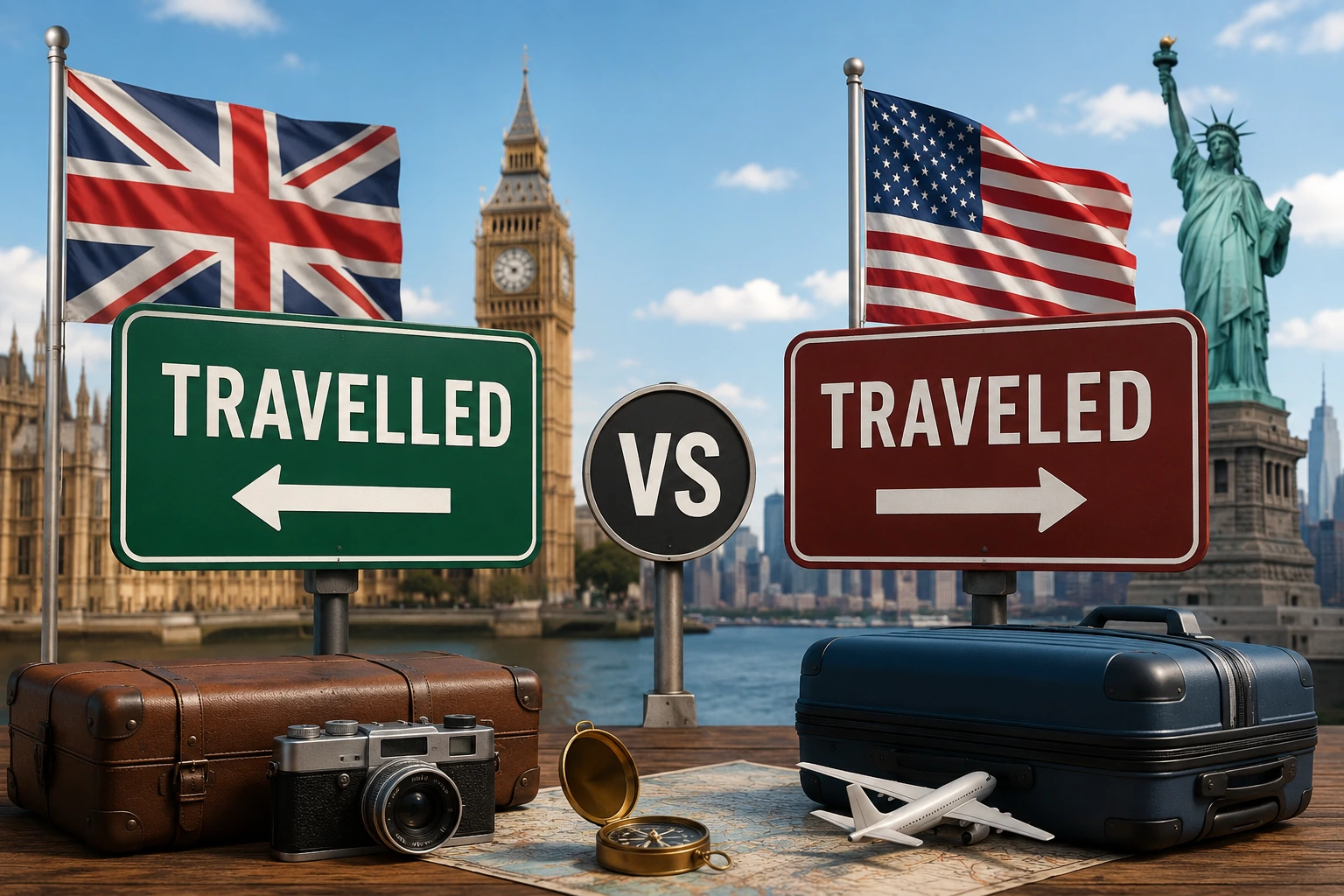
Travelled and traveled are two correct spellings of the past tense and past participle of the verb travel. Travelled is the preferred spelling in British English, while traveled is the standard spelling in American English.
Have you ever paused while writing and wondered whether it should be travelled or traveled? You’re not alone. These two spellings often confuse English learners, students, writers, and even native speakers because both appear in books, websites, and everyday writing.
The good news is that both spellings are correct. The difference lies in the variety of English you’re using. Travelled is the preferred spelling in British English, while traveled is the standard spelling in American English. They have the same meaning and are pronounced the same way.
In this guide, you’ll learn the difference between travelled and traveled, when to use each spelling, why they are different, what major dictionaries recommend, and plenty of real-life examples to help you choose the correct form with confidence.
Travelled or Traveled: Which Is Correct?
Both travelled and traveled are correct spellings of the past tense and past participle of the verb travel. The only difference is the version of English being used.
- Travelled is the standard spelling in British English, as well as in many countries that follow British conventions, including the United Kingdom, Australia, New Zealand, and South Africa.
- Traveled is the preferred spelling in American English and is widely used throughout the United States.
Quick Answer
- Travelled → British English ✅
- Traveled → American English ✅
- Meaning: Past tense and past participle of travel
- Pronunciation: Both are pronounced the same.
Examples
British English
- We travelled across Scotland during the summer holidays.
- She has travelled to more than twenty countries.
American English
- We traveled across California last summer.
- He has traveled extensively for work.
As long as you remain consistent with the variety of English you’re using, either spelling is perfectly acceptable.
What’s the Difference Between Travelled and Traveled?
The difference between travelled and traveled is purely one of regional spelling rather than meaning or pronunciation.
Both words describe an action that has already happened. They function as the past tense and past participle of the verb travel.
For example:
- I travelled to London last year. (British English)
- I traveled to New York last year. (American English)
Both sentences communicate exactly the same idea. The only distinction is the spelling convention followed by the writer.
This pattern appears in many other English words as well. British English often prefers a double l, while American English commonly uses a single l before certain suffixes.
British vs American English Variation
The difference between travelled and traveled comes from one of the most common spelling variations between British and American English.
British English Rule
In British English, when many verbs ending in a vowel followed by l take a suffix such as -ed, -ing, or -er, the final l is usually doubled.
Examples:
- travel → travelled
- travel → travelling
- travel → traveller
- cancel → cancelled
- signal → signalling
This convention has been part of British spelling for generations and remains the standard in countries that follow British English.
American English Rule
American English simplifies this pattern in many cases by keeping a single l when the final syllable is not stressed.
Examples:
- travel → traveled
- travel → traveling
- travel → traveler
- cancel → canceled
- signal → signaling
This simplified spelling became widely accepted in American English and is now the standard used in the United States.
Why Do These Spellings Exist?
The difference developed over time as British and American English evolved independently. While British English preserved many traditional spelling conventions, American English adopted simplified forms for numerous words. As a result, both spellings became standard within their respective language varieties.
Today, neither spelling is more correct than the other. The best choice depends on your audience and the style guide you follow.
Use travelled if you’re writing in British English. Use traveled if you’re writing in American English.
💡 Did You Know?
The difference between travelled and traveled isn’t unique. It’s part of a broader spelling pattern that distinguishes British English from American English.
In British English, many words ending in a vowel followed by l double the final l before adding suffixes such as -ed, -ing, and -er. American English often simplifies these words by keeping a single l.
For example:
- travelled → traveled
- travelling → traveling
- traveller → traveler
- cancelled → canceled
- labelled → labeled
- signalling → signaling
This spelling difference reflects regional writing conventions rather than grammar or meaning. Both forms are correct—you simply need to choose the one that matches your audience and use it consistently throughout your writing.
What Does Travelled Mean?
Travelled is the British English past tense and past participle of the verb travel.
It means to have gone from one place to another, whether for business, education, holidays, or any other purpose.
Examples
- They travelled through Europe by train.
- She travelled abroad to complete her master’s degree.
- We travelled hundreds of miles to attend the wedding.
- My grandparents travelled extensively after retirement.
The meaning remains exactly the same regardless of where the journey takes place.
What Does Traveled Mean?
Traveled is the American English spelling of the past tense and past participle of travel.
Like travelled, it means that someone went from one place to another in the past.
Examples
- We traveled across Texas during spring break.
- He traveled overseas for an international conference.
- Our family traveled together every summer.
- She has traveled to more than thirty states.
Although the spelling differs, the definition, pronunciation, and grammatical function are identical to travelled.
Origin and History of Travelled and Traveled
The verb travel entered English through Old French, where it developed from the word travail, meaning hard work, labor, or toil. In medieval times, long journeys were often physically demanding and dangerous, so the idea of travel became closely associated with hardship.
As English evolved, travel gradually shifted from meaning difficult labor to referring primarily to moving from one place to another.
For centuries, English spelling was far less standardized than it is today. Writers often used different spellings of the same word, and there was little consistency between regions.
During the eighteenth and nineteenth centuries, British English largely retained the convention of doubling the final l before adding endings such as -ed and -ing. This gave rise to forms like travelled, travelling, and traveller.
Meanwhile, American English gradually adopted simplified spellings for many words. As a result, traveled, traveling, and traveler became the preferred forms in the United States.
Today, both spellings are recognized by major dictionaries and style guides. The correct choice depends on whether you’re writing in British or American English, not on which spelling is inherently more accurate.
Read more: Truely or Truly: Which Spelling Is Correct? (2026)
When to Use Travelled
Use travelled whenever you’re writing in British English or for an audience that follows British spelling conventions. It is the preferred form in the United Kingdom and is also widely used in Australia, New Zealand, Ireland, South Africa, and many other Commonwealth countries.
If you’re following style guides or publications that use British English, always choose travelled and use related British spellings consistently, such as travelling and traveller.
Examples
- We travelled around England by train.
- She travelled to Paris for a business conference.
- They travelled through Europe during the summer holidays.
- My parents have travelled extensively over the years.
- He travelled nearly 500 miles to attend the ceremony.
Tip
If your document uses words like colour, favourite, and centre, then travelled is the correct spelling to use.
When to Use Traveled
Use traveled when writing in American English. It is the standard spelling in the United States and is recommended by most American dictionaries and style guides.
To maintain consistency, pair it with other American spellings such as traveling and traveler.
Examples
- We traveled across the United States by car.
- She traveled to Chicago for an interview.
- They traveled overseas last summer.
- My brother has traveled to every state on the East Coast.
- He traveled alone for the first time.
Tip
If your writing includes words like color, favorite, and center, then traveled is the appropriate spelling.
Travelled vs Traveled: Side-by-Side Comparison
| Feature | Travelled | Traveled |
|---|---|---|
| English variety | British English | American English |
| Meaning | Past tense and past participle of travel | Past tense and past participle of travel |
| Pronunciation | Same | Same |
| Correct? | Yes | Yes |
| Commonly used in | UK, Australia, New Zealand, South Africa | United States |
Real-Life Examples of Travelled and Traveled
Seeing both spellings in context makes it easier to remember when to use each one.
British English Examples
- We travelled across Wales by train.
- She travelled abroad after graduating from university.
- The scientist travelled to Antarctica for research.
- Thousands of supporters travelled to watch the final.
- He travelled frequently for work.
American English Examples
- We traveled across Florida during our vacation.
- She traveled to Boston for a medical conference.
- The family traveled by plane instead of driving.
- He traveled across the country to start a new job.
- They traveled together every summer.
Notice that the only difference is the spelling. The meaning and pronunciation remain exactly the same.
Common Mistakes to Avoid
Although the distinction is simple, writers often make a few avoidable mistakes.
Mixing British and American Spellings
One of the most common errors is switching between spelling systems in the same document.
❌ We travelled across France and later traveled to Spain.
✔ We travelled across France and later travelled to Spain. (British English)
✔ We traveled across France and later traveled to Spain. (American English)
Choose one style and use it consistently throughout your writing.
Assuming One Spelling Is Incorrect
Many learners believe only one spelling is correct.
The truth is:
- Travelled is correct in British English.
- Traveled is correct in American English.
Neither spelling is grammatically wrong.
Forgetting Related Spellings
If you’re writing in British English, remember that related words also follow the double-l pattern.
| British English | American English |
|---|---|
| travelled | traveled |
| travelling | traveling |
| traveller | traveler |
Using a consistent spelling style makes your writing look more professional.
What Major Dictionaries Say
Leading English dictionaries recognize both travelled and traveled as correct spellings.
Cambridge Dictionary
The Cambridge Dictionary lists travelled as the primary spelling in British English while also recognizing traveled as the American variant.
Oxford English Dictionary
The Oxford English Dictionary follows British spelling conventions and uses travelled while acknowledging traveled as the American spelling.
Merriam-Webster
Merriam-Webster, one of the leading American dictionaries, lists traveled as the standard spelling in American English and identifies travelled as the British variant.
Across these trusted references, the conclusion is the same:
- Travelled = British English
- Traveled = American English
Both spellings are correct when used in the appropriate regional context.
Read more: Forty or Fourty? Which Spelling Is Correct? (With Easy Examples)
Which Spelling Should You Use?
The best spelling depends entirely on your audience.
Use travelled if you are writing for readers in:
- The United Kingdom
- Australia
- New Zealand
- Ireland
- South Africa
- Countries that follow British English
Use traveled if your audience is primarily in:
- The United States
If you’re writing for an international audience, choose one spelling style at the beginning and remain consistent throughout the article, report, or document.
Consistency is far more important than choosing one spelling over the other.
Key Takeaways
- Travelled and traveled have the same meaning.
- Both are the past tense and past participle of travel.
- Travelled is the standard British English spelling.
- Traveled is the standard American English spelling.
- Both are accepted by major dictionaries.
- Always use one spelling style consistently throughout your writing.
Frequently Asked Questions
Q: Is it travelled or traveled?
Both are correct. Travelled is the standard spelling in British English, while traveled is the preferred spelling in American English. The correct choice depends on the variety of English you’re using.
Q: Is travelled correct in the UK?
Yes. Travelled is the accepted and standard spelling in the United Kingdom. British publishers, schools, and style guides use travelled, along with related forms such as travelling and traveller.
Q: Is traveled correct in the US?
Yes. Traveled is the standard American English spelling and is used throughout the United States in newspapers, books, academic writing, and everyday communication.
Q: Why does British English use “travelled” with two Ls?
British English generally doubles the final l before adding suffixes like -ed, -ing, or -er to many verbs ending in a vowel followed by l.
For example:
- travel → travelled
- travel → travelling
- travel → traveller
American English usually simplifies these forms by using a single l.
Q: Why does American English spell it “traveled”?
American English follows a spelling convention that often keeps a single l when the final syllable of the word is not stressed.
This results in:
- traveled
- traveling
- traveler
These spellings have been standard in American English for many years.
Q: Are travelled and traveled pronounced differently?
No. Both spellings have the same pronunciation. The difference exists only in the written form, not in how the word is spoken.
Q: Which spelling should I use in academic writing?
Use the spelling required by your institution, publisher, or style guide.
- If you’re writing in British English, use travelled.
- If you’re writing in American English, use traveled.
Whichever spelling you choose, keep it consistent throughout your work.
Q: Is “travelled” considered incorrect in America?
No. American readers will usually understand travelled, but it may appear unusual because traveled is the standard American spelling.
Similarly, British readers understand traveled, even though travelled is more common in British English.
Q: What are the related spellings?
The same regional difference applies to other forms of the word.
| British English | American English |
|---|---|
| travelled | traveled |
| travelling | traveling |
| traveller | traveler |
Final Verdict: Travelled or Traveled?
Both travelled and traveled are correct spellings of the past tense and past participle of travel. They carry the same meaning, have the same pronunciation, and are accepted by major dictionaries.
The only difference is regional preference:
- Choose travelled when writing in British English.
- Choose traveled when writing in American English.
Neither spelling is more accurate than the other. What matters most is using the version that matches your audience and remaining consistent throughout your writing.
Whether you’re preparing an academic paper, writing a blog post, sending a business email, or sharing your travel experiences, selecting the appropriate regional spelling will make your writing look polished and professional.
Read more: Grey or Gray: Which Spelling Is Correct? (2026)

Amna Akhtar is a writer dedicated to making English easier to understand. She creates research-informed guides on grammar, vocabulary, spelling differences, and commonly confused words, combining careful research with clear, practical explanations. She is also the co-author of the peer-reviewed research article “Determinants of Jobs Satisfaction of Female Teachers: An Evidence from District Hafizabad, Pakistan,” published in the Journal of Education and Social Studies (2021).