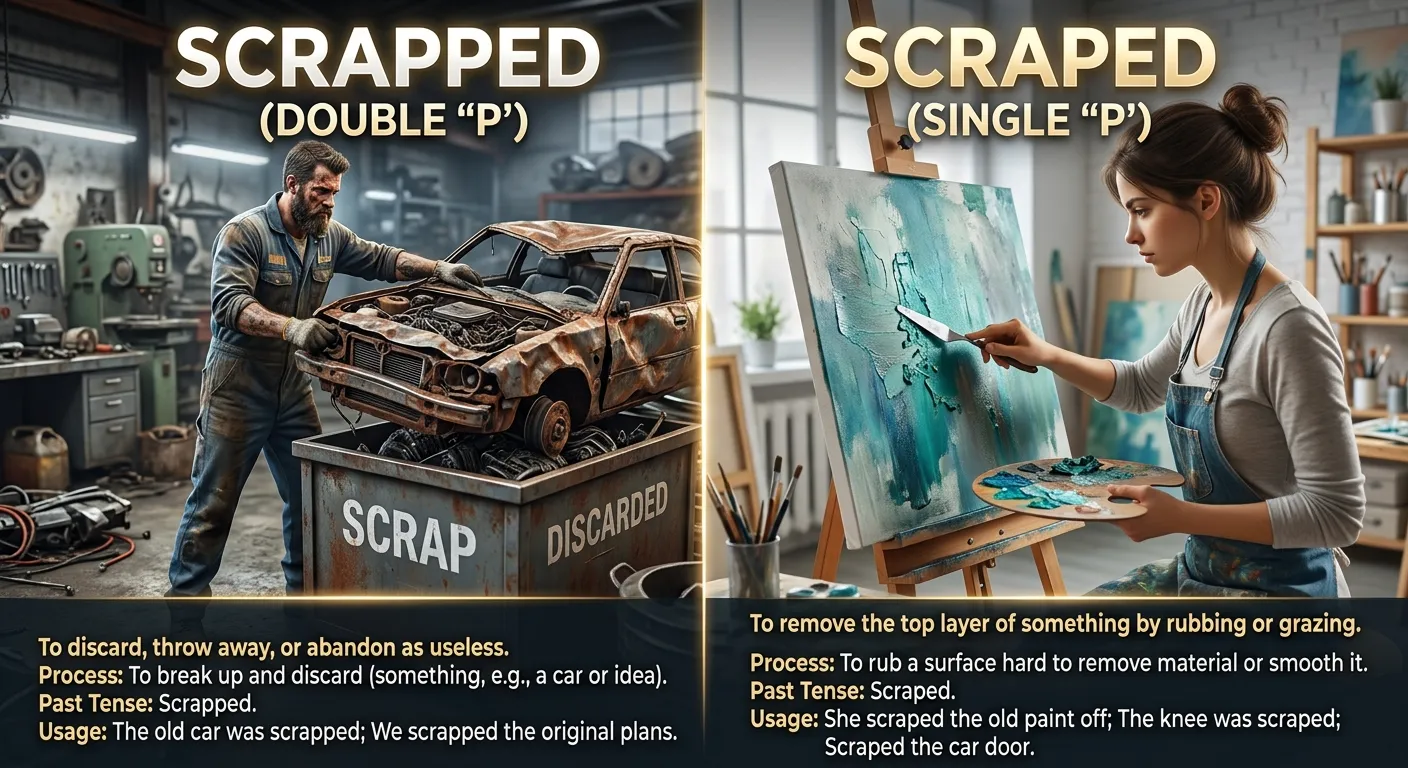
Scrapped means canceled, abandoned, or discarded, while scraped usually means rubbed against a surface, removed with a tool, or collected with difficulty. Both spellings are correct, but they have different meanings.
Quick Answer
Scrapped and scraped are both correct words, but they are not interchangeable.
- Scrapped = canceled, abandoned, or thrown away.
- Scraped = rubbed against something, removed from a surface, or gathered in a limited amount.
- Scrapped comes from scrap.
- Scraped comes from scrape.
Example:
The company scrapped the old plan.
She scraped the paint off the wall.
Scrapped vs. Scraped: Quick Comparison
| Word | Base verb | Main meaning | Example |
| Scrapped | scrap | Canceled, abandoned, or discarded | They scrapped the project. |
| Scraped | scrape | Rubbed, removed, or collected | He scraped the mud off his shoes. |
What Does “Scrapped” Mean?
Scrapped is the past tense and past participle of scrap.
As a verb, scrap means to abandon, cancel, or get rid of something. It can also mean to discard something as useless or send it for recycling.
Examples
- The school scrapped the old timetable.
- The company scrapped its expansion plans.
- They scrapped the damaged car.
- The government scrapped the outdated rule.
In each example, something was canceled, abandoned, or discarded.
Common phrases with “scrapped”
- scrapped the plan
- scrapped the project
- scrapped the idea
- scrapped the proposal
- scrapped the policy
- scrapped the old system
- scrapped the car
Memory tip: If something is canceled or discarded, think scrapped.
What Does “Scraped” Mean?
Scraped is the past tense and past participle of scrape.
The verb scrape has several related meanings. It can mean to rub against a surface, remove something from a surface, or collect something by using a tool or by making an effort.
Examples
- She scraped her knee on the pavement.
- He scraped the paint off the door.
- I scraped the mud from my shoes.
- We scraped the last bits of food from the bowl.
- He scraped together enough money for the ticket.
Here, scraped refers to physical rubbing, removal, or gathering.
Common phrases with “scraped”
- scraped his knee
- scraped the paint off
- scraped the dirt away
- scraped the surface
- scraped the bottom
- scraped together enough money
Memory tip: If something is rubbed, removed, or gathered by scraping, use scraped.
Scrapped vs. Scraped in Sentences
The difference becomes clearer when you see the words side by side.
| Sentence | Meaning |
| They scrapped the proposal. | They canceled the proposal. |
| They scraped the label off the box. | They removed the label by scraping. |
| The company scrapped the old machine. | The machine was discarded. |
| She scraped her arm against the wall. | Her arm rubbed against the wall. |
| We scrapped the original design. | We abandoned the design. |
| He scraped the mud off his boots. | He removed the mud. |
Grammar Rule: Scrapped vs. Scraped
Both words are past-tense and past-participle forms of verbs.
Scrap → Scrapped
The verb scrap ends in a consonant-vowel-consonant pattern, so the final p is doubled before adding -ed:
scrap + ed → scrapped
Examples:
- They scrapped the plan.
- The idea was scrapped last year.
Scrape → Scraped
The verb scrape ends in a silent e. The final e is removed before adding -ed:
scrape + ed → scraped
Examples:
- She scraped the paint.
- He scraped his knee.
This spelling difference is easy to remember:
scrap → scrapped
scrape → scraped
Why Are “Scrapped” and “Scraped” Confused?
The words look and sound similar, especially in fast speech. Both begin with scrap- / scrape-, and both can describe getting rid of something.
However, their base verbs are different:
- scrap → scrapped
- scrape → scraped
The meaning usually tells you which word you need.
If a plan, idea, project, rule, or system is canceled, use scrapped.
If something is rubbed, removed from a surface, or gathered, use scraped.
Grammar Relay
Scrapped and scraped can both work as verbs, but their meanings control the choice.
As past-tense verbs
- The manager scrapped the proposal.
- The worker scraped the paint.
As past participles
- The proposal was scrapped.
- The paint was scraped away.
adjectives
Both can also appear in participial adjective phrases:
- a scrapped project
- a scraped knee
- a scraped surface
The adjective describes the result of the corresponding action.
A Simple Way to Remember the Difference
Think about the final letters:
Scrapped = Scrap + ped
Something was scrapped when it was canceled or thrown away.
The plan was scrapped.
Scraped = Scrape + d
Something was scraped when it was rubbed or removed.
The paint was scraped off.
Quick memory trick
SCRAPPED → canceled
SCRAPED → rubbed or removed
Common Mistakes
❌ The company scraped the new project.
If you mean the company canceled the project, this is incorrect.
✅ The company scrapped the new project.
Here, scrapped means canceled or abandoned.
❌ She scrapped her knee.
If you mean she injured her knee by rubbing it against a rough surface, the usual expression is:
✅ She scraped her knee.
❌ They scraped the old policy.
If you mean they abolished or canceled the policy:
✅ They scrapped the old policy.
Scrapped or Scraped: Which One Should You Use?
Use scrapped when the idea is:
- canceled
- abandoned
- rejected
- discarded
- removed from use
Use scraped when the idea is:
- rubbed against a surface
- removed from a surface
- collected with a tool
- gathered with difficulty
| If you mean… | Use |
| Canceled a plan | scrapped |
| Abandoned an idea | scrapped |
| Discarded a machine | scrapped |
| Rubbed your knee | scraped |
| Removed paint | scraped |
| Removed dirt | scraped |
| Gathered enough money | scraped |
Vocabulary Corner
Scrap
Scrap can be a verb meaning to abandon or discard something.
Example:
The team scrapped the original design.
It can also be a noun referring to a small piece or fragment of something.
Example:
She used a scrap of paper to write the note.
Scrape
Scrape is a verb associated with rubbing or removing something from a surface.
Example:
He scraped the ice from the windshield.
It can also be a noun referring to a minor injury or the sound/action of rubbing against a surface.
Example:
She got a small scrape on her elbow.
Mini Quiz
Choose scrapped or scraped in each sentence.
- The company ______ the expensive project.
- He ______ his knee while playing outside.
- She ______ the burnt food from the pan.
- The school ______ the outdated rule.
- They ______ the old vehicle.
Answers
- scrapped — the project was canceled.
- scraped — the knee was injured by rubbing against a surface.
- scraped — the food was removed from the pan.
- scrapped — the rule was canceled.
- scrapped — the vehicle was discarded.
Practice Guide
When choosing between scrapped and scraped, replace the word with its base verb.
Ask:
Does the sentence mean “cancel or discard”?
→ Use scrapped.
Does it mean “rub, remove, or gather by scraping”?
→ Use scraped.
Try this test
The committee ______ the proposal.
If you mean canceled the proposal, the correct word is:
The committee scrapped the proposal.
Now:
She ______ the mud off her shoes.
The correct word is:
She scraped the mud off her shoes.
The surrounding meaning makes the answer clear.
What Major Dictionaries Say
Major English dictionaries distinguish the two words through their different base verbs.
Scrapped is the past form of scrap, which includes the sense of abandoning or getting rid of something.
Scraped is the past form of scrape, which includes the sense of rubbing against a surface or removing something from one.
So, neither spelling is a misspelling of the other. Scrapped and scraped are both correct words with different meanings.
Final Answer
Scrapped and scraped are both correct, but they are used in different situations.
- Scrapped = canceled, abandoned, or discarded.
- Scraped = rubbed, removed from a surface, or gathered with difficulty.
Correct: The company scrapped the plan.
Correct: She scraped the paint off the wall.
Remember: scrap → scrapped, but scrape → scraped.
Preform or Perform: Meaning, Difference &Examples

Amna Akhtar is a writer dedicated to making English easier to understand. She creates research-informed guides on grammar, vocabulary, spelling differences, and commonly confused words, combining careful research with clear, practical explanations. She is also the co-author of the peer-reviewed research article “Determinants of Jobs Satisfaction of Female Teachers: An Evidence from District Hafizabad, Pakistan,” published in the Journal of Education and Social Studies (2021).