Definition
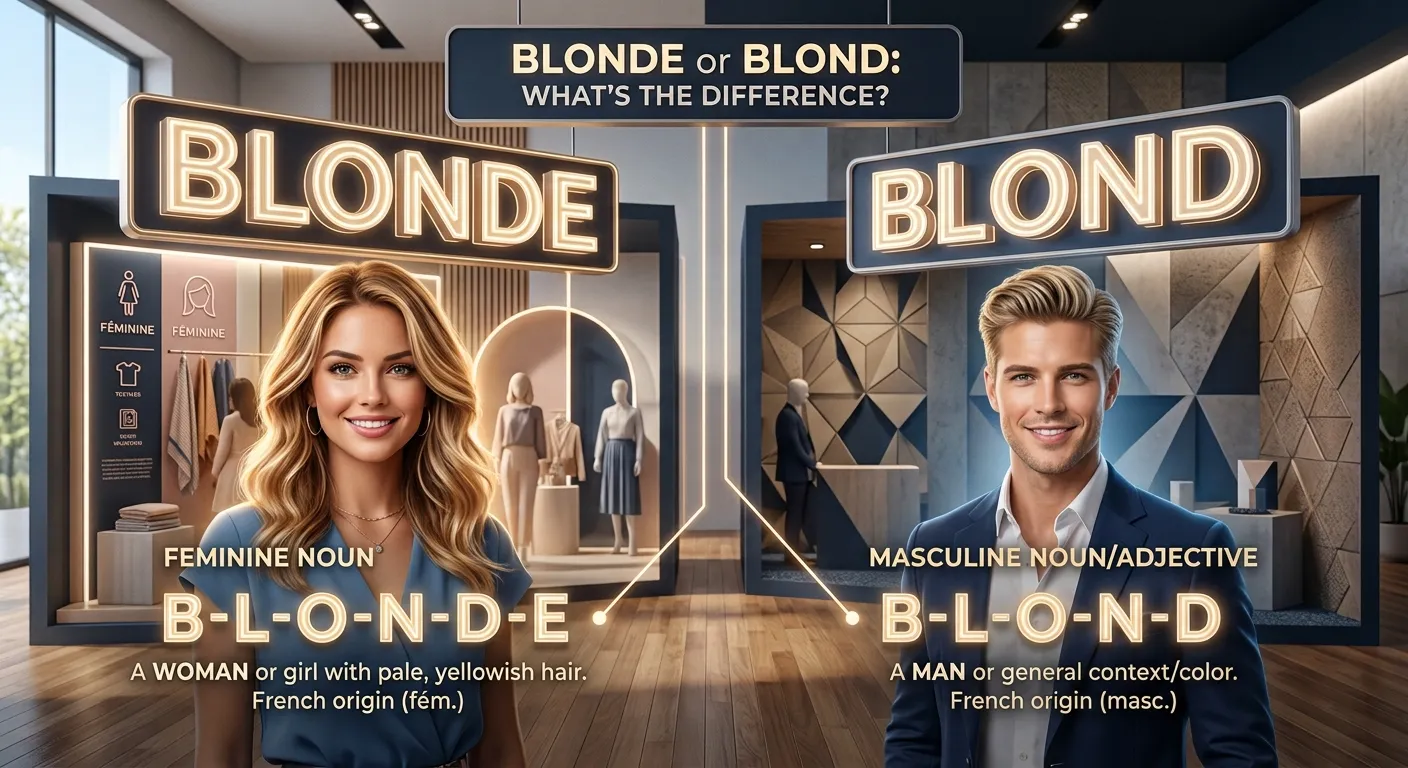
Blond and blonde both describe a light yellow or golden hair color. Blond is the standard gender-neutral form, while blonde is traditionally used for a woman or girl in English.
Quick Answer
Both blond and blonde are correct spellings, but their traditional usage differs:
- Blond can be used for anyone and is the more common gender-neutral form.
- Blonde traditionally refers to a woman or girl.
- As a noun, blonde traditionally means a woman with blond hair.
- Modern English increasingly uses blond as the general form for all people.
Example:
- He has blond hair.
- She has blonde hair.
- They have blond hair.
Quick Comparison Table
| Word | Correct? | Traditional Use | Example |
| blond | ✅ Yes | Men, women, or gender-neutral use | He has blond hair. |
| blonde | ✅ Yes | Traditionally women/girls | She has blonde hair. |
| blond as a noun | ✅ Yes | A person with blond hair; increasingly gender-neutral | The actor is a natural blond. |
| blonde as a noun | ✅ Yes | Traditionally a woman with blond hair | She is a blonde. |
What Does “Blond” Mean?
Blond is an adjective describing hair that is naturally or artificially light in color, usually ranging from pale yellow to golden or light brown.
Examples:
- He has blond hair.
- The child has naturally blond hair.
- She dyed her hair blond.
The word can also be used as a noun:
He is a natural blond.
In modern usage, blond is often preferred when you want a gender-neutral form.
What Does “Blonde” Mean?
Blonde has the same basic meaning but traditionally functions as the feminine form.
Examples:
- She has blonde hair.
- The blonde woman walked into the room.
- She is a natural blonde.
Historically, English borrowed the masculine/feminine distinction from French, where adjectives can change according to gender.
Blond vs. Blonde: The Grammar Rule
The traditional distinction is based on gender:
Blond → masculine or gender-neutral
Blonde → feminine
So, in traditional usage:
- a blond man
- a blonde woman
- blond hair can describe hair belonging to anyone
However, English usage is changing. Many modern writers and style guides favor blond as a gender-neutral adjective and noun.
Compare:
- He is blond.
- She is blonde.
- They are blond.
- She has blond hair.
- She has blonde hair.
Both blond hair and blonde hair are widely used when describing a woman’s hair.
Is “Blonde Hair” Correct?
Yes.
Blonde hair is completely acceptable, especially when referring to a woman or girl.
For example:
She has long blonde hair.
You can also write:
She has long blond hair.
The second version treats blond as the gender-neutral adjective.
Therefore, blonde hair is not a spelling mistake.
Is “Blond Hair” Correct?
Yes.
Blond hair is also correct.
It is particularly common when:
- referring to a man or boy
- using gender-neutral language
- discussing hair color generally
Examples:
- He has short blond hair.
- The character has blond hair.
- Blond hair can range from pale yellow to darker golden shades.
Blond or Blonde for a Man?
For traditional usage, use blond for a man.
✅ He is blond.
❌ He is blonde. — traditionally less standard
However, modern English does sometimes use blonde without strictly following the gender distinction. Blond remains the safer choice when describing a man.
Blond or Blonde for a Woman?
For traditional usage, blonde is the feminine form.
✅ She is blonde.
✅ She is blond. — increasingly used as a gender-neutral alternative
Both can be encountered in modern English.
If you are following the traditional distinction, choose blonde for a woman.
Blond or Blonde for Hair?
Both forms can be correct.
The choice depends partly on style and context:
- blond hair → gender-neutral or general description
- blonde hair → traditionally associated with a woman or girl
Examples:
The model has blonde hair.
The actor has blond hair.
Blond hair is common in several European populations.
Common Expressions
Here are some common uses of the word:
| Expression | Example |
| blond hair | He has blond hair. |
| blonde hair | She has blonde hair. |
| blond man | A blond man entered the room. |
| blonde woman | A blonde woman answered the door. |
| blond child | The blond child was playing outside. |
| blonde actress | The blonde actress appeared in the film. |
| blond color | The dye creates a warm blond color. |
Blond or Blonde: Which One Should You Use?
Use blond when you want a gender-neutral form or when describing a man.
Use blonde when following the traditional feminine distinction or referring specifically to a woman.
Simple rule to remember:
Blond = general/masculine
Blonde = traditionally feminine
If you’re writing for a broad modern audience, blond is often the simplest gender-neutral choice.
Grammar Relay
Try completing these sentences:
- He has ______ hair.
- She has ______ hair.
- They both have ______ hair.
- She is a natural ______.
- He is a natural ______.
Answers
- blond
- blonde / blond
- blond
- blonde
- blond
The answers reflect the traditional gender distinction. Modern usage may vary, especially with blond as a gender-neutral form.
Vocabulary Corner
Blond/blonde can describe several shades of light hair, including:
- platinum blond: extremely pale blond
- ash blond: blond with cooler, grayish tones
- golden blond: warm, yellow-golden blond
- strawberry blond: blond with noticeable reddish tones
- dark blond: a deeper shade of blond
Example:
She naturally has dark blonde hair, but she dyed it platinum blond.
Mini Quiz
Choose blond, blonde, or either.
- He has ___ hair.
- She has ___ hair.
- They have ___ hair.
- She is a natural ___.
- He is a natural ___.
Answers:
- blond
- blonde/blond
- blond
- blonde
- blond
Practice Guide
When choosing between blond and blonde, ask yourself:
1. Am I describing a man?
→ Traditionally, use blond.
2. Am I describing a woman?
→ Traditionally, use blonde.
3. Am I talking about people generally?
→ Blond is a useful gender-neutral choice.
4. Am I describing hair rather than a person?
→ Both blond hair and blonde hair are correct, depending on style and context.
What Major Dictionaries Say
Major English dictionaries recognize blond and blonde as legitimate forms. Their traditional distinction is connected to grammatical gender, but contemporary English increasingly uses blond more broadly.
This means you should not treat “blonde” as a misspelling of “blond” or vice versa. They are both established English words.
Final Verdict
Blond and blonde are both correct.
The traditional distinction is simple:
Blond → masculine or gender-neutral
Blonde → traditionally feminine
So:
✅ He has blond hair.
✅ She has blonde hair.
✅ They have blond hair.
✅ She is a blonde.
✅ He is a blond.
For modern, gender-neutral writing, blond is often the better all-purpose choice.
Quick Memory Trick
Blond → one “e” less → traditionally used for men/general use
Blonde → extra “e” → traditionally used for women
Bottom line: Neither spelling is wrong. The difference is mainly one of traditional gender-based usage, with modern English increasingly favoring “blond” as the neutral form.
Whiskey or Whisky: What’s the Difference?

Rose Vault is an English language author who specializes in spelling comparisons, commonly confused words, and grammar. She creates clear, well-researched content that helps readers improve their writing and use English with confidence. Her goal is to make language learning simple, accurate, and accessible for everyone.