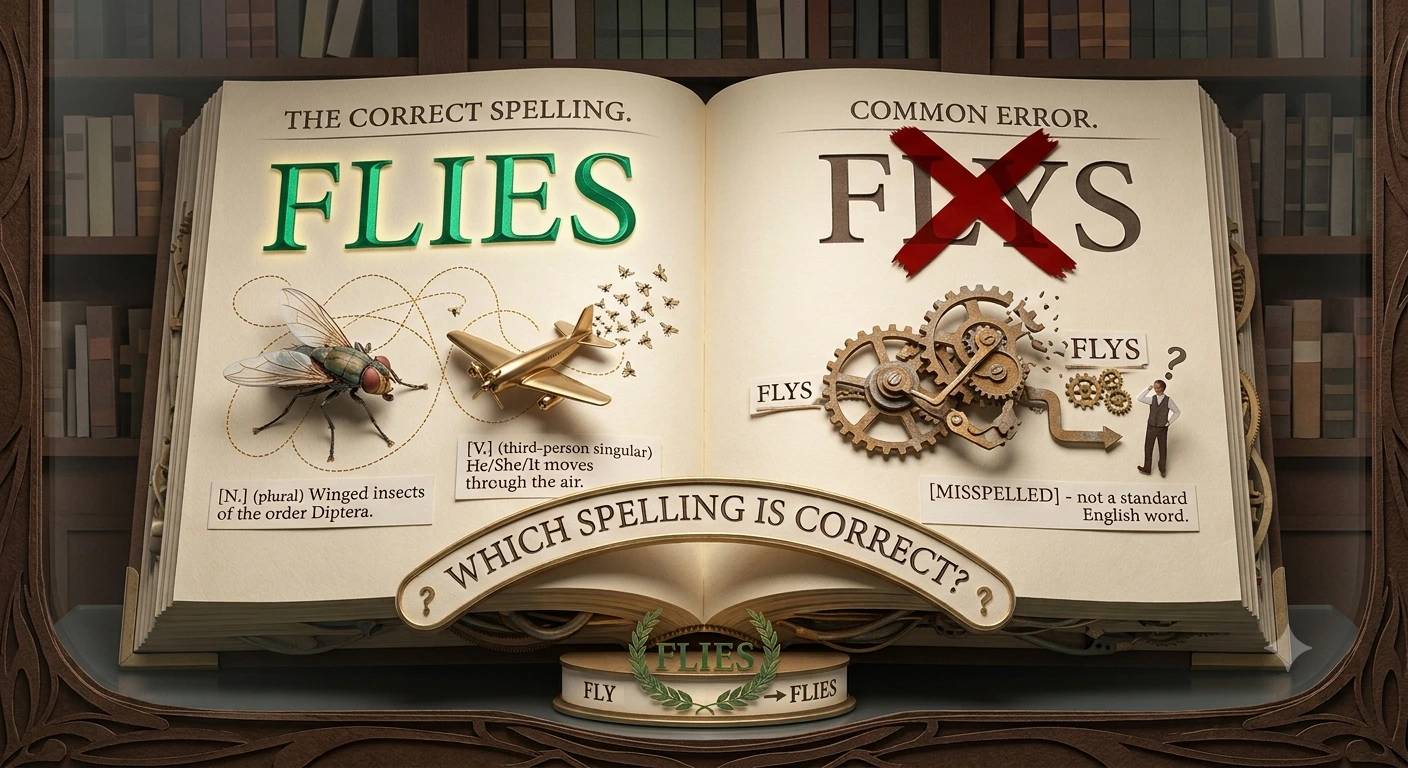
Flies is the correct spelling in almost all everyday English. It is the plural of fly (the insect) and the third-person singular form of the verb fly. Flys is generally considered incorrect in standard English, except when it appears as a proper noun, brand name, surname, or in a few specialized technical contexts.
Have you ever wondered whether flies or flys is the correct spelling? You’re not alone. This is a common question because many English words simply add -s to form the plural, but words ending in -y sometimes follow a different rule.
The confusion becomes even greater because fly can be both a noun and a verb. Depending on how it’s used, its spelling changes when you make it plural or use it with a third-person singular subject.
In this guide, you’ll learn whether flies or flys is correct, why English spelling changes the -y to -ies, when each spelling is used, and the few situations where flys may appear. You’ll also find plenty of examples, common mistakes, memory tricks, and a short quiz to help you remember the rule.
Featured Snippet Answer
The correct spelling is flies, not flys, in standard English. Use flies as the plural of fly and as the third-person singular form of the verb fly. The spelling flys is rarely used except as a proper noun or in certain specialized names.
Standalone Comparison Table
| Feature | Flies | Flys |
|---|---|---|
| Correct spelling | ✅ Yes | ❌ No (in standard English) |
| Meaning | Plural of fly (the insect) and the third-person singular form of the verb fly | Generally a misspelling of flies |
| When to use | When referring to more than one fly or when describing someone or something that flies | Do not use in standard English writing |
| Example | The birds flies south every winter. (verb) / Several flies landed on the fruit. (noun) | She flys to Paris every month. ❌ |
| Dictionary status | Recognized by major English dictionaries | Not recognized as the standard spelling |
Note: Flys may occasionally appear as a surname, brand name, or proper noun, but it is not the correct spelling in standard English.
Flies or Flys at a Glance
| Spelling | Correct? | Common Use |
| Flies | ✅ Yes | Plural noun and third-person singular verb |
| Flys | ❌ Usually no | Proper names or rare specialized uses |
What’s the Difference Between Flies and Flys?
Flies is the standard English spelling used in nearly every situation. Flys is almost always a spelling mistake when someone means the plural of fly or the verb flies.
If you’re writing about insects, airplanes, birds, superheroes, or anything that flies, the correct spelling is flies.
Quick Decision Rule
Ask yourself:
Are you talking about more than one fly or saying that someone flies?
- Yes → Use flies.
- No → If you’re referring to a company, surname, or another proper name spelled “Flys,” keep the original spelling.
Why Is Flies the Correct Spelling?
The spelling flies follows a standard English rule for words ending in -y.
Rule: If a word ends in a consonant + y, change the y to i and add -es.
Since fly ends with l + y, the correct form is:
fly → flies ✅
Not:
fly → flys ❌
This same spelling rule applies to many other English words.
More Examples
| Singular | Correct Plural |
| fly | flies |
| baby | babies |
| city | cities |
| lady | ladies |
| country | countries |
| story | stories |
Once you learn this rule, you’ll recognize it in hundreds of English words.
When to Use Flies
The word flies has two main uses in modern English.
1. As the Plural of Fly
When referring to more than one insect, flies is always the correct spelling.
Examples
- Flies are attracted to uncovered food.
- We kept the windows closed to stop the flies from coming inside.
- The farmer sprayed the field to reduce the number of flies.
- Houseflies can spread harmful bacteria.
2. As the Third-Person Singular Form of the Verb Fly
Use flies when the subject is he, she, it, or a singular noun.
Examples
- The bird flies south every winter.
- She flies to Dubai every month for work.
- The airplane flies above the clouds.
- A superhero flies through the sky.
Why Isn’t Flys Correct?
Many learners assume every word simply adds -s to become plural.
That works for many nouns:
- book → books
- chair → chairs
- apple → apples
However, words ending in a consonant + y follow a different spelling rule.
Because fly ends with l + y, English changes the y to i before adding -es.
That’s why flies is correct and flys is not.
Are There Any Exceptions?
Yes—but they’re uncommon.
You may occasionally see Flys used as:
- A surname
- A company or brand name
- A product name
- A place name
- Certain specialized technical terms chosen by organizations
These are proper nouns, meaning they intentionally use that spelling.
For ordinary English writing, however, you should always use flies.
Origin of Flies and Flys
The word fly comes from Old English flēoge (the insect) and flēogan (the verb meaning “to move through the air”). Over time, English adopted the common spelling rule that nouns and verbs ending in a consonant followed by -y change -y to -ies when forming certain word forms.
For example:
- fly → flies
- cry → cries
- try → tries
Because of this spelling rule, flies became the correct plural form of the noun fly and the correct third-person singular form of the verb fly. The spelling flys never became part of standard English and is now considered a misspelling in everyday writing.
Usage Trends
Modern English overwhelmingly favors flies over flys. You’ll find flies in dictionaries, books, newspapers, academic writing, and professional publications because it follows standard English spelling rules.
The spelling flys appears only rarely and is usually the result of a spelling mistake. In a few cases, it may be used as part of a proper noun, surname, or brand name, but these exceptions do not change the standard spelling.
If you’re writing for school, work, exams, or online content, always use flies unless you’re referring to a specific name or trademark spelled Flys. This follows standard English conventions and matches what readers and search engines expect.
Dictionary Preferences
Leading English dictionaries recognize flies as the correct standard spelling.
- Merriam-Webster: Lists flies as the plural of fly and the third-person singular form of the verb fly.
- Cambridge Dictionary: Recognizes flies as the standard spelling in all common contexts.
- Oxford English Dictionary / Oxford Learner’s Dictionaries: Uses flies as the correct form.
- Collins Dictionary: Lists flies as the accepted spelling.
None of these major dictionaries recognize flys as the standard English spelling. If you encounter flys, it is usually a misspelling or part of a proper noun, such as a brand or surname.
Common Mistakes
Here are some mistakes learners frequently make.
Mistake 1: Writing flys as the plural
❌ There were many flys in the kitchen.
✔ There were many flies in the kitchen.
Mistake 2: Writing flys as a verb
❌ The plane flys every morning.
✔ The plane flies every morning.
Mistake 3: Applying the Wrong Spelling Rule
Some learners think every noun forms its plural by adding -s.
That rule doesn’t apply to words ending in a consonant + y.
Remember:
Consonant + y → change y to i + es
Flies in Different Types of Writing
Everyday Conversation
- The flies won’t leave us alone.
- My brother flies drones every weekend.
School Writing
- Flies play an important role in some ecosystems.
- The eagle flies at high altitudes.
Business Writing
- Our delivery drone flies twice each day.
- The company flies employees to regional meetings.
News Writing
- The rescue helicopter flies despite difficult weather.
- Scientists are studying how flies transmit disease.
Memory Trick
Here’s an easy way to remember the correct spelling.
Think of this sentence:
“A fly becomes flies because the Y says goodbye.”
Or simply remember:
Consonant + Y = IES
Examples:
- fly → flies
- baby → babies
- city → cities
If you remember this one spelling rule, you’ll avoid dozens of common mistakes.
Expert Tip
When proofreading, look for words ending in -y.
If the word ends with a consonant + y and you’re making it plural or adding the third-person singular verb ending, change the y to i before adding -es.
This simple habit will improve both your spelling and your writing accuracy.
Read more: Truely or Truly: Which Spelling Is Correct? (2026)
Key Takeaways
- Flies is the correct spelling in standard English.
- Flys is usually incorrect unless it’s part of a proper name or specialized term.
- Use flies as both the plural of fly and the third-person singular form of the verb fly.
- Remember the spelling rule: consonant + y → ies.
- When in doubt, choose flies.
Practice Quiz
Test your understanding by choosing the correct spelling.
1. The bird _______ over the lake every morning.
A. flys
B. flies
2. We couldn’t enjoy our picnic because of the _______.
A. flys
B. flies
3. Which spelling is correct in standard English?
A. flys
B. flies
4. The pilot _______ between Karachi and Lahore every week.
A. flys
B. flies
5. Complete the sentence:
The butterfly _______ from flower to flower.
A. flys
B. flies
6. Which word follows the same spelling rule as flies?
A. babys
B. babies
7. Choose the correct sentence.
A. The airplane flys over the mountains.
B. The airplane flies over the mountains.
8. Fill in the blank.
House _______ are most active during warm weather.
A. flys
B. flies
Answer Key
- B. flies
- B. flies
- B. flies
- B. flies
- B. flies
- B. babies
- B. The airplane flies over the mountains.
- B. flies
Frequently Asked Questions
Q: Is flies or flys correct?
A: Flies is the correct spelling in standard English. It is used as the plural of fly and the third-person singular form of the verb fly. Flys is generally incorrect unless it is part of a proper noun or a specialized name.
Q:Why is it flies instead of flys?
A:The word fly ends with a consonant + y. According to a standard English spelling rule, the y changes to i before adding -es, resulting in flies.
Q:Is flys ever correct?
A: Yes, but only in limited situations. You may see Flys as a surname, company name, brand name, or another proper noun. In everyday English writing, however, flies is the correct spelling.
Q:Is flies a noun or a verb?
A:It can be both.
- As a noun, flies is the plural of fly (the insect).
- As a verb, flies is the third-person singular form of fly.
Examples:
- The flies are buzzing around the fruit. (noun)
- The eagle flies high above the mountains. (verb)
Q:What is the plural of fly?
A: The plural of fly is flies.
Example:
- One fly
- Two flies
What other words follow the same spelling rule?
Many English words ending in a consonant + y follow the same pattern, including:
- baby → babies
- city → cities
- country → countries
- lady → ladies
- story → stories
Can I use flies in formal writing?
Yes. Flies is the standard spelling used in academic writing, business communication, journalism, and everyday English. It is accepted by major dictionaries and style guides.
Related Articles
Continue improving your English with these spelling guides:
- Truly or Truely: Which Spelling Is Correct?
- Forty or Fourty: Correct Spelling Explained
- Cancelled or Canceled: What’s the Difference?
- Grey or Gray: Which Spelling Should You Use?
- Their, There, or They’re: Easy Grammar Guide
Conclusion
The answer is simple: flies is the correct spelling in standard English. Whether you’re talking about more than one fly or describing someone or something that flies, this is the form you should use.
Remember the key spelling rule: when a word ends in a consonant followed by y, change the y to i and add -es. That’s why fly becomes flies, just as city becomes cities and baby becomes babies.
Whenever you’re unsure, think of the rule rather than relying on how the word sounds. With a little practice, choosing flies over flys will become second nature.
Read more: Forty or Fourty? Which Spelling Is Correct? (With Easy Examples)

Hi, I’m Ashley Brown, a lifelong word enthusiast with a passion for making the English language less confusing.My goal is to help readers spell with confidence and never second-guess themselves again.