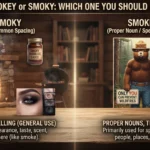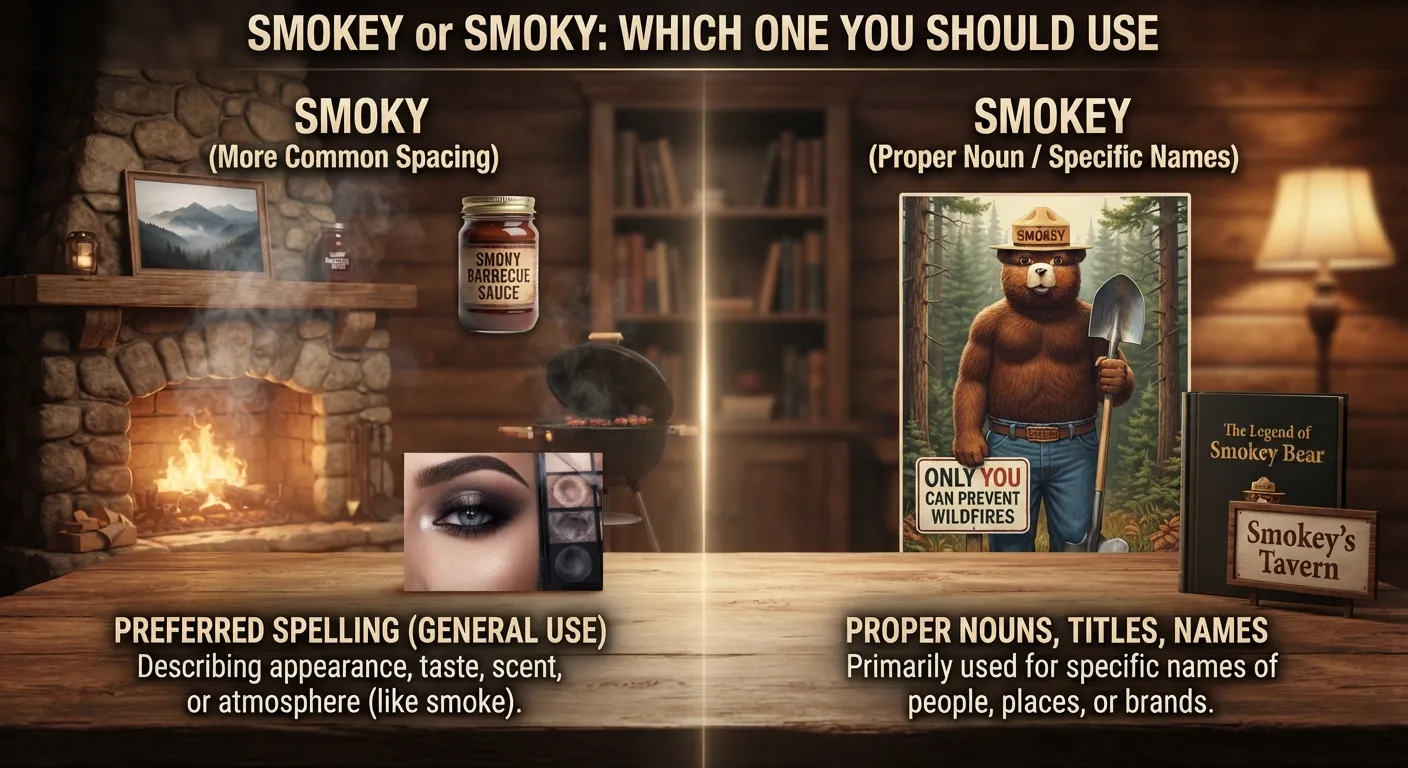
Smoky is the standard spelling of the adjective meaning “full of smoke,” “like smoke,” or “having a smoky flavor,” while smokey is also an accepted variant in some dictionaries.
Quick Answer
Both smoky and smokey can be correct, but smoky is the standard and more widely preferred spelling in general English.
- Smoky = standard spelling
- Smokey = accepted variant of smoky
- Both mean full of smoke, resembling smoke, or having a flavor like smoke.
- For formal, academic, and general writing, smoky is the safest choice.
For example:
The room was smoky after the fire.
The chicken had a delicious smoky flavor.
Cambridge lists smokey as another spelling of smoky, while Collins also gives smokey as an alternative spelling.
Smokey or Smoky: Quick Comparison Table
| Word | Correct? | Part of Speech | Meaning | Example |
| smoky | Yes | Adjective | Full of, resembling, or tasting like smoke | The room was smoky. |
| smokey | Yes, as a variant | Adjective | Same basic meaning as smoky | The restaurant had a smokey atmosphere. |
Best general choice: smoky
What Does “Smoky” Mean?
Smoky is an adjective formed from smoke. It describes something that contains smoke, produces a lot of smoke, resembles smoke, or has the taste or smell associated with smoke.
Common meanings of smoky
- Filled with smoke
- We walked into a smoky room.
- Producing a lot of smoke
- The wood made a smoky fire.
- Having the taste or smell of smoke
- The grilled vegetables had a smoky flavor.
- Resembling the appearance or color of smoke
- She chose a smoky gray shade.
Oxford lists these major uses, including “full of smoke,” “producing a lot of smoke,” “tasting or smelling like smoke,” and having the color or appearance of smoke.
What Does “Smokey” Mean?
Smokey can be used as a variant spelling of smoky.
For example:
- a smokey room
- a smokey flavor
- a smokey atmosphere
Cambridge explicitly lists smokey as another form of smoky. Collins likewise gives smokey as an alternative spelling.
However, smoky is the more conventional spelling to choose when you simply mean “like smoke” or “full of smoke.”
The Main Difference Between Smoky and Smokey
The main difference is spelling preference, not meaning.
Smoky
Smoky is the standard spelling and is widely used in dictionaries and ordinary English writing.
Examples:
- a smoky kitchen
- smoky air
- a smoky barbecue flavor
- smoky blue glass
Smokey
Smokey is an accepted variant spelling of the same adjective.
Examples:
- a smokey atmosphere
- a smokey flavor
- smokey gray eyes
So, this is not a case where the two spellings have completely different meanings.
Why Is “Smoky” Spelled Without an “e”?
The spelling smoky follows the common pattern of adding -y to a noun to form an adjective:
smoke + y → smoky
The final e in smoke is dropped before the suffix -y.
Compare:
- smoke → smoky
- ice → icy
- spice → spicy
- noise → noisy
- taste → tasty
This pattern makes smoky the natural standard spelling.
Grammar Rule: Smoky Is an Adjective
Both smoky and smokey function as adjectives when they describe something related to smoke.
Before a noun
- a smoky room
- a smoky fire
- a smoky flavor
- smoky blue glass
After a linking verb
- The room is smoky.
- The flavor was smoky.
- The air became smoky.
Comparative and superlative forms
The standard forms are:
- smoky
- smokier
- smokiest
Examples:
Today’s air is smokier than yesterday’s.
This is the smokiest room in the building.
Cambridge and Oxford both list smokier and smokiest as the comparative and superlative forms.
Important: We normally do not write smokeyer or smokeyest.
Smoky vs. Smokey in Example Sentences
| Smoky | Smokey |
| The kitchen became smoky. | The kitchen became smokey. |
| I love the smoky flavor of grilled meat. | I love the smokey flavor of grilled meat. |
| Her eyes were a smoky gray. | Her eyes were a smokey gray. |
| The fireplace produced a smoky smell. | The fireplace produced a smokey smell. |
Both versions can communicate the same adjective meaning, but smoky is the better default for general writing.
Is “Smoky” British or American English?
Smoky is used in both British and American English.
The pronunciation differs slightly between the two varieties:
- British English: /ˈsməʊki/
- American English: /ˈsmoʊki/
Cambridge gives smoky in both British and American English and also records smokey as an alternative spelling.
Collins similarly records smoky and smokey in British English and identifies smokey as an alternative spelling in American English.
Which spelling should you use?
| Writing situation | Recommended spelling |
| Academic writing | smoky |
| Professional writing | smoky |
| School assignments | smoky |
| General online writing | smoky |
| Informal writing | smoky or smokey |
| When following a specific name/brand | Follow the official spelling |
Common Mistake: Thinking “Smokey” Is Always Wrong
It is too strong to say that smokey is always incorrect.
Some dictionaries recognize smokey as a legitimate variant. Cambridge lists it directly as an alternative form, and Dictionary.com also defines smokey as a variant of smoky.
So:
❌ “Smokey is always a misspelling.”
is not accurate.
A better rule is:
Use “smoky” as your standard spelling, but recognize “smokey” as an accepted variant.
Grammar Relay: Smoke → Smoky
Understanding the word family makes the spelling easier.
| Word | Part of Speech | Example |
| smoke | Noun | The smoke filled the room. |
| smoke | Verb | They smoke the fish over wood. |
| smoky | Adjective | The fish has a smoky flavor. |
| smokiness | Noun | The smokiness of the room was unpleasant. |
| smokily | Adverb | The fire burned smokily. |
When Should You Use “Smoky”?
Choose smoky when you want to describe:
- air filled with smoke
- a fire that produces smoke
- a smell or flavor resembling smoke
- a color or appearance resembling smoke
- something darkened or hazy because of smoke
Examples:
The firefighters entered the smoky building.
This cheese has a strong smoky flavor.
She wore smoky gray eyeshadow.
The sunset appeared through the smoky haze.
When Might “Smokey” Appear?
Smokey can appear when a writer or publication uses the accepted variant spelling. It can also occur in proper names, where the spelling should be preserved exactly.
For example, Smokey Bear is a proper name in the United States. In that case, changing the spelling to Smoky Bear would not be appropriate.
This is different from choosing an adjective in ordinary writing.
Memory Trick: Think “Smoke + Y”
If you are unsure, remember:
SMOKE + Y = SMOKY
Think of the final e in smoke stepping aside:
smoke → smoky
This gives you the standard spelling quickly.
Smokey or Smoky: Which One Should You Use?
Use this simple decision guide:
Are you writing normal English?
→ Choose smoky.
Are you quoting or preserving a source that uses “smokey”?
→ Keep smokey.
Is it part of an official name?
→ Use the official spelling.
Are you writing for school, work, or formal publication?
→ Smoky is the safest choice.
What Major Dictionaries Say
Major dictionaries support the idea that smoky is the standard form while smokey is recognized as a variant.
- Cambridge Dictionary: lists smoky and identifies smokey as another spelling.
- Oxford Advanced Learner’s Dictionary: lists smoky as an adjective and gives its major meanings and forms.
- Collins Dictionary: lists smoky and smokey as alternative forms.
- Dictionary.com: lists smoky and separately identifies smokey as a variant.
Vocabulary Corner
Here are useful words related to smoky:
- smoke: the visible substance produced by burning
- smoked: preserved or flavored using smoke
- smokiness: the quality of being smoky
- smokier: more smoky
- smokiest: most smoky
- hazy: unclear or misty
- charred: burned and blackened
- fume-filled: filled with fumes
Smoky vs. Smoked
Do not confuse smoky with smoked.
The restaurant had a smoky atmosphere.
Here, smoky describes the atmosphere.
We ordered smoked salmon.
Here, smoked describes salmon that has been treated or preserved with smoke.
Mini Quiz: Smokey or Smoky?
Choose the better spelling for each sentence.
- The room was very ______ after the fire.
- I love the ______ flavor of grilled vegetables.
- She chose a ______ gray color.
- This cheese has a rich ______ taste.
- The official name should be written exactly as it appears, even if it uses Smokey.
Answers
- smoky
- smoky
- smoky
- smoky
- Smokey, if that is the official name
Remember: smokey can be an accepted adjective variant, so the goal is not to call every use of it wrong. Smoky is simply the preferred standard spelling for general writing
Frequently Asked Questions
Q: Is “smoky” or “smokey” correct?
Both can be correct. Smoky is the standard spelling, while smokey is recognized as a variant.
Q: Is “smokey” a misspelling?
Not necessarily. Major dictionaries recognize smokey as an alternative spelling of smoky.
Q: Which spelling is more common in formal writing?
Smoky is the safer standard choice for formal and general writing.
Q: What is the plural of smoky?
Smoky is an adjective, so it does not have a plural form. However, its comparative and superlative forms are smokier and smokiest.
Q: Is Smokey a name?
Yes. Smokey can occur in proper names, such as Smokey Bear. Proper names should retain their official spelling.
Q: Is “smoky” British or American?
Smoky is used in both British and American English. The pronunciation varies slightly between the two varieties.
Final Answer: Smokey or Smoky?
Smoky is the best spelling to use in most situations.
Smokey is not simply a misspelling; it is recognized as a variant of smoky by major dictionaries.
So, when you are writing an essay, article, school assignment, or professional document, choose:
The room was smoky.
rather than:
The room was smokey.
Quick rule to remember:
Smoky = standard choice
Smokey = accepted variant
Boney or Bony: Are Both Spellings Correct?

Hi, I’m Ashley Brown, a lifelong word enthusiast with a passion for making the English language less confusing.My goal is to help readers spell with confidence and never second-guess themselves again.