Both grey and gray are correct spellings of the same word. Gray is the preferred spelling in American English, while grey is the standard spelling in British English and is also widely used in Australia, New Zealand, and many other English-speaking countries.
Many writers pause when they need to write this color. Should it be grey or gray? You may have seen both spellings in books, websites, emails, and even product names. That makes it easy to wonder whether one is wrong or whether both are acceptable.
The good news is that both spellings are correct. The difference comes down to regional English rather than meaning. American English usually prefers gray, while British English favors grey. Other countries often follow the British spelling, although there are a few exceptions.
Knowing which version to use can make your writing look more natural and professional. Whether you’re writing an essay, a business email, a blog post, or social media content, choosing the right spelling for your audience helps avoid confusion. Let’s start with the question most people ask first.
Is It Grey or Gray?✅
Both “grey” and “gray” are correct spellings. The only real difference is regional preference. If you’re writing for an American audience, use gray. If your readers are mainly in the United Kingdom or countries that follow British English, use grey.
For example:
- 🇺🇸 The sky turned gray before the storm.
- 🇬🇧 The sky turned grey before the storm.
The meaning does not change. Both words describe the same neutral color between black and white.
If you are writing for an international audience, either spelling is acceptable. The key is to pick one version and use it consistently throughout your document. Mixing both spellings in the same article or report can make your writing look careless unless you’re intentionally comparing American and British English.
📖What Does Grey or Gray Mean?
Grey and gray both refer to the color that falls between black and white on the color spectrum. The spelling changes depending on the variety of English you use, but the meaning stays exactly the same.
The word is also used in many figurative ways. For example, people often describe something as a gray area or grey area when it is unclear or does not have a simple answer.
Examples:
- She wore a gray sweater to work.
- The old castle was built from grey stone.
Figurative examples:
- There is a legal gray area in the new policy.
- The rules leave plenty of grey areas for interpretation.
Whether you choose grey or gray, readers will understand the same meaning.
🔉How Do You Pronounce Grey and Gray?
There is no pronunciation difference between grey and gray.
| Spelling | IPA | Simple Pronunciation |
| Grey | /ɡreɪ/ | GRAY |
| Gray | /ɡreɪ/ | GRAY |
Both spellings rhyme with:
- day
- play
- stay
- say
Since they sound identical, readers usually recognize the regional spelling only when they see it written.
📔Origin and History

The story behind grey and gray goes back many centuries.
The word comes from the Old English word grǣg, which referred to the color between black and white. Over time, spelling was less standardized than it is today, so different written forms appeared in manuscripts.
During the Middle English period, both grey and gray were used. Writers often spelled words differently because there were no fixed spelling rules.
As English developed, regional preferences became stronger. British publishers gradually settled on grey, while American English increasingly favored gray. This difference became more consistent after American spelling reforms encouraged simpler and more standardized spellings in the United States.
Modern dictionaries recognize both spellings as correct. The preferred version depends on the variety of English you’re using, not on the meaning of the word.
Key Differences Between Grey and Gray
| Feature | Grey | Gray |
| Meaning | Color between black and white | Color between black and white |
| Pronunciation | /ɡreɪ/ | /ɡreɪ/ |
| American English | Less common | Preferred |
| British English | Preferred | Less common |
| Canadian English | More common | Also accepted |
| Australian English | Preferred | Rare |
| New Zealand English | Preferred | Rare |
| Formal Writing | Correct in British English | Correct in American English |
| Academic Writing | Use for British English | Use for American English |
| Business Writing | Match British audiences | Match American audiences |
| Dictionaries | Accepted | Accepted |
| Recommended For | UK and most Commonwealth audiences | US audiences |
The table shows that the only meaningful difference is regional spelling. Meaning, pronunciation, and grammar remain the same.
Think of grey and gray the same way you think about colour and color or centre and center. Each spelling follows the conventions of a particular variety of English rather than indicating a different definition.
What Do Major Dictionaries Say About Grey and Gray?
Major English dictionaries recognize both grey and gray as correct spellings. The difference is not about accuracy—it’s about regional English.
Here’s how some of the most trusted dictionaries present the two spellings:
| Dictionary | Preferred Spelling | Notes |
|---|---|---|
| Merriam-Webster | Gray | American English dictionary. Lists gray as the primary spelling and grey as a variant. |
| American Heritage Dictionary | Gray | Follows standard American English usage. |
| Oxford English Dictionary (OED) | Grey | Recognizes both spellings but uses grey as the standard British form. |
| Oxford Learner’s Dictionaries | Grey | Uses grey for British English and notes gray as the American spelling. |
| Cambridge Dictionary | Grey / Gray | Shows grey for British English and gray for American English. |
| Collins Dictionary | Grey / Gray | Accepts both spellings and labels them by region. |
No major dictionary says that one spelling is universally correct and the other is wrong. Instead, they identify gray as the standard American spelling and grey as the standard British spelling.
If you’re ever unsure, check the dictionary that matches the variety of English you’re writing in. That helps keep your spelling consistent and appropriate for your audience.
Which Version Should You Use?
The best spelling depends on who will read your writing.
Students
Follow your school’s style guide or your teacher’s instructions. If you’re studying in the United States, use gray. If you’re studying in the United Kingdom, use grey.
Business Professionals
Match your customers and clients.
- Companies serving American customers should usually write gray.
- Companies serving British or international markets that follow British English should usually write grey.
Keeping your spelling consistent helps your brand appear polished and professional.
Academic Writers
Universities usually expect consistent spelling throughout a paper. Don’t switch between grey and gray unless you’re quoting a source that uses the other spelling.
Bloggers and Content Creators
Write for your target audience.
Match your spelling to your audience. Use gray for readers in the United States and grey for readers in the UK, Australia, and New Zealand. If you’re writing for an international audience, either spelling is acceptable, but don’t switch between the two.Just stay consistent across the entire article.
ESL Learners
Choose one version and practice it regularly. Learning one spelling first makes writing easier and helps you avoid mixing regional forms.
International Audiences
International organizations often follow either American or British English as part of their editorial style. Check your organization’s style guide and stick to it throughout every document.
Still wondering whether you can switch between grey and gray in the same piece of writing? Here’s when using both spellings is appropriate—and when it isn’t.
Can You Use Grey and Gray in the Same Document?
Usually, no. It’s best to choose one spelling and use it consistently throughout your document. Mixing grey and gray in the same piece of writing can distract readers and make your work look inconsistent.
The only time it’s appropriate to use both spellings is when you’re comparing them, quoting a source, or referring to an official name that uses one specific spelling.
For example, this comparison is correct because it discusses both spellings:
In American English, gray is preferred, while grey is the standard spelling in British English.
A direct quotation should also keep the original spelling:
The report described the sky as “a dull grey.”
Likewise, official names should never be changed:
- Grey Goose (brand)
- Gray Television (company)
For all other writing, stick with one version from beginning to end.
Quick Guide
| Situation | Use Both Spellings? |
|---|---|
| Comparing American and British English | ✅ Yes |
| Quoting a source | ✅ Yes |
| Using official brand or company names | ✅ Yes |
| Writing a blog post | ❌ No |
| Academic paper | ❌ No |
| Business report | ❌ No |
| ❌ No |
Easy Memory Trick
A simple memory trick can help you remember which spelling to use.
- Gray → A → America
- Grey → E → England
Both words begin with Gr. Just look at the next letter.
- A reminds you of America, so use gray in American English.
- E reminds you of England, so use grey in British English.
This trick isn’t a grammar rule, but it’s an easy way to remember the regional preference.
⚠️Common Mistakes
Here are some of the most common mistakes writers make when using grey and gray.
❌ Mixing spellings in the same document
Incorrect:
The walls are gray, and the carpet is grey.
Correct (American English):
The walls are gray, and the carpet is gray.
Correct (British English):
The walls are grey, and the carpet is grey.
Why it happens: Writers copy text from different sources without checking for consistency.
❌ Using British spelling for an American audience
Incorrect (US website):
We sell grey office chairs.
Correct:
We sell gray office chairs.
Why it happens: Many people learn British English at school but later write for American readers.
❌ Using American spelling for a British audience
Incorrect (UK publication):
The gray clouds covered the city.
Correct:
The grey clouds covered the city.
Why it happens: American spelling is common online, so it sometimes appears in British writing.
❌ Thinking one spelling is wrong
Incorrect belief:
Only gray is correct.
Correct understanding:
Both gray and grey are correct. The choice depends on regional English.
Why it happens: People often see only one version in daily reading.
❌ Changing spellings after quoting a source
Incorrect:
Changing grey to gray inside a direct quotation.
Correct:
Keep the original spelling exactly as it appears in the quoted text.
Why it happens: Editors sometimes try to make every spelling match the rest of the document.
❌ Forgetting your style guide
If your school, company, or publisher follows American English, use gray consistently.
If it follows British English, use grey throughout the document.
Real, World Examples
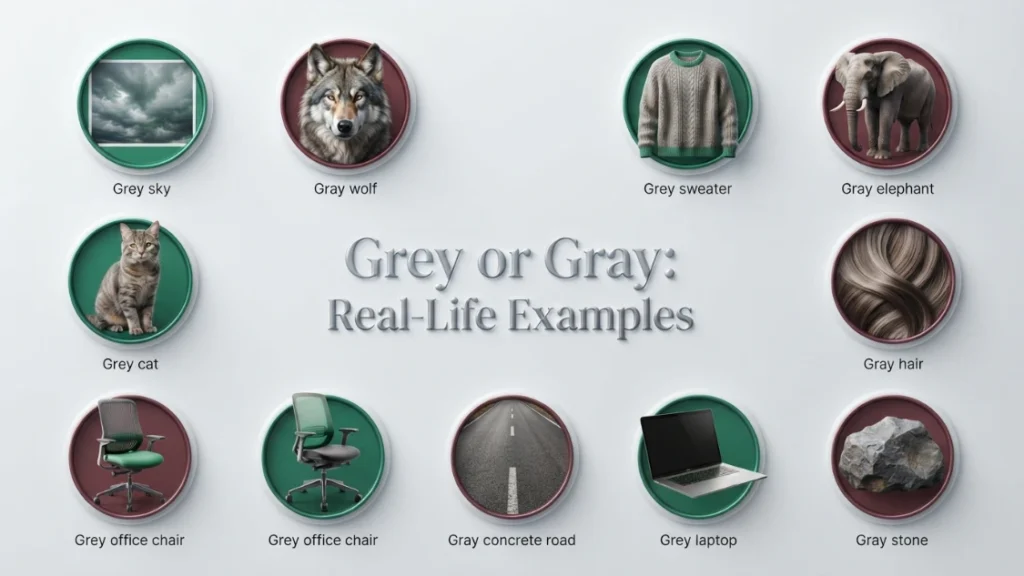
Here is how the word naturally appears in different types of writing.
Professional Email
American English
Please use the gray background for the presentation slides.
British English
Please use the grey background for the presentation slides.
Business Report
Sales of the gray product line increased by 12% in the first quarter.
News Article
Thick grey clouds moved across southern England during the afternoon.
Academic Writing
Participants identified several shades of gray during the experiment.
Social Media
Loving this grey winter outfit. ❄️
Marketing Copy
Our new gray sofa blends beautifully with modern interiors.
Everyday Conversation
I think the car looks better in gray.
My favorite hoodie is grey.
📝Common Words and Phrases
Many common expressions use this word. The spelling changes with the variety of English.
| American English | British English |
| gray area | grey area |
| gray hair | grey hair |
| gray market | grey market |
| gray skies | grey skies |
| gray suit | grey suit |
| gray wolf | grey wolf |
| gray matter | grey matter |
Remember that the meaning stays the same. Only the spelling changes.
Some scientific names, trademarks, or official titles may keep one spelling regardless of regional English.
Brands, Titles & Proper Names
Official names always keep the spelling chosen by the owner or creator.
For example:
- Grey Goose uses Grey because that is its registered brand name.
- Gray Television uses Gray because that is the company’s official name.
- People with the surname Gray or Grey keep their family spelling.
- Book titles, movie titles, and company names should never be changed to match your preferred spelling.
Even if you’re writing in British English, don’t change Gray Television to Grey Television. Likewise, don’t change Grey Goose to Gray Goose.
Search Trends & Usage
Although both spellings are correct, they are not equally common everywhere.
United States
Gray is the standard spelling in schools, businesses, newspapers, and most style guides.
United Kingdom
Grey is the preferred spelling.
Canada
Both spellings appear, but grey is generally more common because Canadian English often follows British spelling traditions while also accepting some American forms.
Australia and New Zealand
Grey is the standard spelling.
Ireland
Most publications prefer grey.
India
Both spellings appear, but grey is more common because British English has had a strong influence on education.
Pakistan
Schools and universities traditionally teach British English, so grey is generally the preferred spelling. American spelling is also widely recognized because of the internet, media, and international business.
International English
Many international organizations choose either American English or British English as their house style. Once a style is chosen, consistency matters more than the spelling itself.
Key Takeaways
- Both grey and gray are correct spellings.
- Gray is the preferred spelling in American English.
- Grey is the preferred spelling in British English and most Commonwealth countries.
- Both spellings have the same meaning and pronunciation.
- Choose the spelling that matches your audience.
- Stay consistent throughout your writing.
- Keep official brand names, titles, and quotations in their original spelling.
- When in doubt, follow your school’s, company’s, or publisher’s style guide.
Frequently Asked Questions
Is grey or gray more correct?
Neither is more correct. Both spellings are accepted by major dictionaries. The right choice depends on whether you’re writing in American English or British English.
Which spelling is American English?
Gray is the standard American spelling. You’ll see it in American schools, newspapers, books, and business writing
Which spelling is British English?
Grey is the standard British spelling. It is also common in Australia, New Zealand, Ireland, and many other countries that follow British English.
Can I use both spellings in the same article?
It’s best not to. Choose one spelling and use it consistently unless you’re comparing the two forms or quoting a source that uses the other spelling.
Which spelling should students use?
Students should follow the spelling style required by their school, university, or teacher. American institutions usually expect gray, while British institutions generally expect grey.
Which spelling should businesses use?
Businesses should match their target audience. American companies usually write gray, while British companies usually write grey. Global companies should follow their brand style guide.
Why are there two spellings?
Both spellings developed over time as English evolved. Regional preferences eventually made gray more common in the United States and grey more common in Britain.
Does the pronunciation change?
No. Both spellings are pronounced /ɡreɪ/ and sound exactly the same.
Do dictionaries accept both spellings?
Yes. Major English dictionaries recognize grey and gray as correct spellings. They simply note the regional preference for each one.
Which spelling is better for international readers?
Either spelling works for international readers. The most important thing is to choose one version and use it consistently throughout your writing.
🎯Conclusion
Choosing between grey and gray is easier once you know the regional difference. Both spellings are correct, both mean the same thing, and both are accepted by major English dictionaries.
If you’re writing for an American audience, gray is the natural choice. If your readers are in the United Kingdom or other countries that follow British English, grey is the better option. For international writing, either spelling is acceptable as long as you stay consistent.
This spelling difference is similar to pairs like color vs colour and center vs centre. None of these versions is universally better—they simply reflect different varieties of English.
Whenever you’re unsure, think about your audience first. Matching their preferred spelling makes your writing look polished, professional, and easy to read.
Bookmark this guide for future reference and share it with anyone who has ever wondered whether grey or gray is the right choice.
See more: Cancelling or Canceling: Which Spelling Is Correct?

Amna Akhtar is a writer dedicated to making English easier to understand. She creates research-informed guides on grammar, vocabulary, spelling differences, and commonly confused words, combining careful research with clear, practical explanations. She is also the co-author of the peer-reviewed research article “Determinants of Jobs Satisfaction of Female Teachers: An Evidence from District Hafizabad, Pakistan,” published in the Journal of Education and Social Studies (2021).