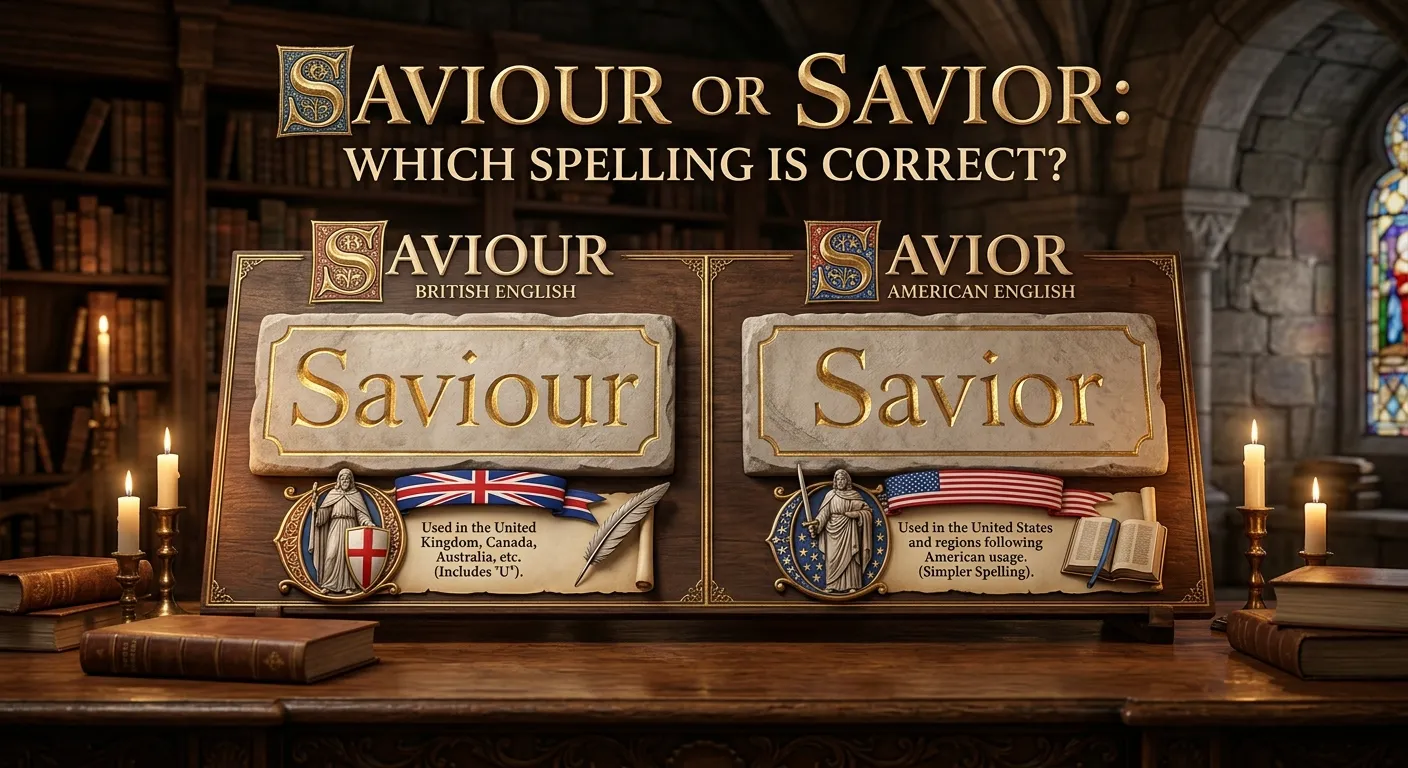
Saviour and savior are both correct spellings of the same noun, meaning a person who saves someone from danger, harm, or difficulty. Saviour is mainly used in British English, while savior is the standard American English spelling.
Quick Answer
- Saviour ✅: British English
- Savior ✅: American English
- Meaning: a person who saves or rescues someone
- Pronunciation: /ˈseɪ.vi.ər/: both spellings are pronounced the same way.
So, neither spelling is wrong. Choose the spelling that matches your variety of English and use it consistently.
Quick Comparison Table
| Feature | Saviour | Savior |
| Correct? | ✅ Yes | ✅ Yes |
| Main variety | British English | American English |
| Meaning | A person who saves or rescues | A person who saves or rescues |
| Pronunciation | /ˈseɪ.vi.ər/ | /ˈseɪ.vi.ər/ |
| Example | She called him her saviour. | She called him her savior. |
Saviour vs. Savior: What Is the Difference?
The difference is spelling, not meaning.
British English generally keeps the -our ending in words such as:
- colour
- honour
- labour
- neighbour
- saviour
American English commonly uses -or instead:
- color
- honor
- labor
- neighbor
- savior
Therefore:
saviour = British spelling
savior = American spelling
Both refer to someone who saves, rescues, or protects another person.
Examples
British English:
The firefighter was hailed as a saviour after rescuing the family.
American English:
The firefighter was hailed as a savior after rescuing the family.
The meaning remains unchanged.
What Does Saviour or Savior Mean?
A saviour/savior is someone who saves another person from danger, trouble, destruction, or a difficult situation.
Example sentences
- The lifeguard became a saviour when he rescued the child.
- The lifeguard became a savior when he rescued the child.
- Her quick decision was a saviour in a difficult situation.
- His advice proved to be a savior when the project was close to failure.
- The charity worker was described as a saviour by the people she helped.
The word can describe a person literally saving someone or, more broadly, something that provides much-needed help.
That cup of coffee was a savior after a long night of work.
Here, savior is used figuratively. The coffee did not literally rescue anyone; it provided welcome relief.
Saviour or Savior in Religious Contexts
Saviour/Savior is also used as a religious term, especially as a title for Jesus Christ in Christian writing.
For example:
- Christians believe in Jesus Christ as their Saviour.
- Christians believe in Jesus Christ as their Savior.
The spelling still follows the regional variety of English.
In British English, Saviour is commonly used.
In American English, Savior is commonly used.
When the word is used as a religious title, capitalization may also depend on the style guide, denomination, or publication.
Grammar Rule
Saviour/savior is a countable noun when it refers to a person who saves someone.
Singular
The doctor was a savior to the injured patient.
Plural
The plural form follows the same regional spelling pattern:
- saviours: British English
- saviors: American English
Examples
- Several firefighters became saviours during the emergency.
- Several firefighters became saviors during the emergency.
Possessive forms
You may also see:
- saviour’s / savior’s: singular possessive
- saviours’ / saviors’: plural possessive
Example:
The savior’s actions were praised by everyone.
British English vs. American English
The spelling difference follows a broader pattern in English.
| British English | American English |
| colour | color |
| honour | honor |
| labour | labor |
| neighbour | neighbor |
| favour | favor |
| saviour | savior |
This does not mean that British English words ending in -our are always changed to -or in American English. The pattern applies to particular words and should be learned word by word.
Which Spelling Should You Use?
Choose according to your audience.
Use saviour when:
- You are writing in British English.
- Your school, workplace, or publication follows British spelling.
- Your audience primarily uses British English.
- You are maintaining consistency with other -our spellings.
Use savior when:
- You are writing in American English.
- Your publication follows American spelling.
- Your audience primarily uses American English.
- You are using American-style spelling throughout a document.
Teacher Tip
The most important rule is consistency.
If your article uses colour, honour, neighbour, and favour, then saviour will normally fit that spelling system.
If you use color, honor, neighbor, and favor, then savior is the natural choice.
Common Mistake
❌ Treating one spelling as incorrect
It is incorrect to assume that saviour is a misspelling of savior, or that savior is always wrong.
Both are standard spellings.
Correct:
He was called a saviour by the villagers. ✅
He was called a savior by the villagers. ✅
The correct choice depends mainly on the variety of English being used.
Memory Tip
Think of -our and -or:
British: saviour
American: savior
A simple way to remember it:
British English keeps the “u”: saviour.
American English drops the “u”: savior.
Word Family
| Word | British English | American English |
| Noun | saviour | savior |
| Plural noun | saviours | saviors |
| Possessive | saviour’s | savior’s |
| Plural possessive | saviours’ | saviors’ |
The spelling difference mainly affects the noun and its related forms.
Vocabulary Corner
Synonyms for saviour/savior
Depending on the context, possible alternatives include:
- rescuer
- protector
- deliverer
- helper
- defender
- lifesaver
- champion
These words are not perfect substitutes in every sentence.
For example, rescuer usually refers to someone who physically saves another person, while lifesaver can also describe something that provides extremely useful help.
Mini Quiz
1. Which spelling is standard in American English?
A. Saviour
B. Savior
Answer: B. Savior
2. Which spelling is commonly used in British English?
A. Savior
B. Saviour
Answer: B. Saviour
3. Are saviour and savior different in meaning?
A. Yes
B. No
Answer: B. No
They have the same basic meaning.
4. Choose the British English sentence.
A. The firefighter was a true savior.
B. The firefighter was a true saviour.
Answer: B. The firefighter was a true saviour.
5. Choose the American English sentence.
A. She considered him her saviour.
B. She considered him her savior.
Answer: B. She considered him her savior.
Learning Outcomes
After reading this guide, you should be able to:
- distinguish saviour from savior;
- identify the British and American spellings;
- understand that both forms have the same meaning;
- use the correct spelling for your target audience;
- recognize the plural forms saviours and saviors;
- avoid treating either standard spelling as a mistake.
What Major Dictionaries Say
Major English dictionaries recognize saviour/savior as standard forms, with the spelling distinction generally reflecting British and American usage.
The important point for writers is not to memorize one spelling as universally correct. Instead, identify the variety of English you are using and maintain that spelling consistently.
Frequently Asked Questions
Is saviour or savior correct?
Both are correct. Saviour is mainly the British English spelling, while savior is the American English spelling.
Is saviour British or American?
Saviour is mainly the British English spelling.
Is savior American spelling?
Yes. Savior is the standard American English spelling.
Do saviour and savior mean the same thing?
Yes. They have the same basic meaning: a person who saves or rescues someone.
Is Jesus called Saviour or Savior?
Both spellings are used. Saviour is common in British English, while Savior is common in American English.
What is the plural of saviour?
The British plural is saviours. The American plural is saviors.
How do you pronounce saviour and savior?
Both are generally pronounced /ˈseɪ.vi.ər/. The spelling difference does not normally change the pronunciation.
Final Answer: Saviour or Savior?
Both “saviour” and “savior” are correct.
- Saviour = mainly British English
- Savior = American English
- Meaning = a person who saves or rescues someone
- Pronunciation = essentially the same
The easiest rule to remember:
Use “saviour” in British English and “savior” in American English.
Neither spelling is inherently more correct. The right choice depends on your variety of English and your audience.
Offense or Offence: A Spelling Guide

Rose Vault is an English language author who specializes in spelling comparisons, commonly confused words, and grammar. She creates clear, well-researched content that helps readers improve their writing and use English with confidence. Her goal is to make language learning simple, accurate, and accessible for everyone.