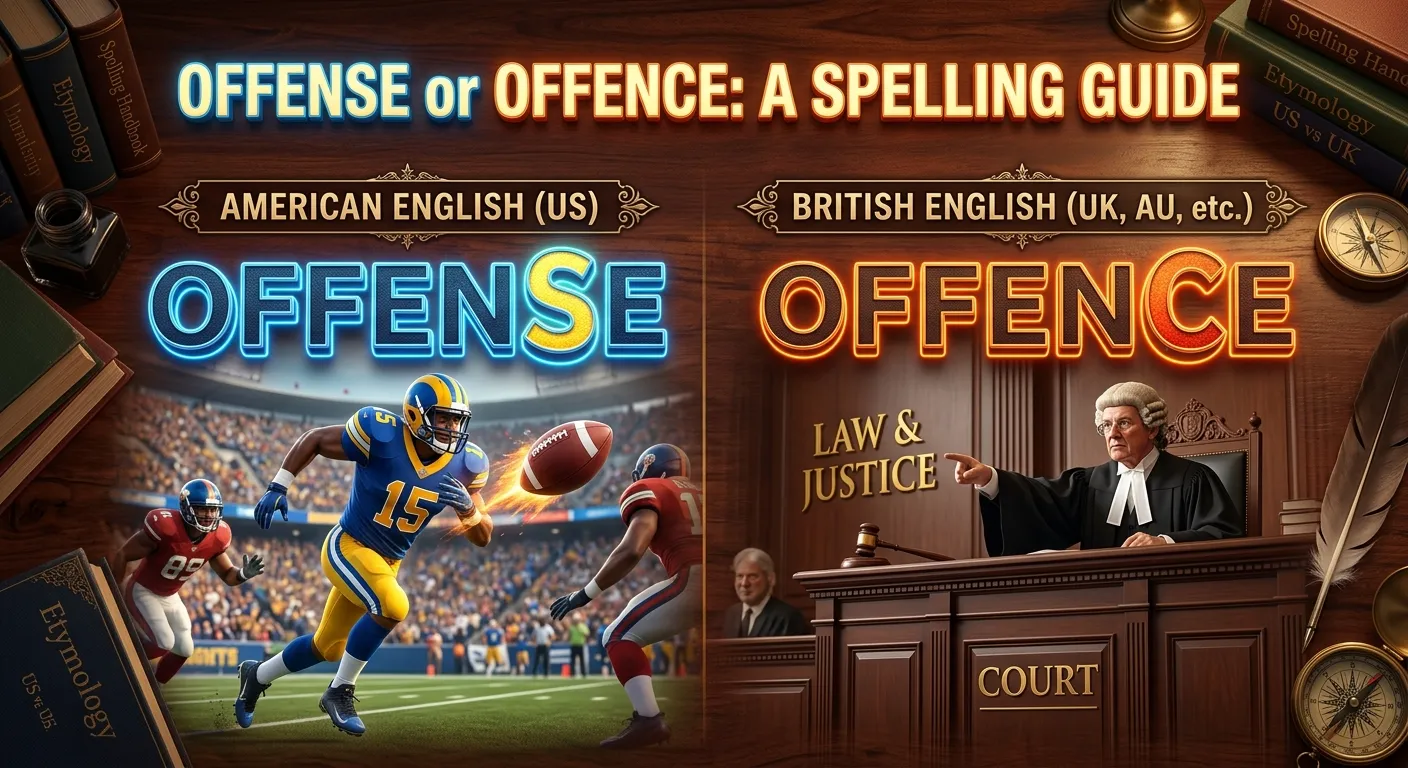
Offense and offence are the same word with the same meanings; offense is the standard American spelling, while offence is preferred in British English and many other varieties.
Offense or Offence: Quick Answer
The difference between offense and offence is mainly a matter of regional spelling.
- Offense → American English 🇺🇸
- Offence → British English 🇬🇧
- Both mean the same thing.
- Both can refer to a crime, an act that causes anger, or a team’s attacking play in sports.
Quick Comparison Table
| Spelling | English variety | Correct? | Example |
| offense | American English | ✅ Yes | The player scored on offense. |
| offence | British English | ✅ Yes | The player scored on offence. |
So, neither spelling is wrong. Choose the spelling that matches the variety of English you are writing in.
What Does Offense or Offence Mean?
Offense and offence are nouns with several related meanings.
1. A crime or illegal act
An offense/offence can mean an act that breaks a law or rule.
He was charged with a serious offense.
British English:
He was charged with a serious offence.
2. Something that causes anger or hurt
The word can also describe an action or remark that upsets, insults, or hurts someone.
She took offense at his comment.
British spelling:
She took offence at his comment.
3. Attacking play in sports
In sports, offense or offence refers to the players or actions used to attack and score.
The team has a strong offense.
British English:
The team has a strong offence.
The Main Difference: American vs. British English
The easiest way to remember the difference is to look at the final letters:
American English:
offense → -se
British English:
offence → -ce
This follows a broader spelling pattern in which American English often uses -se, while British English retains -ce in certain noun forms.
For example:
| American English | British English |
| offense | offence |
| defense | defence |
| license (noun) | licence (noun) |
| pretense | pretence |
However, these patterns are not universal, so it is better to learn each word’s standard spelling rather than assume every -se/-ce pair works the same way.
Is Offense American or British?
Offense is the standard spelling in American English.
The referee called an offensive offense.
In British English, the usual spelling is:
The referee called an offensive offence.
If you are writing for an American audience, choose offense. If you are following British English conventions, choose offence.
Is Offence American or British?
Offence is the standard spelling in British English.
It is also commonly used in other varieties of English that follow British spelling conventions, including many Commonwealth contexts.
For example:
It is a criminal offence.
American English:
It is a criminal offense.
Offense vs. Offence in a Sentence
Here are some examples showing how the spelling changes by English variety.
American English
The police investigated the offense.
She did not mean to cause offense.
The team’s offense was difficult to stop.
British English
The police investigated the offence.
She did not mean to cause offence.
The team’s offence was difficult to stop.
Notice that the meaning and grammar remain the same. Only the spelling changes.
Offense/Offence as a Verb
The related verb is offend.
Unlike the noun, the verb does not change between American and British English.
I did not mean to offend you.
His comments may offend some people.
The adjective is offensive in both varieties:
That was an offensive remark.
So the spelling difference is mainly found in the noun:
offense 🇺🇸 / offence 🇬🇧
Offense or Offence in Sports
Both forms are also used when discussing sports.
In American English:
Our offense scored three touchdowns.
In British English:
Our offence scored three goals.
The meaning is the same: the attacking side or its play.
However, individual sports have their own terminology, so the surrounding vocabulary may also vary between American and British usage.
Offense or Offence: Grammar Rule
Offense/offence is a countable noun when it refers to a particular crime, act, or incident.
He committed an offense.
It was a serious offence.
It can also be used as an uncountable noun when referring to the feeling of being insulted or upset.
She took offense at the remark.
He took offence at the comment.
The spelling does not affect the grammatical role.
A Simple Memory Trick
Think of the spelling used in defense/defence.
- American English: offense, defense
- British English: offence, defence
A quick trick is:
American → -se
British → -ce
So:
American: offense
British: offence
Common Mistakes
❌ Mixing regional spellings
If you are writing in American English, avoid switching between:
offense, defence
Instead, use the American forms consistently:
offense, defense
Likewise, British English normally uses:
offence, defence
Consistency matters more than choosing one spelling universally.
❌ Assuming one spelling is incorrect
It is incorrect to say that offence is always wrong because American English uses offense.
Likewise, offense is not wrong simply because British English prefers offence.
They are standard regional variants.
Which One Should You Use?
Choose based on your audience and the English style you are following.
| If you are writing for… | Use |
| 🇺🇸 American readers | offense |
| 🇬🇧 British readers | offence |
| American English school/work writing | offense |
| British English school/work writing | offence |
| A style guide requiring American English | offense |
| A style guide requiring British English | offence |
If your website targets an international audience, either spelling can be correct. The important thing is to follow one English variety consistently within a piece of writing.
What Major Dictionaries Say
Major dictionaries recognize both forms as standard spellings, but their usage labels reflect regional preferences.
American dictionaries such as Merriam-Webster use offense as the main American spelling, while British dictionaries such as Cambridge Dictionary and Oxford Learner’s Dictionaries recognize offence as the British form.
This reflects a regional spelling difference rather than a difference in meaning.
Offense or Offence: Mini Quiz
Choose the correct spelling for the variety of English shown.
1. American English
The player improved his team’s ___.
A. offence
B. offense
2. British English
He was charged with a criminal ___.
A. offence
B. offense
3. American English
I did not mean to cause ___.
A. offense
B. offence
4. British English
She took ___ at his comment.
A. offence
B. offense
Answers:
- offense
- offence
- offense
- offence
Final Answer: Offense or Offence?
Offense and offence are both correct spellings.
Use offense in American English and offence in British English and other varieties that follow British spelling conventions.
The two words have the same meaning, pronunciation, and grammatical uses. The difference is primarily regional spelling.
Easy rule:
🇺🇸 American English → offense
🇬🇧 British English → offence
Once you know which English variety you are using, choosing the correct spelling is easy.
Centre vs Center: British English or American English?

Amna Akhtar is a writer dedicated to making English easier to understand. She creates research-informed guides on grammar, vocabulary, spelling differences, and commonly confused words, combining careful research with clear, practical explanations. She is also the co-author of the peer-reviewed research article “Determinants of Jobs Satisfaction of Female Teachers: An Evidence from District Hafizabad, Pakistan,” published in the Journal of Education and Social Studies (2021).