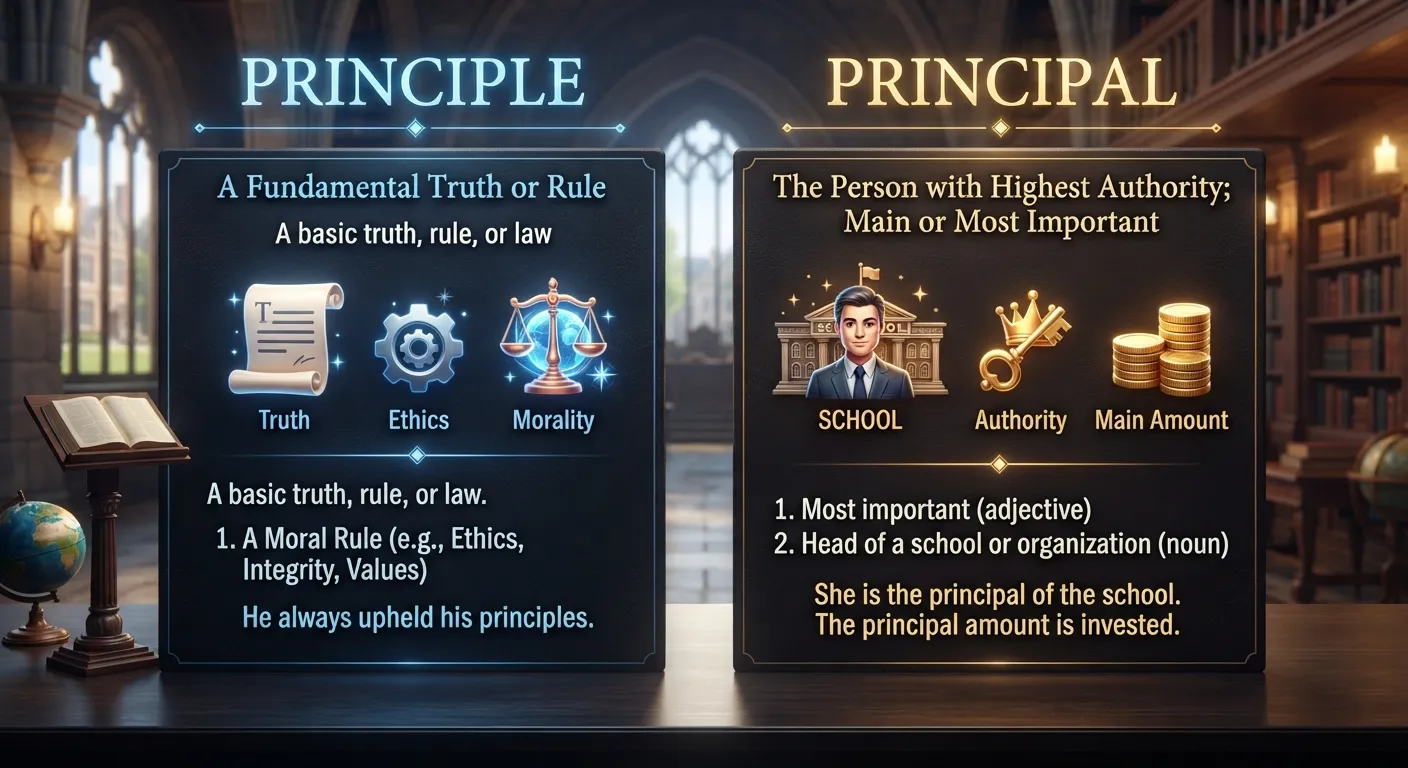
Principle and principal are both correct words, but they have different meanings and uses. Principle is usually a noun meaning a rule, belief, or basic truth. Principal can be a noun meaning a person in charge, especially a school leader, or an adjective meaning most important. They are not interchangeable.
Definition
Principle means a rule, belief, or basic truth, while principal means a person in charge or something most important.
Quick Answer
- Use principle for a rule, belief, or basic truth.
- Use principal for a person in charge or something most important.
- In education, the principal is the head of a school.
- A useful memory trick: The principal is your “pal” → principal = person in charge.
Principle vs. Principal: Quick Comparison
| Word | Part of Speech | Meaning | Example |
| principle | Noun | A rule, belief, or basic truth | Honesty is an important principle. |
| principal | Noun | A person in charge, especially of a school | The principal spoke to the students. |
| principal | Adjective | Most important or main | Safety is our principal concern. |
What Does Principle Mean?
Principle is a noun. It refers to a basic rule, belief, standard, or truth that guides behavior, decisions, or a system.
Examples of Principle
- She refused to lie because honesty is one of her principles.
- The company operates according to strict ethical principles.
- Respect is an important principle of good leadership.
- The scientist explained the basic principle behind the machine.
Common Uses of Principle
You may see principle used in phrases such as:
- moral principles
- ethical principles
- basic principles
- scientific principles
- religious principles
- guiding principles
- fundamental principles
Grammar Tip
Principle is normally used as a countable noun when referring to a specific rule or belief.
She follows strong moral principles.
It can also refer to a basic truth or law:
The machine works on a simple scientific principle.
What Does Principal Mean?
Principal has two common uses.
1. Principal as a Noun
As a noun, principal often means the person who has the highest authority in a school.
The principal welcomed the new students.
It can also refer to a person who has a leading role in another organization or situation.
2. Principal as an Adjective
As an adjective, principal means main, chief, or most important.
The principal reason for the delay was bad weather.
Our principal goal is to improve customer service.
More Examples of Principal
- The school principal addressed the teachers.
- The principal called a meeting after the incident.
- Her principal responsibility is managing the department.
- The principal cause of the problem was poor planning.
- Education is the principal focus of the program.
Principle vs. Principal: The Main Difference
The easiest way to separate these words is to focus on their meanings.
Principle = a rule or belief
Fairness is an important principle.
Principal = a person in charge
The principal announced the new school policy.
Principal = main or most important
The principal reason for the change was cost.
So, if you are talking about a rule or belief, choose principle. If you mean the head of a school or something main/most important, choose principal.
A Simple Memory Trick
A popular way to remember principal is:
The principal is your pal.
The word pal appears at the end of principal:
princi + pal
This can help you remember that a principal can be a person, especially the person in charge of a school.
For principle, think of a rule or belief that guides your actions.
Quick Memory Test
Ask yourself:
Am I talking about a rule or belief?
→ principle
Am I talking about a school leader?
→ principal
Am I talking about something main or most important?
→ principal
Principle or Principal in School Context
School-related writing is a common place where these words get confused.
Correct:
The principal met with the parents.
Here, principal means the head of the school.
Also Correct:
Respect is an important principle in our school.
Here, principle means a guiding belief or rule.
Compare:
The principal explained the school’s principles.
This sentence uses both words correctly:
- principal = school leader
- principles = rules or beliefs
Common Mistakes
❌ Incorrect:
Honesty is an important principal.
✅ Correct:
Honesty is an important principle.
Here, honesty is a belief or value, so principle is correct.
❌ Incorrect:
The school principle called the students.
✅ Correct:
The school principal called the students.
Here, the word refers to the head of the school, so principal is correct.
❌ Incorrect:
The principle reason for the decision was cost.
✅ Correct:
The principal reason for the decision was cost.
Here, principal means “main” or “most important.”
Principle vs. Principal in Sentences
| Meaning | Correct Word | Example |
| A moral belief | principle | Honesty is a core principle. |
| A basic rule | principle | The system follows a simple principle. |
| A school leader | principal | The principal spoke at the assembly. |
| A chief person | principal | The principal parties signed the agreement. |
| Main or most important | principal | This is our principal concern. |
Pronunciation
Both words are commonly pronounced the same way in standard English, even though they have different spellings and meanings.
principle (/ˈprɪnsəpəl/)
principal (/ˈprɪnsəpəl/)
This makes the spelling difference especially important in writing.
Grammar Relay
Principle
- Part of speech: noun
- Plural: principles
- Refers to rules, beliefs, or basic truths
Principal
- Part of speech: noun or adjective
- Noun: principal → a person in charge
- Adjective: principal → main or most important
Word Forms
| Word | Form | Example |
| principle | singular noun | a moral principle |
| principles | plural noun | ethical principles |
| principal | singular noun | the school principal |
| principals | plural noun | several school principals |
| principal | adjective | the principal reason |
Vocabulary Corner
Principle
Related words include:
- rule
- belief
- standard
- value
- doctrine
- guideline
- tenet
Principal
When used as an adjective:
- main
- chief
- primary
- leading
- foremost
When used as a noun:
- head
- leader
- director
These words are related in meaning, but they cannot always replace principle or principal in every sentence.
How to Choose the Right Word
Use this three-question test:
1. Is it a rule, belief, or basic truth?
Use principle.
Freedom of speech is an important principle.
2. Is it a school leader or person in charge?
Use principal.
The principal met the teachers.
3. Does it mean main or most important?
Use principal.
Her principal concern was safety.
Mini Quiz
Choose principle or principal.
- The school ______ announced the new timetable.
- Honesty is an important ______ of good character.
- The ______ reason for the delay was heavy traffic.
- The machine works according to a basic scientific ______.
- The ______ met with the parents.
- She refused to compromise her personal ______.
Answers
- principal
- principle
- principal
- principle
- principal
- principle
Practice Guide
To remember the difference, connect each word with its most common idea:
Principle → principle of behavior or belief
Honesty is a principle.
Principal → person or primary
The principal is the school leader.
The principal reason is the main reason.
When proofreading, look carefully at sentences involving school leaders, rules, beliefs, and main reasons. These contexts make the correct spelling much easier to identify.
What Major Dictionaries Say
Major English dictionaries distinguish the words by meaning rather than treating them as spelling variants.
- Principle is used for a fundamental truth, rule, belief, or standard.
- Principal is used as a noun for someone in a leading position, especially a school head, and as an adjective meaning main or most important.
The key distinction is therefore meaning, not pronunciation.
Final Takeaway
Principle and principal sound alike in common English pronunciation, but they have different meanings.
Principle = rule, belief, or basic truth.
Principal = person in charge or main/most important.
If you mean a school leader, use principal. If you mean a rule or belief, use principle.
Easy memory trick:
The principal is your pal.
Whose or Who’s: Difference, Meaning & Examples

Rose Vault is an English language author who specializes in spelling comparisons, commonly confused words, and grammar. She creates clear, well-researched content that helps readers improve their writing and use English with confidence. Her goal is to make language learning simple, accurate, and accessible for everyone.