Inquire means to ask for information about something or someone.
Quick Answer
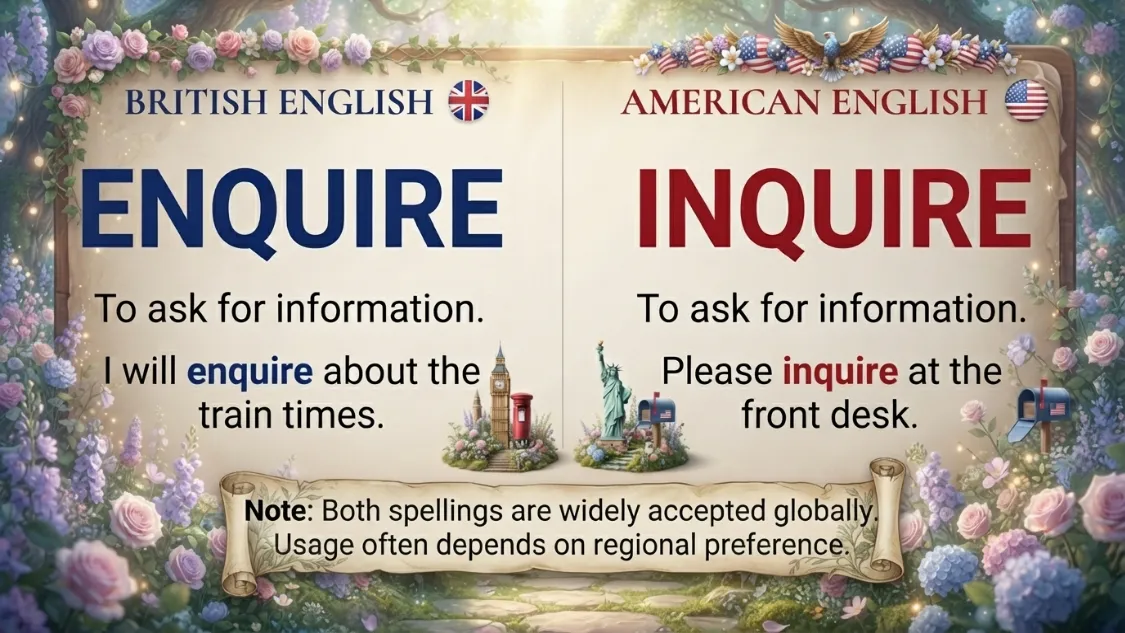
Enquire and inquire are both correct spellings. Enquire is especially common in British English, while inquire is the usual spelling in American English. In British English, inquire is also used, especially when referring to a formal investigation.
| Spelling | English Variety | Correct? | Common Meaning |
|---|---|---|---|
| enquire | British English | Yes | Ask for information |
| inquire | American English; also British English | Yes | Ask for information; investigate |
What You’ll Learn
By the end of this guide, you will know:
- Whether enquire or inquire is correct
- Which spelling is preferred in British and American English
- Whether the two words have different meanings
- How to use each spelling in a sentence
- How to avoid common spelling mistakes
Why Are “Enquire” and “Inquire” Confusing?
Have you ever written enquire in one place and inquire in another and wondered which one is correct?
You are not alone. The two spellings look almost identical, sound the same in most varieties of English, and have the same basic meaning: to ask for information.
The main difference is regional spelling. British English commonly uses enquire, while American English generally uses inquire. However, British English also accepts inquire, so the situation is not as simple as saying that one spelling is British and the other is American.
There is also a useful British-English distinction between the two forms. Some British speakers use enquire for ordinary questions and inquire for a formal investigation. This distinction is real, but it is not an absolute rule. Both spellings can be used in either sense.
What Does “Enquire” Mean?
Enquire means to ask for information about something or someone.
It is especially common in British English.
Example:
I called the hotel to enquire about room availability.
You can also use it with phrases such as:
- enquire about something
- enquire after someone
- enquire into something
For example:
She enquired about the course fees.
Cambridge lists enquire as a UK form and gives it the meaning “to ask someone for information about something.”
What Does “Inquire” Mean?
Inquire also means to ask for information.
It is the standard spelling in American English and is also used in British English.
Example:
I called the hotel to inquire about room availability.
It can also mean to investigate or examine something, especially when used with into.
Example:
The committee will inquire into the allegations.
Merriam-Webster defines inquire both as asking for information and as making an investigation.
Enquire vs Inquire: What’s the Difference?
The basic meaning is the same, but regional usage can differ.
British English
In British English, enquire is often used for the general meaning of “ask for information.”
I am writing to enquire about your services.
Inquire is also correct in British English. Some speakers use it for a more formal sense of investigating something.
The committee will inquire into the matter.
Oxford notes this traditional distinction but also makes an important point: either spelling can be used for either meaning in British English.
American English
American English generally uses inquire for both meanings.
I called to inquire about the price.
The committee will inquire into the complaint.
The spelling enquire exists in American dictionaries as a variant, but it is not the usual choice in standard American writing. Merriam-Webster describes enquire and related forms as chiefly British spellings of inquire and its related forms.
Quick Rule
British English: enquire is common for asking for information; inquire is also accepted.
American English: inquire is the normal spelling for both meanings.
So, if you are writing for an American audience, inquire is usually the safest choice. If you are following British English, enquire is a natural choice for ordinary requests for information.
Is “Enquire” British or American?
Enquire is mainly associated with British English.
Cambridge labels enquire as a UK form and lists inquire as the corresponding spelling. Oxford likewise describes enquire as especially British English and gives inquire as another form.
However, calling enquire “British only” would be misleading. The spelling is recognized in American English dictionaries as a variant, although inquire is much more usual in American writing.
Is “Inquire” British or American?
Inquire is standard in American English and is also used in British English.
This is why the simple rule “enquire = British, inquire = American” is useful but incomplete.
A better rule is:
Enquire is especially British; inquire is especially American, but both spellings are accepted in British English.
Oxford’s learner dictionary specifically states that British English can use either spelling, while American English usually uses inquire for both meanings.
Dictionary Guidance: What Do Major Dictionaries Say?
Major dictionaries agree that these are legitimate spellings, but they describe their regional use differently.
| Dictionary | Treatment of “Enquire” | Treatment of “Inquire” |
|---|---|---|
| Oxford | Especially British; also uses inquire | Standard, especially North American |
| Cambridge | UK spelling | UK and US spelling |
| Merriam-Webster | Chiefly British variant | Main entry |
Oxford says that enquire is especially British and that inquire is also used in British English. Cambridge marks enquire as UK and inquire as a UK/US form. Merriam-Webster describes enquire as a chiefly British spelling of inquire.
This shows why neither spelling should be called an outright misspelling.
Pronunciation of “Enquire” and “Inquire”
In most varieties of English, enquire and inquire have the same pronunciation.
A simple pronunciation guide is:
enquire: /ɪnˈkwaɪə(r)/
inquire: /ɪnˈkwaɪə(r)/ in British English; /ɪnˈkwaɪr/ in American English.
The spelling changes, but the main pronunciation remains the same.
This makes the pair a spelling and regional-usage issue rather than a typical homophone problem.
Grammar Rule
Grammar Rule: Both enquire and inquire are verbs.
They can be followed by about, a question word, or certain other structures.
Examples:
- She enquired about the job.
- He inquired about the price.
- They enquired why the meeting was cancelled.
- She inquired whether the documents had arrived.
Their forms also change normally:
| Base Form | Past Tense | -ing Form |
|---|---|---|
| enquire | enquired | enquiring |
| inquire | inquired | inquiring |
Notice the spelling difference in the endings too:
enquire → enquired → enquiring
inquire → inquired → inquiring
Real-World Examples
British English
- I enquired about the cost of the course.
- She called to enquire whether the shop was open.
- He enquired about the train schedule.
American English
- I called to inquire about the cost of the course.
- She called to inquire whether the shop was open.
- He inquired about the train schedule.
Formal or Investigative Context
In British English, inquire may be preferred by some writers when the meaning is closer to investigate.
The committee will inquire into the complaint.
But enquire into is also possible in British English, so this is a usage preference rather than a strict grammar rule.
Common Mistakes
| Common Mistake | Correct Form | Why? |
|---|---|---|
| She enquire about the price. | She enquires about the price. | Third-person singular needs -s. |
| He inquire about the job yesterday. | He inquired about the job yesterday. | Use the past-tense form. |
| I am inquire about the course. | I am inquiring about the course. | Use the -ing form after “am.” |
| I am enquiring about the position. | Correct | Enquiring is a standard British form. |
| I am inquiring about the position. | Correct | Inquiring is standard, especially in American English. |
Grammar Relay Corner
Both spellings work in the same sentence structure.
British English:
She enquired about the school timetable.
American English:
She inquired about the school timetable.
The meaning does not change. The main difference is the spelling preference.
For formal writing, the most important rule is consistency. If your document follows British English, use British spelling consistently. If it follows American English, use American spelling consistently.
Vocabulary Corner
The related noun forms follow the same regional pattern:
- enquire → enquirer → enquiry
- inquire → inquirer → inquiry
Examples:
We received an enquiry from a customer.
We received an inquiry from a customer.
Cambridge recognizes enquirer as a UK form and inquirer as the corresponding form, while Merriam-Webster identifies enquiry as a chiefly British spelling.
Mini Quiz
Choose the best spelling for each sentence.
- I called to ______ about the course.
- a) enquire
- b) inquire
- Which spelling is especially associated with British English?
- a) enquire
- b) inquire
- Which spelling is normally preferred in American English?
- a) enquire
- b) inquire
- She ______ about the job yesterday.
- a) enquired
- b) enquire
Answers
- Both enquire and inquire can be correct, depending on the English variety.
- Enquire
- Inquire
- Enquired
Enquire vs Inquire: Final Comparison
| Term | Meaning | Region/Context | Best Used When |
|---|---|---|---|
| enquire | Ask for information | Especially British English | Writing in British English |
| inquire | Ask for information | American and British English | Writing in American English or using the more widely recognized form |
| inquire into | Investigate | British and American English | Referring to an investigation |
| enquiry | A request for information | Especially British English | Following British spelling |
| inquiry | A request for information or investigation | American English; also British | Following American spelling or using the common -quiry form |
FAQs
Q: Is “enquire” or “inquire” correct?
A: Both are correct. Enquire is especially common in British English, while inquire is the usual American spelling. British English also accepts inquire.
Q: Is “enquire” British English?
A: Yes. Enquire is strongly associated with British English and is a standard British spelling.
Q: Is “inquire” American English?
A: Yes. Inquire is the standard spelling in American English. It is also used in British English.
Q: Do “enquire” and “inquire” have different meanings?
A: Usually, no. Both can mean to ask for information. In British English, some writers distinguish enquire for general questions from inquire for formal investigation, but Oxford notes that either spelling can be used for either meaning.
Q: Can I use “inquire” in British English?
A: Yes. Inquire is accepted in British English. It is often used in more formal or investigative contexts, although enquire is also correct in those contexts.
Q: Which spelling should ESL learners use?
A: Choose the spelling that matches the variety of English you are learning or writing. Use enquire for a British-English style and inquire for American English. Most importantly, stay consistent.
Q: Are “enquiry” and “inquiry” also different spellings?
A: Yes. They follow the same general regional pattern. Enquiry is especially British, while inquiry is standard in American English and is also used in British English.
Key Takeaways
- Enquire and inquire are both correct spellings.
- Enquire is especially common in British English.
- Inquire is the usual spelling in American English.
- British English can use inquire as well, especially in formal or investigative contexts.
- The safest choice is to follow the English variety used throughout your writing.
A Familiar Divide, One Letter Wide
“Enquire” and “inquire” follow the same story as so many British-versus-American pairs no rule was broken, just two regions settling on slightly different spellings over time. British English tends to favor “enquire” for general asking, while American English sticks with “inquire” across the board. It’s the same regional split behind Tyre or Tire and Aluminium or Aluminum different words, same transatlantic story.
Conclusion
So, is it enquire or inquire? The answer is both. The difference is mainly one of regional spelling and usage.
If you are writing in British English, enquire is a natural choice when you mean “ask for information.” Inquire is also correct and may be used for formal investigation or simply as an alternative spelling. In American English, inquire is the standard choice for both meanings.
The related nouns follow a similar pattern: enquiry is especially British, while inquiry is standard in American English.
Once you know the regional preference, this spelling pair becomes easy to remember: enquire for British English, inquire for American English while remembering that British English accepts both.
Now that you know the difference, you can use the right spelling with confidence.

Amna Akhtar is a writer dedicated to making English easier to understand. She creates research-informed guides on grammar, vocabulary, spelling differences, and commonly confused words, combining careful research with clear, practical explanations. She is also the co-author of the peer-reviewed research article “Determinants of Jobs Satisfaction of Female Teachers: An Evidence from District Hafizabad, Pakistan,” published in the Journal of Education and Social Studies (2021).