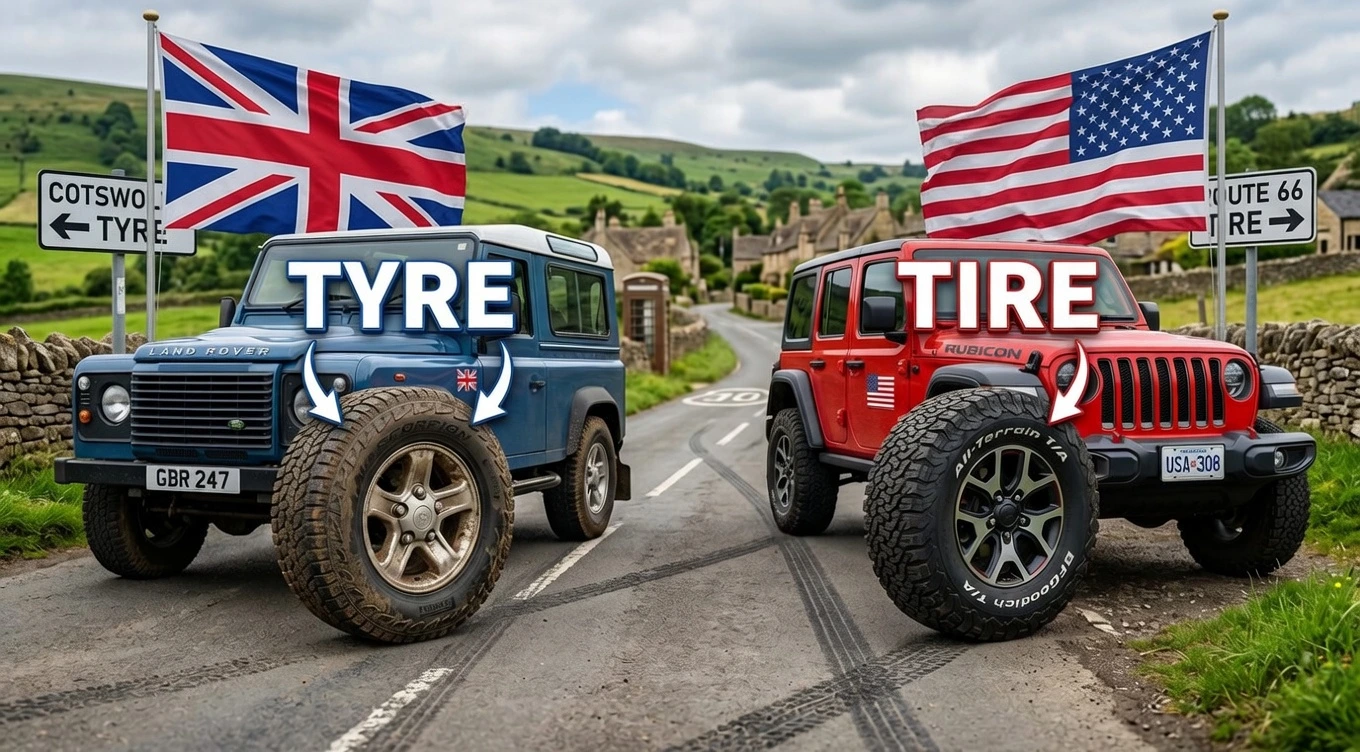
Tyre is used in British English for the rubber wheel covering, while tire is the American English spelling and is also the verb meaning to become tired.
Quick Answer
Both tyre and tire are correct spellings, but they are used in different varieties of English.
- Tyre is the standard spelling in British English and refers to the rubber covering around a wheel.
- Tire is the standard spelling in American English for the same object.
In addition, tire is also a verb in both British and American English meaning to become or make someone feel tired.
Quick Comparison Table
| Word | British English | American English | Meaning |
|---|---|---|---|
| Tyre | ✅ Standard | ❌ Rare | The rubber covering on a wheel |
| Tire | ❌ For the wheel | ✅ Standard | The rubber covering on a wheel |
| Tire | ✅ Yes | ✅ Yes | To become tired or make someone tired |
If you’ve ever read a British website and an American website about cars, you’ve probably noticed two different spellings: tyre and tire.
Although they refer to the same part of a vehicle, the spelling depends on the variety of English being used. This difference is similar to colour/color, centre/center, and travelling/traveling.
Understanding when to use tyre and tire will help you write naturally for your audience.
Is It Tyre or Tire?
The answer depends on your audience.
Use tyre if you’re writing in:
- British English
- Australian English
- New Zealand English
- Indian English
- Pakistani English
Use tire if you’re writing in:
- American English
- Most American publications
- U.S. businesses
- U.S. schools
Examples:
British English:
- My car needs a new tyre.
- The front tyre is flat.
American English:
- My car needs a new tire.
- The front tire is flat.
Both sentences are correct.
What Does “Tyre” Mean?
Tyre is the British English spelling of the rubber covering fitted around a vehicle’s wheel.
Examples:
- The bicycle has a flat tyre.
- Check the tyre pressure before driving.
- Winter tyres provide better grip on snow.
- The mechanic replaced both front tyres.
What Does “Tire” Mean?
The word tire has two different meanings.
1. A Vehicle Tire (American English)
Examples:
- I bought four new tires.
- The rear tire needs air.
- The truck has heavy-duty tires.
2. To Become Tired (Verb)
This meaning is used in both British and American English.
Examples:
- Long walks tire me.
- The children soon tired after hiking.
- Don’t tire yourself.
Notice that tyre is never used as the verb.
Are They Pronounced Differently?
No.
Both tyre and tire are pronounced exactly the same.
IPA (UK): /taɪə/
IPA (US): /taɪr/
The pronunciation changes slightly because of the accent, not because of the spelling.
The Origin of Tyre and Tire
The history of these two spellings is closely connected.
Originally, tire was the only spelling used for the rubber covering of a wheel. It comes from the word attire, referring to something that covers or dresses another object. Early writers used tire because the rubber covering “dressed” the wheel.
In the early 20th century, British English gradually adopted the spelling tyre for the wheel to distinguish it from the verb tire, which means to become weary.
Today:
- Tyre refers only to the rubber covering on a wheel in British English.
- Tire refers to the wheel covering in American English and remains the spelling of the verb in all major varieties of English.
Pronunciation
Although the spellings differ, the pronunciation is almost the same.
| Word | IPA (UK) | IPA (US) |
|---|---|---|
| Tyre | /taɪə/ | — |
| Tire (wheel) | — | /taɪr/ |
| Tire (verb) | /taɪə/ | /taɪr/ |
The difference comes from the accent, not the spelling.
British vs American English
This is one of the best-known spelling differences between British and American English.
| Meaning | British English | American English |
|---|---|---|
| Rubber covering on a wheel | Tyre | Tire |
| To become weary | Tire | Tire |
British English Examples
- The front tyre is flat.
- Check the tyre pressure regularly.
- My bicycle needs a new tyre.
American English Examples
- The front tire is flat.
- Check the tire pressure regularly.
- My bicycle needs a new tire.
Verb Examples (Both Varieties)
- Long meetings tire me.
- She quickly tired after running.
- Don’t tire yourself.
Common Mistakes
Mistake 1: Using Tyre in American English
❌ I need to replace my car’s tyre. (For U.S. English.)
✅ I need to replace my car’s tire.
Mistake 2: Using Tire for the Wheel in British English
❌ The car has a flat tire. (For British English.)
✅ The car has a flat tyre.
Mistake 3: Using Tyre as a Verb
❌ Long journeys tyre me.
✅ Long journeys tire me.
Remember:
- Tyre = noun only (British English)
- Tire = noun (American English) and verb (all varieties)
Where This Confusion Comes From
The difference between “Tyre” and “Tire” is a straightforward case of British versus American English the two regions simply adopted different spellings for the same word over time. This same pattern shows up in other everyday words too, such as Grey or Gray and Realised or Realized where regional spelling preferences, not grammar rules, decide which version is correct. Knowing which English variety, you’re writing for makes choosing the right spelling simple.
Everyday Examples
Vehicle Maintenance
British English
- The mechanic replaced the rear tyre.
- Check your tyres before a long trip.
- My motorcycle needs a new tyre.
American English
- The mechanic replaced the rear tire.
- Check your tires before a road trip.
- My motorcycle needs a new tire.
Using the Verb “Tire”
- Running five kilometers can tire beginners.
- The long flight tired everyone.
- Try not to tire yourself before the competition.
Tips to Remember
Tyre is for British English vehicles.
Tire is for American English vehicles.
Tire is always the correct verb meaning to become weary, regardless of whether you’re writing British or American English.
Memory trick:
Tyre travels in British English; tire travels in American English and only tire can mean “become tired.”
What Major Dictionaries Say
Major English dictionaries agree that both tyre and tire are correct, but their use depends on the variety of English.
- Cambridge Dictionary lists tyre as the British spelling for the rubber covering on a wheel and tire as the American spelling. It also recognizes tire as the verb meaning to become or make someone feel tired.
- Merriam-Webster uses tire for both the vehicle wheel covering and the verb because it follows American English conventions.
- Oxford English Dictionary documents the historical development of tyre and tire, noting their regional usage.
The important point is that both spellings are correct, but you should choose the one that matches your audience.
Mini Quiz
1. Which spelling is standard in British English for the rubber covering on a wheel?
A. Tire
B. Tyre ✅
2. Which spelling is standard in American English?
A. Tire ✅
B. Tyre
3. Which word can also be used as a verb meaning “to become weary”?
A. Tyre
B. Tire ✅
4. Which sentence is correct in British English?
A. The front tire is flat.
B. The front tyre is flat. ✅
5. True or False
Tyre and tire always have the same meaning in every context.
Answer: False. ✅
Tire can also be a verb, while tyre cannot.
Practice Exercise
Choose the correct word.
- The mechanic replaced the damaged ______. (British English)
✅ tyre
- My bicycle has a flat ______. (American English)
✅ tire
- Long meetings ______ me.
✅ tire
- Check the air pressure in each ______ before your trip. (British English)
✅ tyre
- We bought four new ______ for the truck. (American English)
✅ tires
Grammar Relay Corner
Synonyms of Tire (Verb)
- exhaust
- weary
- fatigue
- drain
- wear out
- overwork
- strain
- sap
Synonyms of Tyre/Tire (Vehicle Part)
- wheel covering
- rubber tyre
- pneumatic tyre
- pneumatic tire
- vehicle tyre
- vehicle tire
Antonyms of Tire (Verb)
- energize
- refresh
- revive
- strengthen
- encourage
- invigorate
- recharge
- restore
Idioms
- Burn rubber
- Hit the road
- On a roll
- Running on empty
Proverbs
- Where there’s a will, there’s a way.
- Slow and steady wins the race.
Vocabulary Corner
| Word | Meaning |
|---|---|
| Tyre | British spelling for the rubber covering on a wheel |
| Tire | American spelling for the rubber covering on a wheel |
| Tire (verb) | To become or make someone feel weary |
| Wheel | The circular part of a vehicle |
| Tread | The patterned surface of a tyre or tire |
| Puncture | A hole that lets air escape |
| Rim | The outer metal edge of a wheel |
| Inflation | The amount of air inside a tyre or tire |
Frequently Asked Questions
Q: Is tyre correct?
A: Yes. Tyre is the standard British English spelling for the rubber covering around a wheel.
Q: Is tire correct?
A: Yes. Tire is the standard American English spelling for the wheel covering and is also the correct verb meaning to become tired.
Q: Which spelling should I use?
- Use tyre if you’re writing for a British, Australian, New Zealand, Indian, or Pakistani audience.
- Use tire if you’re writing for an American audience.
Q: Can I use tyre as a verb?
A: No. Only tire is used as the verb meaning to become weary.
Example:
✅ The long hike tired us.
❌ The long hike tyred us.
Q: Does Google understand both spellings?
A: Yes. Search engines recognize tyre and tire as regional spelling variants. However, using the spelling that matches your target audience can improve user experience and relevance.
Key Takeaways
- ✅ Tyre is the British English spelling for the rubber covering on a wheel.
- ✅ Tire is the American English spelling for the same object.
- ✅ Tire is also the correct verb meaning to become tired.
- ✅ Both spellings are correct in their respective varieties of English.
- ✅ Use the spelling that matches your target audience.
Conclusion
When comparing tyre and tire, neither spelling is more correct than the other they simply belong to different varieties of English. Tyre is the preferred spelling in British English for the rubber covering on a wheel, while tire is the standard spelling in American English for the same object.
One important difference is that tire is also the only correct spelling of the verb meaning to become or make someone feel weary. Tyre is never used as a verb.
To write naturally and professionally, choose the spelling that matches your audience and remember that regional spelling differences are a normal part of English.

Amna Akhtar is a writer dedicated to making English easier to understand. She creates research-informed guides on grammar, vocabulary, spelling differences, and commonly confused words, combining careful research with clear, practical explanations. She is also the co-author of the peer-reviewed research article “Determinants of Jobs Satisfaction of Female Teachers: An Evidence from District Hafizabad, Pakistan,” published in the Journal of Education and Social Studies (2021).