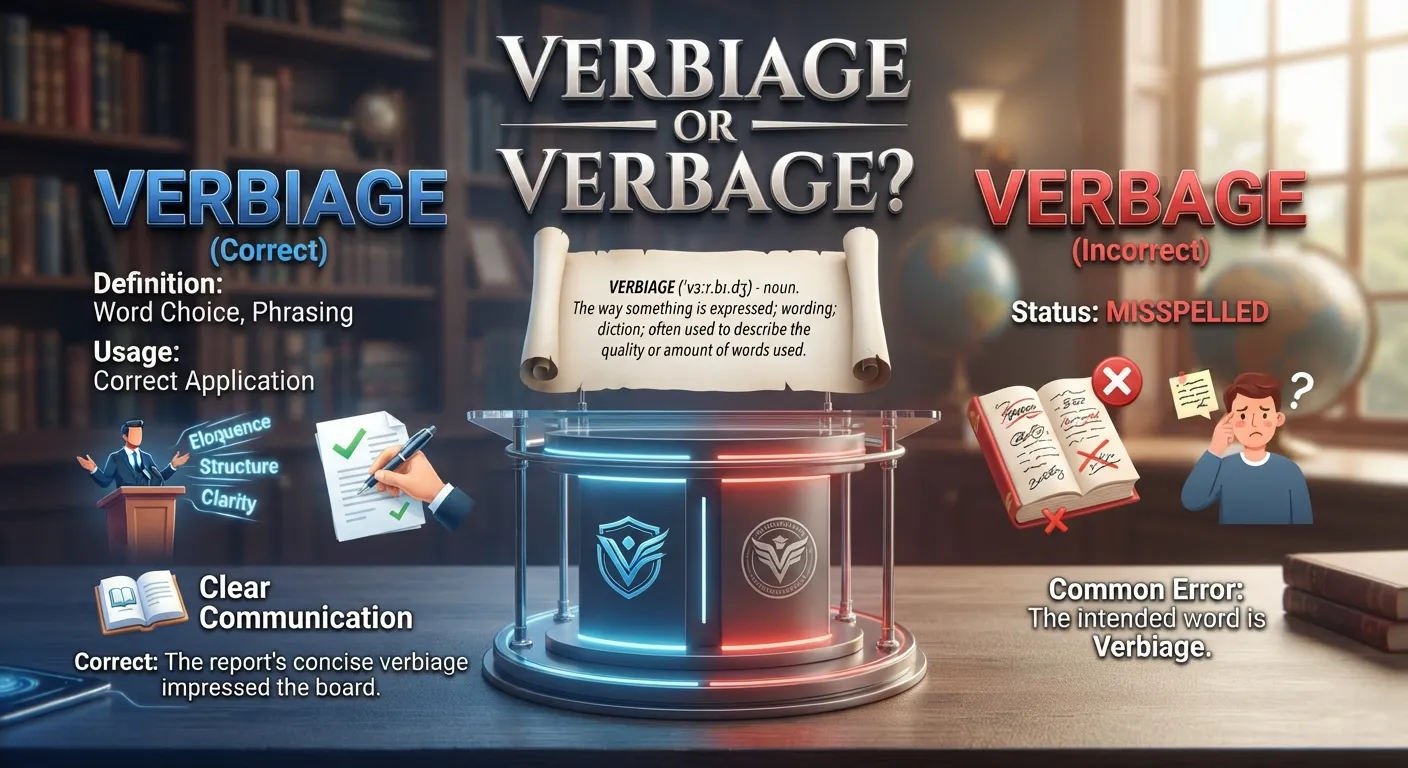
Verbiage is the standard spelling for language or wording, especially when it is unnecessarily complicated or wordy; verbage is generally considered a misspelling.
Quick Answer
The correct spelling is verbiage.
- ✅ Verbiage: standard English spelling
- ❌ Verbage: commonly treated as a misspelling of verbiage
Example:
The contract contains a lot of legal verbiage.
If you are writing for school, work, or formal communication, use verbiage.
Side by Side Comparison
| Form | Correct? | Meaning | Example |
| verbiage | ✅ Yes | The words or wording used, often especially wordy or complicated language | The report contains unnecessary verbiage. |
| verbage | ❌ Usually no | Common misspelling of verbiage | Avoid verbage in formal writing. |
Learning Outcomes
After reading this guide, you will know:
- why verbiage is the standard spelling;
- what verbiage means;
- how to use it naturally in a sentence;
- why verbage appears so often;
- and how to remember the correct form.
Verbiage: Meaning and Use
Verbiage is a noun that refers to the words or wording used to express something. It often carries the idea of wordy, complicated, or unnecessarily elaborate language.
For example:
The instructions contain too much technical verbiage.
Here, verbiage suggests that the instructions use more complicated wording than necessary.
The word can also be used more neutrally to mean the particular wording of a document, statement, or message.
Please check the verbiage of the agreement before we publish it.
Is “Verbiage” Always Negative?
Not necessarily.
Traditionally, verbiage has often suggested excessive or unnecessarily complicated wording. However, modern usage also commonly uses it more neutrally for the wording or language of a text.
Compare:
- The policy contains unnecessary legal verbiage.
- I like the verbiage used in the new policy.
The first clearly suggests criticism. The second simply refers to the wording.
Why Is “Verbage” Incorrect?
Verbage is a common spelling mistake caused partly by pronunciation and word formation.
People may naturally connect the word with verb or verbal, leading them to write verbage. However, the standard spelling is verbiage, with an -i- before -age.
So remember:
verbiage ✅
verbage ❌
In edited and formal English, verbiage is the form to choose.
Grammar Rule
Verbiage is a noun.
It can refer to the wording used in speech or writing.
Common Patterns
verbiage + of + noun
The verbiage of the contract is difficult to understand.
verbiage + in + noun
The verbiage in the report needs revision.
too much + verbiage
The presentation contains too much verbiage.
Because verbiage is generally treated as an uncountable noun, expressions such as “verbiages” are normally avoided in standard English.
Instead, use:
- wording
- language
- phrases
- terms
- passages
depending on what you mean.
Grammar Relay
Verbiage → noun → refers to wording or language.
Singular/uncountable use
The verbiage is confusing.
There is too much verbiage in this document.
With modifiers
legal verbiage
technical verbiage
unnecessary verbiage
complicated verbiage
contractual verbiage
Verbiage vs. Wording
These words are related, but they are not always interchangeable.
Wording is neutral. It simply means the particular words used to express something.
Verbiage can be neutral, but it often suggests wordiness or unnecessarily complicated language.
| Word | Usual Sense | Example |
| wording | The particular words used | I changed the wording of the email. |
| verbiage | Wording or language, often wordy or complicated | The legal verbiage is difficult to follow. |
If you simply mean “the words used,” wording is often the clearer choice.
Common Mistake
❌ The contract contains complicated verbage.
✅ The contract contains complicated verbiage.
Another example:
❌ Please review the verbage before sending the letter.
✅ Please review the verbiage before sending the letter.
Memory Trick
Think:
verbiage = verbi + age
The middle i is important.
VERBIAGE → not VERBAGE
Vocabulary Corner
Here are some useful alternatives to verbiage, depending on context:
- wording: the particular words used
- language: words and expressions used to communicate
- terminology: specialized words used in a subject
- phrasing: the way something is expressed
- prose: written language, especially in contrast with poetry
- wordiness: excessive use of words
- verbosity: the use of more words than necessary
Verbiage and verbosity are related, but they are not identical. Verbiage focuses on the language or wording itself, while verbosity focuses more directly on excessive use of words.
Mini Quiz
Choose the correct spelling.
- The agreement contains complicated (verbiage / verbage).
- Please check the (verbiage / verbage) before publication.
- The report has too much unnecessary (verbiage / verbage).
Answers:
- verbiage
- verbiage
- verbiage
Practice Guide
When you want to talk about the wording of a document, message, agreement, or statement, use verbiage.
Formal writing
The contract’s verbiage should be reviewed carefully.
Workplace communication
I suggest simplifying the verbiage in this section.
Academic writing
The article uses technical verbiage that may confuse new readers.
Everyday communication
I don’t understand the verbiage in this message.
If you want a completely neutral and simple word, wording is often a better choice.
What Major Dictionaries Say
Major English dictionaries recognize verbiage as the established standard word. Its meanings center on words, language, or wording, with traditional definitions often emphasizing excessive or elaborate language.
Verbage, by contrast, is not the standard spelling you should choose in formal English. It commonly appears as a misspelling of verbiage.
Frequently Asked Questions
Q: Is “verbage” a word?
Verbage is commonly encountered, but it is generally treated as a misspelling of the standard word verbiage. Use verbiage in formal and standard writing.
Q: Is “verbiage” singular or plural?
Verbiage is generally used as an uncountable noun, so it normally does not take a plural -s.
Q: What does verbiage mean?
Verbiage means the words or wording used to express something, often with an implication of wordiness or complicated language.
Q: What is another word for verbiage?
Depending on context, alternatives include wording, language, phrasing, terminology, wordiness, and verbosity.
Final Verdict
Verbiage is the standard spelling.
✅ VERBIAGE
❌ VERBAGE
When referring to the wording or language of a document, statement, or message, choose verbiage. If you simply mean the words used, wording may be the clearer alternative.
Savy or Savvy: Meaning, Spelling & Correct Usage

Rose Vault is an English language author who specializes in spelling comparisons, commonly confused words, and grammar. She creates clear, well-researched content that helps readers improve their writing and use English with confidence. Her goal is to make language learning simple, accurate, and accessible for everyone.