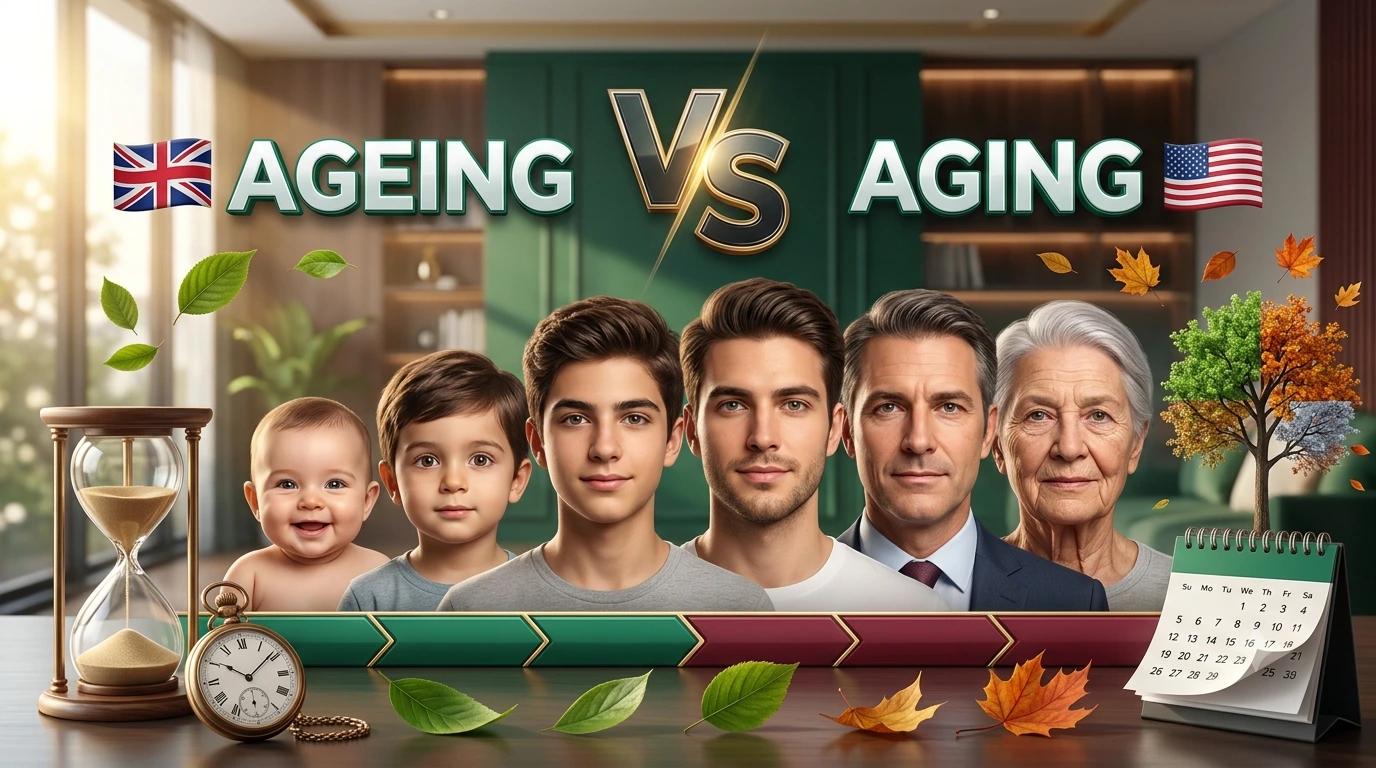
Ageing and aging are two correct spellings of the same term that refers to the natural process of growing older over time. Ageing is the preferred spelling in British English, while aging is the standard spelling in American English.
Growing older is a natural part of life, but spelling the word that describes the process can sometimes be confusing. Should you write ageing or aging? If you’ve seen both spellings in books, newspapers, or online articles, you may wonder whether one is incorrect or if they simply belong to different varieties of English.
The good news is that both ageing and aging are correct. They have the same meaning, pronunciation, and grammatical function. The only difference is the variety of English you are using. Ageing is the preferred spelling in British English, while aging is the standard spelling in American English.
In this guide, you’ll learn the difference between ageing and aging, discover why two spellings exist, understand when to use each one, explore real-life examples, and see what major dictionaries recommend.
Ageing or Aging: Which Is Correct?
Both ageing and aging are correct spellings of the present participle and gerund of the verb age.
The difference depends entirely on the type of English you’re writing.
- Ageing is the standard spelling in British English.
- Aging is the preferred spelling in American English.
Quick Answer
- Ageing → British English 🇬🇧
- Aging → American English 🇺🇸
- Meaning: The process of growing older.
- Pronunciation: Both are pronounced exactly the same.
Examples
British English
- Scientists continue to study the effects of ageing on the brain.
- Healthy eating can slow the signs of ageing.
American English
- Researchers are exploring the causes of aging.
- Regular exercise may reduce the effects of aging.
No matter which spelling you choose, the meaning remains exactly the same.
What’s the Difference Between Ageing and Aging?
The only difference between ageing and aging is regional spelling.
Both words describe the process of becoming older over time, whether referring to people, animals, plants, or even objects such as wine, cheese, or wood.
For example:
- Ageing populations are creating new healthcare challenges. (British English)
- Aging populations are creating new healthcare challenges. (American English)
Both sentences are equally correct. The choice depends on whether you’re following British or American English conventions.
Like many other spelling differences, this variation reflects different regional writing standards rather than a change in meaning or grammar.
British vs American English Variation
The difference between ageing and aging follows one of the most recognizable spelling variations between British and American English.
British English
British English traditionally prefers ageing, inserting an extra e before the suffix -ing.
Examples:
- ageing population
- ageing process
- healthy ageing
- active ageing
This spelling is commonly used in the United Kingdom, Australia, New Zealand, Ireland, and many Commonwealth countries.
American English
American English simplifies the spelling to aging, omitting the extra e.
Examples:
- aging population
- aging process
- healthy aging
- aging research
This form is the standard spelling throughout the United States and appears in American newspapers, academic journals, and medical publications.
Why Are There Two Spellings?
Unlike travelled and traveled, which differ because of the doubling of the letter l, the variation between ageing and aging developed through spelling conventions.
Historically, ageing was the traditional spelling in Britain. Over time, American English adopted the simplified form aging, and it became the standard spelling in the United States.
Today, both spellings are accepted by major dictionaries and style guides. Neither is more correct than the other.
The best choice depends entirely on your audience.
💡 Did You Know?
The word ageing is one of the few English words ending in -e where British English often keeps the final “e” before adding “-ing”, while American English usually drops it.
The same pattern appears in several regional spelling differences:
- ageing → aging
- likeable → likable
- routeing → routing (in some technical contexts)
Unlike many spelling differences, this variation doesn’t affect pronunciation or meaning. It simply reflects the writing conventions of different English-speaking countries.
Tip: If you’re writing for an international audience, choose either ageing or aging at the beginning of your document and use that spelling consistently throughout.
What Does Ageing Mean?
Ageing is the British English spelling of the present participle and gerund of the verb age.
It refers to the natural process of growing older over time. The term is commonly used when discussing people, animals, plants, products, and even scientific or medical research.
Examples
- Regular exercise supports healthy ageing.
- Scientists continue to study the biological mechanisms of ageing.
- The country’s ageing population is increasing demand for healthcare services.
- Fine wine often improves with careful ageing.
In British English, ageing is the preferred spelling in newspapers, academic writing, government publications, and everyday communication.
What Does Aging Mean?
Aging is the American English spelling of the same word.
Like ageing, it describes the process of becoming older or maturing over time.
Examples
- Researchers are investigating the causes of aging.
- Healthy habits can slow some effects of aging.
- The aging infrastructure requires major repairs.
- Doctors encourage healthy lifestyles to support successful aging.
Although the spelling differs, aging has exactly the same meaning, pronunciation, and grammatical function as ageing.
Origin and History of Ageing and Aging
The word age comes from the Old French word aage, which later became age in Middle English. Its roots can be traced even further back to the Latin word aetas, meaning lifetime, era, or period of life.
As English developed, the verb age began to describe the process of growing older or maturing over time. Eventually, the -ing form emerged to describe the ongoing process, giving rise to ageing and aging.
For many centuries, British English preserved the spelling ageing, which remained the standard throughout the United Kingdom and other countries that follow British conventions.
American English later adopted the simplified spelling aging, reflecting its broader tendency to simplify certain spellings while preserving pronunciation and meaning.
Today, both spellings are widely accepted by major dictionaries, educational institutions, and style guides. The choice depends not on correctness but on whether you’re writing in British or American English.
Read more: Grey or Gray: Which Spelling Is Correct? (2026)
When to Use Ageing
Use ageing whenever you’re writing in British English or for an audience that follows British spelling conventions. It is the preferred spelling in the United Kingdom, Australia, New Zealand, Ireland, and many other Commonwealth countries.
You’ll commonly see ageing in British newspapers, government publications, healthcare resources, scientific research, and everyday writing.
Examples
- Healthy ageing depends on a balanced diet and regular exercise.
- The government has introduced new policies to support an ageing population.
- Researchers continue to study the biological process of ageing.
- Modern medicine has improved the quality of ageing in many countries.
- Fine whisky develops its character through careful ageing.
Tip
If your document uses British spellings such as colour, favourite, travelling, and centre, then ageing is the correct choice.
When to Use Aging
Use aging when writing in American English. It is the standard spelling used in the United States and is recommended by American dictionaries, universities, publishers, and style guides.
You’ll frequently find aging in American medical journals, newspapers, academic papers, and government websites.
Examples
- Scientists are studying the effects of aging on memory.
- Regular physical activity promotes healthy aging.
- The city is investing in its aging infrastructure.
- Doctors recommend healthy habits to slow the effects of aging.
- The company is replacing its aging equipment.
Tip
If your writing follows American spellings such as color, favorite, traveling, and center, then aging is the correct spelling.
📊 Quick Visual Guide: Ageing vs Aging
| 🇬🇧 British English | 🇺🇸 American English |
|---|---|
| ageing | aging |
| healthy ageing | healthy aging |
| ageing population | aging population |
| ageing process | aging process |
| successful ageing | successful aging |
Quick Rule
✅ Ageing = British English
✅ Aging = American English
Both words have the same meaning, same pronunciation, and same grammatical function. The only difference is the regional spelling convention.
Ageing vs Aging: Side-by-Side Comparison
| Feature | Ageing | Aging |
|---|---|---|
| English variety | British English | American English |
| Meaning | The process of growing older | The process of growing older |
| Pronunciation | Same | Same |
| Correct? | Yes | Yes |
| Commonly used in | UK, Australia, New Zealand, Ireland | United States |
Real-Life Examples of Ageing and Aging
Seeing both spellings in context helps you understand that the meaning remains identical.
British English Examples
- Healthy ageing starts with good nutrition and regular exercise.
- The charity supports people in an ageing society.
- Scientists are researching the causes of ageing.
- Advances in medicine have changed the experience of ageing.
- The museum is restoring an ageing historic building.
American English Examples
Engineers are repairing the city’s aging bridges.
Healthy aging involves staying physically active.
Researchers continue to study aging and brain health.
The country faces challenges from an aging population.
Technology is helping improve aging care.
Ageing vs Aging in Healthcare and Research
The terms ageing and aging are widely used in healthcare, medicine, and scientific research to describe the biological process of growing older and the physical, mental, and social changes that occur over time. Although the spellings differ, they refer to exactly the same concept. Ageing is the preferred spelling in British English, while aging is the standard form in American English.
For example, healthcare organizations in the United Kingdom often publish guidance on healthy ageing, whereas medical institutions in the United States commonly use the term healthy aging. Likewise, British researchers may study an ageing population, while American researchers discuss an aging population. The choice of spelling depends on the regional variety of English, not on a difference in meaning. Whether you’re reading a medical journal, government report, or health article, both terms describe the same process of growing older and promoting well-being throughout life.
Common Mistakes to Avoid
Although the difference is straightforward, writers often make a few common mistakes.
Mixing British and American Spellings
Avoid switching between the two spelling systems in the same piece of writing.
❌ The country has an ageing population, and scientists are studying aging.
✔ The country has an ageing population, and scientists are studying ageing. (British English)
✔ The country has an aging population, and scientists are studying aging. (American English)
Choose one spelling style and use it consistently.
Thinking One Spelling Is Wrong
Many people assume that one spelling is incorrect.
The truth is:
- Ageing is correct in British English.
- Aging is correct in American English.
Both spellings are accepted by major dictionaries.
Forgetting Your Audience
If you’re writing for readers in the United Kingdom, Australia, or other countries that use British English, ageing is the better choice.
If your audience is primarily in the United States, aging is the preferred spelling.
What Major Dictionaries Say
Leading English dictionaries recognize both ageing and aging as correct spellings, with the preferred form depending on the variety of English.
Cambridge Dictionary
The Cambridge Dictionary uses ageing as the primary British English spelling while identifying aging as the American variant.
Oxford English Dictionary
The Oxford English Dictionary follows British spelling conventions and lists ageing as the standard form while acknowledging aging as the American spelling.
Merriam-Webster
Merriam-Webster, one of the leading American dictionaries, lists aging as the standard spelling in American English and recognizes ageing as the British equivalent.
Across all three dictionaries, the conclusion is consistent:
- Ageing = British English
- Aging = American English
Neither spelling is more correct than the other.
Read more: Flies or Flys: Which Spelling Is Correct?
Which Spelling Should You Use?
The best spelling depends on your audience and the style guide you’re following.
Use ageing if you’re writing for readers in:
- The United Kingdom
- Australia
- New Zealand
- Ireland
- South Africa
- Other countries that follow British English
Use aging if your audience is primarily in:
- The United States
If your audience is international, choose one spelling style and use it consistently throughout your document.
Key Takeaways
- Ageing and aging have the same meaning and pronunciation.
- Both refer to the process of growing older.
- Ageing is the standard spelling in British English.
- Aging is the standard spelling in American English.
- Major dictionaries recognize both spellings.
- The best choice depends on your audience and the variety of English you’re using.
- Consistency is more important than choosing one spelling over the other.
Frequently Asked Questions
Q: Is it ageing or aging?
A: Both ageing and aging are correct spellings. Ageing is the preferred spelling in British English, while aging is the standard spelling in American English. They have the same meaning and pronunciation.
Q: Is ageing correct in the UK?
A: Yes. Ageing is the standard spelling in the United Kingdom and is widely used in British newspapers, government publications, universities, and healthcare resources.
Q: Is aging correct in the US?
A: Yes. Aging is the accepted American English spelling. It appears in American dictionaries, style guides, academic journals, and everyday writing.
Q: Why do British and American English spell it differently?
A: The difference comes from regional spelling conventions.
British English traditionally keeps the e in ageing, while American English simplifies the spelling to aging. Both forms developed over time and are considered correct within their respective varieties of English.
Q: Which spelling should I use in academic writing?
A: Follow the style guide required by your institution or publisher.
- Use ageing if you’re writing in British English.
- Use aging if you’re writing in American English.
Whichever spelling you choose, use it consistently throughout your document.
Q: Are ageing and aging pronounced differently?
A: No. Both words are pronounced exactly the same. The difference exists only in spelling, not pronunciation.
Q: Can I use ageing and aging interchangeably?
A: Only if you’re switching between British and American English.
Within a single article, report, or document, it’s best to choose one spelling style and remain consistent from beginning to end.
Q: Does the spelling difference change the meaning?
A: No. Both words describe the process of growing older. The spelling variation does not affect the meaning, pronunciation, or grammatical function.
Final Verdict: Ageing or Aging?
Both ageing and aging are correct spellings that describe the process of growing older. They share the same definition, pronunciation, and grammatical role. The only difference is the regional variety of English.
Choose ageing when writing in British English and choose aging when writing in American English.
Neither spelling is better or more accurate than the other. The key is to write for your audience and remain consistent throughout your content.
Whether you’re discussing healthy ageing, medical research, demographic trends, or the ageing of wine and cheese, selecting the appropriate regional spelling will make your writing more professional and easier for your readers to follow.
Read more: Travelled or Traveled: Which Spelling Is Correct? Complete Guide

Rose Vault is an English language author who specializes in spelling comparisons, commonly confused words, and grammar. She creates clear, well-researched content that helps readers improve their writing and use English with confidence. Her goal is to make language learning simple, accurate, and accessible for everyone.