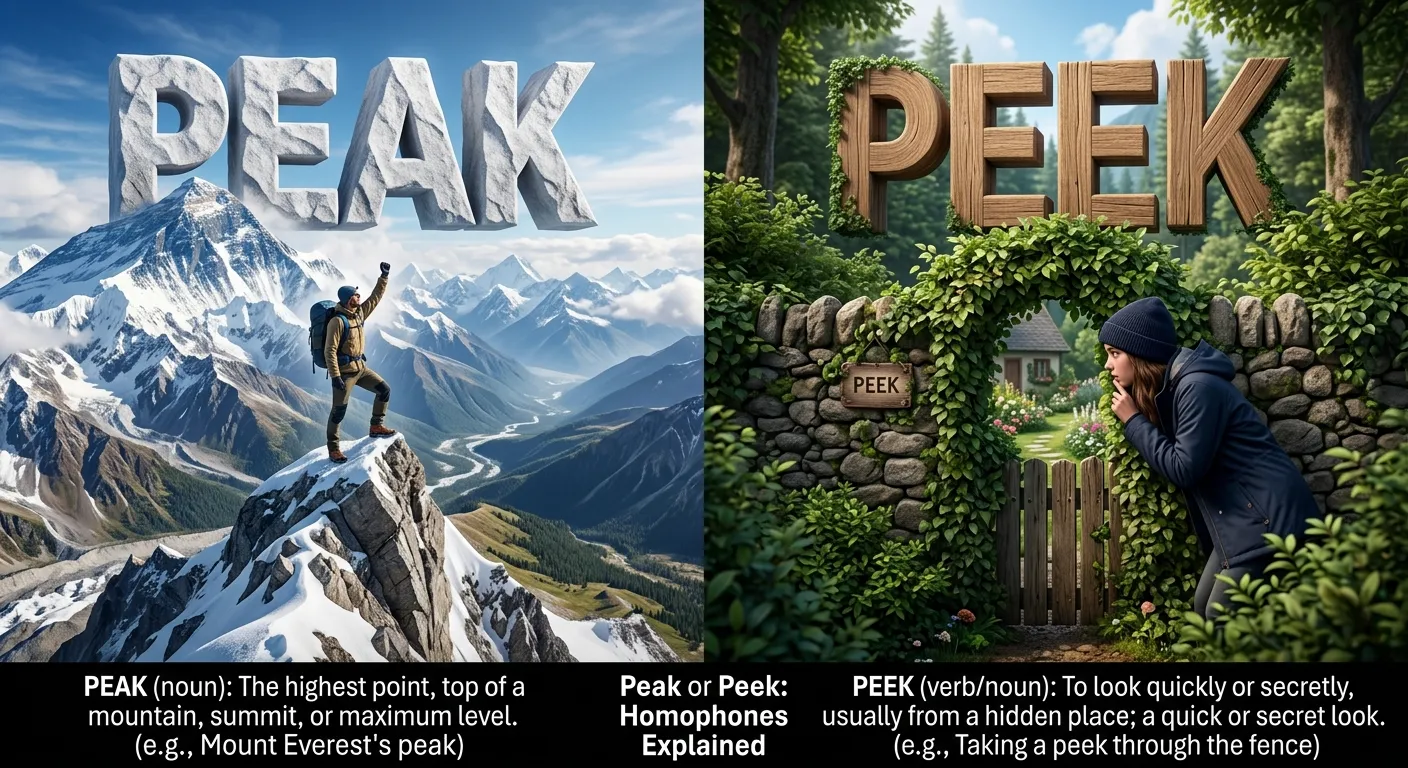
Peak and peek are both correct English words, but they have completely different meanings. Peak refers to the highest point, level, or top of something, while peek means to look at something quickly or secretly.
The Main Difference
- Peak = the highest point, level, or maximum.
- Peek = a quick or secret look.
Quick Answer
Use peak when you mean the top, highest point, or greatest level of something.
Use peek when you mean to look quickly, briefly, or secretly.
Examples:
- We reached the peak of the mountain.
- She took a quick peek inside the box.
Although these words sound alike, they cannot be used interchangeably.
Peak vs. Peek: Quick Comparison Table
| Word | Meaning | Part of Speech | Example |
| peak | The highest point or greatest level | Noun, verb, adjective | Sales reached their peak in July. |
| peek | A quick or secret look | Noun, verb | He took a peek through the window. |
What Does Peak Mean?
Peak means the highest point, level, or degree of something.
It can describe a physical high point, such as the top of a mountain, or the greatest level of something, such as popularity, performance, or activity.
Examples of Peak
- We finally reached the peak of the mountain.
- The athlete is performing at her peak.
- Traffic reaches its peak in the evening.
- The singer was at the peak of her career.
- Temperatures usually peak in the afternoon.
Peak as a Noun
As a noun, peak refers to the highest point or level.
The climbers reached the peak before sunset.
Here, peak means the highest point of the mountain.
Peak as a Verb
As a verb, peak means to reach the highest point or level.
Her performance peaked during the final round.
Peak as an Adjective
Peak can also describe something related to the highest level or busiest period.
We traveled during peak season.
Here, peak season means the busiest or most popular period.
What Does Peek Mean?
Peek means to take a quick, brief, or secret look at something.
It can be used as either a noun or a verb.
Examples of Peek
- She peeked through the door.
- Can I have a peek at your new book?
- The child peeked out from behind the curtain.
- He took a quick peek at the answer.
- Don’t peek at your gift before your birthday.
Peek as a Verb
As a verb, peek means to look quickly or secretly.
She peeked inside the bag.
Peek as a Noun
As a noun, peek means a quick look.
I took a peek at the schedule.
Peak or Peek in a Sentence?
The correct word depends on what you want to say.
Use peak for the highest point
The hikers reached the peak after several hours.
The sentence refers to the highest point of the mountain.
Use peek for a quick look
The children tried to peek through the window.
The sentence refers to looking quickly or secretly.
Peak vs. Peek: Easy Memory Trick
A simple way to remember the difference is:
Peak → highest point
Think of the two ee sounds in peak as a mountain rising to a high point.
Peek → quick look
Think of peek as secretly looking at something.
You can also remember this common expression:
Take a peek = take a quick look.
And:
Mountain peak = the top of a mountain.
Peak and Peek: Grammar Relay
Both words can function as nouns and verbs, but their meanings remain different.
Peak
Noun:
The mountain has a snowy peak.
Verb:
Demand peaked in December.
Adjective:
Flights are more expensive during peak travel periods.
Peek
Noun:
She took a peek at the present.
Verb:
He peeked through the curtains.
The grammatical role can change, but the basic distinction remains: peak is about a high point; peek is about looking.
Common Expressions With Peak
Here are some useful expressions containing peak:
| Expression | Meaning | Example |
| mountain peak | the top of a mountain | Snow covered the mountain peak. |
| peak season | the busiest or most popular period | Hotels cost more during peak season. |
| peak hours | the busiest hours | Avoid driving during peak hours. |
| at its peak | at its highest level | The festival was at its peak on Saturday. |
| peak performance | the highest level of performance | The machine operates at peak performance. |
Common Expressions With Peek
Peek is also common in everyday expressions.
| Expression | Meaning | Example |
| take a peek | take a quick look | Can I take a peek at your notes? |
| peek inside | look briefly inside | She peeked inside the box. |
| peek through | look through an opening | He peeked through the curtain. |
| peek at | look quickly at something | Don’t peek at the answers. |
Peak vs. Peek vs. Pique
There is a third word that often causes confusion: pique.
These three words are pronounced alike in standard English, but their meanings are different.
| Word | Meaning | Example |
| peak | highest point or level | The mountain peak was covered in snow. |
| peek | quick or secret look | She took a peek inside. |
| pique | stimulate interest or curiosity; also irritate | The unusual story piqued my curiosity. |
A useful expression is:
pique someone’s interest
For example:
The mysterious letter piqued her interest.
So remember:
Peak = highest point
Peek = quick look
Pique = stimulate interest
Common Mistakes With Peak and Peek
❌ I took a peak at the document.
✅ I took a peek at the document.
You are describing a quick look, so peek is correct.
❌ The mountain’s peek was covered with snow.
✅ The mountain’s peak was covered with snow.
You mean the top of the mountain, so peak is correct.
❌ Sales peeked in December.
✅ Sales peaked in December.
The sentence means sales reached their highest level, so peaked is correct.
❌ Can I have a peak at your phone?
✅ Can I have a peek at your phone?
Here, peek means a quick look.
Mini Quiz: Peak or Peek?
Choose the correct word.
- The hikers finally reached the mountain ___.
- She wanted to ___ inside the envelope.
- Electricity demand usually ___ during the evening.
- Can I take a quick ___ at your new phone?
- The company reached the ___ of its success.
- Don’t ___ at the answers before the test ends.
Answers
- peak
- peek
- peaks
- peek
- peak
- peek
Practice Guide
When deciding between peak and peek, ask yourself one simple question:
Am I talking about the highest point or looking at something?
- If you mean highest point, maximum, or greatest level, choose peak.
- If you mean a quick or secret look, choose peek.
Compare These Sentences
The athlete reached her peak.
That means athlete reached her highest level of performance.
The athlete took a peek at the scoreboard.
The athlete looked quickly at the scoreboard.
The context makes the difference clear.
What Major Dictionaries Say
Major English dictionaries define peak around the idea of a highest point or maximum level, while peek is defined as looking quickly or secretly.
This distinction is consistent across standard English usage: peak is associated with height or maximum level, whereas peek is associated with sight or looking.
Frequently Asked Questions
Q: Is it peak or peek?
Both peak and peek are correct words. Use peak for the highest point or level and peek for a quick or secret look.
Q: Is it take a peak or take a peek?
The correct expression is take a peek when you mean “take a quick look.”
Q: Is it mountain peak or mountain peek?
The correct phrase is mountain peak because it refers to the highest point of a mountain.
Q: What is the difference between peak and peek?
Peak means the highest point, level, or degree. Peek means to look quickly or secretly.
Q: Is “peek” a verb or a noun?
Peek can be both a verb and a noun. For example, “She peeked inside” uses it as a verb, while “I took a peek” uses it as a noun.
Q: Is “peak” a verb?
Yes. Peak can be a verb meaning to reach the highest point or level, as in “Sales peaked in December.”
Final Answer
Peak and peek are both correct, but they have different meanings.
- Peak = the highest point, level, or degree.
- Peek = a quick or secret look.
Easy rule:
If you mean the top or maximum → peak.
If you mean a quick look → peek.
The climbers reached the peak and took a peek at the valley below.
This sentence uses both words correctly: peak refers to the high point, while peek refers to a quick look.
Cannon or Canon: Meaning, Differences &Examples
Hi, I’m Ashley Brown, a lifelong word enthusiast with a passion for making the English language less confusing.My goal is to help readers spell with confidence and never second-guess themselves again.