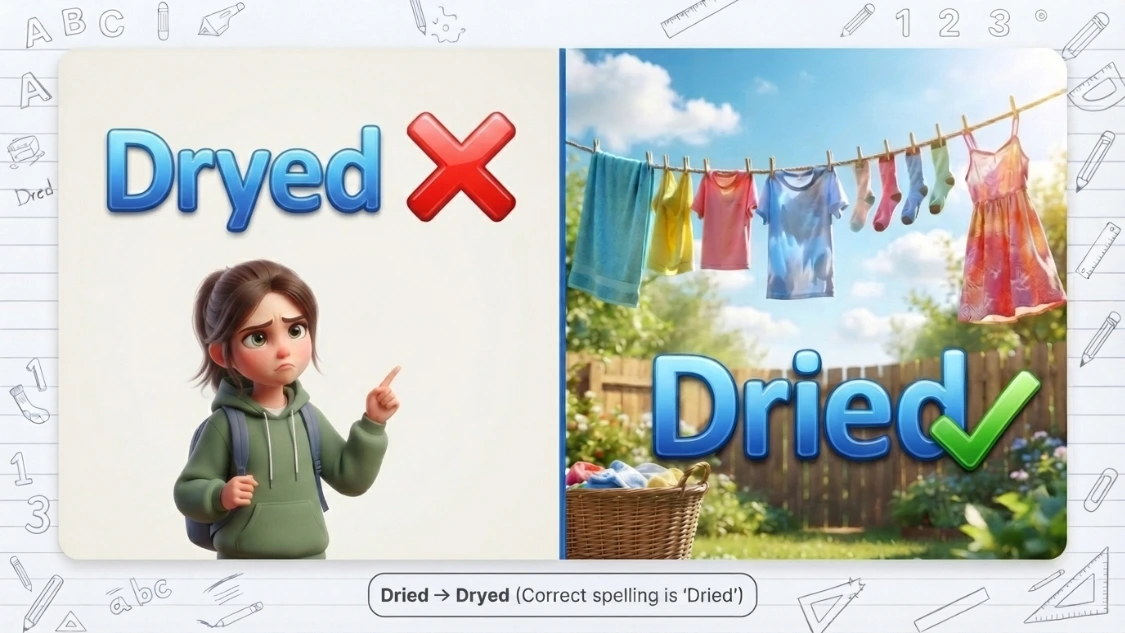
Dried is the correct past tense of dry, while dryed is an incorrect spelling.
Quick Answer
The correct spelling is dried.
❌ Dryed is not a correct English word.
✅ Dried is the past tense and past participle of dry.
Examples
- ✅ The clothes dried quickly in the sun.
- ✅ I dried my hands with a towel.
Remember this simple rule:
- Dry → Dried ✅
- Dry → Dryed ❌
Quick Comparison Table
| Feature | Dryed | Dried |
|---|---|---|
| Correct spelling | ❌ No | ✅ Yes |
| Standard English | ❌ No | ✅ Yes |
| Meaning | Not a word | Past tense of dry |
| Used in dictionaries | ❌ No | ✅ Yes |
| Example | ❌ The paint dryed. | ✅ The paint dried. |
If you’ve ever typed dryed, you’re not alone. Many English learners think adding -ed to dry should create dryed, just as play becomes played.
However, English spelling follows a different rule for verbs ending in a consonant + y.
The correct past tense is:
✅ dried
not
❌ dryed
For example:
- ❌ The clothes dryed overnight.
- ✅ The clothes dried overnight.
In this guide, you’ll learn why dried is correct, why dryed is incorrect, the spelling rule behind it, common mistakes, dictionary guidance, and easy ways to remember the correct form.
Is “Dryed” a Word?
No.
Dryed is not a standard English word and does not appear as the accepted past tense of dry in major English dictionaries.
If you use dryed in school, professional writing, exams, or published content, it will generally be marked as a spelling mistake.
Examples:
❌ I dryed my shoes.
✅ I dried my shoes.
❌ The road dryed after the rain.
✅ The road dried after the rain.
What Does “Dried” Mean?
Dried is the correct past tense and past participle of dry.
It means:
- became dry
- removed moisture
- caused something to become dry
Examples
- The paint dried overnight.
- She dried her hair after the shower.
- The towels dried quickly.
- I dried the dishes before putting them away.
“Dried” in Food
The word dried is also commonly used to describe foods that have had their moisture removed to preserve them.
Examples include:
- dried fruit
- dried herbs
- dried beans
- dried mushrooms
- dried flowers
Examples
- We bought dried apricots.
- Add some dried oregano to the sauce.
- The recipe calls for dried thyme.
Why Is “Dryed” Wrong?
The mistake happens because learners apply the regular -ed rule without considering English spelling rules.
The verb dry ends with:
- consonant (r)
- followed by y
When this happens, English changes the y to i before adding -ed.
So:
dry → dried
not
dry → dryed
The Spelling Rule
For most verbs ending in a consonant + y:
Change the y to i before adding -ed.
| Base Verb | Past Tense |
|---|---|
| dry | dried |
| carry | carried |
| study | studied |
| marry | married |
| worry | worried |
| hurry | hurried |
This is one of the most common spelling rules in English.
What Major Dictionaries Say
Leading English dictionaries list dried as the correct past tense and past participle of dry.
They do not recognize dryed as a standard spelling.
All major style guides and dictionaries consistently recommend using dried in every context.
Word Origin
The adjective and verb dry come from Old English drȳge, meaning without moisture. As English spelling developed, verbs ending in a consonant followed by y adopted the rule of changing y to i before adding -ed, giving us the modern form dried.
Why Is Dried Correct?
The answer comes from a basic English spelling rule.
When a verb ends in a consonant + y, change the y to i before adding -ed.
Formula:
Consonant + y → i + ed
So:
- dry → dried ✅
- dry → dryed ❌
This same rule applies to many common English verbs.
| Base Verb | Correct Past Tense | Incorrect |
|---|---|---|
| dry | dried | ❌ dryed |
| carry | carried | ❌ carryed |
| study | studied | ❌ studyed |
| worry | worried | ❌ worryed |
| marry | married | ❌ marryed |
| hurry | hurried | ❌ hurryed |
Dryed vs Dried in Sentences
Reading both spellings side by side helps you spot the mistake.
| ❌ Incorrect | ✅ Correct |
|---|---|
| The paint dryed overnight. | The paint dried overnight. |
| She dryed her hair. | She dried her hair. |
| My clothes dryed quickly. | My clothes dried quickly. |
| I dryed the dishes. | I dried the dishes. |
| The road dryed after the rain. | The road dried after the rain. |
| We bought dryed fruit. | We bought dried fruit. |
British vs American English
Unlike spelling pairs such as colour/color or labelling/labeling, there is no regional difference here.
| Feature | Dryed | Dried |
|---|---|---|
| British English | ❌ Incorrect | ✅ Correct |
| American English | ❌ Incorrect | ✅ Correct |
| Canadian English | ❌ Incorrect | ✅ Correct |
| Australian English | ❌ Incorrect | ✅ Correct |
Every major variety of English uses dried.
Pronunciation
Both the correct and incorrect spellings would be pronounced the same if spoken, but only dried is accepted in writing.
Dried
Pronunciation: /draɪd/
Examples:
- The clothes dried quickly.
- My hair dried naturally.
Verb Forms
| Form | Word |
|---|---|
| Base verb | dry |
| Third person | dries |
| Present participle | drying |
| Past tense | dried |
| Past participle | dried |
Examples
- Wet clothes dry quickly.
- The paint dries in two hours.
- She is drying her hair.
- I dried the dishes.
- The towels have dried completely.
Common Mistakes
Here are some common errors learners make.
❌ I dryed my hands.
✅ I dried my hands.
❌ The paint dryed overnight.
✅ The paint dried overnight.
❌ We bought dryed herbs.
✅ We bought dried herbs.
❌ The clothes have dryed already.
✅ The clothes have dried already.
❌ She dryed the floor after cleaning.
✅ She dried the floor after cleaning.
Memory Tricks
These simple tricks will help you remember the correct spelling.
Trick 1
If a verb ends with a consonant + y, change the y to i before adding -ed.
Dry → Dried
Trick 2
Think of these familiar words:
- carry → carried
- study → studied
- worry → worried
The same spelling rule gives you:
dry → dried
Trick 3
Ask yourself:
Does the word end with a consonant + y?
If yes, don’t write -yed.
Write -ied instead.
Everyday Examples
- I dried my hands before eating.
- The towels dried in the sunshine.
- She dried her hair with a towel.
- The road dried after the storm.
- We decorated the room with dried flowers.
- The paint dried before the second coat.
- The dishes dried on the rack.
Search Intent Answer
If you searched “dryed or dried,” here’s the simple answer:
✅ Dried is the only correct spelling.
❌ Dryed is a spelling mistake and should not be used in standard English.
The reason is that dry ends with a consonant + y, so the y changes to i before adding -ed, giving dried.
Frequently Asked Questions (FAQs)
Is dryed a real word?
No. Dryed is not a standard English word.
The correct past tense and past participle of dry is dried.
Why is it dried instead of dryed?
Because dry ends with a consonant + y.
According to English spelling rules, you change the y to i before adding -ed.
- dry → dried ✅
- dry → dryed ❌
Is dried correct in British English?
Yes.
Dried is the correct spelling in:
- British English
- American English
- Canadian English
- Australian English
There is no regional spelling difference.
Is it dried fruit or dryed fruit?
✅ Dried fruit is correct.
Examples:
- dried mango
- dried apricots
- dried dates
- dried figs
What is the past tense of dry?
The past tense is dried.
Examples:
- The clothes dried quickly.
- She dried the dishes.
- The paint dried overnight.
Mini Quiz
Choose the correct answer.
1. The clothes ______ in the sun.
A. dryed
B. dried ✅
2. She ______ her hair before leaving.
A. dried ✅
B. dryed
3. We bought ______ herbs.
A. dryed
B. dried ✅
4. The paint ______ overnight.
A. dried ✅
B. dryed
5. Which spelling is correct?
A. dryed
B. dried ✅
Practice Exercise
Fill in the blanks with the correct form.
- I __________ my hands after washing them.
- The road __________ after the heavy rain.
- She bought __________ flowers.
- The towels __________ quickly in the sunshine.
- The paint has __________ completely.
Answers
- dried
- dried
- dried
- dried
- dried
Did You Know?
Not every verb ending in y follows the same spelling rule.
If a verb ends with a vowel + y, you simply add -ed.
Examples:
- play → played
- enjoy → enjoyed
- stay → stayed
But if a verb ends with a consonant + y, change the y to i before adding -ed.
Examples:
- dry → dried
- study → studied
- carry → carried
- marry → married
This small rule prevents many common spelling mistakes.
Grammar Relay Corner
Synonyms of Dry
- dehydrate
- evaporate
- wipe
- blot
- absorb moisture
- air-dry
Antonyms of Dry
- wet
- soak
- dampen
- moisten
- hydrate
Related Words
- dry
- dries
- drying
- dried
- dryness
- dryly
- dryer (machine or person/thing that dries)
- dry-clean
Idioms
- Dry as a bone.
Completely dry. - High and dry.
Left without help or support.
Proverb
After rain comes fair weather.
Meaning: Difficult times are often followed by better days.
Key Takeaways
- ✅ Dried is the only correct spelling.
- ❌ Dryed is a spelling mistake.
- Dry ends with a consonant + y, so the y changes to i before adding -ed.
- The same rule applies to study → studied, carry → carried, and worry → worried.
- Dried is correct in British, American, Canadian, and Australian English.
- Use dried for clothes, paint, flowers, food, herbs, hair, and anything that has lost moisture.
Conclusion
The choice between dryed and dried is straightforward.
Dried is the correct past tense and past participle of dry, while dryed is a spelling error that should be avoided in all forms of English writing.
Whenever you use a verb ending in a consonant + y, remember to change the y to i before adding -ed. Following this simple rule will help you spell many English verbs correctly.
Related Articles
Perfer or Prefer: Which Spelling Is Correct?
Fiend or Feen: Which Spelling Is Correct?

Hi, I’m Ashley Brown, a lifelong word enthusiast with a passion for making the English language less confusing.My goal is to help readers spell with confidence and never second-guess themselves again.