
Definition: CC’d or cc’ed means to send someone a carbon copy of an email by including them as a copy recipient.
Quick Answer
If you are wondering whether cc’d or cc’ed is correct, the short answer is that both spellings are acceptable. However, cc’d is more common in professional writing because it keeps the abbreviation CC intact and simply adds ‘d to form the past tense.
Examples:
- ✅ I cc’d my manager on the email.
- ✅ I cc’ed everyone in the department.
Most business emails, workplace communication, and online writing prefer cc’d, while cc’ed is less common but still understood.
What Does “CC” Mean in Email?
CC stands for Carbon Copy. It is an email feature that lets you send a copy of your message to additional recipients without making them the main recipient.
For example:
To: Sarah
CC: David, Emma
Sarah is the primary recipient, while David and Emma receive a copy of the email.
When talking about an email you sent earlier, you need the past tense:
- I cc’d the finance team.
- She cc’ed her supervisor.
Why Are There Two Spellings?
The confusion happens because CC is an abbreviation rather than a regular English word.
When writers turn abbreviations into verbs, there is no single universal rule.
Some writers:
- keep the abbreviation unchanged and add ‘d
- add -ed like an ordinary verb
That creates two versions:
| Spelling | Formation |
|---|---|
| cc’d | CC + ‘d |
| cc’ed | CC + ed |
Both forms communicate the same meaning.
The same pattern appears with other abbreviations:
- OK → OK’d / OKed
- ID → ID’d
- TV → TV’d
Because abbreviations behave differently from ordinary words, variation is common.
CC’d vs. CC’ed: What’s the Difference?
The meaning does not change.
Both mean:
Someone received a carbon copy of an email.
The only real difference is writing style.
| CC’d | CC’ed |
|---|---|
| More common | Less common |
| Looks cleaner | Looks more like a regular verb |
| Preferred in many workplaces | Occasionally used in informal writing |
| Keeps the abbreviation intact | Adds the standard “-ed” ending |
In everyday communication, people understand both spellings immediately.
Which Spelling Is More Common?
Although both spellings appear online, cc’d is generally more common.
Why?
Because people usually treat CC as an abbreviation instead of a normal word. Adding ‘d keeps the abbreviation recognizable.
For example:
- I cc’d the client.
- She cc’d the HR department.
- We cc’d everyone involved.
These examples are especially common in workplace emails, business communication, and project updates.
The spelling cc’ed also appears, but much less frequently.
How to Use CC’d and CC’ed Correctly
Here are some natural examples.
Using cc’d
- I cc’d the project manager yesterday.
- Please check whether you cc’d the customer.
- She cc’d the entire marketing team.
- They cc’d the CEO on the final report.
- I accidentally cc’d the wrong person.
Using cc’ed
- He cc’ed the department head.
- We cc’ed every committee member.
- She cc’ed her assistant for reference.
Both sets of sentences are grammatically correct, although the first group reflects the spelling most readers expect.
Common Mistakes to Avoid
Avoid these common errors.
❌ I cc the manager yesterday.
✅ I cc’d the manager yesterday.
❌ I cced the manager yesterday.
✅ I cc’d the manager yesterday.
❌ I CC’D the manager yesterday.
✅ I cc’d the manager yesterday.
❌ I copied everyone using CC yesterday.
✅ I cc’d everyone yesterday.
Using the correct past-tense form makes your writing clearer and more professional.
👉🏻English spelling often includes confusing word pairs. If you’ve ever wondered whether truly or truely is correct, our detailed guide explains the spelling rule and shows why only one form is accepted.
Grammar Tip: Forming the Past Tense of Abbreviations
English does not have one fixed rule for turning abbreviations into verbs.
Writers often choose one of two methods:
Method 1: Add ‘d
- ID → ID’d
- CC → cc’d
- OK → OK’d
Method 2: Add -ed
- Some writers use forms like cc’ed or OKed, although these are generally less common.
When in doubt, follow the spelling that is most familiar to your audience and remain consistent throughout your document.
What Style Guides and Dictionaries Say
Unlike ordinary English words, cc’d and cc’ed are not covered consistently by every dictionary or style guide. This is because CC is an abbreviation that became a verb through everyday use in email communication.
In general:
- Most dictionaries define CC (carbon copy) as both a noun and a verb.
- Style guides rarely prescribe a single mandatory past-tense spelling.
- Professional writers and businesses commonly use cc’d because it preserves the abbreviation CC.
The lack of a strict rule explains why you may see both spellings in books, emails, and online articles.
Practical Recommendation
For most situations, cc’d is the better choice because it is:
- More familiar to readers
- Common in workplace communication
- Easy to recognize as the past tense of CC
If your organization or publication has its own style guide, follow that guide consistently.
Quick Comparison Table
| Feature | CC’d | CC’ed |
|---|---|---|
| Correct spelling | ✅ Yes | ✅ Yes |
| Meaning | Carbon copied | Carbon copied |
| Common in business emails | ✅ Very common | ⚪ Less common |
| Easy to recognize | ✅ Yes | ✅ Yes |
| Professional writing | ⭐ Preferred | Acceptable |
| Recommended for most writers | ✅ Yes | Optional |
Frequently Asked Questions
Q: Is cc’d grammatically correct?
A: Yes. Cc’d is grammatically correct and is the spelling most commonly used in business emails and professional communication.
Example:
I cc’d my supervisor on the message.
Q: Is cc’ed wrong?
A: No. Cc’ed is also correct. Although it appears less often, English speakers still understand it without confusion.
Q: Which spelling should I use in professional emails?
A: If you’re unsure, choose cc’d. It is the more widely used form and looks natural in workplace writing.
Q: Why is there an apostrophe in cc’d?
A: The apostrophe helps attach the -d ending to the abbreviation CC, making the past tense easier to read.
Q: Can I use either spelling in everyday writing?
A: Yes. Both spellings communicate the same idea. The most important thing is to use one spelling consistently throughout your document.
Q: Is CC always written in capital letters?
A: When referring to the email feature, CC is traditionally capitalized because it is an abbreviation for Carbon Copy. However, many writers use lowercase forms such as cc, cc’d, and cc’ing in informal writing and digital communication.
Q: What is the present tense of cc’d?
A: The base verb is cc.
Examples:
- Please cc me on the email.
- Always cc your manager when sending the report.
Q: What is the difference between CC and BCC?
BCC (Blind Carbon Copy): Other recipients cannot see the BCC recipients.
CC (Carbon Copy): All recipients can see who received the email.
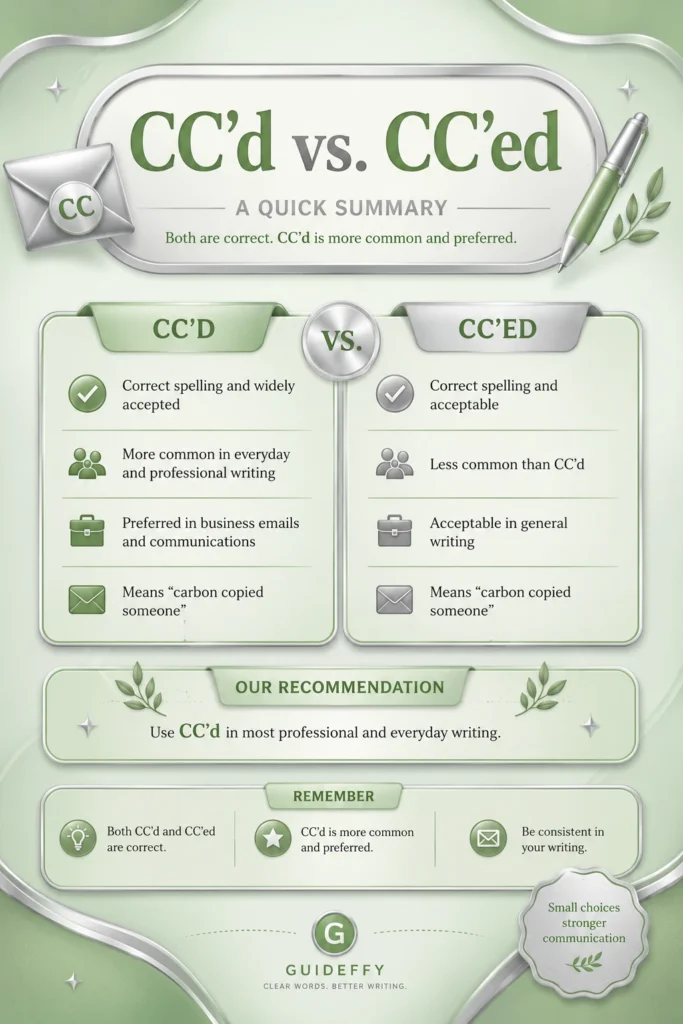
Key Takeaways
- Both cc’d and cc’ed are correct.
- Cc’d is the more common and preferred spelling in professional writing.
- Both spellings mean to send someone a carbon copy of an email.
- There is no universal grammar rule because CC is an abbreviation rather than a regular verb.
- For consistency and readability, use cc’d unless your organization follows a different style preference.
- Whichever spelling you choose, use it consistently throughout your writing.
- Similar spelling questions appear with professional titles as well. For example, many writers ask whether adviser or advisor is the better choice, even though both spellings are considered correct in different contexts.
Conclusion
Both cc’d and cc’ed are correct ways to write the past tense of CC (carbon copy) in email communication. However, cc’d is the more common and widely preferred spelling because it preserves the original abbreviation and is familiar to most readers. While cc’ed is also acceptable, it appears less frequently in professional and business writing. If you’re unsure which form to use, cc’d is the safest choice. Whatever spelling you choose, stay consistent throughout your writing to keep your communication clear and professional.

I’m Leo Jackson, an English writer with a soft spot for the peculiarities of language and spelling. I believe good spelling shouldn’t feel like guesswork, so I break down each comparison into clear, practical explanations anyone can use. Outside of writing, I’m usually buried in a novel or hunting down the next tricky word pair to demystify.