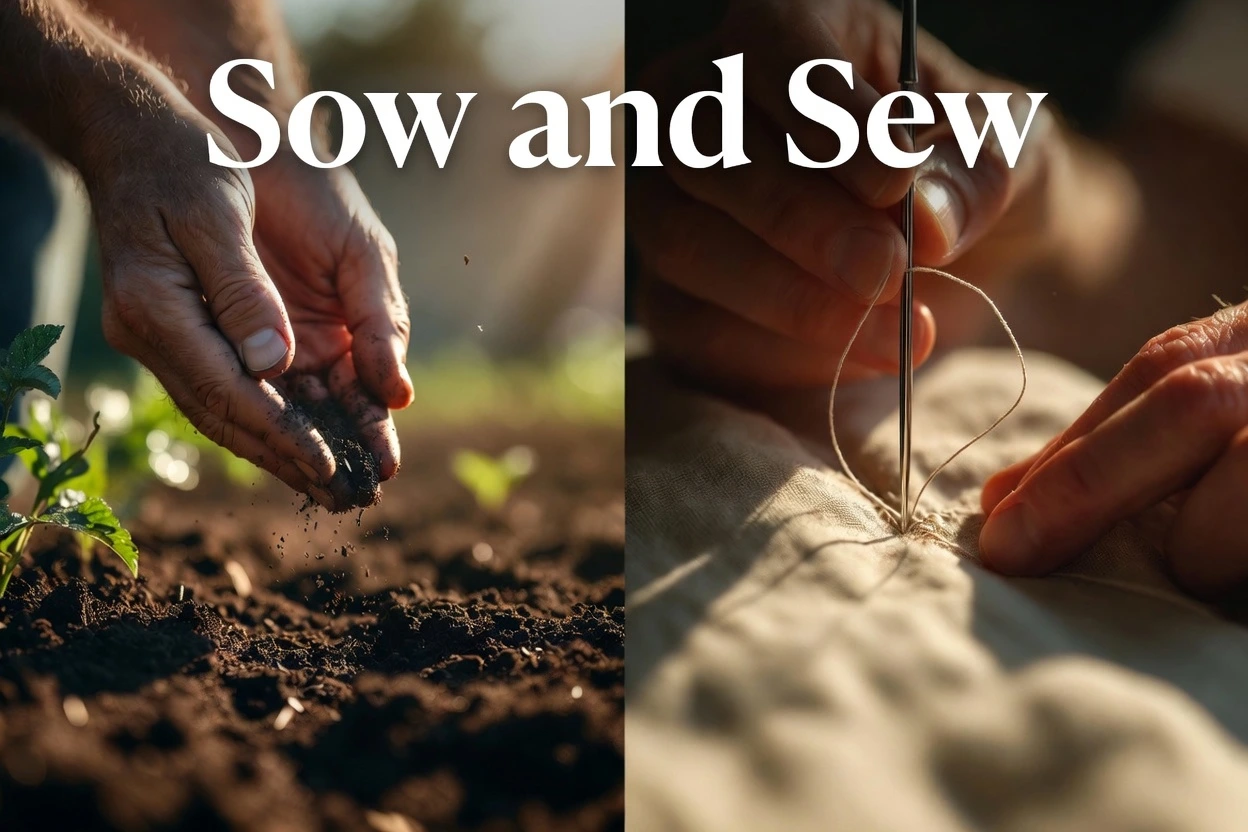
Sow means to plant seeds or spread ideas, while sew means to stitch fabric together with a needle and thread.
Quick Answer
Although sow and sew sound exactly the same, they have completely different meanings.
- Sow means to plant seeds in the ground or to spread something, such as ideas, fear, or doubt.
- Sew means to join fabric or other materials together using a needle and thread or a sewing machine.
The easiest way to remember them is:
- 🌱 Sow = Seeds
- 🧵 Sew = Stitching
Both words are correct, but you should choose the one that matches your meaning.
Quick Comparison Table
| Feature | Sow | Sew |
|---|---|---|
| Correct spelling | ✅ Yes | ✅ Yes |
| Meaning | Plant seeds or spread something | Stitch fabric together |
| Part of speech | Verb | Verb |
| Pronunciation | /soʊ/ | /soʊ/ |
| Common use | Farming, gardening, figurative language | Clothing, tailoring, crafts |
| Example | Farmers sow wheat every autumn. | She can sew a beautiful dress. |
If you hear someone say the word aloud, you cannot tell whether they mean planting seeds or stitching clothes without the context.
For example:
- “She will sow flowers this spring.”
- “She will sew a new curtain.”
These sentences sound identical when spoken, but their meanings are completely different.
This guide explains:
- the meaning of each word,
- when to use them,
- common mistakes,
- dictionary definitions,
- examples,
- pronunciation,
- and simple memory tricks.
By the end, you’ll never confuse sow and sew again.
What Does “Sow” Mean?
Sow is a verb that means to plant seeds in soil so that plants can grow.
Examples
- Farmers sow rice before the rainy season.
- We will sow sunflower seeds tomorrow.
- Every spring they sow vegetables in their garden.
- She sowed grass seed across the lawn.
Figurative Meaning of Sow
“Sow” is also used figuratively to mean spread or introduce something that will produce future results.
Examples include:
- sow doubt
- sow fear
- sow hope
- sow confusion
- sow kindness
- sow peace
Examples
- False news can sow panic.
- Good teachers sow confidence in their students.
- His speech sowed hope among the people.
- Rumors sowed confusion throughout the office.
Common Collocations with “Sow”
People often use sow with these words:
| Collocation | Example |
|---|---|
| sow seeds | Farmers sow seeds every spring. |
| sow wheat | They sow wheat after harvesting rice. |
| sow crops | Villagers sow crops before the rains. |
| sow doubt | The report sowed doubt among investors. |
| sow fear | The incident sowed fear across the town. |
| sow chaos | The attackers tried to sow chaos. |
| sow kindness | Parents should sow kindness in children. |
| sow hope | Volunteers sow hope in difficult times. |
What Does “Sew” Mean?
Sew is a verb that means to join pieces of fabric or material together with thread using a needle or sewing machine.
It is commonly used in:
- tailoring
- fashion
- embroidery
- quilting
- crafts
- home repairs
Examples
- My grandmother can sew beautifully.
- She sewed a button onto my shirt.
- I learned to sew in school.
- They sew uniforms for students.
- He sewed the torn pocket in five minutes.
Common Collocations with “Sew”
| Collocation | Example |
|---|---|
| sew clothes | She loves to sew clothes for her children. |
| sew a dress | My mother will sew a dress for Eid. |
| sew a button | Can you sew this button back on? |
| sew by hand | She prefers to sew by hand. |
| sew with a machine | Beginners often sew with a machine. |
| sew fabric | Designers sew different fabrics together. |
| sew a quilt | They spent months sewing a quilt. |
| sew a patch | He sewed a patch onto his jacket. |
Why Are “Sow” and “Sew” Confused?
There are three main reasons.
1. They Sound Identical
Both words are pronounced:
/soʊ/
Because they sound the same, many writers accidentally choose the wrong spelling.
2. They Are Homophones
A homophone is a word that sounds like another word but has a different spelling and meaning.
Other examples include:
- flower → flour
- pair → pear
- right → write
- sea → see
- sow → sew
3. Spell Check May Not Catch the Mistake
Since both words are correct English words, grammar checkers often won’t identify an error if you’ve chosen the wrong one.
For example:
❌ She can sow my jacket.
The sentence is grammatically correct, but the meaning is wrong.
Correct:
✅ She can sew my jacket.
What Major Dictionaries Say
Leading English dictionaries clearly distinguish these words.
- Sow is defined as planting seeds or spreading something that later develops, such as ideas or emotions.
- Sew is defined as joining fabric or materials together with stitches.
Major dictionaries agree that although the pronunciation is the same, the meanings are entirely different.
Word Origin
Origin of “Sow”
The verb sow comes from Old English sāwan, meaning to scatter or plant seeds. It has been used for farming for over a thousand years and later gained figurative meanings like sow discord and sow hope.
Origin of “Sew”
The verb sew comes from Old English siwian, meaning to stitch with a needle. It has always been associated with making, repairing, and decorating clothing and fabrics.
Even though these words developed separately, changes in English pronunciation eventually made them sound exactly alike.
Which Word Should You Use?
Use this simple rule whenever you’re unsure.
Choose sow when you’re talking about:
- 🌱 Planting seeds
- 🌱 Farming
- 🌱 Gardening
- 🌱 Spreading ideas, fear, hope, doubt, or confusion
Choose sew when you’re talking about:
Sow vs Sew in Sentences
Seeing both words side by side makes the difference much easier to remember.
| Sow | Sew |
|---|---|
| Farmers sow wheat every year. | Tailors sew suits every day. |
| We will sow flower seeds tomorrow. | My grandmother can sew by hand. |
| They sow rice before the rainy season. | She sewed a button onto my shirt. |
| Good leaders sow hope. | My sister loves to sew dresses. |
| Rumors sow confusion. | He learned to sew at school. |
| The gardener sowed vegetable seeds. | She is sewing a pillow cover. |
| We should sow kindness wherever we go. | They sew school uniforms locally. |
British vs American English
Unlike many spelling pairs (such as colour/color or labelling/labeling), sow and sew are not British and American spelling variants.
| Feature | Sow | Sew |
|---|---|---|
| British English | ✅ Sow | ✅ Sew |
| American English | ✅ Sow | ✅ Sew |
| Difference in spelling? | ❌ None | ❌ None |
| Difference in meaning? | ✅ Yes | ✅ Yes |
Whether you are writing for readers in the UK, the US, Canada, Australia, or elsewhere, the meanings stay exactly the same.
Pronunciation
Both words are pronounced:
/soʊ/
This identical pronunciation is the main reason people confuse them in writing.
Example
“She will sow the seeds.”
“She will sew the shirt.”
When spoken, these sound exactly alike.
Verb Forms
Sow
| Form | Word |
|---|---|
| Base verb | sow |
| Third person | sows |
| Present participle | sowing |
| Past tense | sowed |
| Past participle | sown (traditional) or sowed (accepted in some contexts) |
Examples
- Farmers sow corn each spring.
- She sows vegetables every year.
- They are sowing grass seed.
- We sowed wheat yesterday.
- The field was sown with barley.
Sew
| Form | Word |
|---|---|
| Base verb | sew |
| Third person | sews |
| Present participle | sewing |
| Past tense | sewed |
| Past participle | sewn or sewed |
Examples
- I sew my own clothes.
- She sews professionally.
- They are sewing curtains.
- He sewed the torn sleeve.
- The patch was sewn onto the jacket.
Common Mistakes
Here are mistakes learners often make.
❌ I will sew tomato seeds tomorrow.
✅ I will sow tomato seeds tomorrow.
❌ Farmers sew wheat every autumn.
✅ Farmers sow wheat every autumn.
❌ She can sow my jacket.
✅ She can sew my jacket.
❌ My mother sowed a beautiful dress.
✅ My mother sewed a beautiful dress.
❌ The tailor sowed my trousers.
✅ The tailor sewed my trousers.
Memory Tricks
These easy tricks can help you remember the difference.
Trick 1
Sow → Seeds
Both words start with S.
Sow = Seeds
Trick 2
Sew → Stitch
Both involve making or repairing fabric with thread.
Think:
Sew = Stitch
Trick 3
Imagine this picture:
🌱 A farmer is sowing seeds in a field.
🧵 A tailor is sewing a shirt.
The two jobs are completely different.
Everyday Examples
Using “Sow”
- Farmers sow crops before the rainy season.
- We sow sunflower seeds every spring.
- Kind words sow happiness.
- The speech sowed confidence among students.
- They sowed grass in the backyard.
Using “Sew”
- My aunt can sew traditional dresses.
- Please sew this button back on.
- She learned to sew from her grandmother.
- They sew bags by hand.
- I need to sew a tear in my jeans.
Search Intent Answer
If you searched “sow or sew,” here’s the simple answer:
- Use sow when referring to planting seeds or spreading ideas, emotions, or influence.
- Use sew when referring to stitching fabric or repairing clothes.
Although they sound identical, they are never interchangeable because their meanings are completely different.
Frequently Asked Questions (FAQs)
Is it sow or sew seeds?
✅ Sow seeds is correct.
Sow means to plant seeds in the ground.
Example:
Farmers sow seeds at the beginning of the growing season.
Is it sow or sew a dress?
✅ Sew a dress is correct.
Sew means to stitch fabric together using a needle and thread or a sewing machine.
Example:
Why do sow and sew sound the same?
They are homophones words that share the same pronunciation but have different spellings and meanings.
Can sow be used figuratively?
Yes. Besides planting seeds, sow also means to spread something that grows or develops over time.
Examples:
- sow hope
- sow fear
- sow doubt
- sow kindness
- sow confusion
What is the past tense of sew?
The past tense is sewed.
The past participle is usually sewn, although sewed is also accepted in some contexts.
Mini Quiz
Choose the correct answer.
1. Farmers _____ wheat every autumn.
A. sew
B. sow ✅
2. My grandmother can _____ beautiful quilts.
A. sew ✅
B. sow
3. False information can _____ panic.
A. sow ✅
B. sew
4. Please _____ this loose button.
A. sew ✅
B. sow
5. We will _____ flower seeds tomorrow.
A. sow ✅
B. sew
Practice Exercise
Fill in the blanks.
- She learned to ______ her own clothes.
- Farmers usually ______ rice before the rainy season.
- His speech ______ hope among the audience.
- Please ______ the tear in my jacket.
- They ______ vegetable seeds every spring.
Answers
- sew
- sow
- sowed
- sew
- sow
Did You Know?
Although sow and sew are pronounced exactly the same today, they come from different Old English verbs.
Over hundreds of years, English pronunciation changed until both words came to be spoken as /soʊ/, while their spellings and meanings remained distinct. That’s why they are classic examples of homophones.
The Pattern Behind This Spelling Rule
The confusion between “sow” and “sew” is a classic example of English homophones words that sound identical but carry completely different meanings and spellings. This same challenge appears in their related forms too, such as Sown or Sewn where the past-tense versions create the exact same mix-up. It also shows up in unrelated word pairs like Cannon or Canon and Sheer or Shear where identical pronunciation leads to frequent spelling errors. Learning to spot homophones like these can save you from common writing mistakes.
Grammar Relay Corner
Synonyms of Sow
- plant
- scatter
- spread
- seed
- broadcast
- cultivate (context-dependent)
Synonyms of Sew
- stitch
- mend
- tailor
- hem
- repair
- embroider
Antonyms
Sow
- harvest
- uproot
- remove
Sew
- rip
- tear
- unpick
- unstitch
Idioms
- You reap what you sow.
Your actions determine your future results. - A stitch in time saves nine.
Fix a small problem before it becomes a bigger one.
Proverb
As you sow, so shall you reap.
Meaning: Your actions today shape the consequences you experience later.
Key Takeaways
- Sow means to plant seeds or to spread ideas, feelings, or influence.
- Sew means to stitch fabric using a needle and thread or a sewing machine.
- Both words are homophones, so they sound the same but have different meanings.
- Neither word is a British or American spelling variant—they are different words altogether.
- Use sow for farming and figurative expressions, and sew for clothing, tailoring, and crafts.
Conclusion
Choosing between sow and sew becomes easy once you understand their meanings.
If you’re talking about planting seeds or spreading ideas, the correct word is sow. If you’re talking about stitching fabric or repairing clothes, the correct word is sew.
Even though they are pronounced the same, they are never interchangeable. Paying attention to the context will help you choose the correct spelling every time.
A simple way to remember them is:
- 🌱 Sow = Seeds
- 🧵 Sew = Stitch
With this memory trick and the examples above, you’ll be able to use both words confidently in your writing.

I’m Leo Jackson, an English writer with a soft spot for the peculiarities of language and spelling. I believe good spelling shouldn’t feel like guesswork, so I break down each comparison into clear, practical explanations anyone can use. Outside of writing, I’m usually buried in a novel or hunting down the next tricky word pair to demystify.