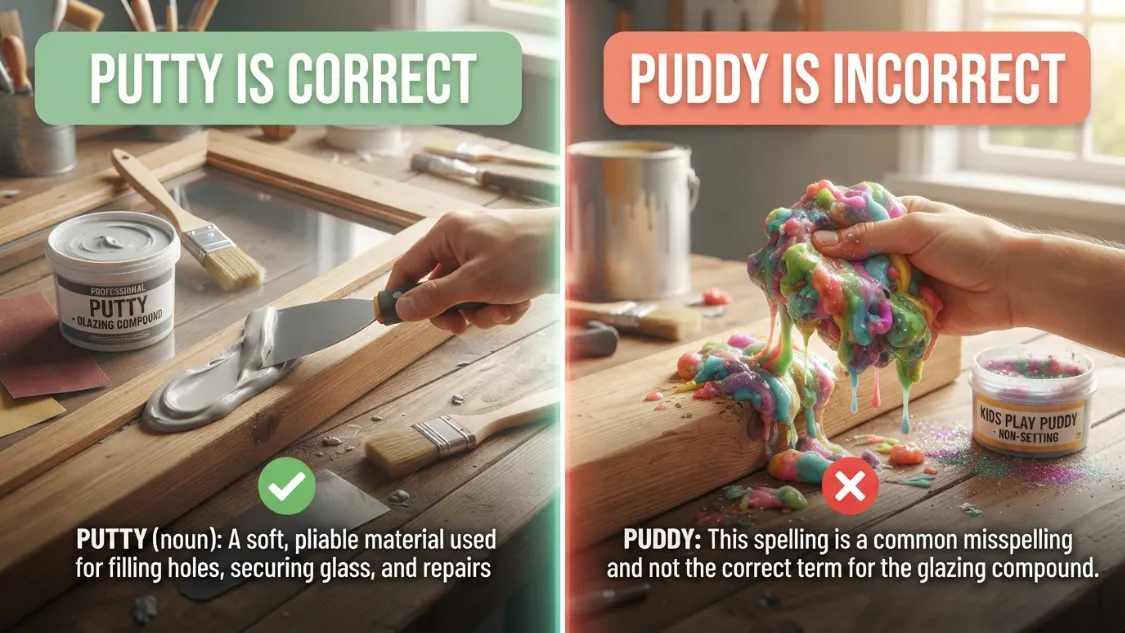
Putty is a soft, moldable material used to fill gaps, seal surfaces, or make repairs while Puddy not a standard English spelling when referring to the material putty.
Quick Answer
“Putty” is the correct spelling when you mean the soft, moldable material used for filling cracks, sealing surfaces, or fixing objects. “Puddy” is not the standard spelling of this word.
So, if you are talking about the material used in construction, carpentry, painting, or repairs, use putty.
Quick Comparison Table
| Spelling | Correct? | Meaning | Common Use |
|---|---|---|---|
| Putty | ✅ Yes | A soft material used for filling, sealing, or repairing | Construction, repairs, crafts |
| Puddy | ❌ No, not for this meaning | Not the standard spelling of putty | Usually a misspelling |
Have you ever wondered whether the correct spelling is “puddy” or “putty”? The two words look and sound similar, making this an easy spelling mistake to make.
If you are talking about the soft material used to fill cracks, repair surfaces, seal windows, or prepare walls for painting, the correct spelling is putty.
Puddy is not the standard spelling of this material. Although you may occasionally encounter puddy in names, informal expressions, or other contexts, it should not be used as an alternative spelling of putty in standard English.
In this article, we will explain the difference between puddy and putty, explore their meanings, look at example sentences, and give you a simple trick for remembering the correct spelling.
Which Spelling Is Correct: Puddy or Putty?
Putty is the correct spelling when referring to the material.
Putty ✅
Puddy ❌
The word putty has a “tt” in the middle:
P-U-T-T-Y
The spelling puddy replaces the “tt” with “dd,” which makes it incorrect when you mean the repair or sealing material.
What Does “Putty” Mean?
Putty is a soft substance that can be shaped or spread and is commonly used for filling holes, cracks, gaps, and imperfections.
Different types of putty are used for different purposes. For example, it can be used in construction, woodworking, painting, glazing, and various repair jobs.
Examples of “Putty”
- The carpenter used putty to fill the small cracks in the wood.
- Apply a thin layer of putty before painting the wall.
- The window frame needed putty to seal the glass.
- She used putty to repair the damaged surface.
In each example, putty refers to a material used for filling, sealing, or repairing something.
What Does “Puddy” Mean?
Puddy is not the standard spelling of the material called putty.
If you write:
“The worker applied puddy to the wall.”
the standard English spelling should be:
“The worker applied putty to the wall.”
Therefore, when discussing the repair material, puddy is best treated as a misspelling of putty.
Puddy vs. Putty: The Main Difference
The main difference is in the middle consonant:
- Putty → tt ✅
- Puddy → dd ❌
The correct word is formed as:
PUT + TY = PUTTY
Not:
PUD + DY = PUDDY
This is a useful spelling distinction because the two forms can sound very similar in casual speech.
Learning Outcome
After reading this article, you should be able to:
- Identify the correct spelling between puddy and putty.
- Understand what putty means.
- Recognize puddy as an incorrect spelling when referring to the material.
- Use putty correctly in a sentence.
- Remember that putty contains double T, not double D.
Grammar Rule
When referring to the soft material used for filling, sealing, repairing, or smoothing surfaces, the correct spelling is:
Putty ✅
The spelling puddy should not be used as an alternative to putty in standard English.
The word putty is generally used as a noun, but it can also be used as a verb when describing the action of applying putty.
How to Use “Putty” as a Noun
As a noun, putty refers to a soft material used for various repair and construction purposes.
Examples:
- The painter applied putty to the wall before painting.
- The old window needed fresh putty around the glass.
- He used putty to fill the small hole in the wooden door.
- The surface was covered with putty before it was polished.
In these sentences, putty names the material being used.
How to Use “Putty” as a Verb
Putty can also function as a verb. As a verb, it means to fill, cover, or repair something with putty.
Examples:
- The worker will putty the cracks before painting.
- They puttied the damaged areas of the wall.
- She is puttying the gaps around the window frame.
Notice how the spelling changes when grammatical endings are added:
| Form | Example |
|---|---|
| Putty | They need to putty the surface. |
| Puttied | He puttied the cracks yesterday. |
| Puttying | She is puttying the damaged area. |
Why Is “Puddy” Incorrect?
The confusion between puddy and putty is largely caused by their similar pronunciation.
When people hear the word rather than see it written, they may incorrectly assume that it contains dd instead of tt.
However, pronunciation should not be used as the only guide to English spelling. The established spelling is:
P-U-T-T-Y → putty
not:
P-U-D-D-Y → puddy
Putty vs. Puddy in a Sentence
| Incorrect | Correct |
|---|---|
| He applied puddy to the wall. ❌ | He applied putty to the wall. ✅ |
| The carpenter used puddy on the door. ❌ | The carpenter used putty on the door. ✅ |
| We need some puddy for the window. ❌ | We need some putty for the window. ✅ |
| She filled the hole with puddy. ❌ | She filled the hole with putty. ✅ |
Common Uses of Putty
Putty can be used in several practical contexts.
1. Wall Repair
Putty can be applied to walls to fill small imperfections and create a smoother surface before painting.
The decorator applied putty to the uneven areas of the wall.
2. Window Repair
Traditional glazing putty is used around glass panes to help secure and seal them within window frames.
The old window needed new putty around the glass.
3. Woodwork
Wood putty can be used to fill small holes, cracks, or imperfections in wooden surfaces.
He used wood putty to fill the holes left by the old nails.
4. General Repairs
Different forms of putty are available for specific repair jobs.
The technician used a special putty to repair the damaged surface.
Quick Memory Trick
Here’s an easy way to remember the spelling:
Putty has TWO T’s: PUT + TY = PUTTY.
Think of “two T’s for putty.”
Whenever you’re unsure between puddy and putty, remember:
PUTTY → TT ✅
PUDDY → DD ❌
This simple trick can help you avoid the common spelling mistake.
Is “Putty” a Correct Word?
Yes. Putty is a standard English word. It refers to a soft material used for purposes such as filling, sealing, smoothing, and repairing surfaces.
It is commonly associated with construction, painting, woodworking, window repair, and other practical applications.
Example:
The painter applied putty to the wall before painting it.
Is “Puddy” a Correct Word?
Puddy is not the standard spelling of the material called putty. If you are referring to the repair or sealing material, writing puddy is considered a spelling error.
However, Puddy can appear in other contexts, such as a surname or a proper name. That does not make it an alternative spelling of the material putty.
Puddy or Putty: Which One Should You Use?
If you mean the material used to fill, seal, smooth, or repair surfaces, always use putty.
Putty ✅: Correct
Puddy ❌: Incorrect for this meaning
Remember that putty contains two T’s.
Putty vs. Puddy: Quick Review
| Feature | Putty | Puddy |
|---|---|---|
| Standard English word for the material | ✅ Yes | ❌ No |
| Correct spelling for repair material | ✅ | ❌ |
| Contains double T | ✅ | ❌ |
| Contains double D | ❌ | ✅ |
| Used in wall and surface repair | ✅ | ❌ |
| May appear as a name/surname | Possible | Possible |
Common Mistakes to Avoid
One of the most common mistakes is replacing the tt in putty with dd.
❌ Puddy
✅ Putty
For example:
❌ The worker applied puddy before painting the wall.
✅ The worker applied putty before painting the wall.
Another mistake is assuming that similar pronunciation means the words can have different spellings. English contains many words whose pronunciation can make spelling difficult, so it is important to remember the established written form.
When Sound Fools the Spelling
Say “putty” out loud a few times fast, and it’s easy to hear why people end up writing “puddy” instead the ‘t’ softens until it almost sounds like a ‘d’. That’s not a spelling rule at play, just pronunciation playing tricks. The same thing happens with Fiend or Feen and Immaculate or Emaculate, where the way a word sounds quietly leads writers toward the wrong spelling.
Mini Quiz
Test your knowledge:
1. Which spelling is correct for the material used to fill cracks and holes?
A. Puddy
B. Putty
Answer: B. Putty
2. Complete the sentence:
The carpenter used _____ to fill the holes in the wood.
A. puddy
B. putty
Answer: B. putty
3. Which spelling contains the correct double consonant?
A. Putty
B. Puddy
Answer: A. Putty
4. Is “puddy” a standard alternative spelling of “putty”?
A. Yes
B. No
Answer: B. No
Vocabulary Corner
Putty: A soft material used to fill, seal, smooth, or repair surfaces.
Glazing putty: A type of putty traditionally used to secure and seal glass in window frames.
Wood putty: A material used to fill imperfections such as small holes and cracks in wood.
Surface: The outer or upper layer of something, such as a wall, door, or piece of wood.
Frequently Asked Questions
Q: Is it puddy or putty?
A: The correct spelling is putty when referring to the material used for filling, sealing, or repairing surfaces.
Q: Is puddy a misspelling of putty?
A: Yes, when you intend to refer to the material, puddy is a misspelling of putty.
Q: Why do people spell putty as puddy?
A: The two forms can sound similar in speech, which can lead to confusion about whether the word contains tt or dd.
Q: What is the correct spelling of wall putty?
A: The correct spelling is wall putty.
Q: What is the correct spelling of wood putty?
A: The correct spelling is wood putty.
Q: Does putty have one T or two?
A: Putty has two T’s: P-U-T-T-Y.
Q: Can “puddy” ever be used?
A: It can appear in contexts unrelated to the material, such as a proper name or surname. But it should not be used as an alternative spelling of putty.
Final Verdict: Puddy or Putty?
When you’re referring to the soft material used to fill cracks, seal gaps, smooth surfaces, or make repairs, the correct spelling is putty.
Putty ✅: Correct
Puddy ❌ :Incorrect as an alternative spelling
The easiest way to remember it is:
Putty has two T’s: PUT + TY = PUTTY.
So, the next time you’re writing about wall repair, window sealing, woodworking, or similar jobs, choose putty, not puddy.

“I am Paul Emerson, a language writer dedicated to untangling the English language’s trickiest spelling dilemmas. With a sharp eye for detail, I break down confusing word pairs into clear, simple comparisons anyone can grasp.”