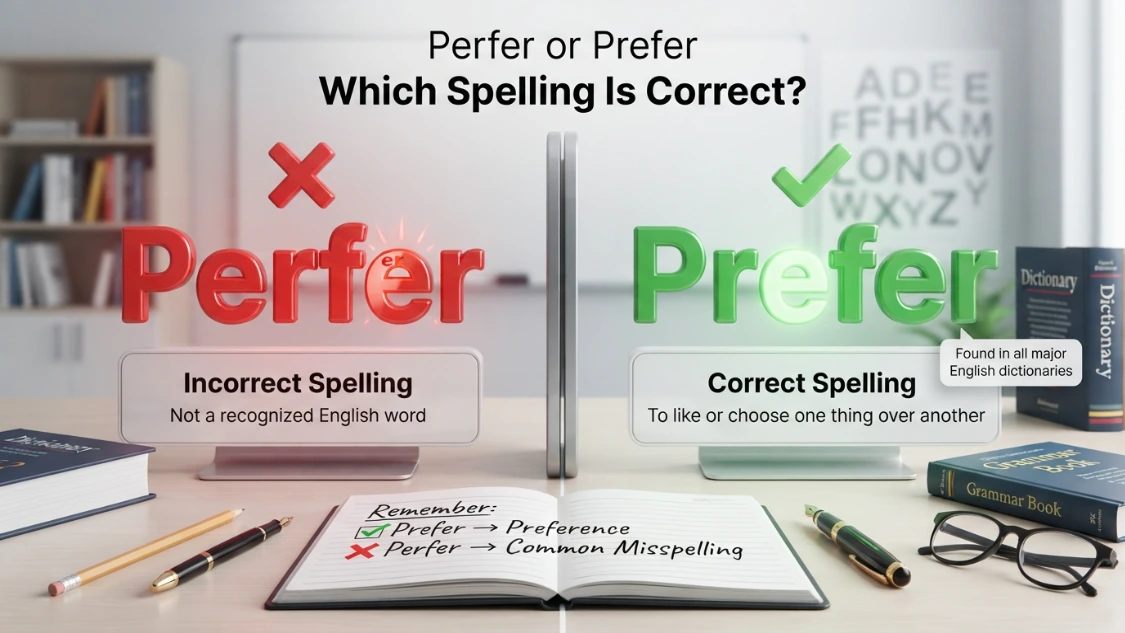
Perfer” or “Prefer” refers to the common spelling confusion between perfer (incorrect) and prefer (correct), a verb meaning to like or choose one person, thing, or option over another.
Perfer or Prefer: Quick Answer
The word prefer means to like, choose, or want one thing more than another. It has been part of English for centuries and appears in every major English dictionary. The spelling perfer is simply a misspelling and should never be used in formal or informal writing.
| Word | Correct? | Meaning |
|---|---|---|
| Prefer | ✅ Yes | To like or choose one thing more than another |
| Perfer | ❌ No | Incorrect spelling of prefer |
Example
✅ I prefer coffee to tea.
❌ I perfer coffee to tea.
In this guide, you’ll learn why people confuse these spellings, how to remember the correct one, what dictionaries say, and how to use prefer confidently in everyday English.
What Does “Prefer” Mean?
The verb prefer means to choose one person, thing, or activity instead of another because you like it more.
Examples
- I prefer reading before bedtime.
- She prefers online classes.
- We prefer homemade food.
- Do you prefer summer or winter?
You can also use prefer when comparing two choices.
Examples:
- I prefer tea to coffee.
- They prefer walking rather than driving.
- She prefers staying home instead of going out.
Why Do People Misspell “Prefer” as “Perfer”?
The mistake happens because of a process called letter transposition. This means two nearby letters are accidentally swapped.
Instead of writing
pre-fer
people sometimes write
per-fer
Since both versions are easy to pronounce, many writers don’t notice the mistake immediately.
Other reasons include:
- typing too quickly
- relying on muscle memory
- not proofreading
- autocorrect being turned off
This is similar to common mistakes such as:
- recieve → receive
- freind → friend
- seperate → separate
How to Pronounce “Prefer”
Prefer
IPA (UK): /prɪˈfɜː(r)/
IPA (US): /prɪˈfɝː/
Pronunciation:
pri-FER
The stress falls on the second syllable.
The Origin of “Prefer”
The word prefer comes from the Latin verb praeferre, meaning to carry before, place before, or value more highly.
It entered English through Old French during the Middle Ages and has always carried the idea of choosing one thing over another.
Its meaning has remained remarkably consistent for hundreds of years.
Related words include:
- preference
- preferable
- preferred
- preferring
Notice that every related word keeps the spelling prefer, never perfer.
How “Prefer” Is Used in Everyday English
You will see prefer almost everywhere in English.
People use it when talking about:
- food
- travel
- hobbies
- education
- work
- shopping
- entertainment
- personal choices
Examples:
- I prefer pizza.
- She prefers working from home.
- Most students prefer digital books.
- We prefer cash payments.
Because it appears so often, learning its correct spelling is especially important.
Common Forms of “Prefer”
Understanding related word forms helps reinforce the correct spelling.
| Word Form | Example |
|---|---|
| Prefer | I prefer tea. |
| Prefers | She prefers coffee. |
| Preferred | They preferred the first option. |
| Preferring | He is preferring a quieter place. (Less common in standard usage; “prefers” is usually more natural.) |
| Preference | Personal preference matters. |
| Preferable | This option is preferable. |
Notice that every form begins with “prefer.”
Why “Perfer” Looks Right but Isn’t
One reason perfer is such a common mistake is that it doesn’t immediately look “wrong.” English has many words beginning with per-, such as:
- perfect
- perform
- perhaps
- permanent
- permission
Because we’re used to seeing per- at the beginning of words, our brain may mistakenly spell prefer as perfer, especially when typing quickly.
However, prefer does not begin with the prefix per-. It follows its own historical spelling, which comes from the Latin praeferre (“to place before” or “to choose first”). That’s why the letters pre stay together in the correct spelling.
Common Mistakes to Avoid with “Prefer”
Many learners make more than one mistake when using prefer. Here are the most common ones.
1. Writing Perfer
❌ I perfer chocolate.
✅ I prefer chocolate.
2. Using the Wrong Preposition
After prefer, the usual preposition is to.
✅ I prefer tea to coffee.
❌ I prefer tea than coffee.
3. Forgetting the Double “R” in Preferred
When adding -ed, the final r doubles.
✅ preferred
❌ prefered
Example:
✅ She preferred the blue dress.
4. Forgetting the Double “R” in Preferring
The same rule applies when adding -ing.
✅ preferring
❌ prefering
Example:
✅ He is preferring a quieter workspace. (Grammatically possible but uncommon; “He prefers…” is usually more natural.)
5. Confusing “Prefer” with “Preference”
Remember the difference:
- Prefer = verb (action)
- Preference = noun (choice or liking)
Examples:
- I prefer coffee.
- My preference is coffee.
Memory Tricks to Remember the Correct Spelling
A simple trick can help you avoid writing perfer.
Trick 1: Think of “Preference”
The word preference starts with prefer-.
Prefer → Preference ✅
Since preference is always spelled with prefer, the base word must also be prefer.
Trick 2: Remember “Pre” Comes First
Think of the phrase:
“PRE comes before choosing.”
Since prefer means choosing one thing before another, the word begins with pre.
Trick 3: Use the Phrase
Repeat this sentence a few times:
I prefer to spell prefer correctly.
Repetition helps build muscle memory.
British vs American English
Unlike many English words, prefer has exactly the same spelling in both British and American English.
| British English | American English |
|---|---|
| Prefer ✅ | Prefer ✅ |
| Perfer ❌ | Perfer ❌ |
There is no regional spelling difference.
Whether you’re writing for the UK, the US, Canada, Australia, or any other English-speaking country, prefer is always correct.
What Major Dictionaries Say
Leading English dictionaries all recognize prefer as the standard spelling.
- Merriam-Webster: Prefer means to like one choice better than another.
- Cambridge Dictionary: To like, choose, or want one thing rather than another.
- Oxford English Dictionary: To choose one option over another or value it more highly.
- Collins Dictionary: To like someone or something better than another alternative.
None of these dictionaries list perfer as a correct spelling. It is treated only as a misspelling.
Examples of “Prefer” in Sentences
Here are some real-life examples.
Daily Conversation
- I prefer coffee in the morning.
- She prefers online shopping.
- We prefer to travel by train.
- They prefer quiet places.
School
- Most students prefer digital notes.
- My teacher prefers handwritten assignments.
Workplace
- Our manager prefers email communication.
- Many employees prefer flexible hours.
Travel
- I prefer window seats.
- They prefer visiting beaches during winter.
Food
- Do you prefer spicy food?
- She prefers homemade desserts.
Common Phrases and Collocations with “Prefer”
Native English speakers often use prefer in fixed expressions.
- prefer to
- prefer over
- prefer A to B
- would prefer
- personally prefer
- generally prefer
- strongly prefer
- much prefer
- prefer rather than
- prefer instead of
Examples
- I prefer to study at night.
- She prefers tea to coffee.
- We’d prefer to leave early.
- Many people prefer online banking.
- He prefers cycling rather than driving.
These combinations sound natural and will make your English more fluent.
Mini Quiz: Can You Choose the Correct Spelling?
Test your understanding by choosing the correct answer.
1. Which spelling is correct?
A. Perfer
B. Prefer ✅
Which sentence is correct?
A. I perfer coffee to tea.
B. I prefer coffee to tea. ✅
3. Complete the sentence:
She ______ working from home.
A. perfer
B. prefers ✅
4. Which word is the noun form?
A. Preference ✅
B. Prefer
5. Which sentence is correct?
A. We prefer tea than coffee.
B. We prefer tea to coffee. ✅
Practice Guide
Improve your spelling with these simple exercises.
Exercise 1: Correct the Mistakes
Rewrite these sentences correctly.
- I perfer reading before bed.
- She prefer tea than coffee.
- We prefered the first option.
- They are prefering online classes.
- My perference is chocolate ice cream.
Answers
- I prefer reading before bed.
- She prefers tea to coffee.
- We preferred the first option.
- They are preferring online classes. (Although “They prefer online classes” is more natural.)
- My preference is chocolate ice cream.
Exercise 2: Fill in the Blank
Choose the correct word.
- I ______ pizza to burgers.
- She ______ working early.
- This option is ______.
- Their ______ is to travel by train.
- We ______ watching movies at home.
Answers
- prefer
- prefers
- preferable
- preference
- prefer
Vocabulary Corner
Synonyms of Prefer
- Choose
- Favor
- Like better
- Select
- Opt for
- Would rather
- Pick
- Value more
Example
I prefer tea.
I favor tea.
Antonyms
- Reject
- Dislike
- Avoid
- Refuse
- Oppose
Idioms Related to Choice
- Have a soft spot for – to like something very much.
- Go with your gut – trust your instinct when choosing.
- Take your pick – choose whichever you want.
- Spoilt for choice – having many good options.
- Pick and choose – select carefully.
Proverb
Different strokes for different folks.
Meaning: Different people have different preferences and tastes.
Frequently Asked Questions (FAQs)
Q: Is perfer a real English word?
A: No. Perfer is not recognized as a correct English word. It is simply a misspelling of prefer.
Q: Why do people write perfer?
A: The letters e and r are accidentally switched. This type of spelling mistake is called a letter transposition.
Q: Is prefer correct in British English?
A: Yes. Prefer is the correct spelling in British English.
Q: Is prefer correct in American English?
A: Yes. American English also uses prefer. There is no alternative spelling.
Q: How do you remember the correct spelling?
A: Think of the word preference. Since it begins with prefer-, the correct spelling is prefer, not perfer.
Is preferred spelled with one “r” or two?
A: It is spelled preferred with two r’s because the final consonant doubles before adding -ed.
Can I say “prefer than”?
No. The standard expression is:
- ✅ Prefer to
- ❌ Prefer than
Example:
- I prefer tea to coffee.
Key Takeaways
- ✅ Prefer is the only correct spelling.
- ❌ Perfer is a common misspelling caused by switching the letters e and r.
- Prefer means to like or choose one thing over another.
- The spelling is the same in British and American English.
- Remember the word preference to help you spell prefer correctly.
- Use the pattern prefer A to B, not prefer A than B.
- Related words include preferred, preferring, preferable, and preference.
Final Verdict
If you’re wondering whether to write perfer or prefer, the answer is simple:
Always use “prefer.”
The spelling perfer is incorrect and should be avoided in all forms of writing. By remembering its connection to preference, practicing common sentence patterns, and proofreading your work, you’ll never confuse these spellings again. Whether you’re writing an email, an essay, or a social media post, prefer is always the right choice.
👉🏻Mastering small spelling differences like prefer instead of perfer will improve your writing accuracy. If you’d like to clear up other common spelling mix-ups, explore our articles on CC’d or CCed and adviser or advisor.

I am Calara Stephen passionate about making English simple and easy to understand through clear spelling comparisons, grammar guides, and language tips. Through thoughtful, reliable content, I aim to be a trusted guide for anyone looking to improve their English.