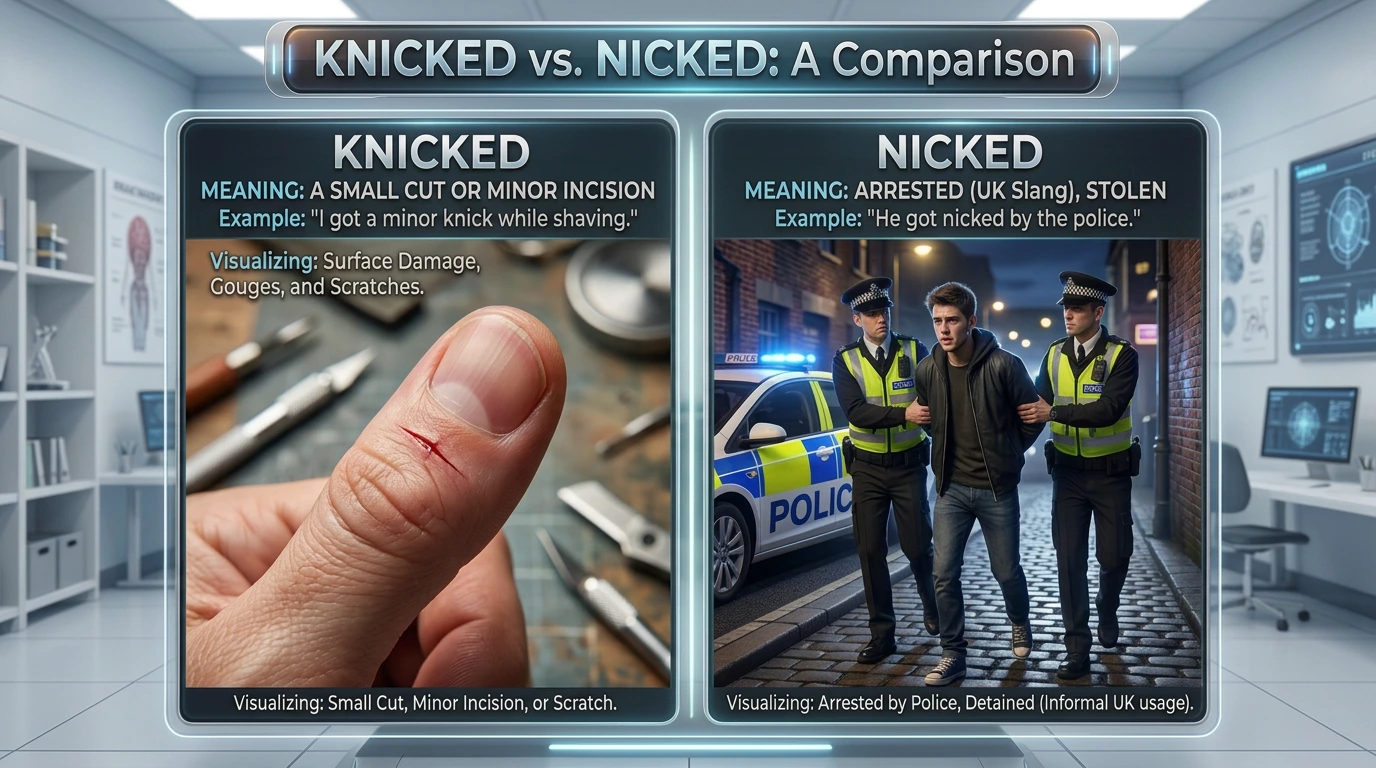
Knicked and nicked are both recognized spellings, but nicked is the standard modern form, meaning “slightly cut,” “stole” (informal), or “was arrested” (British informal), while knicked is a rare historical variant, mainly used to mean “made a small cut.”
Quick Answer
Both knicked and nicked are correct English words, but they are not always interchangeable.
- Nicked is the standard and much more common spelling.
- Knicked is a less common variant that appears mainly when writers want to highlight its connection to the verb knick, meaning “to make a small cut.”
In everyday English, nicked is almost always the preferred spelling.
Quick Comparison Table
| Word | Correct? | Meaning | Example |
|---|---|---|---|
| Nicked | ✅ Yes | Made a small cut; stole; arrested (informal British English) | I nicked my finger while cooking. |
| Knicked | ✅ Yes | Made a small cut (rare spelling) | He knicked the edge of the wood. |
English contains many words that look almost identical but differ in how often they are used. Knicked and nicked are a good example.
Most English speakers and writers use nicked, whether they are talking about a small cut, stealing something, or someone being arrested in British slang. The spelling knicked exists but is much less common.
If you’ve seen both spellings and wondered which one belongs in your writing, this guide explains everything you need to know.
Is It Knicked or Nicked?
The answer depends on what you mean, but in nearly every situation, nicked is the correct choice.
Modern dictionaries list nick as the standard verb.
Examples:
- She nicked her finger with a knife.
- The car door was nicked by another vehicle.
- Someone nicked my wallet.
- The police nicked the suspect.
Although knicked appears occasionally, especially in older writing or by writers emphasizing the original verb knick, it is considered uncommon.
Rule to remember:
If you’re unsure, choose nicked.
What Does “Nicked” Mean?
The word nicked has several meanings depending on the context.
1. Made a Small Cut
This is its most common meaning.
Examples:
- I nicked my thumb while slicing bread.
- She nicked the paper with the scissors.
- The razor nicked his chin.
2. Damaged Slightly
It can describe a tiny scratch or dent.
Examples:
- The table was nicked during the move.
- The bicycle frame got nicked on the curb.
- The paint was nicked near the door.
3. Stole Something (Informal)
In British English, nick often means steal.
Examples:
- Someone nicked my umbrella.
- My bike was nicked yesterday.
- Who nicked my pen?
4. Arrested Someone (British Slang)
British police slang often uses nick to mean arrest.
Examples:
- The officers nicked the suspect.
- He was nicked outside the stadium.
- They were nicked after the robbery.
What Does “Knicked” Mean?
Knicked is simply the past tense of the rare verb knick.
It means:
- to make a tiny cut
- to notch slightly
Examples:
- The carpenter knicked the edge of the board.
- She accidentally knicked the ribbon.
- The blade knicked the leather.
Today, most dictionaries and style guides prefer nicked instead.
Why Are Both Spellings Found?
Historically, English used both knick and nick.
Over time, the silent K disappeared in everyday spelling, just as it did in words like:
- knife
- knee
- knock
- knot
As English evolved, nick became the dominant spelling, while knick survived only in limited use.
The Origin of Nicked and Knicked
The story of these two spellings goes back hundreds of years.
The noun nick has been used since Middle English to mean a small cut, notch, or groove. Soon after, the verb to nick developed, meaning to make a small cut.
The spelling knick also appeared in older English. It reflected the pronunciation of several Germanic words that originally began with kn-, just like knife, knee, and knock.
Over time, English spelling became simpler for many words. The silent K disappeared from common use in this word, and nick became the standard spelling.
Today:
- Nick is the accepted modern form.
- Knick survives only occasionally in historical or stylistic writing.
Pronunciation
Both words are pronounced exactly the same.
Nicked
IPA (UK): /nɪkt/
IPA (US): /nɪkt/
There is no pronunciation difference between knicked and nicked.
The K in knicked is silent.
British vs American English
Unlike many spelling pairs such as colour/color or realise/realize, this pair is not a British vs American spelling difference.
| English Variety | Preferred Spelling |
|---|---|
| American English | Nicked |
| British English | Nicked |
| Australian English | Nicked |
| Canadian English | Nicked |
British English simply gives nick more meanings because it is common slang for steal and arrest.
Examples in British English:
- Someone nicked my phone.
- The police nicked two suspects.
American English usually uses nick only for a small cut or scratch.
Why Did Nicked Become the Standard?
Languages naturally simplify spelling over time.
Several factors helped nicked become the preferred form.
Easier to Write
Removing the silent K makes the word shorter without changing its pronunciation.
Dictionary Preference
Modern dictionaries overwhelmingly list nick as the main verb.
Everyday Usage
Books, newspapers, websites, schools, and style guides almost always use nicked.
Reader Familiarity
Most readers instantly recognize nicked, while knicked may look like a spelling mistake.
Which Word Should You Use?
For almost every situation, choose nicked.
Use knicked only if:
- you’re quoting an old text,
- you’re preserving a historical spelling,
- or you’re intentionally following a source that uses knick.
For modern writing:
✅ I nicked my finger.
❌ I knicked my finger. (rare and likely to confuse readers)
Common Mistakes
Mistake 1: Thinking “Knicked” Is More Correct
Some people assume that adding the silent K makes the spelling more accurate.
Actually, modern English prefers nicked.
Mistake 2: Confusing It with Knitted
Because knicked begins with kn-, some readers accidentally read it as knitted.
Example:
❌ She knicked a sweater.
✅ She knitted a sweater.
Mistake 3: Mixing the Meanings
Remember that nick has several meanings depending on context.
Examples:
- nicked his finger
- nicked the paint
- nicked my wallet
- got nicked by the police
The surrounding sentence tells readers which meaning is intended.
Everyday Examples
Small Cut
- I nicked my finger while peeling potatoes.
- He nicked his hand on broken glass.
- She nicked the edge of the paper.
Minor Damage
- The suitcase was nicked during the flight.
- Someone nicked the corner of the desk.
- The car door got nicked in the parking lot.
British Slang for Steal
- Someone nicked my bicycle.
- They nicked my headphones.
- My lunch was nicked from the office fridge.
British Slang for Arrest
- The police nicked three suspects.
- He was nicked after the match.
- She was nicked for shoplifting.
Tips to Remember
Think of nick as the standard dictionary word.
The silent K is unnecessary in modern English.
If you’re writing for school, work, blogs, or exams, use nicked.
Remember this simple sentence:
If you make a small cut, you’ve nicked it—not knicked it.
What Major Dictionaries Say
Leading English dictionaries recognize nick as the standard modern verb.
- Cambridge Dictionary defines nick as making a small cut or damage and also includes British informal meanings such as steal. Cambridge Dictionary
- Merriam-Webster lists nick as the standard spelling for a small cut or notch. Merriam-Webster
- Oxford English Dictionary records the historical development of nick and its various meanings in English. Oxford English Dictionary
None of these major dictionaries recommend knicked as the preferred modern spelling.
Mini Quiz
Test your understanding.
1. Which spelling is preferred in modern English?
A. Knicked
B. Nicked ✅
2. Which sentence is correct?
A. She knicked her finger.
B. She nicked her finger. ✅
3. In British English, “He nicked my phone” means:
A. He repaired it.
B. He stole it. ✅
C. He painted it.
4. “The police nicked the suspect” means:
A. They praised the suspect.
B. They arrested the suspect. ✅
C. They helped the suspect.
5. True or False
Knicked is the most common modern spelling.
Answer: False. ✅
Grammar Relay Corner
Synonyms of Nicked (small cut)
- scratched
- grazed
- sliced
- cut
- clipped
- notched
- chipped
- scraped
Antonyms of Nicked
- repaired
- restored
- fixed
- healed
- mended
- protected
- preserved
Idioms Related to Damage
- Cut corners
- A close shave
- By a hair
- Leave your mark
Proverbs
- A stitch in time saves nine.
- Look before you leap.
Vocabulary Corner
| Word | Meaning |
|---|---|
| Nick | A small cut or notch |
| Notch | A V-shaped cut |
| Scratch | A light mark on a surface |
| Graze | A minor scrape on the skin |
| Chip | A small broken piece |
| Slice | A clean cut |
| Dent | A small hollow in a surface |
| Scar | A mark left after healing |
Frequently Asked Questions
Q: Is knicked a real word?
A: AYes. It is a real but rare spelling of the past tense of knick. Modern English almost always prefers nicked.
Q: Which spelling should I use in school or professional writing?
A: Use nicked. It is the accepted standard in modern English.
Q: Is knicked wrong?
A: Not completely. It exists but is uncommon and may confuse readers because most people expect nicked.
Q: Does nicked only mean “made a small cut”?
A: No. It can also mean:
- made a slight scratch
- stole something (British informal)
- arrested someone (British slang)
Q: Are knicked and nicked pronounced differently?
A: No. Both are pronounced /nɪkt/. The K in knicked is silent.
Key Takeaways
- ✅ Nicked is the standard modern spelling.
- ✅ Knicked is rare and mainly historical.
- ✅ Both words are pronounced the same.
- ✅ Nicked can mean a small cut, slight damage, stealing (British informal), or arresting someone (British slang).
- ✅ For almost every situation, choose nicked.
Utmost or Upmost: What’s the Difference and Which Is Correct?

Rose Vault is an English language author who specializes in spelling comparisons, commonly confused words, and grammar. She creates clear, well-researched content that helps readers improve their writing and use English with confidence. Her goal is to make language learning simple, accurate, and accessible for everyone.