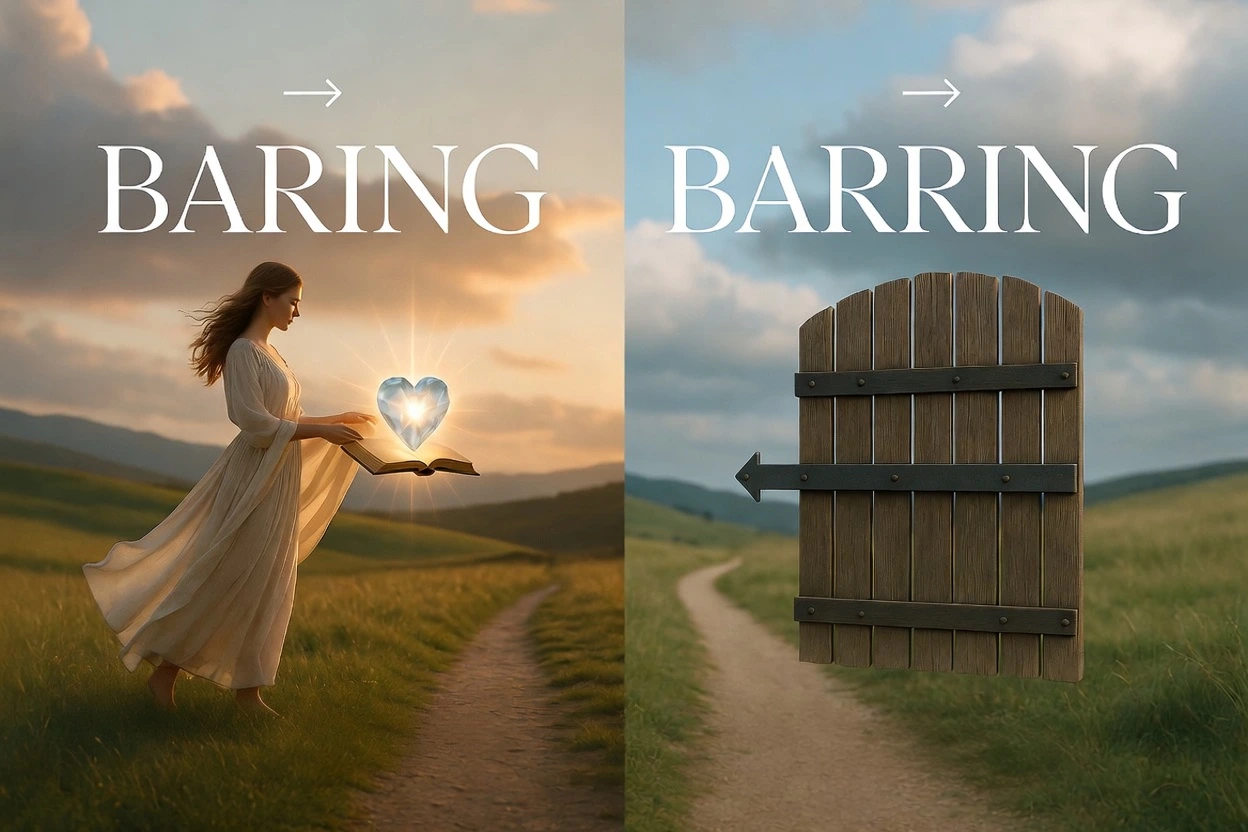
Baring or Barring: “Baring” means revealing or uncovering something, while “barring” means except for or preventing something from happening.
Quick Answer
Baring and barring sound the same but have different meanings.
- Baring means revealing, uncovering, or exposing something.
- Barring means except for, unless, or preventing something from happening.
Example:
- She was baring her shoulders in the summer dress. ✅
- Barring any delays, the train will arrive on time. ✅
Although they are homophones, they are not interchangeable.
Quick Comparison Table
| Feature | Baring | Barring |
|---|---|---|
| Part of Speech | Verb (present participle of bare) | Preposition or verb (present participle of bar) |
| Meaning | Revealing or uncovering | Except for; preventing |
| Used For | Exposing something | Making exceptions or blocking |
| Example | He was baring his teeth. | Barring rain, we’ll play outside. |
English has many words that sound alike but carry completely different meanings. Baring and barring are a perfect example. Since they are pronounced the same, many writers accidentally choose the wrong spelling.
The good news is that the difference is simple once you know what each word means. Baring is related to bare, which means to uncover or reveal. Barring comes from bar, meaning to block, prevent, or except for.
In this guide, you’ll learn the meaning, pronunciation, grammar, examples, and easy memory tricks to help you choose the correct spelling every time.
Are Baring and Barring Homophones?
Yes.
They are homophones, meaning they have the same pronunciation but different spellings and meanings.
Pronunciation:
- Baring → /ˈber.ɪŋ/
- Barring → /ˈber.ɪŋ/
Because they sound identical, they often cause confusion in writing but rarely in spoken English, where context makes the meaning clear.
What Does Baring Mean?
Baring is the present participle of the verb bare.
It means:
- revealing
- uncovering
- exposing
- making visible
Examples
- The dog was baring its teeth.
- She was baring her arms in the hot weather.
- He kept baring his emotions during the interview.
- The storm was baring the tree roots.
Common Expressions
- baring your soul
- baring your teeth
- baring your shoulders
- baring the truth
What Does Barring Mean?
Barring comes from the verb bar.
As a preposition, it usually means:
- except for
- unless
- if nothing prevents
As a verb, it means:
- blocking
- preventing
- stopping access
Examples
- Barring any problems, we’ll finish today.
- Barring illness, she never misses work.
- Security was barring people from entering.
- The police were barring the road after the accident.
Baring vs. Barring: The Main Difference
The easiest way to remember them is this:
- Baring = revealing or exposing
- Barring = except for or preventing
Think of bare inside baring.
Think of bar inside barring, like a barrier that blocks something.
When Should You Use Baring?
Use baring whenever something is being revealed or uncovered.
Correct examples:
- She smiled, baring her teeth.
- The documentary is baring hidden facts.
- He stood on the beach, baring his feet in the sand.
- The investigation is baring new evidence.
When Should You Use Barring?
Use barring when you mean except for, unless, or preventing something.
As a Preposition (Meaning “Except For”)
This is the most common use.
Examples:
- Barring any last-minute changes, the meeting will begin at 9 a.m.
- Barring bad weather, the match will go ahead.
- Barring illness, she attends every class.
- Barring unexpected expenses, we will stay within budget.
As a Verb (Meaning “Blocking or Preventing”)
Here, barring is the present participle of bar.
Examples:
- Police were barring the entrance.
- Heavy snow was barring traffic from the mountain road.
- Security guards were barring unauthorized visitors.
Baring vs. Barring: Side-by-Side Comparison
| Situation | Correct Word | Example |
|---|---|---|
| Revealing emotions | Baring | She was baring her feelings. |
| Showing teeth | Baring | The wolf was baring its teeth. |
| Except for delays | Barring | Barring delays, we’ll arrive by noon. |
| Preventing entry | Barring | Officers were barring the gate. |
| Exposing the truth | Baring | The report is baring hidden facts. |
| Unless something happens | Barring | Barring emergencies, the office stays open. |
Common Mistakes
❌ Incorrect: Baring any problems, we’ll leave tomorrow.
✅ Correct: Barring any problems, we’ll leave tomorrow.
❌ Incorrect: The dog was barring its teeth.
✅ Correct: The dog was baring its teeth.
❌ Incorrect: She is barring her heart to the audience.
✅ Correct: She is baring her heart to the audience.
❌ Incorrect: Baring rain, the event will continue.
✅ Correct: Barring rain, the event will continue.
British vs. American English
There is no spelling difference between British and American English.
| British English | American English |
|---|---|
| baring | baring |
| barring | barring |
The distinction depends entirely on meaning, not regional spelling.
Grammar Tips
Baring
- Verb only
- Present participle of bare
- Refers to revealing or uncovering
Example:
- He is baring his soul.
Barring
Can function as:
- A preposition (“except for”)
- A verb (“blocking”)
Examples:
- Barring bad weather, we’ll travel.
- Workers are barring the entrance.
Easy Memory Trick
Remember BARE → BARING
If something is becoming bare, it is being uncovered.
Bare = Reveal
➡ Baring = Revealing
Remember BAR → BARRING
A bar blocks your way.
Bar = Block or Exception
➡ Barring = Except for or Preventing
Everyday Examples
Baring
- She was baring her shoulders.
- The child laughed, baring his tiny teeth.
- The documentary is baring the truth.
- The storm kept baring tree roots.
Barring
- Barring traffic, we’ll arrive early.
- Barring illness, everyone should attend.
- Guards were barring the entrance.
- Barring unforeseen problems, the project will finish on time.
Quick Practice
Choose the correct word.
- The dog was ______ its teeth.
- ______ heavy rain, the picnic will continue.
- Security was ______ visitors from entering.
- She was ______ her true feelings.
Answers
baring ✅
baring ✅
Barring ✅
barring ✅
Word Origin (Etymology)
Baring
The word baring comes from the Old English word beran, meaning to make visible, uncover, or expose. Over time, the verb bare developed the meaning “to reveal,” and baring became its present participle.
Barring
Barring comes from the Old French word barre, meaning bar, rod, or obstacle. The verb bar later came to mean to block, prevent, or exclude, giving us the modern meanings of barring.
What Major Dictionaries Say
Most leading English dictionaries agree on these meanings:
| Word | Standard Meaning |
|---|---|
| Baring | Revealing, uncovering, or exposing something. |
| Barring | Except for; unless; preventing or blocking. |
Why Do People Confuse Baring and Barring?
These words are often confused because:
- They are homophones (they sound exactly alike).
- They differ by only one letter.
- Both are common in formal and everyday English.
- Spell-checkers may not catch the mistake because both are correctly spelled words.
The easiest way to avoid confusion is to ask yourself:
- Am I revealing something? → baring
- Do I mean except for or preventing? → barring
Mini Quiz
Choose the correct answer.
- ______ any delays, the flight should arrive on time.
- A. Baring
- B. Barring
- The tiger was ______ its sharp teeth.
- A. Baring
- B. Barring
- Police were ______ the road after the accident.
- A. Baring
- B. Barring
- She was ______ her heart during the interview.
- A. Baring
- B. Barring
Answers
- B. Barring
- A. Baring
- B. Barring
- A. Baring
Practice Guide
To master these words:
- Read example sentences aloud.
- Remember bare = reveal.
- Remember bar = block.
- Write five sentences using baring and five using barring.
- Check whether your sentence is talking about revealing or excluding/preventing.
Grammar Relay Corner
Synonyms
Baring
- revealing
- exposing
- uncovering
- displaying
- unveiling
Barring
- except for
- excluding
- unless
- preventing
- blocking
Antonyms
Baring
- covering
- concealing
- hiding
- masking
Barring
- allowing
- permitting
- admitting
- welcoming
Idioms
- Bare your soul – reveal your deepest feelings.
- Behind bars – in prison.
- Raise the bar – increase the standard.
- No holds barred – without restrictions.
Proverb
“Honesty is the best policy.”
Being willing to bare the truth builds trust.
Frequently Asked Questions
Q: Is baring a real word?
A: Yes. Baring is the present participle of bare, meaning revealing or uncovering.
Q: Is barring a real word?
A: Yes. It means except for, unless, or blocking something.
Q: Which word is more common?
Barring is generally more common because it frequently appears in phrases like “barring any changes” or “barring bad weather.”
Q: Can baring and barring be used interchangeably?
A: No. Although they sound the same, they have different meanings and should never replace one another.
Key Takeaways
- Baring means revealing, exposing, or uncovering.
- Barring means except for, unless, or preventing.
- They are homophones but have different meanings.
- There is no British vs. American spelling difference.
- Use baring for revealing and barring for exceptions or blocking.
Conclusion
Although baring and barring sound identical, they serve very different purposes in English. Baring is used when something is revealed or uncovered, while barring expresses an exception or the act of preventing something. Remember the simple connection bare = reveal and bar = block to choose the correct word with confidence. Mastering this pair will make your writing clearer, more accurate, and more professional.
Related Articles

“I am Paul Emerson, a language writer dedicated to untangling the English language’s trickiest spelling dilemmas. With a sharp eye for detail, I break down confusing word pairs into clear, simple comparisons anyone can grasp.”