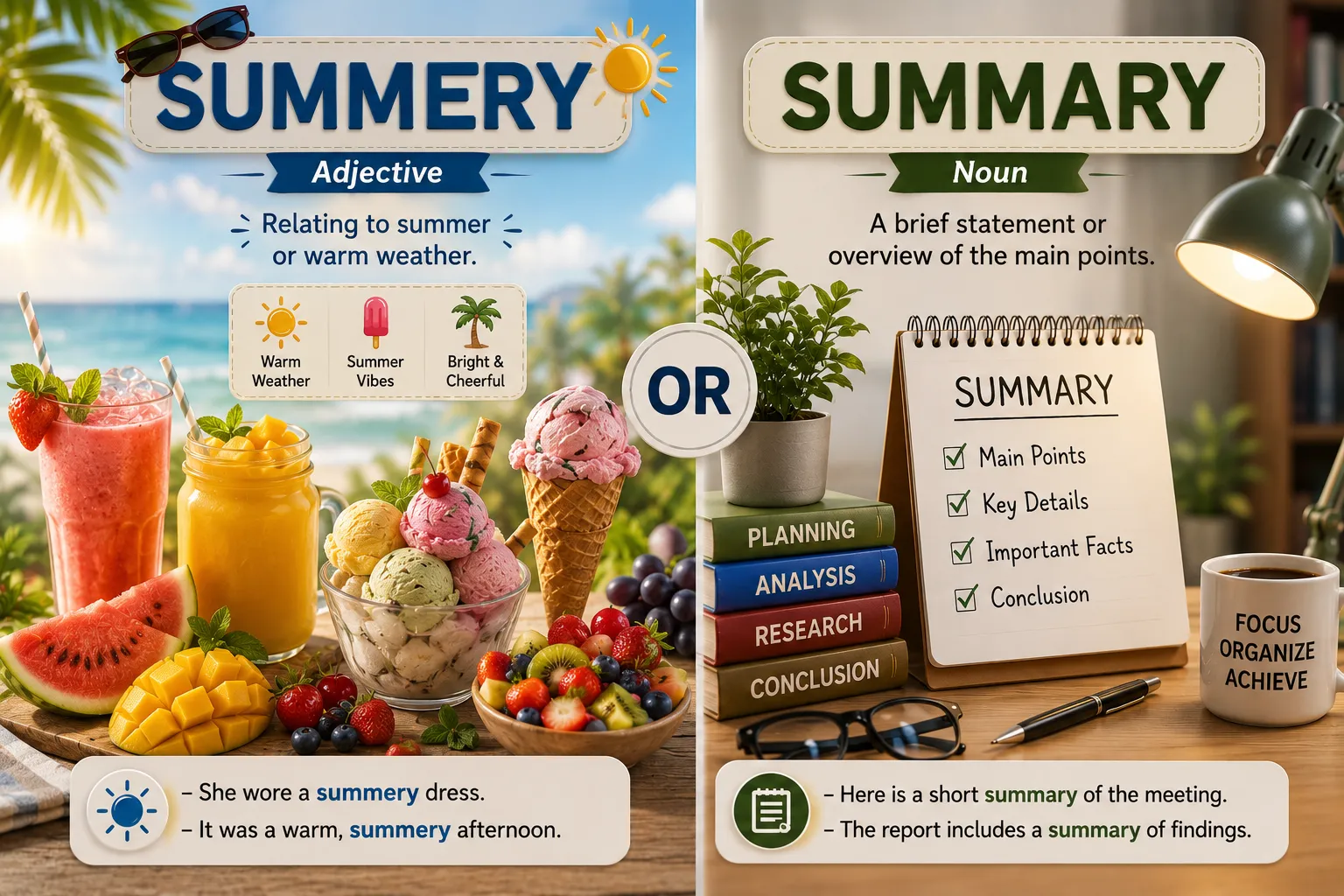
Summery: relating to summer or characteristic of warm, sunny weather.
Summary: a brief statement that gives the main points or essential information.
Quick Answer
“Summery” and “summary” are both correct English words, but they have completely different meanings.
- Summery means related to or characteristic of summer.
- Summary means a short version of the main points or ideas of something.
They can sound very similar, but they are not interchangeable.
Summery = related to summer 🌞
Summary = a short version of something 📝
Quick Comparison Table
| Word | Meaning | Part of Speech | Example |
|---|---|---|---|
| Summery | Related to or characteristic of summer | Adjective | She wore a summery dress. |
| Summary | A brief statement of the main points | Noun | Please write a summary of the article. |
Have you ever confused “summery” and “summary”? You’re not alone. These two words look and sound remarkably similar, but their meanings are completely different.
Summery is connected with summer. It is an adjective used to describe something that reminds you of summer, such as warm weather, bright colors, light clothing, or a seasonal atmosphere.
Summary, on the other hand, is usually a noun that means a shortened version of a longer text, speech, event, or explanation. A summary gives you the most important information without all the original details.
The confusion becomes especially common because the two words are near-homophones in many accents. Their pronunciation can be very similar, but their spelling and meanings are different.
In this guide, we’ll explain summery vs. summary, show you how to use each word correctly, and give you simple examples and memory tricks to help you keep them apart.
Summery vs. Summary: Which Word Should You Use?
The correct word depends on what you want to say.
Use summery when you are describing something connected with summer.
The restaurant has a bright, summery atmosphere.
Use summary when you mean a brief account of the main points.
The teacher asked us to write a summary of the chapter.
So:
Talking about summer? → Summery
Talking about a shortened version? → Summary
What Does “Summery” Mean?
Summery is an adjective meaning typical of, suitable for, or characteristic of summer.
It can describe things such as:
- Weather
- Clothing
- Colors
- Food
- Decorations
- Scenery
- Atmosphere
- Activities
For example:
The room has a summery feel.
This means the room has an atmosphere that reminds you of summer.
Examples of “Summery”
Here are some examples:
- She chose a summery yellow dress.
- The garden looks bright and summery.
- We decorated the room with summery colors.
- The restaurant has a fresh, summery atmosphere.
- I love the light and summery feeling of this song.
In each sentence, summery describes something associated with summer.
What Does “Summary” Mean?
Summary is a noun meaning a brief statement or account that gives the main points of something without including all the details.
You can write a summary of:
- A book
- An article
- A story
- A movie
- A lecture
- A meeting
- A report
- A chapter
For example:
The teacher asked the students to write a summary of the story.
The summary does not repeat every detail from the story. Instead, it presents the most important information in a shorter form.
Examples of “Summary”
- Please read the summary before starting the full report.
- I wrote a short summary of the chapter.
- The manager gave us a summary of the meeting.
- Can you provide a summary of the article?
- The book includes a brief summary at the end of each chapter.
Summery vs. Summary: The Main Difference
The easiest way to distinguish these words is to look at their meanings:
Summery → Summer
Summary → Main points
Summery describes something that feels or looks like summer.
Summary gives you the main points of something in a shorter form.
| If you mean… | Use… |
|---|---|
| Related to summer | Summery |
| Characteristic of summer | Summery |
| A brief version of a text | Summary |
| Main points of a report | Summary |
| Short account of an event | Summary |
Learning Outcomes
After reading this article, you should be able to:
- Understand the difference between summery and summary.
- Recognize that both words are correctly spelled.
- Use summery when describing something related to summer.
- Use summary when referring to a shortened account of something.
- Avoid confusing these similar-sounding words.
- Remember the difference using simple spelling and meaning clues.
Grammar Rule
The words summery and summary belong to different grammatical categories and have different meanings.
- Summery is an adjective. It describes something connected with or characteristic of summer.
- Summary is usually a noun. It refers to a shortened version containing the main points of something.
Compare:
It was a summery afternoon. ✅
I wrote a summary of the article. ✅
You cannot normally replace one with the other because they perform different grammatical roles.
How to Use “Summery”
Use summery when you want to describe something that reminds you of summer.
It can describe an appearance, feeling, atmosphere, style, or experience.
Examples
- She wore a summery dress.
- The bright colors give the room a summery look.
- We enjoyed a warm, summery afternoon.
- The café has a relaxed and summery atmosphere.
- These flowers create a beautiful summery display.
In each example, summery acts as an adjective.
How to Use “Summary”
Use summary when you are referring to a shortened presentation of the main points of something.
Examples
- I need to write a summary of the book.
- The teacher asked for a summary of the lesson.
- Please give me a summary of the report.
- She prepared a summary of the meeting.
- The article begins with a brief summary of the findings.
Here, summary is a noun referring to the shortened account.
Summery vs. Summary in Sentences
| Word | Correct Sentence | Meaning |
|---|---|---|
| Summery | The beach has a summery atmosphere. | Characteristic of summer |
| Summery | She chose a summery outfit. | Suitable for or suggestive of summer |
| Summary | I read the summary of the book. | Short account of the book |
| Summary | Write a summary of the chapter. | Brief version of the main points |
Why Are Summery and Summary Confused?
The confusion comes mainly from their similar spelling and pronunciation.
Both words begin with summ-, and their pronunciation can be very similar in some accents. However, their endings and meanings are different:
Summery → summer + y
Summary → summar + y
A useful clue is that summery is directly connected to the word summer.
A Simple Spelling Trick
Look at the first word hidden inside summery:
SUMMER + Y = SUMMERY
If the sentence is talking about something associated with summer, choose summery.
For example:
The bright colors look very summery.
For summary, think:
SUMMARY = MAIN POINTS
If you’re talking about a shortened version of a book, article, report, or speech, choose summary.
Common Mistakes
Mistake 1: Using “summery” for a short explanation
❌ Please give me a summery of the article.
✅ Please give me a summary of the article.
Here, summary is correct because the speaker wants a brief version of the article.
Mistake 2: Using “summary” to describe summer
❌ She wore a summary dress.
✅ She wore a summery dress.
Here, summery is correct because the dress has a style associated with summer.
Summery or Summary: Context Matters
The easiest way to choose the right word is to ask yourself one question:
Am I talking about summer or a shortened explanation?
If you’re talking about summer, use:
Summery ✅
If you’re talking about a shortened version, use:
Summary ✅
Sound the Same, Mean Something Different
Say “summary” and “summery” out loud and you’ll notice something they’re nearly impossible to tell apart by ear. Yet one wraps up information into key points, and the other simply means something related to summer. That’s homophone confusion doing what it does best. The same thing happens with Cannon or Canon and Chord or Cord words that sound identical but live in completely different corners of meaning.
Quick Comparison: Meaning in Context
| Sentence | Correct Word | Why? |
|---|---|---|
| She wore a ___ dress. | summery | The dress is associated with summer. |
| Please write a ___ of the story. | summary | It means a shortened version. |
| The garden has a ___ appearance. | summery | The appearance reminds us of summer. |
| I read the ___ before the report. | summary | It gives the main points. |
| We enjoyed a warm, ___ evening. | summery | The evening felt like summer. |
Vocabulary Corner
Summery: Related to or characteristic of summer.
Summary: A brief account containing the main points of something.
Summarize: To give the main points of something in a shorter form.
Seasonal: Related to a particular season of the year.
Synopsis: A brief summary or general outline of a longer work.
Remember the Difference
Keep this simple formula in mind:
☀️ SUMMERY = SUMMER
📝 SUMMARY = MAIN POINTS
If you can remember these two associations, you’ll rarely confuse the words again.
Is “Summery” a Correct Word?
Yes. Summery is a correctly spelled English word.
It is an adjective used to describe something that is related to, characteristic of, or suggestive of summer.
Example:
The bright colors give the room a summery feel.
Here, summery describes the atmosphere of the room.
Is “Summary” a Correct Word?
Yes. Summary is also a correctly spelled English word.
It is usually a noun that refers to a shortened account containing the main points of something.
Example:
The teacher asked us to write a summary of the chapter.
Here, summary means a brief version of the chapter.
Are Summery and Summary Homophones?
Summery and summary are often described as homophones or near-homophones, depending on the speaker’s accent and pronunciation.
A homophone is a word that sounds the same as another word but has a different meaning and spelling, such as:
- flower / flour
- sea / see
- right / write
The pronunciation of summery and summary can be extremely similar, although some speakers make a distinction between them.
Regardless of pronunciation, their meanings and spellings are different.
Summery or Summary: Which One Should You Use?
Use summery when describing something associated with summer.
It was a warm and summery day.
Use summary when referring to a short version or account of something.
I prepared a summary of the report.
So remember:
Summery = related to summer ☀️
Summary = brief version 📝
Summery vs. Summary: Quick Review
| Feature | Summery | Summary |
|---|---|---|
| Correct English word? | ✅ Yes | ✅ Yes |
| Part of speech | Adjective | Usually noun |
| Main meaning | Related to summer | Brief account of main points |
| Connected with “summer”? | ✅ Yes | ❌ No |
| Can describe something? | ✅ Yes | Usually no |
| Can refer to a shortened text? | ❌ No | ✅ Yes |
| Common spelling mistake? | Sometimes confused with summary | Sometimes confused with summery |
Mini Quiz
Test yourself:
1. Which word means “related to summer”?
A. Summary
B. Summery
Answer: B. Summery
2. Which word means “a short version of the main points”?
A. Summery
B. Summary
Answer: B. Summary
3. Choose the correct word:
She wore a bright, ___ dress.
A. summery
B. summary
Answer: A. Summery
4. Choose the correct word:
Please give me a ___ of the article.
A. summery
B. summary
Answer: B. Summary
5. Are both “summery” and “summary” correctly spelled words?
A. Yes
B. No
Answer: A. Yes
Frequently Asked Questions
Q: Is it summery or summary?
A: Both are correct words, but they have different meanings. Summery relates to summer, while summary means a brief account of the main points.
Q: What is the difference between summery and summary?
A: Summery is an adjective meaning “related to or characteristic of summer.” Summary is usually a noun meaning “a shortened version of something.”
Q: Is “summery” a misspelling of “summary”?
A: No. Summery is a real English word. It should be used when you mean something related to summer.
Q: Is “summary” a misspelling of “summery”?
A: No. Summary is a standard English word referring to a brief account of something.
Q: How do I remember summery vs. summary?
A: Remember: SUMMERY contains SUMMER. If you’re talking about summer, use summery. If you’re talking about the main points of something, use summary.
Q: Can summery be used as a noun?
A: No. Summery is normally an adjective. For example, you can say a summery dress or a summery atmosphere.
Q: Can summary be used as a verb?
A: No. The related verb is summarize (American English) or summarise (British English).
Grammar Relay
Here’s a quick way to identify the words grammatically:
Summery → Adjective
a summery afternoon
Summary → Noun
a summary of the story
Summarize → Verb
Please summarize the article.
This distinction makes it easier to choose the correct word in a sentence.
Final Verdict: Summery or Summary?
Summery and summary are both correct English words, but they cannot be used interchangeably.
Use summery when something is connected with summer:
The garden has a beautiful, summery appearance.
Use summary when you mean a short account containing the main points:
The teacher asked for a summary of the lesson.
The easiest memory trick is:
☀️ SUMMERY = SUMMER
📝 SUMMARY = MAIN POINTS
So, the final answer is:
Summery ✅: related to summer
Summary ✅: a brief account of the main points
Once you connect summery with summer and summary with summarizing information, the difference becomes easy to remember.

Rose Vault is an English language author who specializes in spelling comparisons, commonly confused words, and grammar. She creates clear, well-researched content that helps readers improve their writing and use English with confidence. Her goal is to make language learning simple, accurate, and accessible for everyone.