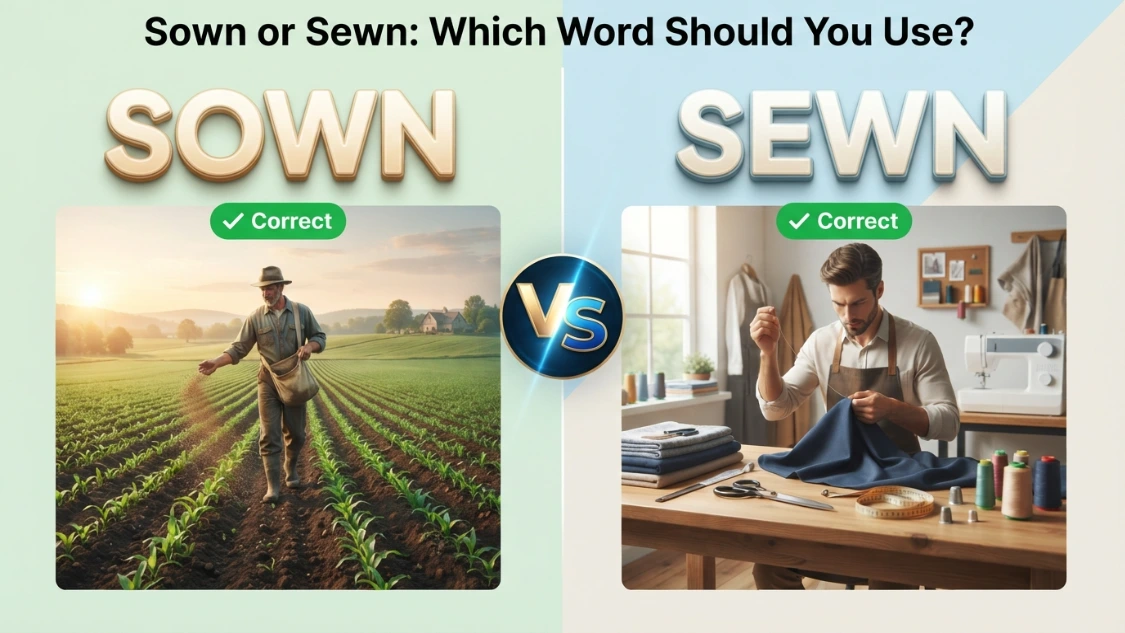
Sown means planted or scattered (such as seeds or ideas), while sewn means stitched together with a needle and thread.
Quick Answer
Both sown and sewn are correct, but they have completely different meanings.
- 🌱 Sown = the past participle of sow, meaning to plant seeds or to spread something.
- 🧵 Sewn = the past participle of sew, meaning to join fabric with a needle and thread.
Although they differ by only one letter, they are not interchangeable.
Introduction
Are you unsure whether to write sown or sewn? You’re not alone. These two words are commonly confused because they look and sound similar. However, they come from different verbs and describe entirely different actions.
If you’re talking about planting seeds, the correct word is sown. If you’re talking about stitching clothes or fabric, the correct word is sewn.
In this guide, you’ll learn:
- The difference between sown and sewn
- Their meanings and origins
- When to use each word
- Common mistakes to avoid
- Easy memory tips
- Real-life examples
By the end, you’ll be able to choose the correct word with confidence.
Sown or Sewn: What’s the Difference?
| Word | Meaning | Past Participle of | Example |
|---|---|---|---|
| Sown | Planted or spread | Sow | The farmer had sown wheat. |
| Sewn | Stitched together | Sew | She had sewn the dress. |
What Does “Sown” Mean?
Sown is the past participle of the verb sow.
It means:
- To plant seeds in the ground.
- To spread something, such as ideas, doubt, or fear.
Examples
- The farmer had sown corn before the rain arrived.
- Seeds were sown in early spring.
- The speech had sown hope among the audience.
- Rumors had sown confusion throughout the town.
What Does “Sewn” Mean?
Sewn is the past participle of the verb sew.
It means:
- To join fabric using a needle and thread.
- To stitch pieces of material together.
Examples
- She had sewn a beautiful wedding dress.
- The button was sewn onto the shirt.
- My grandmother has sewn quilts for years.
- The torn pocket was carefully sewn back in place.
The Origin of the Words
Although sown and sewn look alike, they have different origins.
Sown
The word sow comes from Old English sāwan, meaning to plant seeds.
Sewn
The word sew comes from Old English siwian, meaning to stitch with thread.
Their similar spellings are a coincidence—they are unrelated verbs.
British English vs American English
There is no spelling difference between British and American English.
| English Variety | Planting | Stitching |
|---|---|---|
| British English | Sown | Sewn |
| American English | Sown | Sewn |
| Australian English | Sown | Sewn |
| Canadian English | Sown | Sewn |
Both forms are used worldwide.
Sown vs Sewn: When Should You Use Each?
Use sown when talking about:
- Planting seeds
- Agriculture
- Gardens
- Crops
- Spreading emotions, ideas, fear, or doubt
Use sewn when talking about:
- Clothing
- Fabric
- Tailoring
- Needlework
- Repairs
- Fashion
Examples in Sentences
Using Sown
- The wheat had been sown before winter.
- Farmers had sown rice across the fields.
- His comments had sown uncertainty.
Using Sewn
- She had sewn a patch onto the jacket.
- The curtains were hand-sewn.
- My mother has sewn many dresses over the years.
Common Mistakes
❌ The seeds were sewn yesterday.
✅ The seeds were sown yesterday.
❌ She had sown a new shirt.
✅ She had sewn a new shirt.
Always match the word to the action:
- Planting = sown
- Stitching = sewn
Easy Trick to Remember
Here’s a simple memory tip:
🌱 Sown → Sow → Seeds
🧵 Sewn → Sew → Shirt
If you’re working in a garden, choose sown.
If you’re working with fabric, choose sewn.
Sown vs Sewn at a Glance
| Feature | Sown | Sewn |
|---|---|---|
| Correct spelling | ✅ | ✅ |
| Related verb | Sow | Sew |
| Meaning | Planted or spread | Stitched together |
| Agriculture | ✅ | ❌ |
| Sewing and clothing | ❌ | ✅ |
Mini Quiz
1. The farmer had ____ the seeds.
A. Sewn
B. Sown ✅
2. She had ____ a button onto the coat.
A. Sewn ✅
B. Sown
3. Which word relates to planting?
A. Sown ✅
B. Sewn
Did You Know?
The verb sow is often used figuratively. You can sow kindness, sow doubt, sow fear, or sow the seeds of success, even when no actual seeds are involved.
What Major Dictionaries Say
Major dictionaries such as Oxford English Dictionary, Cambridge Dictionary, Merriam-Webster, and Collins Dictionary define sown as the past participle of sow and sewn as the past participle of sew. They treat the words as separate entries because they have different meanings and uses.
Grammar Relay Corner
Synonyms
Sown
- Planted
- Scattered
- Broadcast
- Spread
Sewn
- Stitched
- Joined
- Mended
- Tailored
Antonyms
Sown
- Harvested
- Uprooted
Sewn
- Torn
- Ripped
- Unstitched
Idiom
Reap what you sow
Meaning: You experience the results of your own actions.
Example: If you work hard today, you’ll reap what you sow.
Proverb
As you sow, so shall you reap.
This proverb reminds us that our actions determine our future outcomes.
Key Takeaways
- Sown and sewn are both correct words.
- Sown relates to planting seeds or spreading ideas or emotions.
- Sewn relates to stitching fabric with a needle and thread.
- Both spellings are used in British and American English.
- Remember: Seeds are sown; clothes are sewn.
Frequently Asked Questions
Q: Is it sown or sewn seeds?
Sown is correct because seeds are planted, not stitched.
Q: Is sewn the past participle of sew?
Yes. Sewn is the standard past participle of sew.
Q: Can I say “sewn seeds”?
No. Sewn refers to stitching fabric. The correct phrase is sown seeds.
Q: Is sown used figuratively?
Yes. You can sow doubt, sow confusion, sow hope, or sow the seeds of change.
Q: Are sown and sewn interchangeable?
No. They have different meanings and should never be used in place of one another.
Conclusion
Although sown and sewn differ by only one letter, they describe completely different actions. Sown is the correct choice when referring to planting seeds or spreading ideas, while sewn is used for stitching fabric or clothing. Understanding this distinction will help you write more accurately and avoid one of English’s most common word confusions.
Leach vs Leech: Meaning, Difference & Examples

Amna Akhtar is a writer dedicated to making English easier to understand. She creates research-informed guides on grammar, vocabulary, spelling differences, and commonly confused words, combining careful research with clear, practical explanations. She is also the co-author of the peer-reviewed research article “Determinants of Jobs Satisfaction of Female Teachers: An Evidence from District Hafizabad, Pakistan,” published in the Journal of Education and Social Studies (2021).