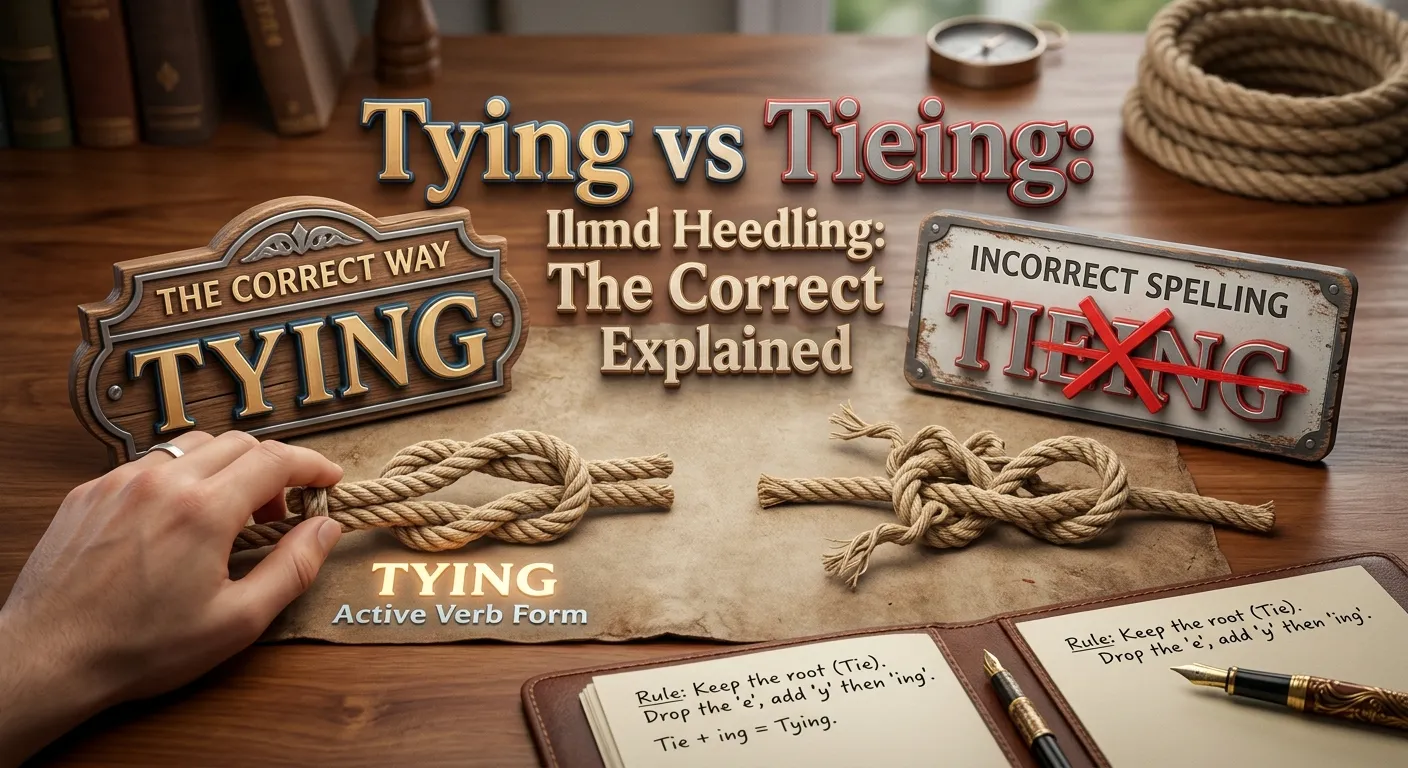
Tying is the correct spelling. Tieing is generally incorrect in standard English.
The confusion happens because the verb tie ends in -ie. When we add -ing, the spelling changes from -ie to -y:
tie → tying
Definition
- Tying: the correct present participle of tie, meaning fastening, connecting, or securing something.
- Tieing : an incorrect spelling in standard English.
Pronunciation
Tying is pronounced like “tie-ing.”
The word has two syllables.
Featured Snippet Answer
Tying is the correct spelling, not tieing. When the verb tie takes the -ing ending, the final -ie changes to -y. Therefore, tie + ing = tying. For example: She is tying her shoelaces.
Quick Answer
The correct spelling is tying. ❌ Tieing is incorrect.
The spelling rule is:
When a verb ends in -ie, change -ie to -y before adding -ing.
So:
tie + ing → tying
Other examples include:
- die → dying
- lie → lying
- vie → vying
Quick Comparison Table
| Word | Correct? | Meaning | Example |
| Tying | ✅ Yes | Fastening or securing something | She is tying her shoes. |
| Tieing | ❌ No | Incorrect spelling | ❌ She is tieing her shoes. |
Tying or Tieing: Which Is Correct?
Tying is the standard and correct spelling.
The word comes from the verb tie, which means to fasten or secure something using a knot, string, rope, ribbon, or similar material.
When -ing is added to tie, we do not simply write:
tie + ing = tieing ❌
Instead, English changes the final -ie to -y:
tie + ing = tying ✅
For example:
She is tying her shoelaces.
He was tying the package with string.
They are tying the boat to the dock.
Why Is “Tieing” Incorrect?
The spelling tieing looks logical because we might expect to add -ing directly to the base word:
tie + ing → tieing
However, English has a specific spelling rule for verbs ending in -ie.
The Rule
When a verb ends in -ie, change -ie to -y before adding -ing.
Pattern
-ie → -y + -ing
Examples:
tie → tying
lie → lying
die → dying
vie → vying
This prevents awkward spellings such as tieing, lieing, and dieing.
Grammar Rule: Verbs Ending in -ie
The -ie → -y spelling change applies when forming the present participle or gerund with -ing.
Examples
| Base Verb | + -ing | Correct Form |
| tie | tie + ing | tying |
| lie | lie + ing | lying |
| die | die + ing | dying |
| vie | vie + ing | vying |
Notice that the -ie at the end of the original verb becomes -y.
Easy Formula
Verb ending in -ie → change -ie to -y + ing
Therefore:
tie → tying
Tying: Meaning and Usage
Tying is the present participle and gerund form of tie.
The verb tie can have several meanings.
1. To fasten something
She is tying her shoelaces.
2. To secure something with a knot
He is tying the rope to the tree.
3. To connect or attach things
The worker is tying the cables together.
4. To make a tie in a competition
The two teams are tying for first place.
5. To connect ideas or events
The researcher is tying the results to previous studies.
Tying in Different Tenses
The spelling tying is used whenever tie takes the -ing form.
Present continuous
She is tying her hair.
Past continuous
She was tying her hair when I called.
Future continuous
She will be tying the decorations tomorrow.
As a gerund
Tying a secure knot takes practice.
Common Mistakes
❌ Mistake 1: Writing “tieing”
Incorrect:
She is tieing her shoes.
Correct:
She is tying her shoes.
Why?
The verb tie ends in -ie, so -ie changes to -y before -ing is added.
❌ Mistake 2: Applying the wrong spelling pattern
Some learners remember the general rule of adding -ing without changing the base word.
For example:
play → playing
work → working
That works for many verbs, but verbs ending in -ie follow a special spelling rule.
tie → tying
❌ Mistake 3: Confusing “tying” with “tied”
Tying and tied are different forms of the verb tie.
She is tying her shoes.
She has tied her shoes.
Tying describes the action in progress, while tied is the past tense or past participle.
Tying vs. Tied
| Form | Function | Example |
| Tie | Base form | Please tie the rope. |
| Tying | Present participle/gerund | He is tying the rope. |
| Tied | Past tense/past participle | He tied the rope. |
Remember:
tie → tying → tied
Tying vs. Tieing Examples
Correct: Tying
- She is tying her shoelaces.
- He is tying a ribbon around the gift.
- They are tying the boat to the dock.
- I watched him tying the rope.
- Tying a knot requires practice.
Incorrect: Tieing
- ❌ She is tieing her shoelaces.
- ❌ He is tieing a ribbon around the gift.
- ❌ They are tieing the boat to the dock.
- ❌ I watched him tieing the rope.
- ❌ Tieing a knot requires practice.
In every case, replace tieing with tying.
Other Words That Follow the Same Rule
Tying is not the only word affected by the -ie → -y rule.
Lie → Lying
He is lying on the sofa.
Not:
❌ He is lieing on the sofa.
Die → Dying
The flowers are dying.
Not:
❌ The flowers are dieing.
Vie → Vying
Several companies are vying for the contract.
Not:
❌ Several companies are vieing for the contract.
Spelling Pattern
tie → tying
lie → lying
die → dying
vie → vying
The pattern is consistent: -ie changes to -y before -ing.
A Note About “Dyeing”
One particularly important distinction is between dying and dyeing.
Dying comes from die:
The plant is dying.
Dyeing comes from dye and means coloring something:
She is dyeing her clothes.
This is different from tying, but it is a useful reminder that English spelling changes can affect pronunciation and meaning.
How to Remember Tying
Use this simple memory trick:
IE changes to Y before ING.
Think:
TIE
↓
Change IE to Y
↓
Add ING
↓
TYING
Memory Formula
tie + ing = tying
Never:
❌ tieing
Tying or Tieing: British vs. American English
There is no major British-American spelling difference here.
Both British English and American English use:
tying ✅
The spelling tieing is not the standard form in either variety.
So whether you are writing for a British or American audience, use tying.
Quick Learning Tip
When you see a verb ending in -ie, pause before adding -ing.
Ask yourself:
Does the verb end in -ie?
If yes, change -ie to -y and then add -ing.
For example:
tie → tying
lie → lying
die → dying
vie → vying
This simple pattern will help you avoid many common spelling mistakes.
Mini Quiz: Tying or Tieing?
Choose the correct spelling.
- She is ___ her shoelaces.
a) tieing
b) tying - He was ___ a knot in the rope.
a) tieing
b) tying - ___ a secure knot is an important skill.
a) Tieing
b) Tying - They are ___ the decorations to the wall.
a) tieing
b) tying - The child is ___ a ribbon around the box.
a) tieing
b) tying
Answers
- b) tying
- b) tying
- b) Tying
- b) tying
- b) tying
Learning Outcomes
After reading this guide, you should be able to:
- identify tying as the correct spelling;
- understand why tieing is incorrect;
- apply the -ie → -y + -ing spelling rule;
- distinguish tying, tied, and tie;
- recognize similar patterns such as lie → lying and die → dying.
Frequently Asked Questions
Q: Is it tying or tieing?
A: Tying is correct. Tieing is incorrect.
Q: Why is tying spelled with a y?
A: Because verbs ending in -ie change -ie to -y before -ing is added.
Q: What is the spelling rule for tie + ing?
A: The final -ie changes to -y, giving tying.
Q: Is tying a correct word?
A: Yes. Tying is the present participle and gerund form of tie.
Q: Is tieing ever correct?
A: No. Tieing is not the standard spelling. Use tying instead.
Q: What are other examples of the -ie to -y rule?
A: Common examples include lie → lying, die → dying, and vie → vying.
Q: What is the past tense of tie?
A: The past tense of tie is tied.
Q: What is the difference between tying and tied?
A: Tying describes an action in progress, while tied is the past tense or past participle of tie.
Final Verdict
Tying is the only correct standard spelling. Tieing is incorrect.
The key rule is simple:
When a verb ends in -ie, change -ie to -y before adding -ing.
So:
tie → tying ✅
tie → tieing ❌
Bottom line: Always write tying in standard English.
Writing” or “Writting”: Which Spelling Is Correct?

Rose Vault is an English language author who specializes in spelling comparisons, commonly confused words, and grammar. She creates clear, well-researched content that helps readers improve their writing and use English with confidence. Her goal is to make language learning simple, accurate, and accessible for everyone.