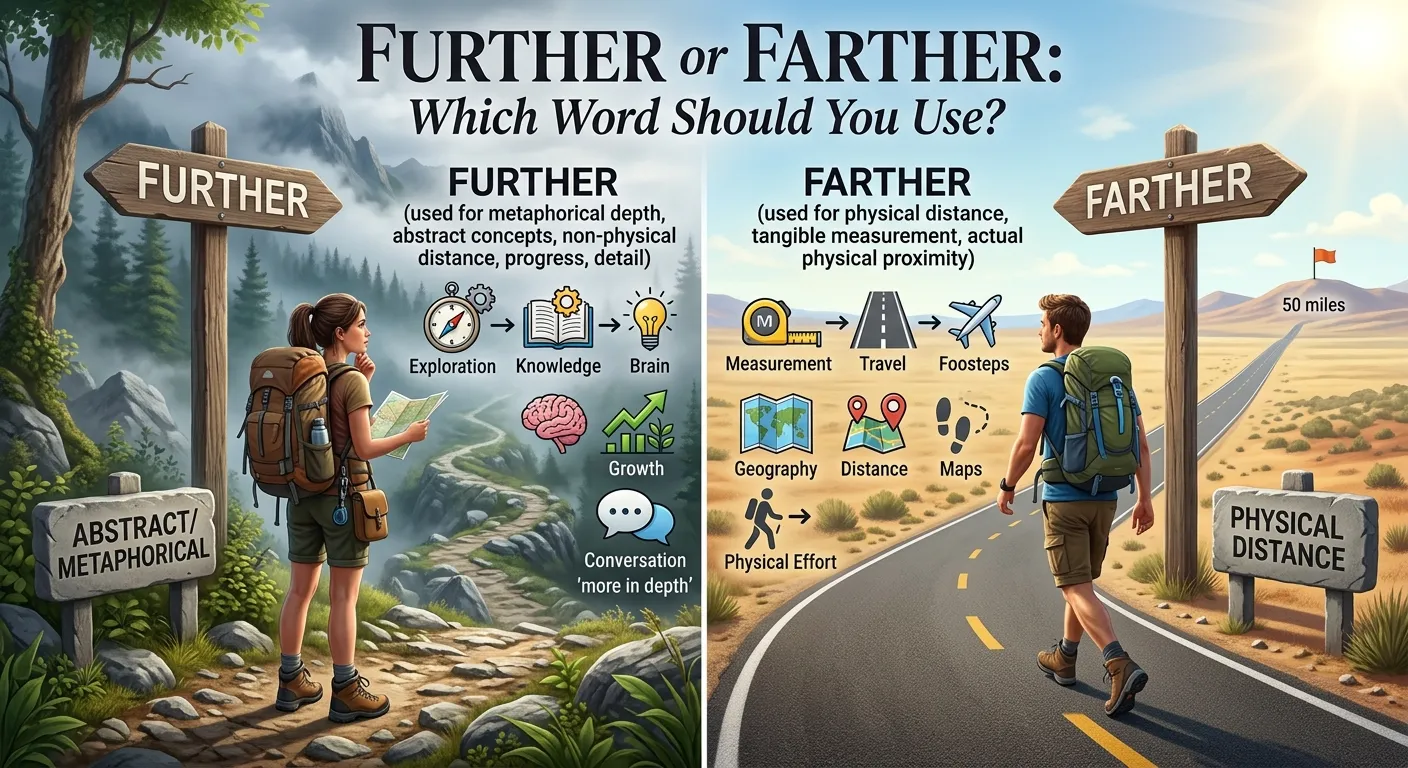
Further and farther are commonly confused words because both can describe something that is more distant. The main difference is that farther is traditionally associated with physical distance, while further is used for additional, figurative, or abstract meanings. However, in modern English, further is also commonly used for physical distance.
One-Line Definitions
- Further = more, additional, or to a greater degree or distance.
- Farther = to or at a greater physical distance.
Pronunciation
- Further: /ˈfɜːr.ðər/ (UK), /ˈfɝː.ðɚ/ (US)
- Farther: /ˈfɑːr.ðər/ (UK), /ˈfɑːr.ðɚ/ (US)
Featured Snippet: Further vs. Farther
Further and farther can both mean “at or to a greater distance.” Use farther especially for measurable physical distance, such as farther down the road. Use further for additional information, progress, degree, or abstract ideas, such as further discussion. In modern English, further is also widely used for physical distance.
Quick Answer: Further or Farther?
Use farther when you are talking specifically about physical distance.
We walked farther than we expected.
Use further when you mean more, additional, or to a greater degree.
We need further information.
But there is an important point: further can also be used for physical distance, and it is very common in everyday English. So these can both be correct:
We walked farther down the road.
We walked further down the road.
A simple rule is:
Physical distance → farther or further
Additional/abstract meaning → further
Quick Comparison Table
| Word | Main Use | Example |
| Further | More or additional | I need further information. |
| Further | Greater degree or progress | We need to discuss this further. |
| Further | Physical distance | Walk further down the road. |
| Farther | Physical distance | The store is farther away. |
| Farther | Greater physical distance | She ran farther than I did. |
What Does Further Mean?
Further means more, additional, to a greater degree, or to a greater distance.
It can describe both physical distance and abstract ideas. It is especially common when talking about additional information, discussion, progress, development, or degree.
Examples of Further
- Please provide further information.
- We need further discussion before making a decision.
- I don’t want to discuss the matter further.
- The problem became further complicated.
- Let’s walk further down the road.
Further as a Verb
Further can also be a verb meaning to develop, advance, or help something progress.
Education can further your career.
The campaign aims to further public awareness.
What Does Farther Mean?
Farther means to or at a greater physical distance. It is traditionally used when comparing measurable or observable distance.
Examples of Farther
- The school is farther from my house than the library.
- How much farther do we have to walk?
- She ran farther than her brother.
- The second village is farther away.
- We drove farther north before stopping.
Think of farther as the word that naturally connects with physical distance.
Further vs. Farther: The Main Difference
The traditional distinction is simple:
Further = additional or abstract
Use further when you mean:
- more
- additional
- to a greater degree
- further progress
- further discussion
- further information
- further explanation
We need further evidence.
Let’s discuss the issue further.
Farther = physical distance
Use farther when comparing actual physical locations or distances.
The airport is farther away than the station.
How much farther is the hotel?
However, modern English does not always maintain this distinction. Further is widely used for physical distance, and major dictionaries recognize both forms in that context.
The Easy Memory Trick
Use this simple trick:
FARTHER → FAR
The word farther contains far.
Far → Farther → physical distance
The mountain is farther away.
For further, think:
Further = more or additional
Do you need further help?
This trick is useful, but remember that further can also describe physical distance.
Further or Farther: Examples Side by Side
| Further | Farther |
| We need further information. | The village is farther away. |
| Let’s discuss this further. | She walked farther than me. |
| There will be further changes. | The second station is farther north. |
| I cannot take this any further. | How much farther is the airport? |
| We need further explanation. | The house is farther down the road. |
Notice the Difference
In the first column, further refers to something additional or a greater degree.
In the second column, farther refers to physical distance.
When Should You Always Use Further?
There are several situations where further is the natural and standard choice.
1. For Additional Information
Use further when you mean additional.
Please contact us for further information.
For further details, visit the office.
❌ farther information
✅ further information
2. For Additional Discussion
Use further when talking about discussing something more.
We need to discuss the matter further.
I don’t want to take this argument any further.
❌ We need to discuss the matter farther.
✅ We need to discuss the matter further.
3. For Progress or Development
Use further when talking about advancing or developing something.
This course will further your knowledge.
The project needs further development.
She wants to further her career.
Cambridge also defines further as a verb meaning to develop or make progress in something.
When Should You Use Farther?
Use farther when the meaning clearly involves physical distance.
Example 1
The blue car is farther from the entrance.
Example 2
We walked farther than the other group.
Example 3
The village is farther north.
Example 4
How much farther do we have to travel?
In these examples, you can imagine measuring the distance.
Can Further Be Used for Physical Distance?
Yes.
This is one of the most important points to remember.
Although traditional grammar advice often says:
farther = physical distance
modern English also commonly uses further for physical distance. Cambridge specifically notes that further and farther can have the same meaning when referring to distance, with further being more common overall.
For example:
We walked farther down the street.
We walked further down the street.
Both are acceptable.
Therefore, don’t assume that every use of further for distance is wrong.
British vs. American English
There is some variation between British and American English.
In both varieties, farther is commonly associated with physical distance, while further is used for additional or abstract meanings.
However, further is also widely used for physical distance, especially in British English and in general modern usage. Cambridge notes that there is no difference in meaning between farther and further when they refer to distance, and that further is more common.
So, depending on the context, you may see:
How much farther do we have to go?
or
How much further do we have to go?
Both are commonly accepted.
Common Expressions With Further
Some expressions almost always use further.
Further information
For further information, please contact us.
Further details
See the website for further details.
Further discussion
We need further discussion before deciding.
Further notice
The office is closed until further notice.
Further education
She plans to continue her further education.
Further to
Further to is commonly used in formal British English correspondence to refer to an earlier letter, email, conversation, or meeting.
Further to your email, I am writing to confirm the meeting.
Common Expressions With Farther
Farther is most natural when the phrase refers to physical distance.
Farther away
The hotel is farther away than I thought.
Farther north
The weather is colder farther north.
Farther south
They traveled farther south.
Farther down the road
The restaurant is farther down the road.
Farther than
She ran farther than anyone else.
Common Mistakes
Mistake 1: Using Farther for Additional Information
❌ Please provide farther information.
✅ Please provide further information.
Why?
Here, information is additional, not physical distance.
Mistake 2: Thinking Further Is Never Used for Distance
❌ We walked further down the road.
“Further is always wrong for distance.”
This is not correct.
✅ We walked further down the road.
✅ We walked farther down the road.
Both can be used for physical distance.
Mistake 3: Using Farther for Abstract Progress
❌ We need to take this discussion farther.
✅ We need to take this discussion further.
Here, the meaning is develop or continue, not physical distance.
Grammar Rule: Further vs. Farther
The traditional grammar rule is:
Use farther for physical distance and further for additional, abstract, or figurative meanings.
But modern English is more flexible:
Further can also be used for physical distance.
Therefore, the safest practical rule is:
Use farther when you want to emphasize measurable physical distance. Use further for additional, abstract, or figurative meanings. For physical distance, further is also correct and widely used.
Further vs. Farther in Sentences
Physical distance
The library is farther from here than the school.
The library is further from here than the school.
Both are acceptable.
Additional information
I need further information.
Only further works naturally here.
More discussion
Let’s discuss this further.
Not farther, because the meaning is abstract.
Greater progress
We need to go further with the research.
Here, further means to make more progress.
Physical movement
We walked farther than expected.
Farther is especially clear because the sentence describes measurable physical distance.
Further or Farther? Quick Decision Guide
Ask yourself one question:
Am I talking about additional information, progress, degree, or an abstract idea?
Yes → Further
We need further explanation.
Am I emphasizing measurable physical distance?
Yes → Farther
The store is farther away.
Is it physical distance, but further sounds natural?
Further is also acceptable.
We walked further down the road.
This flexible approach reflects modern English usage.
Mini Quiz: Further or Farther?
Choose further or farther in each sentence.
- How much ______ do we have to walk?
- I need ______ information about the course.
- The hospital is ______ away than the school.
- We need to discuss this ______.
- The train traveled ______ north.
- Please contact us for ______ details.
- She ran ______ than her sister.
- We cannot take this argument any ______.
Answers
- farther / further
- further
- farther / further
- further
- farther / further
- further
- farther / further
- further
For sentences involving physical distance, both forms can often work. For additional or abstract meanings, further is the correct choice.
Learning Outcomes
After reading this guide, you should be able to:
- Understand the difference between further and farther.
- Identify farther as a traditional choice for physical distance.
- Use further for additional and abstract meanings.
- Recognize that further can also describe physical distance.
- Avoid common mistakes such as farther information.
- Choose the most natural word based on context.
Frequently Asked Questions
Q: Is farther or further correct?
A: Both are correct. Traditionally, farther is associated with physical distance, while further is used for additional or abstract meanings. However, further is also commonly used for physical distance.
Q: Is further information or farther information correct?
A: Further information is correct.
Please contact us for further information.
Here, further means additional.
Q: Is it farther away or further away?
A: Both can be used. Farther away emphasizes physical distance, while further away is also common in modern English.
Q: Is farther only used for distance?
A: Farther is primarily associated with physical distance. For additional, abstract, or figurative meanings, further is the standard choice.
Q: Which is more common: further or farther?
A: Further is more common overall. Cambridge notes that both words can refer to distance but further is more common.
Q: What is the easiest way to remember farther vs. further?
A: Remember:
Farther → far → physical distance
Further → more/additional
This is a helpful shortcut, although further can also be used for physical distance.
Final Answer: Further or Farther?
Further and farther are both correct words, but they are traditionally used in different ways.
- Further = more, additional, greater degree, progress, or distance.
- Farther = greater physical distance.
Remember:
Farther → physical distance
Further → additional or abstract meaning
But don’t treat this as an absolute rule. Further is also commonly used for physical distance, so sentences such as “We walked further down the road” are perfectly acceptable.
If you’re writing formal or carefully edited English and want to emphasize measurable physical distance, farther is a useful choice. For expressions such as further information, further discussion, further details, and further progress, always choose further.
In One Sentence
Use farther when you want to emphasize physical distance but use further for additional or abstract meanings and remember that further is also acceptable for physical distance.
Dictionary reference: Cambridge Dictionary and English Grammar Today recognize further and farther as comparative forms of far and explain that both can be used for distance, while further has additional meanings such as “more,” “extra,” and “to a greater degree.”
Affect or Effect: What’s the Difference?
Hi, I’m Ashley Brown, a lifelong word enthusiast with a passion for making the English language less confusing.My goal is to help readers spell with confidence and never second-guess themselves again.