Writing means the act of putting words, letters, or ideas into written form.
Quick Answer
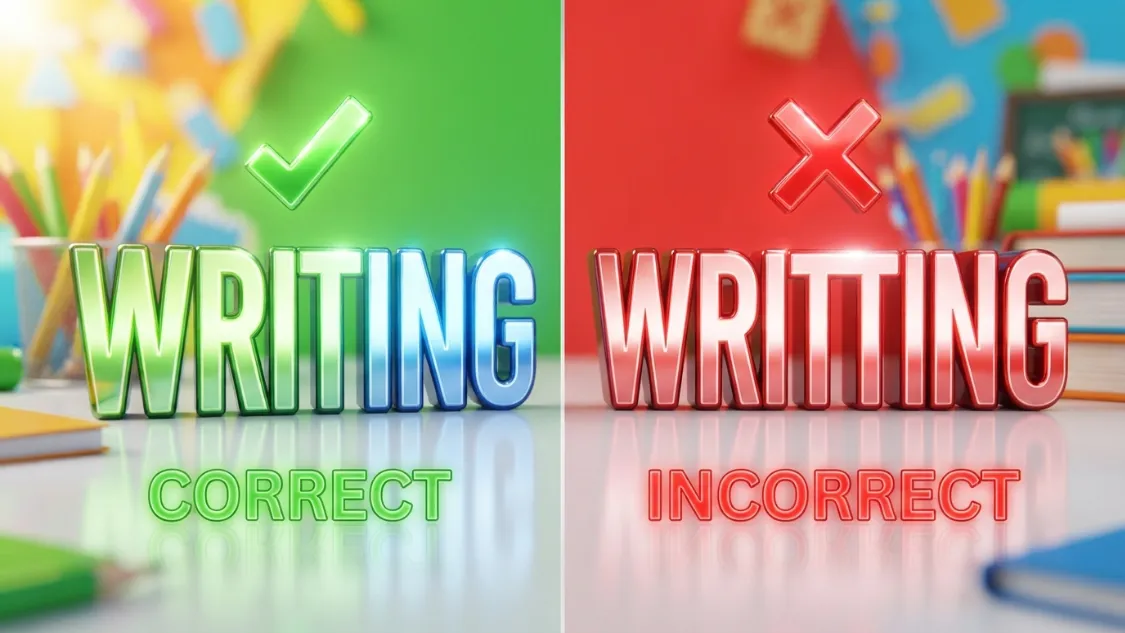
Writing is the correct spelling. Writting is incorrect. The word writing is the -ing form of write, and the final silent e is dropped before adding -ing.
| Spelling | Correct? | Meaning | Usage |
|---|---|---|---|
| writing | ✅ Yes | Putting words, letters, or ideas into written form | Standard English |
| writting | ❌ No | — | Common misspelling |
What You’ll Learn
By the end of this guide, you will know:
- Why writing is correct
- Why writting is incorrect
- How write changes to writing
- Why the t is not doubled
- How to use writing correctly in sentences
Why Is “Writing” Sometimes Spelled “Writting”?
The spelling writting is a common mistake because English has many verbs that double their final consonant before adding -ing.
For example:
- run → running
- sit → sitting
- stop → stopping
Because of these patterns, writting may look correct.
However, the verb write follows a different spelling rule. Its final silent e is removed before -ing is added:
write → writing
Therefore:
❌ writting
✅ writing
What Does “Writing” Mean?
Writing means putting words, letters, or ideas into written form.
It is the -ing form of the verb write and can also be used as a noun.
Examples
She is writing a letter.
I enjoy writing stories.
His writing is very clear.
The meaning depends on how the word is used in the sentence.
Why Is “Writing” Correct?
The base verb is write.
When a verb ends in a silent e, the final e is usually removed before adding -ing.
So:
write + ing → writing
The e disappears, but the t stays single.
Other examples
- make → making
- take → taking
- drive → driving
- hope → hoping
- use → using
The same general pattern explains why we write writing, not writting.
Why Don’t We Double the “T”?
This is the key point behind the spelling mistake.
Some verbs double their final consonant before adding -ing:
- run → running
- swim → swimming
- sit → sitting
- plan → planning
But write does not follow this pattern.
It ends with a silent e, so the spelling changes like this:
write → writing
The final e is removed, and the t is not doubled.
As a result, the correct spelling has only one t:
writing ✅
Memory Trick
Drop the E, keep one T.
WRITE → WRITING ✅
WRITTING ❌
“Writing” vs “Writting”: The Spelling Rule
The simple rule is:
When a verb ends in a silent -e, usually drop the -e before adding -ing.
For write:
write → writing
Not:
write → writeing ❌
And not:
write → writting ❌
This pattern also appears in:
- write → writing
- bite → biting
- invite → inviting
- excite → exciting
- complete → completing
Is “Writting” Ever Correct?
No. Writting is not the standard spelling of the -ing form of write.
The correct spelling is always writing when you mean the action or process of putting words into written form.
If you see writting in normal English writing, it is a spelling error.
Grammar Rule
Writing is the present participle and -ing form of write.
It can be used with forms of be to form continuous tenses:
She is writing an email.
They were writing their exams.
It can also function as a noun:
Writing takes practice.
And it can describe the written work produced by someone:
Her writing is easy to understand.
Verb Forms of “Write”
| Form | Word | Example |
|---|---|---|
| Base form | write | I write every day. |
| Third-person singular | writes | She writes well. |
| Past tense | wrote | He wrote a letter. |
| Past participle | written | She has written a book. |
| -ing form | writing | They are writing now. |
Common Mistakes
| Common Mistake | Correct Form | Why? |
|---|---|---|
| I am writting a letter. | I am writing a letter. | Drop the silent e and do not double t. |
| She is writeing an email. | She is writing an email. | The final e is removed before -ing. |
| He enjoys writting stories. | He enjoys writing stories. | Writing is the correct -ing form. |
| They were writting notes. | They were writing notes. | The correct participle is writing. |
Real-World Examples
Everyday English
I am writing a shopping list.
She is writing a message to her friend.
He spends an hour writing every evening.
Academic Writing
Students should improve their writing skills.
She is writing an essay for her English class.
Good writing requires clear ideas.
Professional Writing
I am writing to ask about the position.
She is writing a report for the manager.
We are writing a proposal for the project.
Grammar Relay Corner
Compare these sentences:
Correct:
She is writing a book.
Incorrect:
She is writting a book.
The correct form comes from:
write → writing
The final silent e is removed before -ing is added.
Similarly:
He is writing an email.
Not:
He is writeing an email.
So, remember both parts of the rule: remove the final e and do not double the t.
Vocabulary Corner
Here are some useful words from the same word family:
- write — to form words using letters or symbols
- writer — a person who writes
- writing — the act or result of writing
- wrote — the past tense of write
- written — the past participle of write
- rewriting — writing something again, often in a revised form
Example
The writer is rewriting the written report.
Mini Quiz
Choose the correct spelling.
- She is ______ an email.
- a) writting
- b) writing
- He enjoys ______ stories.
- a) writing
- b) writeing
- Which is the correct -ing form of write?
- a) writting
- b) writing
- c) writeing
- They were ______ notes during the lecture.
- a) writing
- b) writting
Answers
- writing
- writing
- writing
- writing
Practice Guide
Correct the spelling in these sentences:
- I am writting a report.
- She enjoys writting poems.
- They are writeing their answers.
- He was writting an email.
Correct Answers
- I am writing a report.
- She enjoys writing poems.
- They are writing their answers.
- He was writing an email.
Writing vs Writting: Final Comparison
| Spelling | Status | Explanation | Example |
|---|---|---|---|
| writing | ✅ Correct | The -ing form of write | She is writing a letter. |
| writting | ❌ Incorrect | Common misspelling | ❌ She is writting a letter. |
FAQs
Is it “writing” or “writting”?
Writing is correct. Writting is incorrect.
Why is “writing” spelled with one “t”?
Because write ends in a silent e. The e is dropped before -ing is added:
write → writing
The t is not doubled.
Why isn’t “writing” spelled “writeing”?
English normally drops the final silent e before adding -ing.
Therefore:
write + ing → writing
Is “writting” a word?
No. Writting is not the standard spelling of the -ing form of write. Use writing instead.
What is the difference between “write” and “writing”?
Write is the base form of the verb, while writing is its -ing form.
I write every day.
I am writing now.
What are the past forms of “write”?
The past tense is wrote, and the past participle is written.
She wrote a letter.
She has written a letter.
How can I remember the spelling of “writing”?
Remember:
write → remove e → writing
Do not double the t.
Key Takeaways
- Writing is the correct spelling.
- Writting is incorrect.
- Writing is the -ing form of write.
- The final silent e in write is dropped.
- The t is not doubled.
- Remember: write → writing, not writting.
The Same Rule, Broken Again
“Writting” is a familiar mistake writers double the final consonant thinking it matches the pattern of words like “sitting” or “running,” but “write” already loses its silent ‘e’ before “-ing,” leaving just one ‘t’. It’s the same rule mix-up that shows up in Comming or Coming, where the exact same silent-e-plus-single-consonant rule gets misapplied, and echoes the letter-slip pattern in Fiend or Feen.
Conclusion
The correct spelling is writing, while writting is a common misspelling.
The confusion comes from the fact that some English verbs double their final consonant before adding -ing, such as running and sitting. However, write follows a different pattern. Because it ends in a silent e, the e is removed before -ing is added:
write → writing
There is no need to double the t. So, whenever you mean the -ing form of write, use writing with one t.
The easiest rule to remember is simple: drop the silent e, but keep one t.
Now you can write writing correctly with confidence.

Amna Akhtar is a writer dedicated to making English easier to understand. She creates research-informed guides on grammar, vocabulary, spelling differences, and commonly confused words, combining careful research with clear, practical explanations. She is also the co-author of the peer-reviewed research article “Determinants of Jobs Satisfaction of Female Teachers: An Evidence from District Hafizabad, Pakistan,” published in the Journal of Education and Social Studies (2021).