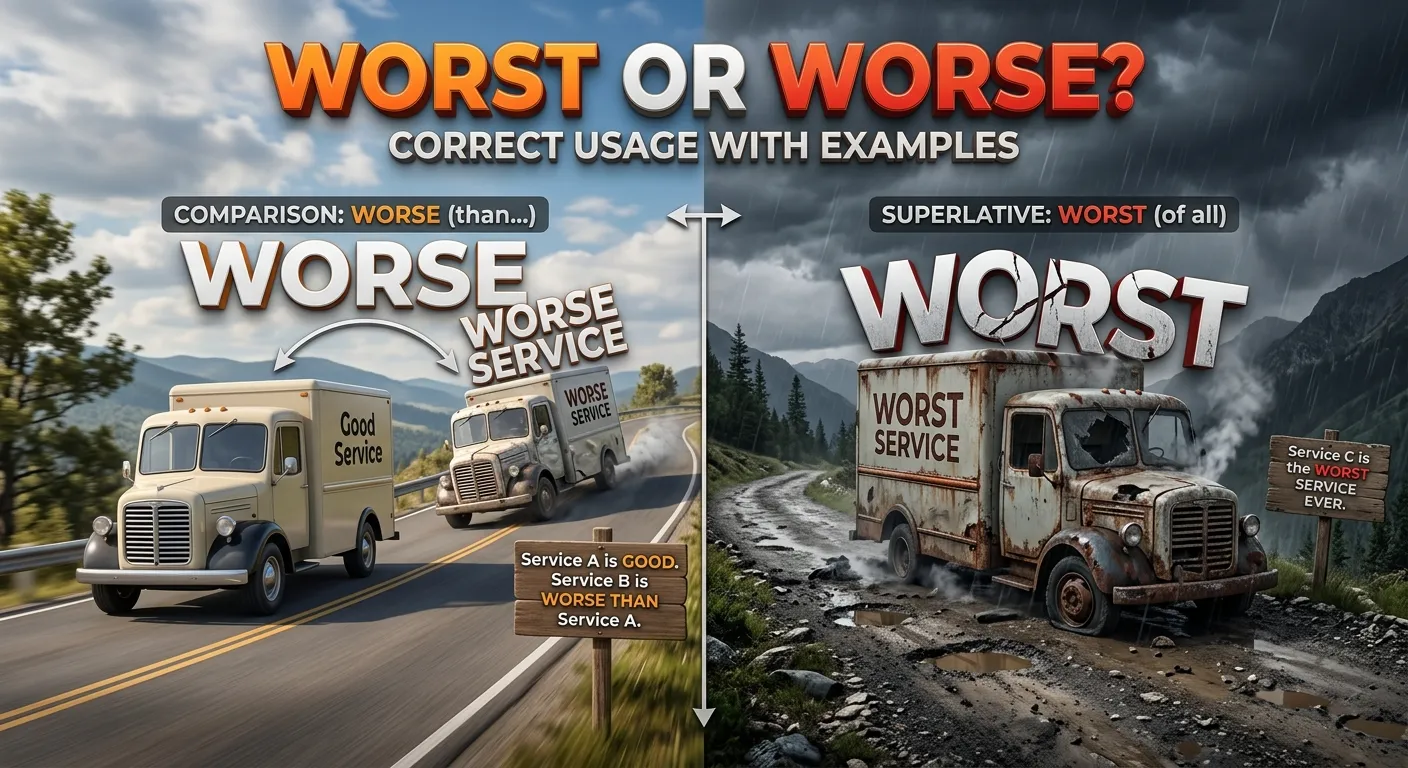
Worst and worse are both correct English words, but they are used differently. The main difference is degree of comparison: worse compares two things, while worst describes the lowest or most unpleasant level among three or more things or something at its extreme.
Quick Answer
Use worse when comparing two people, things, situations, or conditions.
This headache is worse than yesterday.
Use worst when talking about the most bad, unpleasant, or severe option in a group or situation.
This was the worst headache I have ever had.
Easy Rule
Bad → worse → worst
- Bad = negative quality
- Worse = more bad; compares two
- Worst = most bad; compares three or more or describes the extreme
Quick Comparison Table
| Word | Meaning | Main Use | Example |
| Worse | More bad or unpleasant | Comparing two things | Today is worse than yesterday. |
| Worst | Most bad or unpleasant | Extreme degree | Today was the worst day of my week. |
Definitions
- Worse the comparative form of bad, used to show that one thing is more unpleasant or serious than another.
- Worst the superlative form of bad, used to show the highest degree of something unpleasant or negative.
Learning Outcomes
By the end of this guide, you will know:
- When to use worse and worst
- Why worse compares two things
- Why worst usually refers to the highest degree
- How to remember the difference easily
- How to avoid common mistakes
- How to use both words naturally in sentences
Worse vs. Worst: What Is the Difference?
The easiest way to understand these words is to look at their place in the comparison of bad.
The three forms are:
Bad → Worse → Worst
For example:
This restaurant is bad.
This restaurant is worse than the one we visited yesterday.
This is the worst restaurant in town.
The meaning becomes stronger as you move from bad to worse to worst.
Grammar Rule
Worse = comparative degree
Use it when comparing two things.
Worst = superlative degree
Use it when identifying the most extreme example in a group or situation.
What Does “Worse” Mean?
Worse means more bad, unpleasant, difficult, serious, or poor than something else.
It is the comparative form of bad.
Examples
- My cold is worse today.
- This road is worse than the other one.
- The weather became worse in the evening.
- Her second attempt was worse than her first.
- The situation is getting worse.
Notice that worse often appears with than when two things are directly compared.
This book is worse than that one.
However, than is not always necessary.
I thought the traffic would improve, but it became worse.
What Does “Worst” Mean?
Worst means the most bad, unpleasant, difficult, serious, or poor.
It is the superlative form of bad.
Examples
- This is the worst movie I have ever seen.
- Monday was the worst day of the week.
- That was the worst mistake I made.
- She had the worst experience at the airport.
- This is the worst restaurant on the street.
Worst usually identifies one thing as the extreme example within a group or experience.
Why Do People Confuse Worse and Worst?
The confusion happens because both words come from bad and both describe something negative.
Their forms are also irregular:
bad → worse → worst
They do not follow the regular pattern:
badder → baddest ❌
Instead, English uses:
bad → worse → worst ✅
Another reason is that people sometimes use worst when they simply mean worse.
For example:
This situation is worst than before. ❌
The correct sentence is:
This situation is worse than before. ✅
Origin of Worse and Worst
Both worse and worst have very old Germanic roots and are historically related to the word bad.
Their forms developed from older English words used to express different degrees of poor or negative quality.
Today, English retains this irregular comparison:
bad → worse → worst
This is why we do not form these words by simply adding -er and -est.
Dictionary Status
Both worse and worst are standard, correct English words.
Major English dictionaries such as Merriam-Webster, Oxford English Dictionary, and Cambridge Dictionary recognize them as established forms of bad.
The important distinction is their grammatical degree:
- Worse = comparative
- Worst = superlative
How to Remember Worse vs. Worst
Here is the easiest memory trick:
Worse = Two
Think:
Worse → We compare two.
Ali is worse than Bilal.
Worst = Winner of the Bad List
Think of worst as the final or extreme level.
Ali is the worst player on the team.
Another simple pattern:
Bad → Worse → Worst
Think of it as climbing down three levels:
bad → more bad → most bad
When to Use “Worse”
Use worse when:
1. Comparing two things
This phone is worse than my old one.
2. Describing a decline
His health became worse after the accident.
3. Saying that a situation is becoming more serious
The traffic is getting worse.
4. Talking about something less good than expected
The actual result was worse than we expected.
5. Comparing two experiences
My second interview was worse than my first.
When to Use “Worst”
Use worst when:
1. Identifying the lowest level in a group
This is the worst option.
2. Describing an extreme experience
It was the worst day of my life.
3. Talking about the most serious outcome
We prepared for the worst possible result.
4. Describing the poorest performance
He gave his worst performance of the season.
5. Talking about an extreme condition
The storm caused the worst damage in years.
Worse or Worst in Common Expressions?
Both words appear in many common expressions.
Worse
- worse than
- getting worse
- for better or worse
- worse still
- worse off
Examples:
Things are getting worse.
She is worse off financially.
Worst
- at worst
- at its worst
- the worst-case scenario
- come to the worst
- if the worst comes to the worst
Examples:
At worst, we will lose one day.
The weather was at its worst during the night.
Worse vs. Worst in Questions
Both words can appear in questions, but their meanings remain different.
Worse
Which situation is worse?
This usually asks you to compare two situations.
Worst
Which situation is the worst?
This asks you to identify the most serious or unpleasant option among several possibilities.
Common Mistakes
Mistake 1: Using “worst” with a two-item comparison
My old laptop is worst than my new laptop. ❌
Correct:
My old laptop is worse than my new laptop. ✅
Mistake 2: Using “worse” for the extreme example
This is the worse movie I have ever seen. ❌
Correct:
This is the worst movie I have ever seen. ✅
Mistake 3: Saying “badder” or “baddest”
This is badder than that. ❌
This is the baddest one. ❌
Correct:
This is worse than that. ✅
This is the worst one. ✅
Correct Examples
Examples with “Worse”
- The weather is worse today than yesterday.
- This problem is worse than I expected.
- My headache became worse after lunch.
- The second test was worse than the first.
- Things could get worse.
Examples with “Worst”
- This is the worst mistake I have ever made.
- It was the worst storm of the year.
- She received the worst score in the class.
- That was the worst experience of my trip.
- We should prepare for the worst.
Worse or Worst: At a Glance
| Situation | Correct Word | Example |
| Compare two things | Worse | This is worse than that. |
| Extreme degree | Worst | This is the worst one. |
| More bad | Worse | The pain is worse today. |
| Most bad | Worst | It was the worst pain I’ve felt. |
| With “than” | Usually worse | This is worse than before. |
| With “the” + extreme | Usually worst | This is the worst result. |
Fun Fact
Worse and worst are examples of irregular adjectives.
Most short adjectives form their comparative and superlative forms by adding -er and -est:
fast → faster → fastest
But bad changes completely:
bad → worse → worst
This irregular pattern is something English learners simply need to remember.
Mini Quiz: Worse or Worst?
Choose the correct word.
- This headache is ______ than yesterday.
- That was the ______ mistake I made.
- The weather is getting ______.
- This is the ______ restaurant in the area.
- Her second performance was ______ than her first.
- We should prepare for the ______.
- Which of the two options is ______?
- This is the ______ movie I have ever watched.
Answers
- worse
- worst
- worse
- worst
- worse
- worst
- worse
- worst
Practice Guide
Use this three-step method:
Step 1: Find the base word
Start with:
bad
Step 2: Ask whether you are comparing two things
If yes, use:
worse
Step 3: Ask whether something is the extreme or lowest level
If yes, use:
worst
Quick Test
Two → worse
Group/extreme → worst
My first attempt was worse than my second.
My first attempt was my worst attempt.
FAQs
Q: Is “worse” a correct word?
A: Yes. Worse is the comparative form of bad.
Q: Is “worst” a correct word?
A: Yes. Worst is the superlative form of bad.
Q: Is it “worse than” or “worst than”?
A: The correct phrase is worse than.
This is worse than before. ✅
Worst than is incorrect in standard English.
Q: Is “worser” a word?
A: Worser is generally considered nonstandard in modern standard English. Use worse instead.
This is worse than before. ✅
A: Is “more worse” correct?
No. In standard English, use worse, not more worse.
The situation is worse. ✅
Q: Which is stronger: worse or worst?
A: Worst is stronger because it expresses the highest degree of negativity.
bad → worse → worst
Grammar Relay Corner 🏃♀️
Bad → positive/base degree
Worse → comparative degree
Worst → superlative degree
Relay Example
The first day was bad.
The second day was worse.
The third day was the worst.
Think of the three forms as a grammar relay:
BAD → WORSE → WORST
Synonyms and Antonyms
Synonyms of Worse
Depending on context:
- poorer
- inferior
- more serious
- more unpleasant
- more difficult
- more harmful
- more problematic
Synonyms of Worst
Depending on context:
- poorest
- lowest
- most serious
- most unpleasant
- most difficult
- most harmful
- most terrible
Antonym Relationship
The opposite scale is commonly expressed as:
good → better → best
So we have:
| Negative | Positive |
| bad | good |
| worse | better |
| worst | best |
Word Family
The comparison family is:
Bad → Worse → Worst
Related forms include:
- badly
- badness
- worsen
- worsening
Example:
The situation began to worsen.
Idiom: For Better or Worse
For better or worse means regardless of whether the situation becomes better or worse.
We decided to stay together for better or worse.
This expression uses worse, not worst, because it contrasts two conditions:
better ↔ worse
Proverb: Hope for the Best, Prepare for the Worst
This familiar expression means that you should remain hopeful while also preparing for a possible bad outcome.
We hope for the best but prepare for the worst.
Notice that worst is used because it refers to the most negative possible outcome.
Key Takeaways
- Worse and worst are both correct words.
- Worse is the comparative form of bad.
- Worst is the superlative form of bad.
- Use worse when comparing two things.
- Use worst for the highest or most extreme negative degree.
- The correct sequence is bad → worse → worst.
- Say worse than, not worst than.
- Avoid nonstandard forms such as worser and more worse in formal English.
Conclusion
Worse and worst are easy to confuse, but their roles are different. Use worse when one thing is more negative than another, especially in a comparison between two things. Use worst when something represents the highest degree of negativity or is the most unpleasant option in a group.
Remember the simple pattern:
Bad → Worse → Worst
If you are comparing two, choose worse. If you are describing the most extreme case, choose worst.
Quite or Quiet: What’s the Difference?

Hi, I’m Ashley Brown, a lifelong word enthusiast with a passion for making the English language less confusing.My goal is to help readers spell with confidence and never second-guess themselves again.