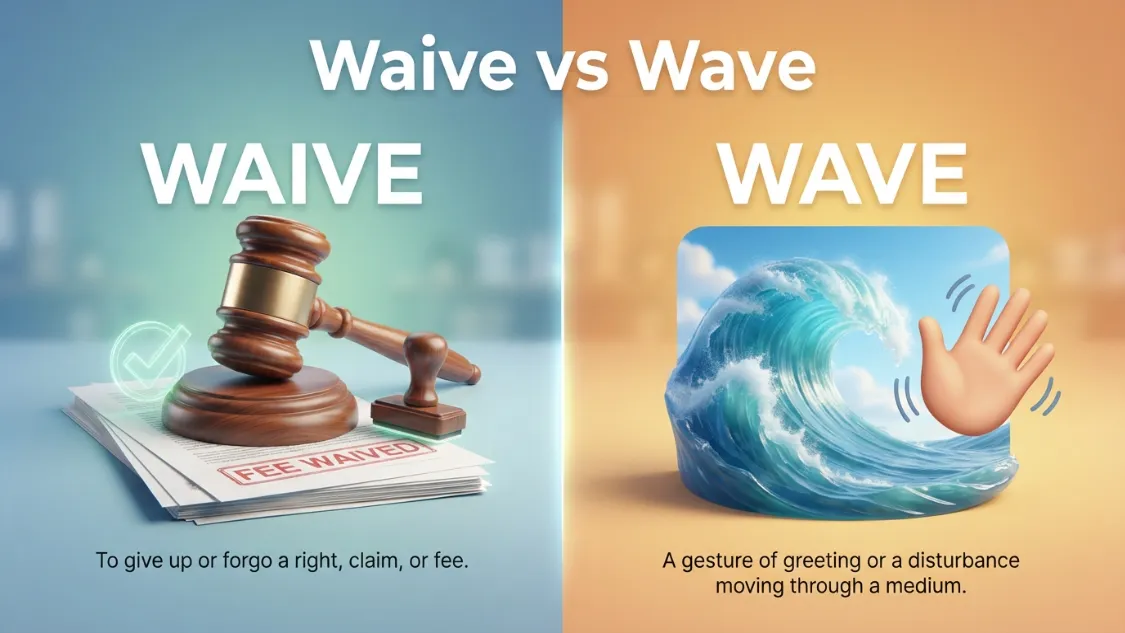
Waive means to voluntarily give up or cancel a right, fee, rule, or requirement, while wave means to move from side to side, especially as a greeting, or a moving ridge of water.
Quick Answer
Waive and wave are both correct English words, but they have different meanings and spellings. They are homophones, which means they are pronounced the same but have different meanings and uses.
Quick Comparison
| Word | Correct? | Meaning | Usage |
|---|---|---|---|
| Waive | Yes | To give up or choose not to enforce something | Formal, legal, everyday |
| Wave | Yes | A moving ridge of water, or to move your hand as a greeting | Everyday, scientific, general |
Why Are Waive and Wave Confusing?
Have you ever heard someone say, “I will waive the fee,” and wondered why it is not spelled wave? Or perhaps you have written waive when you meant the movement of your hand?
These two words are easy to mix up because waive and wave sound exactly the same in standard English. But their meanings are very different. One is mainly about giving up a right, rule, fee, or requirement, while the other can describe a movement, a greeting, or a ridge of water.
The good news is that the difference becomes simple once you connect each spelling with its meaning. In this guide, you will learn what waive and wave mean, how they are used, common mistakes to avoid, and an easy way to remember which word you need.
What Does “Waive” Mean?
Waive means to give up a right, claim, rule, fee, or requirement voluntarily.
For example:
- The company agreed to waive the delivery fee.
- She decided to waive her right to appeal.
- The school may waive the application fee for eligible students.
Think of waive as giving something up.
Common Uses of “Waive”
You often see waive in formal, legal, financial, and administrative contexts.
Common phrases include:
- waive a fee
- waive a requirement
- waive a right
- waive a rule
- waive a penalty
- waive a charge
Grammar Rule: Waive is a verb. It normally takes an object: someone waives something.
The bank waived the fee.
The past tense is waived.
The company waived the charge.
What Does “Wave” Mean?
Wave has several meanings, but the most common ones involve movement.
As a noun, a wave can mean a raised movement of water:
A large wave hit the shore.
It can also describe a period or increase of something:
A new wave of students joined the program.
As a verb, wave means to move your hand or another object from side to side, often as a greeting.
She waved goodbye.
So, while waive is connected with giving something up, wave is connected with movement.
“Waive” vs “Wave”: What’s the Difference?
The key difference is meaning and spelling, not pronunciation.
| Feature | Waive | Wave |
|---|---|---|
| Pronunciation | Same | Same |
| Part of speech | Verb | Noun and verb |
| Main meaning | Give up or remove a right, fee, or requirement | Move from side to side; a moving ridge of water |
| Example | They waived the fee. | She waved at me. |
| Common context | Legal, financial, formal | Everyday, physical, scientific |
A Simple Rule to Remember
If you mean “give up” or “not require,” use waive.
If you mean “move your hand” or “a moving ridge of water,” use wave.
The hotel waived the cancellation fee.
She waved to her friend.
Why Are “Waive” and “Wave” Homophones?
Waive and wave are homophones because they have the same pronunciation but different spellings and meanings.
The spelling helps distinguish the words in writing.
- waive → give up or remove a requirement
- wave → move, greet, or a moving ridge of water
This is why hearing the word alone may not tell you which spelling is intended. The context gives you the answer.
Pronunciation
Both words are generally pronounced:
/weɪv/
They sound like the word “wave.”
The difference is visible in writing, not in normal pronunciation.
waive → /weɪv/
wave → /weɪv/
Because they sound alike, spelling mistakes are common, especially for English learners.
Easy Memory Trick: Waive vs Wave
Waive = Give up
Wave = Move
Common Mistakes
| Common Mistake | Correct Form | Why? |
|---|---|---|
| The company will wave the fee. | waive the fee | A fee is being given up or removed. |
| She waived at me. | waved at me | A person moves a hand: wave. |
| The bank waved the penalty. | waived the penalty | A penalty is being removed. |
| The children waived goodbye. | waved goodbye | The action of greeting is wave. |
| The manager waved the requirement. | waived the requirement | A requirement is being given up. |
Real-World Examples
Everyday English
I waved to my neighbor this morning.
Here, waved means moved your hand as a greeting.
Financial Context
The bank waived the late payment fee.
Here, waived means the bank chose not to charge the fee.
School Context
The university may waive the application fee.
The university may choose not to require the fee.
Physical Meaning
A huge wave crashed onto the beach.
Here, wave refers to moving water.
Professional Writing
The organization agreed to waive the requirement.
This is a formal use of waive.
Grammar Relay Corner
Both words can appear in different grammatical roles.
Waive
Waive is a verb.
- Present: They waive the fee.
- Past: They waived the fee.
- Present participle: They are waiving the fee.
Wave
Wave can be a noun or a verb.
As a verb:
She waves at her friends.
Past tense:
She waved at them.
As a noun:
A large wave approached the boat.
The grammatical role and sentence meaning help you choose the correct spelling.
Vocabulary Corner
Word Family of “Waive”
Useful related forms include:
- waive — give up a right or requirement
- waived — gave up or removed something
- waiving — giving up or removing something
Words Related to “Wave”
Depending on the meaning, related words include:
- waved
- waving
- waves
- wavelike
Common collocations include:
- wave goodbye
- wave hello
- wave a flag
- ocean wave
- sound wave
- heat wave
How Can You Remember the Difference?
Try this simple memory trick:
Waive = Give up
Both waive and give involve giving something up.
Waive a fee = give up the fee.
Wave = Move
Think about your hand moving from side to side.
Wave hello.
Wave goodbye.
You can also remember:
Waive → permission, fees, rights, requirements
Wave → hands, flags, water, movement
Mini Quiz
Choose waive or wave.
- The hotel agreed to ______ the extra charge.
- She ______ goodbye before leaving.
- A huge ______ hit the boat.
- The school may ______ the admission fee.
- He ______ at his teacher.
Answers
- waive
- waved
- wave
- waive
- waved
Standalone Comparison
| Word | Meaning | Typical Context | Example |
|---|---|---|---|
| Waive | Give up or remove a right, fee, or requirement | Legal, financial, formal | They waived the fee. |
| Wave | Move from side to side or a moving ridge of water | Everyday, physical, scientific | She waved goodbye. |
What You’ll Learn
By the end of this guide, you should know:
- Waive and wave are both correct words.
- They are pronounced the same.
- Waive means to give up or remove something.
- Wave refers to movement, a greeting, or moving water.
- Context determines which spelling you need.
Frequently Asked Questions
Q: Is “waive” or “wave” correct?
A: Both are correct. They have different meanings. Use waive when you mean to give up or remove something, and wave for movement, greeting, or moving water.
Q: Are “waive” and “wave” homophones?
A: Yes. Waive and wave are homophones because they have the same pronunciation but different spellings and meanings.
Q: What does “waive” mean?
A: Waive means to voluntarily give up a right, fee, requirement, claim, or rule.
The company waived the fee.
Q: What does “wave” mean?
A: Wave can mean to move your hand from side to side, or it can refer to a moving ridge of water. It has other meanings as well, such as a sound wave or heat wave.
Q: Is “wave the fee” correct?
A: No, not when you mean to remove or cancel a fee. The correct expression is “waive the fee.”
The hotel agreed to waive the fee.
Q: Is “waived goodbye” correct?
A: No. The correct form is “waved goodbye.”
She waved goodbye to her friends.
Q: Do “waive” and “wave” sound the same?
A: Yes. Both are normally pronounced /weɪv/. Their spelling and meaning are different even though their pronunciation is the same.
Key Takeaways
- Waive and wave are both correct English words.
- They are homophones with the same pronunciation.
- Waive means to give up or remove something, such as a fee or requirement.
- Wave can mean to move your hand, greet someone, or describe moving water.
- Remember: waive = give up; wave = move.
One Sound, Two Directions
Say “waive” and “wave” out loud and there’s no telling them apart yet one means giving up a right or claim, and the other means anything from a hand gesture to an ocean swell. Same sound, completely unrelated meanings. It’s the same trick English plays in Baring or Barring and Whack or Wack words that sound identical but demand you know exactly which one fits the sentence.
Conclusion
The difference between waive and wave is simple once you connect each spelling with its meaning. Waive is a verb meaning to give up, remove, or choose not to enforce something. You can waive a fee, requirement, right, or penalty. Wave, on the other hand, can describe a hand movement, a greeting, or a ridge of moving water. It can also be used for other kinds of movement, such as a sound wave.
Both words are correct, but they cannot normally replace each other. Since they sound exactly alike, focus on the meaning of the sentence before choosing the spelling.
Remember the shortcut: waive = give up; wave = move. Once you learn this simple connection, you can use both words confidently.

I’m Leo Jackson, an English writer with a soft spot for the peculiarities of language and spelling. I believe good spelling shouldn’t feel like guesswork, so I break down each comparison into clear, practical explanations anyone can use. Outside of writing, I’m usually buried in a novel or hunting down the next tricky word pair to demystify.