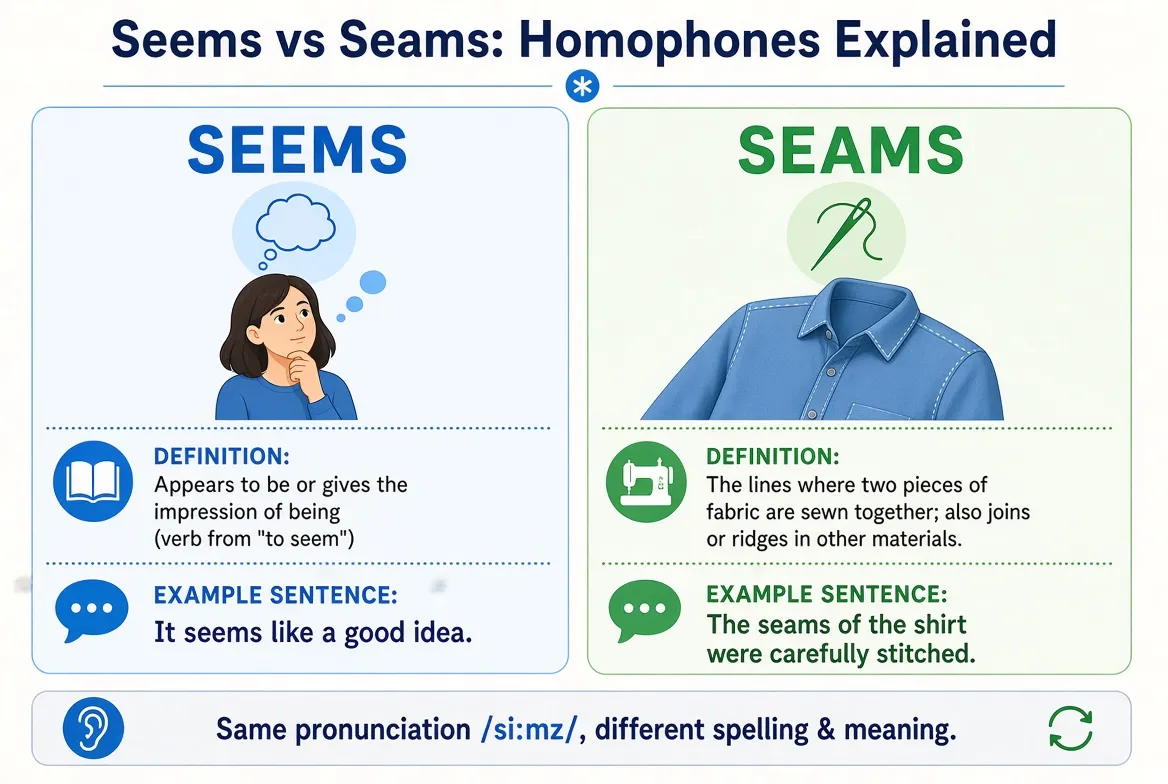
Seems means appears to be or gives the impression of something while Seams are Lines where two pieces of fabric or another material are joined.
Quick Answer
“Seems” and “seams” are both correct English words, but they have different meanings. Seems is the third-person singular form of the verb seem, meaning “appears” or “gives an impression.” Seams is the plural of seam, meaning lines where pieces of fabric or other materials are joined. They are homophones because they sound the same but have different spellings and meanings.
Quick Comparison Table
| Word | Meaning | Part of Speech | Example |
|---|---|---|---|
| Seems | Appears or gives an impression | Verb | She seems happy. |
| Seams | Lines where materials are joined | Noun | The dress has neat seams. |
What Does “Seems” Mean?
Seems is the third-person singular present form of the verb seem.
It means appears to be true, appears to have a particular quality, or gives a particular impression.
Examples of “Seems”
- He seems tired after work.
- This solution seems reasonable.
- She seems very confident.
- It seems like a good idea.
- The weather seems colder today.
Grammar Rule for “Seems”
Use seems with a singular third-person subject, such as he, she, it, or a singular noun.
- She seems happy. ✅
- The plan seems practical. ✅
- They seems happy. ❌
- They seem happy. ✅
Common structures include:
Subject + seems + adjective
The movie seems interesting.
Subject + seems + like + noun
It seems like a good opportunity.
And Subject + seems + to + verb
He seems to understand the problem.
What Does “Seams” Mean?
Seams is the plural form of the noun seam.
A seam is a line where two pieces of fabric or another material are joined together. The word is commonly used when talking about clothing, sewing, upholstery, and manufactured materials.
Examples of “Seams”
- The tailor carefully stitched the seams.
- Check the seams of the jacket for loose threads.
- The dress has decorative seams.
- The trousers are beginning to split at the seams.
- The seams of the cushion are neatly finished.
“Seams” in a Figurative Expression
Seams also appears in the expression “bursting at the seams.”
This means extremely full or crowded.
The small restaurant was bursting at the seams.
Here, seams refers metaphorically to the places where something could split or come apart because it is too full.
Seems vs Seams: What’s the Difference?
The main difference is meaning and grammatical function.
Seems is a verb related to appearance or impression.
The answer seems correct.
Seams is a plural noun referring to joined lines in fabric or other materials.
The seams of the shirt are strong.
Easy Rule
If you can replace the word with “appears,” use seems.
She seems tired.
She appears tired.
If you are talking about stitched or joined lines, use seams.
The seams of the shirt are loose.
Seems vs Seams: Easy Memory Trick
A simple way to remember the difference is:
Seems = appears
It seems easy.
It appears easy.
Seams = sewing
The shirt has loose seams.
The spelling seams contains “seam,” which is connected with sewing and stitching.
Common Mistakes
Incorrect: Using “seams” for “seems”
She seams worried about the exam. ❌
The sentence describes her apparent emotional state, so seems is correct.
She seems worried about the exam. ✅
Incorrect: Using “seems” for “seams”
The seems of the shirt are coming apart. ❌
The sentence refers to the stitched lines of the shirt.
The seams of the shirt are coming apart. ✅
Are “Seems” and “Seams” Homophones
Yes. “Seems” and “seams” are homophones.
Homophones are words that sound alike but have different meanings and spellings.
For example:
- Seems / seams
- See / sea
- Right / write
- Pair / pear
- Flower / flour
Because seems and seams have the same pronunciation, you cannot determine their spelling from sound alone. You need to understand the meaning and context.
How to Choose the Correct Word
Ask yourself what the sentence is describing.
Use seems when:
- Something appears a certain way.
- Someone gives a particular impression.
- You are describing an apparent situation.
Example:
The task seems difficult.
Use seams when:
- You are talking about sewing.
- You mean joined lines in fabric.
- You are discussing stitching or construction.
Example:
The seams need to be repaired.
Seems vs Seams in Example Sentences
| Word | Example |
|---|---|
| Seems | She seems excited about the trip. |
| Seems | This restaurant seems popular. |
| Seems | He seems to know the answer. |
| Seams | The seams on my jeans are loose. |
| Seams | The tailor checked all the seams. |
| Seams | These seams need stronger stitching. |
Mini Quiz
Choose seems or seams in each sentence.
- The new student ___ very friendly.
- The ___ of my jacket are coming loose.
- It ___ like everyone enjoyed the event.
- The tailor reinforced the ___.
- The answer ___ correct.
Answers
- seems
- seams
- seems
- seams
- seems
Learning Outcomes
After reading this guide, you should be able to:
- Understand the difference between seems and seams.
- Identify the meaning and grammatical role of each word.
- Use seems correctly when discussing appearance or impressions.
- Use seams correctly when discussing joined or stitched materials.
- Recognize seems and seams as homophones.
Final Verdict
“Seems” and “seams” are both correct spellings, but they cannot be used interchangeably.
Use seems when you mean “appears” or “gives the impression.” Use seams when you mean “joined or stitched lines in fabric or another material.”
The easiest way to remember:
Seems = appears
Seams = sewing/stitching
So, if something appears difficult, it seems difficult. If a shirt has stitched lines, it has seams.
Reviewer/Author Note: Reviewed for English spelling, grammar, usage, and homophone accuracy.

Rose Vault is an English language author who specializes in spelling comparisons, commonly confused words, and grammar. She creates clear, well-researched content that helps readers improve their writing and use English with confidence. Her goal is to make language learning simple, accurate, and accessible for everyone.