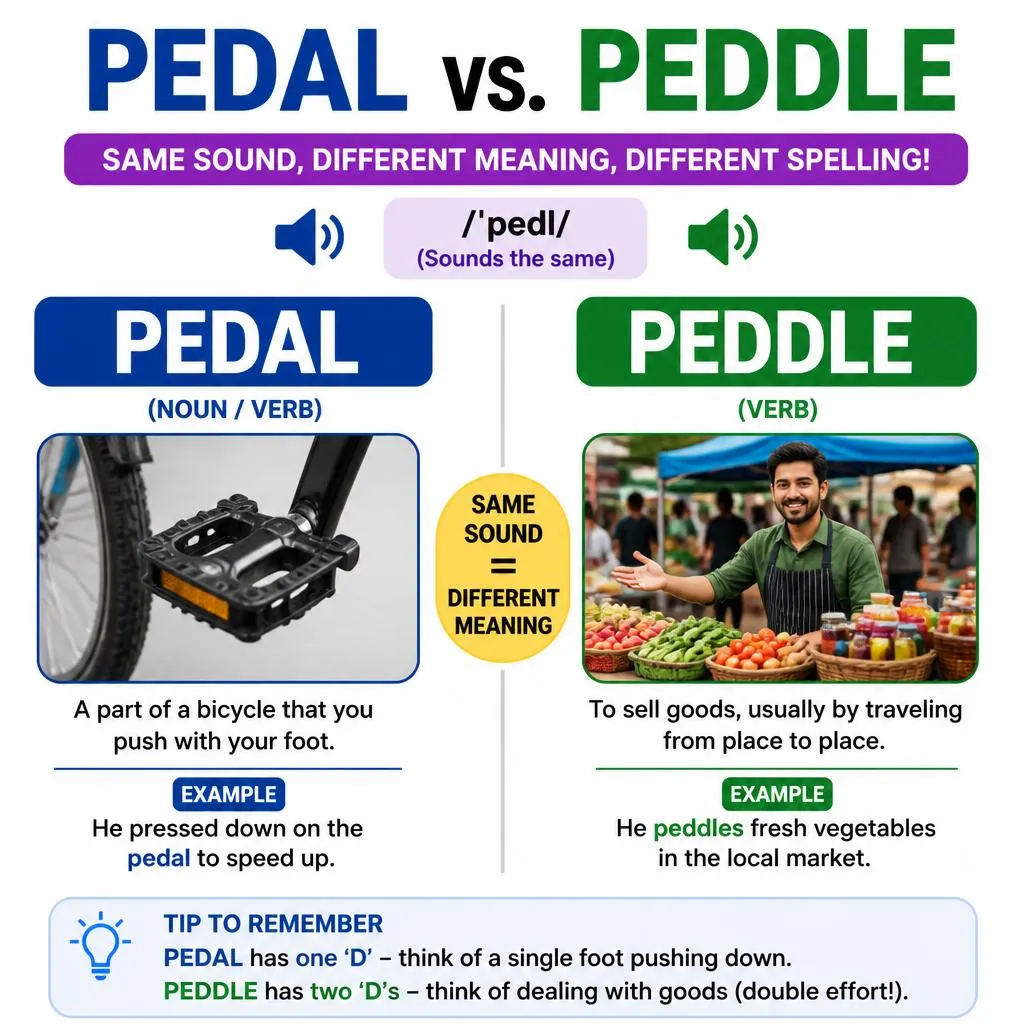
Pedal means a part of a bicycle, vehicle, or machine that you push with your foot, or the action of using it while Peddle means to sell goods, often by going from place to place, or to promote something such as an idea or belief.
Quick Answer
Pedal and peddle are both correct words, but they have different meanings. Pedal usually refers to a foot-operated part of a bicycle, vehicle, or machine, or the action of using it. Peddle means to sell or promote something, often by going from place to place.
| Word | Correct? | Meaning | Example |
|---|---|---|---|
| pedal | Yes | A foot-operated control or to use one | She pressed the pedal. |
| peddle | Yes | To sell or promote something | They peddle goods in the market. |
What You’ll Learn
By the end of this guide, you will know:
- What pedal means
- What peddle means
- Why these words are homophones
- How to use each word correctly
- How to avoid confusing pedal with peddle
Why Are “Pedal” and “Peddle” Confusing?
If you hear someone say pedal and peddle, you may not know which spelling they mean. That is because the two words are pronounced the same in standard English, even though their spellings and meanings are different.
Pedal is connected with feet, bicycles, vehicles, and controls. Peddle, on the other hand, is connected with selling or promoting goods.
In other words, the sound does not tell you which word to choose. You need to look at the meaning and the sentence.
What Does “Pedal” Mean?
Pedal can be a noun or a verb.
As a noun, a pedal is a part that you push with your foot to operate something.
He pressed the brake pedal.
My bicycle has two pedals.
As a verb, pedal means to use the pedals of a bicycle or similar machine.
She learned to pedal a bicycle when she was six.
He pedaled quickly down the road.
Common Uses of “Pedal”
You will often see pedal in these contexts:
- bicycle pedal
- brake pedal
- gas pedal
- accelerator pedal
- pedal a bicycle
- pedal faster
What Does “Peddle” Mean?
Peddle is a verb meaning to sell goods, especially by going from place to place.
Vendors peddle fruit along the roadside.
It can also mean to promote or spread something, especially an idea, belief, or story that may be viewed negatively.
The website was accused of peddling false information.
The related noun peddler refers to a person who sells goods, traditionally by travelling from place to place.
A street peddler was selling handmade crafts.
Pedal vs Peddle: What’s the Difference?
The easiest way to remember the difference is to connect each word with its main idea:
Pedal → feet and machines
Peddle → selling
| Word | Part of Speech | Main Meaning | Example |
|---|---|---|---|
| pedal | Noun | A foot-operated part | Press the brake pedal. |
| pedal | Verb | Use a bicycle pedal | He pedaled up the hill. |
| peddle | Verb | Sell goods | They peddle handmade items. |
| peddle | Verb | Promote or spread something | He peddled a strange theory. |
A Simple Memory Trick
Think:
Pedal = bicycle
Peddle = sell
If you are talking about riding a bicycle, you almost certainly need pedal.
If you are talking about selling something, use peddle.
Why Are “Pedal” and “Peddle” Homophones?
Pedal and peddle are homophones because they have the same pronunciation but different spellings and meanings.
Other common homophone pairs include:
- right / write
- sea / see
- flower / flour
- pair / pear
- buy / by
Just like these pairs, pedal and peddle sound alike but must be chosen according to meaning.
Pronunciation
In standard English, pedal and peddle have the same pronunciation.
Pedal: /ˈpedəl/
Peddle: /ˈpedəl/
The first syllable sounds like ped, while the final syllable has a weak -əl sound.
Therefore, you cannot usually distinguish these words by hearing them alone. Context tells you which spelling is needed.
Grammar Rule
Pedal can be used as both a noun and a verb.
The bike has a broken pedal.
She pedaled across the park.
Peddle is a verb.
They peddle clothes at the market.
He peddled his products online.
Both verbs can take normal tense endings:
- pedal → pedaled → pedaling
- peddle → peddled → peddling
Notice the Spelling
The final e in both verbs is dropped before -ing:
pedal → pedaling
peddle → peddling
The spelling becomes slightly different because peddle already contains a double d.
Common Mistakes
| Common Mistake | Correct Form | Why? |
|---|---|---|
| He pressed the brake peddle. | He pressed the brake pedal. | A vehicle control is a pedal. |
| She peddled her bicycle to school. | She pedaled her bicycle to school. | Riding a bicycle involves pedaling. |
| They pedal goods in the market. | They peddle goods in the market. | Selling goods is peddling. |
| He tried to peddle his bike faster. | He tried to pedal his bike faster. | The action of using bicycle pedals is pedaling. |
Real-World Examples
“Pedal” in Everyday English
My bicycle pedal came loose.
Press the brake pedal gently.
She pedaled as fast as she could.
In Everyday English
The vendors peddle snacks near the station.
He travels from town to town peddling handmade products.
“Peddle” in Figurative Use
Peddle can also describe promoting an idea or belief.
The company was accused of peddling misleading claims.
He continued to peddle the same old story.
Here, peddle does not mean physically selling an object. It means promoting or spreading something.
Grammar Relay Corner
Look at how the two words work in different sentences:
Correct:
She pedaled her bicycle to school.
Incorrect:
She peddled her bicycle to school.
The second sentence suggests selling a bicycle, not riding one.
Now compare:
Correct:
The street vendors peddled fruit.
Incorrect:
The street vendors pedaled fruit.
The first sentence means that the vendors sold fruit.
So, always check the meaning before choosing the spelling.
Vocabulary Corner
Here are some useful words related to each homophone.
Words Related to “Pedal”
- pedal: a foot-operated control
- pedaling: the action of using pedals
- pedaled: used the pedals
- pedal-powered: operated by pedals
Words Related to “Peddle”
- peddle: sell or promote
- peddler: a person who sells goods
- peddling: selling or promoting
- peddled: sold or promoted
A useful distinction is:
pedaling = using pedals
peddling = selling or promoting
Mini Quiz
Choose the correct word.
- She learned to ______ a bicycle.
- a) pedal
- b) peddle
- The merchant tried to ______ his products.
- a) pedal
- b) peddle
- Press the brake ______ slowly.
- a) pedal
- b) peddle
- The salesman was ______ goods in the village.
- a) pedaling
- b) peddling
- He ______ up the steep hill.
- a) pedaled
- b) peddled
Answers
- pedal
- peddle
- pedal
- peddling
- pedaled
Practice Guide
Fill in each blank with pedal or peddle in the correct form.
- The cyclist began ______ faster.
- The vendor was ______ handmade toys.
- My bike has a broken ______.
- They have been ______ products in the local market.
Answers
- pedaling
- peddling
- pedal
- peddling
Pedal vs Peddle: Final Comparison
| Term | Meaning | Part of Speech | Example |
|---|---|---|---|
| pedal | A foot-operated control | Noun | Press the brake pedal. |
| pedal | To use a pedal | Verb | She pedaled uphill. |
| peddle | To sell goods | Verb | They peddle fruit. |
| peddle | To promote or spread something | Verb | He peddled a false claim. |
FAQs
Q: Are “pedal” and “peddle” homophones?
A: Yes. Pedal and peddle are homophones because they are pronounced the same but have different spellings and meanings.
Q: What is the difference between pedal and peddle?
A: Pedal relates to a foot-operated control or the action of using one. Peddle means to sell or promote something.
Q: Is it “pedal a bicycle” or “peddle a bicycle”?
A: The correct phrase is pedal a bicycle.
She pedaled her bicycle to school.
Q: Is it “brake pedal” or “brake peddle”?
A: The correct phrase is brake pedal.
A pedal is the foot-operated control in a vehicle.
Q: What does “peddle” mean?
A: Peddle means to sell goods, often by travelling from place to place. It can also mean to promote or spread an idea, claim, or story.
Q: Is “peddler” related to “peddle”?
A: Yes. A peddler is traditionally a person who sells goods, especially by travelling from place to place.
Q: How can I remember pedal vs peddle?
A: Use this simple memory trick:
Pedal = bicycle or machine
Peddle = sell
Key Takeaways
- Pedal and peddle are both correct words.
- They are homophones because they have the same pronunciation.
- Pedal refers to a foot-operated control or the action of using one.
- Peddle means to sell or promote something.
- Remember: pedal = bicycle; peddle = sell.
Different Jobs, Same Sound
“Pedal” and “peddle” have nothing to do with each other in meaning one is what your foot pushes on a bike, the other is what a street vendor does with goods, yet they sound completely identical when spoken. It’s homophone confusion in its purest form. The same setup plays out in Chord or Cord and Oversite or Oversight, where sound-alike words carry entirely unrelated meanings.
Conclusion
Pedal and peddle sound the same, but they have different meanings and spellings. Pedal is connected with bicycles, vehicles, and other foot-operated controls. You can press a pedal or pedal a bicycle. Peddle, however, means to sell something, especially by going from place to place. It can also mean to promote or spread an idea or claim.
The easiest way to remember the difference is to connect pedal with bicycles and peddle with selling. When you hear the word but cannot decide which spelling to use, simply ask yourself what you mean.
Pedal = use your feet. Peddle = sell.
Now that you know the difference, you can use both homophones correctly with confidence.

Hi, I’m Ashley Brown, a lifelong word enthusiast with a passion for making the English language less confusing.My goal is to help readers spell with confidence and never second-guess themselves again.