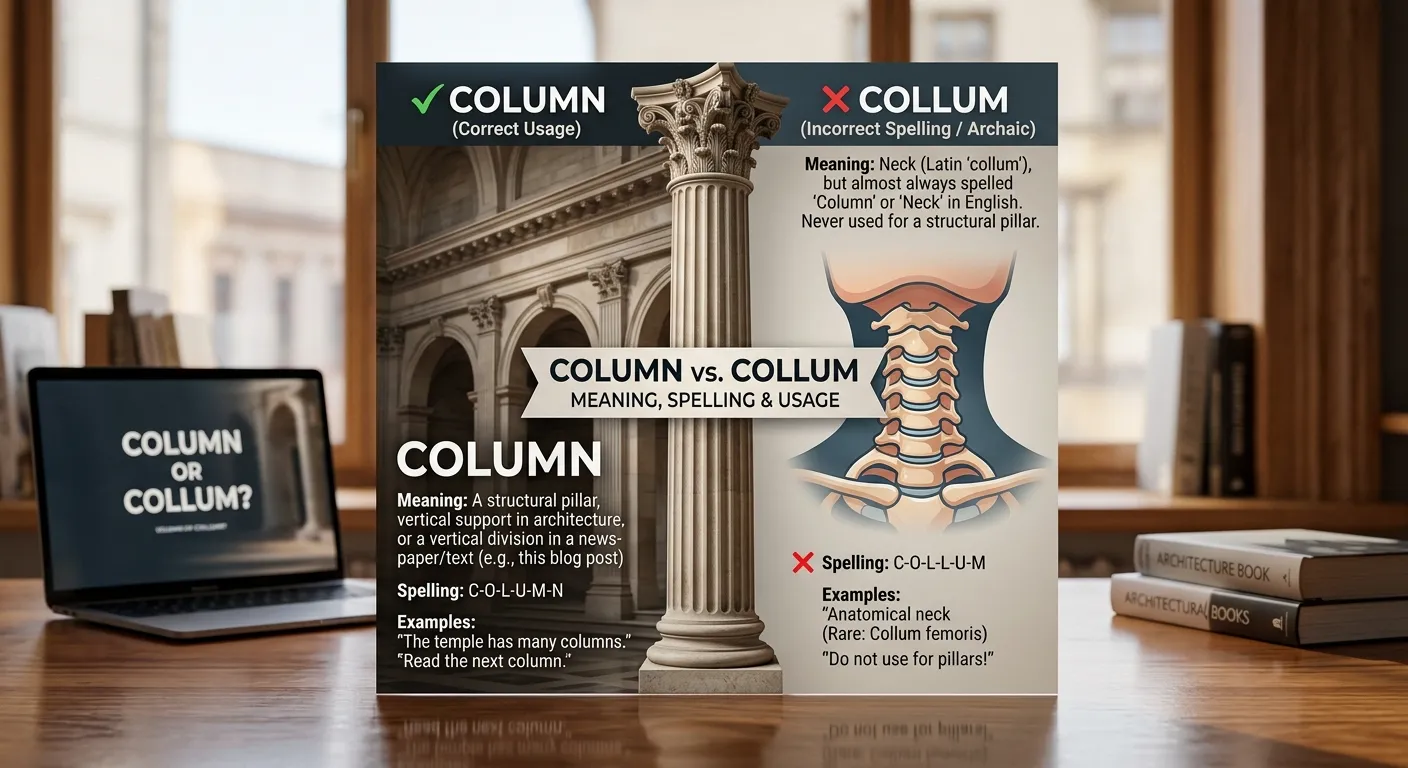
Column means a vertical arrangement of words, numbers, or objects, or a tall supporting structure; collum is usually a misspelling of this word.
Quick Answer
Column is the correct spelling in standard English. Collum is generally a misspelling when you mean a vertical structure, a section of text, or a vertical arrangement of numbers. For example, write “the first column of the table,” not “the first collum of the table.” Cambridge Dictionary lists column as the standard English word and gives several meanings, including a vertical block of words or numbers and a tall supporting structure.
Quick Comparison
| Spelling | Correct? | Meaning | Example |
| Column | ✅ Yes | A vertical arrangement, supporting pillar, or regular article | Write your answer in the second column. |
| Collum | ❌ Usually no | Not the standard spelling for this meaning | Collum is a common spelling mistake for column. |
What Is the Correct Spelling: “Collum” or “Column”?
The correct spelling is column.
Collum is a common misspelling that can occur because the pronunciation of column does not clearly reveal its spelling. In English, column is pronounced without a clearly pronounced n sound at the end: /ˈkɒl.əm/ in British English and /ˈkɑː.ləm/ in American English.
So, although column contains the letters -umn, its pronunciation is closer to “COL-um.”
Column: Meaning and Uses
Column is a noun with several common meanings.
1. A vertical section of words or numbers
A column can be a vertical arrangement of information in a table, spreadsheet, newspaper, or other document.
Examples:
- Enter your name in the first column.
- The figures are arranged in three columns.
- Check the right-hand column for the total.
Cambridge Dictionary defines column as a vertical block of words or numbers.
2. A supporting structure
A column can also mean a tall vertical post, often made of stone, concrete, or another material, that supports part of a building.
Examples:
- The entrance is supported by several marble columns.
- The ancient temple has impressive stone columns.
- The roof rests on massive columns.
This is another established meaning listed by Cambridge Dictionary.
3. A newspaper or magazine article
A column can refer to a regular article written by the same person, often about a particular subject.
Examples:
- She writes a weekly column about education.
- I always read his sports column.
- The newspaper published her first column last month.
Cambridge Dictionary includes this journalistic meaning as well.
Is “Collum” a Correct English Word?
For the ordinary meanings discussed above, no. If you are referring to a vertical section in a table, a newspaper section, or a supporting pillar, column is the correct spelling.
The spelling collum is therefore best treated as a misspelling of column when used in these contexts.
Incorrect:
Please write your details in the second collum.
Correct:
Please write your details in the second column.
Why Do People Spell “Column” as “Collum”?
The main reason is pronunciation.
The word column contains several letters that are not pronounced in the way learners might expect. Its standard pronunciation is:
- British English: /ˈkɒl.əm/
- American English: /ˈkɑː.ləm/
Because the final n is not pronounced as a separate /n/ sound, people may spell the word according to how it sounds and write collum instead.
This is a good example of why English spelling cannot always be predicted directly from pronunciation.
Pronunciation of Column
Column is pronounced approximately:
COL-um
- UK: /ˈkɒl.əm/
- US: /ˈkɑː.ləm/
The n in the spelling is silent.
Easy pronunciation tip
Think:
column → COL-um
not:
column → COL-umn
Remembering the silent n can make both the spelling and pronunciation easier.
“Column” in American and British English
There is no spelling difference between British and American English for this word.
Both varieties use:
column ✅
The pronunciation differs slightly:
| Variety | Pronunciation |
| British English | /ˈkɒl.əm/ |
| American English | /ˈkɑː.ləm/ |
The spelling remains column in both varieties.
Common Mistake: Collum vs. Column
Because column is pronounced approximately “COL-um,” learners sometimes replace the unusual -umn spelling with the more phonetic -lum spelling.
| Common mistake | Correct spelling |
| collum | column |
| collums | columns |
| collum of numbers | column of numbers |
| newspaper collum | newspaper column |
Memory trick
A simple way to remember the spelling is:
COLUMN = COL + UMN
The N is silent, but it still belongs in the spelling.
Examples of Column in Sentences
Here are some natural examples:
- Add the figures in the first column.
- Please enter your phone number in the correct column.
- The newspaper published a new opinion column.
- The ancient building has tall marble columns.
- The table contains five columns and ten rows.
- A stone column supports the entrance.
- Look at the final column for the answer.
- She writes a weekly column for the magazine.
Column vs. Row
A common source of confusion is the difference between a column and a row.
- A column runs vertically.
- A row runs horizontally.
For example:
| Column 1 | Column 2 | Column 3 |
| A | B | C |
| D | E | F |
The vertical groups are columns, while the horizontal groups are rows.
Grammar and Word Forms
Column is a countable noun.
Singular:
column
The table has one column.
Plural:
columns
The table has six columns.
Notice that the plural form is simply formed by adding -s:
column → columns
The n remains in the spelling even though it is not pronounced separately.
Related Words
Several common words are built from column:
- columnist — a person who regularly writes a newspaper or magazine column
- columnar — arranged in or resembling columns
- columns — plural of column
For example:
She is a newspaper columnist.
Cambridge Dictionary defines a columnist as someone who writes a regular article for a newspaper or magazine.
Common Questions
Q: Is “collum” or “column” correct?
A: Column is correct when you mean a vertical section of information, a supporting structure, or a regular newspaper or magazine article.
Q: Is “collum” a misspelling?
A: Yes, collum is generally a misspelling when it is intended to mean column.
Q: Why is column spelled with an “n”?
A: The n is part of the established spelling even though it is not pronounced separately. This is why the word is written column, not collum.
Q: How do you pronounce column?
A: Column is pronounced approximately “COL-um.” Cambridge gives /ˈkɒl.əm/ in British English and /ˈkɑː.ləm/ in American English.
Q: Is column British or American English?
A: Column is used in both British and American English. The spelling is the same in both varieties.
Q: What is the plural of column?
A: The plural is columns.
The spreadsheet has four columns.
Learning Outcomes
After reading this guide, you should be able to:
- Identify column as the correct spelling.
- Recognize collum as a common misspelling in this context.
- Understand the different meanings of column.
- Pronounce column correctly.
- Remember the silent n in column.
- Distinguish a column from a row.
A Silent Letter, Easily Forgotten
“Collum” drops the silent ‘n’ at the end of “column” a letter that doesn’t get pronounced but still belongs in the spelling, much like the silent letters in words such as “autumn” or “hymn.” Since the ear doesn’t catch it, the hand often leaves it out. This same silent-letter slip shows up in Comming or Coming and Savy or Savvy, where a missing or misplaced letter is the only thing separating the correct spelling from a common mistake.
Final Verdict
Column is the correct spelling. ✅
Collum is generally incorrect when you mean a vertical section of words or numbers, a supporting structure, or a regular newspaper or magazine article.
The easiest way to remember it is:
COLUMN = correct
COLLUM = common misspelling
So, always write “column”, even though the n is silent in pronunciation.
Dictionary source: Cambridge Dictionary confirms column as the standard English spelling and documents its meanings, pronunciation, and usage.
Reviewer/Author note: This article follows standard English spelling, pronunciation, grammar, and dictionary usage conventions.

Hi, I’m Ashley Brown, a lifelong word enthusiast with a passion for making the English language less confusing.My goal is to help readers spell with confidence and never second-guess themselves again.