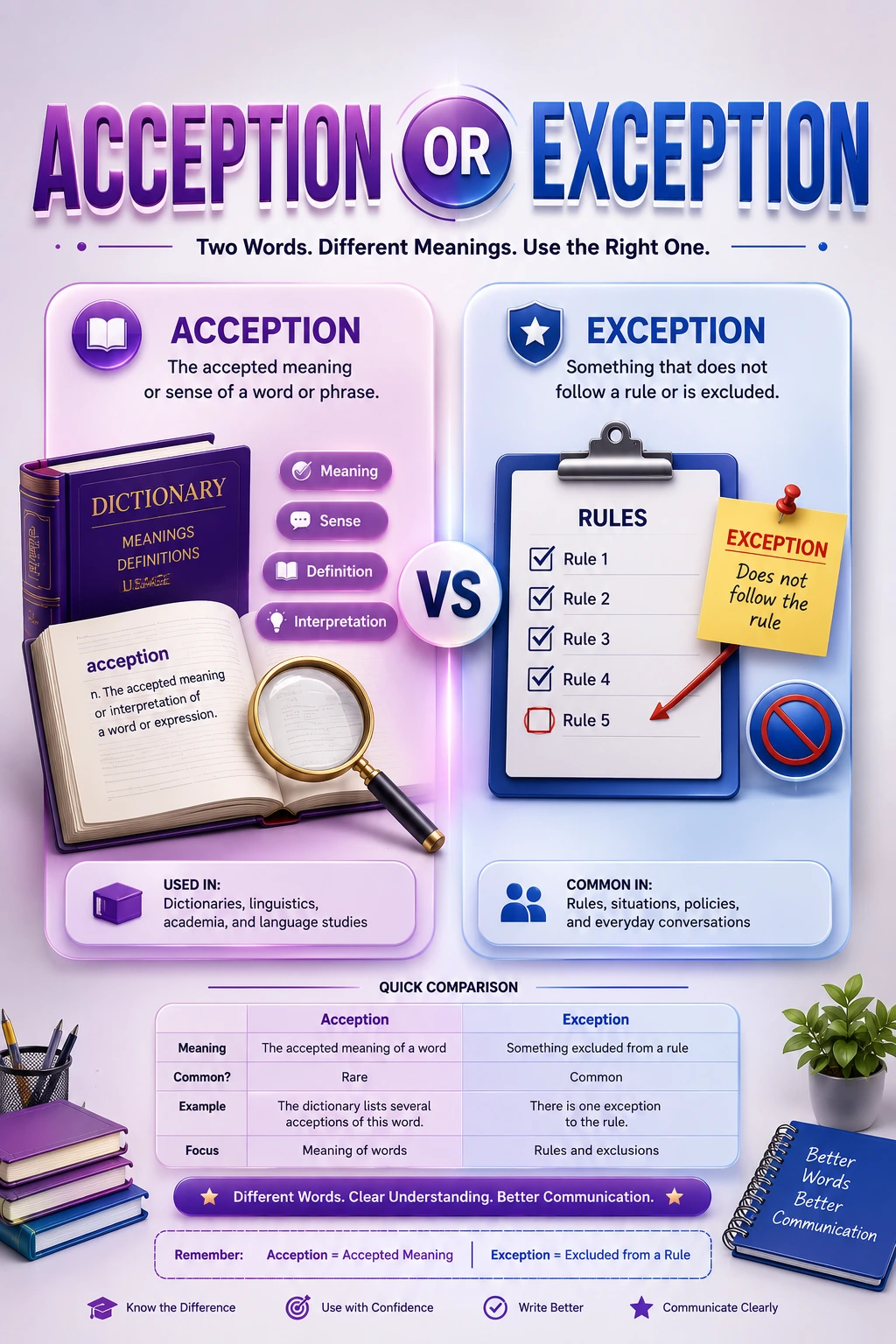
Acception means the accepted meaning of a word, while exception refers to something that does not follow a general rule.
Quick Answer
Acception and exception are both correct English words, but they have completely different meanings.
- Acception is a rare word that means the accepted meaning or sense of a word or phrase.
- Exception is a common word that means someone or something that does not follow a rule or is excluded from it.
If you are talking about something that does not follow a rule, the correct word is almost always exception. Use acception only in specialised contexts such as linguistics, lexicography, or philosophy.Understanding the difference is important because using the wrong word can completely change the meaning of your sentence. For example, saying “This word has several exceptions” is incorrect if you mean different meanings of the word. Likewise, saying “There was one acception to the rule” is also incorrect.
In this guide, you’ll learn what each word means, where it comes from, how to use it correctly, and simple tricks to remember the difference forever.
Quick Comparison Table
| Word | Correct? | Meaning | Common or Rare? | Example |
|---|---|---|---|---|
| Acception | ✅ Yes | The accepted meaning or sense of a word | Rare | The dictionary lists several acceptions of the term. |
| Exception | ✅ Yes | Something or someone excluded from a rule | Very common | Everyone passed the exam without exception. |
Acception vs Exception: What’s the Difference?
The easiest way to understand these words is to remember what they refer to.
- Acception refers to the meaning of a word.
- Exception refers to something that does not follow a rule.
Think of it this way:
- If you’re reading a dictionary or discussing language, you might come across acception.
- If you’re talking about rules, laws, policies, or general situations, you almost certainly need exception.
Quick Rule
✅ Meaning of a word → Acception
✅ Not following a rule → Exception
What Does “Acception” Mean?
Acception is a noun that means the accepted meaning, interpretation, or sense of a word or expression.
It is an old English word that survives mainly in specialised fields such as:
- Linguistics
- Lexicography
- Philosophy
- Literary studies
- Historical language research
In everyday conversation, most people never use acception. Instead, they simply say meaning, definition, or sense.
Examples
- The dictionary explains every acception of the word.
- Scholars debated the original acception of the ancient text.
- The first acception of the term differs from its modern usage.
- This word has several historical acceptions.
Notice that every sentence talks about the meaning of a word rather than an exception to a rule.
What Does “Exception” Mean?
Exception is a noun that means a person, thing, or situation that does not follow a general rule.
It is one of the most common words in English and is used in everyday speech, writing, education, business, and law.
You will often hear expressions such as:
- An exception to the rule
- Without exception
- No exceptions
- With one exception
Examples
- Everyone attended the meeting except Sarah, who was the only exception.
- There is one exception to this rule.
- The library closes every Sunday without exception.
- Good habits usually lead to success, although there are always exceptions.
Because exception is so common, it is usually the word people intend to write.
The Origin of Acception and Exception
Although these words look alike, they developed from different Latin roots, which explains why they have different meanings.
Origin of Acception
The word acception comes from the Latin verb accipere, meaning to receive or to accept. Over time, it came to describe the accepted sense or meaning of a word. This is why dictionaries and language scholars sometimes use it when discussing how a word is understood in a particular context.
Origin of Exception
The word exception comes from the Latin exceptio, meaning something taken out or excluded. It entered English through Old French and has long been used to describe a case that is left out of a general rule or statement.
Although both words share a similar ending, their roots reveal why they describe two completely different ideas. One is about accepted meaning, while the other is about being excluded from a rule.
Understanding their origins makes the distinction easier to remember and helps you choose the correct word with confidence.
Key Differences Between Acception and Exception
Although acception and exception differ by only one letter, they are used in completely different situations.
| Feature | Acception | Exception |
|---|---|---|
| Part of Speech | Noun | Noun |
| Meaning | The accepted meaning or sense of a word | Something or someone excluded from a rule |
| Usage | Linguistics, dictionaries, philosophy | Everyday English |
| Frequency | Rare | Very common |
| Related Words | Meaning, sense, definition | Exclusion, exemption, anomaly |
| Example | The second acception appears in older dictionaries. | There is one exception to the rule. |
The Simple Difference
Think of these two questions:
- Are you talking about the meaning of a word? → Use acception.
- Are you talking about a rule that has one special case? → Use exception.
This simple test will help you choose the correct word almost every time.
When Should You Use “Acception”?
Use acception only when discussing the meaning or interpretation of a word or expression.
It is most commonly found in:
- Dictionaries
- Academic books
- Linguistics
- Philosophy
- Historical language studies
Correct Examples
- The first acception of the word dates back to the 16th century.
- Modern dictionaries include several acceptions of this term.
- The scholar explained the original acception of the phrase.
- Different cultures sometimes give different acceptions to the same word.
Tip
If you can replace acception with meaning, sense, or definition, you are probably using it correctly.
When Should You Use “Exception”?
Use exception whenever you mean something that does not follow a rule or is excluded from it.
This is the word used in everyday conversations, classrooms, workplaces, and official documents.
Correct Examples
- Every student submitted the assignment without exception.
- There is one exception to this grammar rule.
- The shop opens daily with no exceptions.
- She is the exception rather than the rule.
Tip
If you can replace exception with special case or exclusion, it is the correct choice.
Real-Life Examples
Seeing the words in context makes the difference much easier to understand.
Examples with Acception
- The dictionary lists three acceptions of the word bank.
- The ancient manuscript uses the word in an unusual acception.
- Linguists discussed the modern acception of the expression.
- The legal acception of the term differs from its everyday meaning.
Examples with Exception
- Everyone was invited with one exception.
- This rule has no exceptions.
- Fridays are an exception because the office closes early.
- Children under five are an exception to the ticket policy.
Common Mistakes to Avoid
Because the words look similar, learners sometimes confuse them.
❌ Mistake 1: Using acception instead of exception
Incorrect:
There is one acception to the rule.
Correct:
There is one exception to the rule.
❌ Mistake 2: Using exception when talking about a word’s meaning
Incorrect:
The dictionary gives two exceptions of this word.
Correct:
The dictionary gives two acceptions of this word.
❌ Mistake 3: Assuming acception is a misspelling
Many people have never seen acception, so they think it is an error.
In fact, acception is a genuine English word. It is simply rare and mainly used in academic or linguistic writing.
Does the Pronunciation Change?
Yes. Although the spellings are similar, the words are pronounced differently.
Acception
Pronunciation: ak-SEP-shən
Exception
Pronunciation: ik-SEP-shən
The endings sound almost identical, but the beginning syllables are different.
What Major Dictionaries Say
Leading English dictionaries recognise exception as a common everyday word and acception as a valid but uncommon term.
Cambridge Dictionary
Cambridge includes exception as a standard English noun meaning something that does not follow a general rule. It does not provide a main learner entry for acception, reflecting its rarity.
Oxford English Dictionary
Oxford recognises acception as a legitimate English word meaning the accepted sense of a word, while exception is listed as the common noun referring to an exclusion from a rule.
Merriam-Webster
Merriam-Webster defines acception as the accepted meaning of a word or phrase and exception as something excluded from a general statement or rule.
These dictionary entries confirm that both words are correct, but they belong in very different contexts.
Did You Know?
Many English learners spend years believing that acception is simply a typo for exception.
In reality, acception has been part of the English language for centuries. It appears in older dictionaries, linguistic research, and scholarly works discussing the meanings of words.
Outside academic writing, however, exception is used far more frequently. That’s why most native English speakers recognise exception immediately but may never encounter acception in everyday life.
A helpful memory trick is:
- Acception → Accepted meaning
- Exception → Excluded from the rule
Grammar Relay
Understanding acception and exception becomes easier when you compare them with other commonly confused English words.
Similar Commonly Confused Words
| Word Pair | Difference |
|---|---|
| Accept vs Except | Accept means to receive; except means excluding. |
| Advice vs Advise | Advice is a noun; advise is a verb. |
| Affect vs Effect | Affect is usually a verb; effect is usually a noun. |
| Principal vs Principle | Principal means main or head; principle means a rule or belief. |
| Acception vs Exception | Acception means the accepted meaning of a word; exception means something excluded from a rule. |
Memory Tip
Remember this simple trick:
- Acception = Accepted meaning
- Exception = Excluded from a rule
If you’re talking about a dictionary or the meaning of a word, choose acception.
If you’re talking about rules, policies, or special cases, choose exception.
Vocabulary Corner
Synonyms of Acception
- Meaning
- Sense
- Interpretation
- Definition
- Signification
Synonyms of Exception
- Exclusion
- Special case
- Anomaly
- Irregularity
- Exemption
Antonyms
Acception
- Misinterpretation
- Misunderstanding
Exception
- Rule
- Standard
- Norm
- General case
Idiom
The exception proves the rule.
Meaning: An unusual case highlights that a general rule normally exists.
Example:
Most shops close on Sundays. The one that stays open is the exception that proves the rule.
Proverb
Every rule has an exception.
Meaning: Few rules apply perfectly in every situation.
Mini Quiz
Choose the correct answer.
1. Which word means the accepted meaning of a word?
A. Exception
B. Acception
✅ Answer: B. Acception
2. Which word means something excluded from a rule?
A. Acception
B. Exception
✅ Answer: B. Exception
3. Which sentence is correct?
A. There is one acception to the rule.
B. There is one exception to the rule.
✅ Answer: B
4. Which sentence uses acception correctly?
A. The dictionary lists several acceptions of the word.
B. Everyone came with one acception.
✅ Answer: A
5. True or False?
Acception is a real English word.
✅ Answer: True
Practice Guide
Fill in each blank with acception or exception.
- There is one ________ to the school’s uniform policy.
- The dictionary explains every ________ of the word.
- Everyone attended the meeting without ________.
- Linguists discussed the oldest ________ of the phrase.
- This rule has no ________.
Answers
- exception
- acception
- exception
- acception
- exception
Frequently Asked Questions (FAQs)
Q: Is acception a real English word?
Yes. Acception is a genuine English noun. It means the accepted meaning or sense of a word, although it is now rare outside academic writing
Q: Is acception a misspelling of exception?
No. They are two separate English words with different meanings.
Q: Why is exception much more common?
Because people often discuss rules, policies, and special cases in everyday life. The word acception is mainly used by linguists, dictionary editors, philosophers, and language researchers.
Q: Can I use acception instead of meaning?
Yes, but only in formal or academic contexts. In everyday English, meaning is much more natural.
Q: Which word should English learners remember?
Learn exception first because it is used frequently in daily conversations and writing. Understand acception as a specialised vocabulary word that appears mainly in dictionaries and linguistic discussions.
Final Verdict
Although acception and exception differ by only one letter, they have entirely different meanings.
Use acception when referring to the accepted meaning or interpretation of a word. This word is rare and mostly found in dictionaries, linguistic studies, and academic writing.
Use exception when referring to something or someone excluded from a rule. It is the correct choice for almost every everyday situation.
A simple way to remember the difference is:
- Acception → Accepted meaning
- Exception → Excluded from a rule
Once you connect each word with its purpose, you’ll never confuse them again.
Key Takeaways
- Acception and exception are both correct English words.
- Acception means the accepted meaning or sense of a word.
- Exception means something excluded from a rule.
- Exception is common in everyday English.
- Acception is rare and mainly used in academic and linguistic writing.
- Choose the word based on the meaning you want to express, not because the spellings look similar.
Related Articles

I’m Leo Jackson, an English writer with a soft spot for the peculiarities of language and spelling. I believe good spelling shouldn’t feel like guesswork, so I break down each comparison into clear, practical explanations anyone can use. Outside of writing, I’m usually buried in a novel or hunting down the next tricky word pair to demystify.