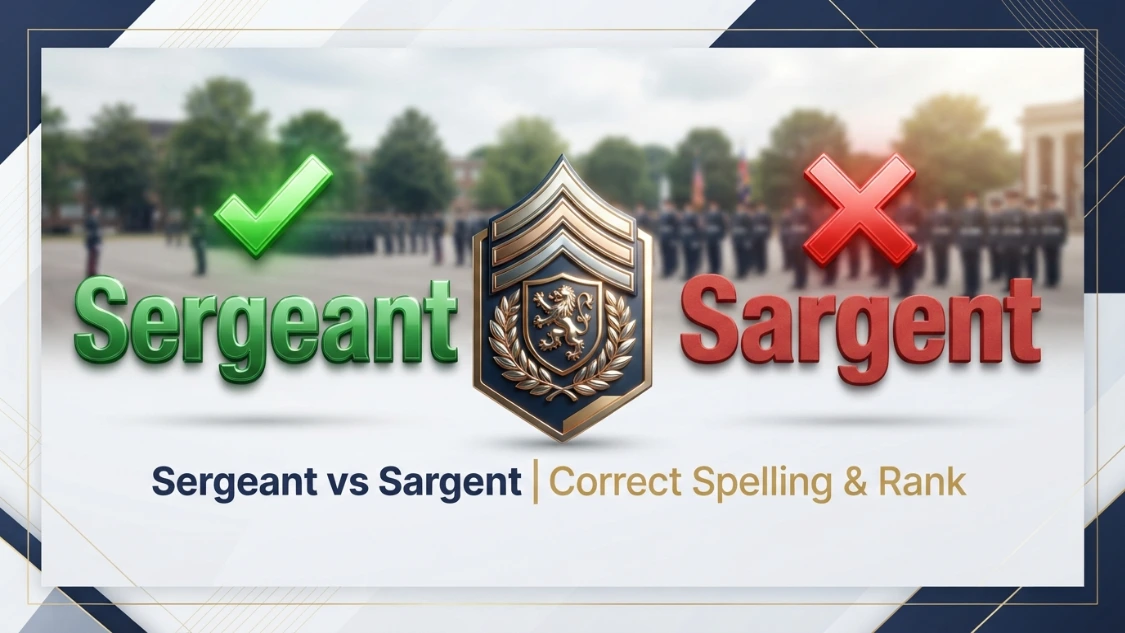
Sergeant is the correct spelling for a military or police rank, while Sargent is a surname and not an alternative spelling of the rank.
Quick Answer
Sergeant is the correct spelling when referring to a military, police, or other official rank.
Sargent is not another spelling of sergeant. It is mainly a surname (family name), such as John Singer Sargent, or an incorrect spelling when someone intends to write sergeant.
- ✅ Sergeant = military or police rank
- ✅ Sargent = surname or proper name
- ❌ Do not use Sargent instead of sergeant unless it is someone’s name.
This confusion often appears in emails, official documents, school assignments, news reports, and online searches. Understanding the difference helps you write more accurately and avoid embarrassing errors.
In this guide, you’ll learn the meaning of each word, why people confuse them, when each is correct, and how to remember the right spelling.
Quick Comparison Table
| Word | Correct? | Meaning | Example |
|---|---|---|---|
| Sergeant | ✅ Yes | A rank in the military, police, or similar organizations | The sergeant gave clear instructions. |
| Sargent | ⚠️ Only as a name | A surname or proper noun | John Singer Sargent was a famous painter. |
Is It “Sergeant” or “Sargent”?
The correct choice depends on what you are talking about.
If you mean a military or police rank, the correct spelling is sergeant.
If Sargent is someone’s family name, then it is also correct because it is a proper noun.
Correct Examples
- The sergeant inspected the soldiers before the parade.
- Please report to the sergeant immediately.
- The police sergeant handled the investigation.
- John Singer Sargent painted many famous portraits.
- Officer Sargent addressed the audience. (Here, Sargent is the officer’s surname.)
Incorrect Examples
- ❌ The Sargent ordered the troops to move.
- ❌ Ask the police Sargent for help.
- ❌ She was promoted to Sargent last year.
In each of these sentences, the correct spelling is sergeant because the word refers to a rank rather than a person’s name.
What Does “Sergeant” Mean?
A sergeant is a person who holds a supervisory rank in organizations such as the military, police, fire service, or other uniformed services. The exact duties vary by organization and country, but a sergeant usually leads a team, maintains discipline, and ensures that orders are carried out.
Common Uses of Sergeant
- Military sergeant
- Police sergeant
- Staff sergeant
- Gunnery sergeant
- Flight sergeant
Example Sentences
- The sergeant briefed the new recruits.
- Our sergeant checked every piece of equipment.
- The police sergeant interviewed the witnesses.
- The sergeant praised the team’s excellent performance.
- Everyone listened carefully to the sergeant’s instructions.
Quick Fact
The word sergeant is always written with a lowercase s unless it begins a sentence or forms part of an official title.
For example:
- Sergeant Davis arrived early. (Beginning of a sentence or title)
- We spoke with the sergeant after the meeting. (Common noun)
What Major Dictionaries Say
Leading English dictionaries agree that sergeant is the standard spelling for the military and police rank.
| Dictionary | Preferred Spelling | Notes |
|---|---|---|
| Cambridge Dictionary | Sergeant | Military and police rank |
| Merriam-Webster | Sergeant | Non-commissioned officer; police rank |
| Oxford English Dictionary | Sergeant | Standard English spelling |
| Collins Dictionary | Sergeant | Official spelling in modern English |
None of these dictionaries list Sargent as an alternative spelling of sergeant. Instead, Sargent appears as a surname or proper noun.
Why Do People Confuse Sergeant and Sargent?
The confusion between sergeant and Sargent comes from their pronunciation and unusual spelling. In everyday speech, many people pronounce sergeant in a way that sounds similar to SAR-jənt, leading some writers to replace the “ea” with a simpler “a.”
English contains many words whose spelling does not perfectly match their pronunciation, and sergeant is one of them.
Here are the main reasons for the confusion:
- The words sound almost identical in normal speech.
- The spelling “ea” is unexpected.
- Many people have seen Sargent as a surname.
- Spell-checkers may not flag Sargent because it is a legitimate name.
Easy Memory Trick
Think of sergeant as the official rank, not just a word that sounds right.
Sergeant serves. Sargent signs.
- Sergeant serves in the military or police.
- Sargent signs documents only if that’s the person’s last name.
When Is Sargent Correct?
Although Sargent is incorrect when referring to a military or police rank, it is perfectly correct as a surname.
Many well-known people have the last name Sargent, so you should keep its capital S when referring to them.
Examples
- John Singer Sargent was a celebrated American portrait painter.
- Professor Sargent published a new research paper.
- Detective Sargent spoke to the media.
- Mrs. Sargent teaches history at our school.
In each sentence, Sargent is someone’s family name—not a military or police rank.
Remember
If the word identifies who someone is, Sargent may be correct.
If the word identifies their rank, use sergeant.
Pronunciation
Although they are spelled differently, sergeant and Sargent are pronounced almost the same in most English accents.
| Word | IPA | Approximate Pronunciation |
|---|---|---|
| Sergeant | /ˈsɑːr.dʒənt/ (UK), /ˈsɑr.dʒənt/ (US) | SAR-jənt |
| Sargent | /ˈsɑːr.dʒənt/ | SAR-jənt |
Because the pronunciation is nearly identical, writers often rely on sound instead of correct spelling, which leads to mistakes.
Where Does the Word Sergeant Come From?
The word sergeant has a long history.
It entered English through Old French (sergent), which came from the Latin word serviens, meaning “one who serves.” Over time, the meaning changed from a servant or attendant to a person who serves in a position of authority within the military or law enforcement.
Today, sergeant is an established rank in many organizations around the world.
The surname Sargent has a different history. Like many English surnames, it developed from an occupational name and eventually became a family name passed down through generations.
Although they share historical roots, sergeant and Sargent are used differently in modern English.
Common Mistakes to Avoid
Here are some frequent errors people make.
Mistake 1: Using Sargent as a Rank
❌ The Sargent called the meeting.
✅ The sergeant called the meeting.
Mistake 2: Correcting a Person’s Name
❌ John Singer Sergeant painted beautiful portraits.
✅ John Singer Sargent painted beautiful portraits.
Never change someone’s surname because it resembles another English word.
Mistake 3: Capitalizing the Rank Unnecessarily
❌ The Sergeant spoke to the recruits.
✅ The sergeant spoke to the recruits.
Use a lowercase sergeant unless it begins a sentence or forms part of an official title.
Mistake 4: Assuming They Are British and American Variants
Some spelling pairs, such as colour and color, differ by region.
That is not the case here.
- ❌ British English: Sargent
- ❌ American English: Sergeant
This is incorrect.
Both British English and American English use sergeant for the rank. Sargent remains a surname in both varieties of English.
Which One Should You Use?
Use this quick guide whenever you’re unsure.
| Situation | Correct Word |
|---|---|
| Military rank | ✅ Sergeant |
| Police rank | ✅ Sergeant |
| Fire service rank | ✅ Sergeant (where applicable) |
| Referring to someone’s surname | ✅ Sargent |
| General writing about ranks | ✅ Sergeant |
Final Rule
Choose sergeant whenever you mean the official rank.
Choose Sargent only when it is part of a person’s name.
If you’re writing an essay, email, report, news article, or exam answer about the military or police, sergeant is almost certainly the spelling you need.
Did You Know?
The unusual spelling of sergeant comes from Old French rather than modern English spelling patterns. Although many people expect the word to be spelled “sargent” because of its pronunciation, English has preserved the historical spelling sergeant for centuries.
Search Intent Answer
Place it immediately after “Which One Should You Use?”
At this point, you’ve fully answered the article’s main question, so a concise search-intent summary reinforces the takeaway.
Example:
If you searched “Sergeant or Sargent?” here’s the answer:
Use sergeant for a military or police rank. Use Sargent only when it is a person’s surname.Everyday Examples
Here are some real-life examples showing the correct use of sergeant and Sargent.
Correct Examples
- The sergeant led the rescue team during the emergency.
- A police sergeant questioned the witnesses after the accident.
- She was promoted to staff sergeant after years of dedicated service.
- The recruits followed the sergeant’s instructions carefully.
- Everyone respected the sergeant for his leadership and discipline.
- We attended a ceremony honoring the retiring sergeant.
- John Singer Sargent painted some of the world’s most famous portraits.
- Officer Sargent welcomed the new members to the department. (Here, Sargent is the officer’s surname.)
Incorrect Examples
- ❌ The Sargent inspected the soldiers before the parade.
- ❌ Ask the police Sargent for assistance.
- ❌ She was promoted to Sargent last month.
Corrected Versions
- ✅ The sergeant inspected the soldiers before the parade.
- ✅ Ask the police sergeant for assistance.
- ✅ She was promoted to sergeant last month.
Quick Tip
If the word describes a rank, write sergeant. If it is someone’s family name, write Sargent.
Common Collocations
Place it after “Everyday Examples.”
Readers already understand the word’s meaning, so showing common word combinations helps them use it naturally.
Example:
- Police sergeant
- Staff sergeant
- Master sergeant
- Drill sergeant
- Sergeant major
- Flight sergeant
- Detective sergeant
- Sergeant at arms
Grammar Relay Corner
Strengthen your vocabulary by learning words related to sergeant.
Synonyms
Depending on the context, these words may have a similar meaning:
- Supervisor
- Officer
- Commander (in a general sense, not the same rank)
- Non-commissioned officer (NCO)
- Leader
Note: These words are not exact replacements. A sergeant is a specific rank with defined responsibilities.
Antonyms
There is no direct antonym for sergeant, but these words express opposite ideas in some contexts:
- Recruit
- Civilian
- Follower
- Subordinate
Related Terms
- Corporal
- Lieutenant
- Captain
- Battalion
- Platoon
- Officer
- Cadet
- Regiment
Vocabulary Corner
Understanding related vocabulary helps you remember the correct spelling.
| Word | Part of Speech | Meaning |
|---|---|---|
| Sergeant | Noun | A military or police rank |
| Sargent | Proper noun | A family name (surname) |
| Corporal | Noun | A military rank below sergeant |
| Lieutenant | Noun | A commissioned officer rank |
| Battalion | Noun | A military unit made up of several companies |
| Recruit | Noun | A newly enlisted member of the military |
Mini Quiz
Test your understanding.
1. Which spelling refers to a military rank?
A. Sargent
B. Sergeant
✅ Answer: B. Sergeant
2. Which sentence is correct?
A. The Sargent inspected the soldiers.
B. The sergeant inspected the soldiers.
✅ Answer: B
3. When is Sargent correct?
A. When referring to a military rank
B. When it is someone’s surname
✅ Answer: B
4. Are sergeant and Sargent British and American spellings?
A. Yes
B. No
✅ Answer: B
5. Complete the sentence.
The police ______ questioned the witness.
✅ Answer: sergeant
Practice Guide
Fill in the blanks using sergeant or Sargent.
- The __________ trained the new recruits.
- Officer __________ received an award for community service.
- Everyone listened carefully to the police __________.
- __________ is one of the world’s best-known portrait painters.
- The army __________ praised the team’s discipline.
Answers
- sergeant
- Sargent
- sergeant
- John Singer Sargent
- sergeant
Key Takeaways
- Sergeant is the correct spelling for a military, police, or similar rank.
- Sargent is primarily a surname, not an alternative spelling.
- Both British and American English use sergeant for the rank.
- Because the words sound alike, they are often confused in writing.
- When talking about a person’s title or rank, always choose sergeant.
- When referring to someone’s family name, use Sargent.
Frequently Asked Questions
Q: Is Sargent another spelling of sergeant?
A: No. Sergeant is the correct spelling for the rank. Sargent is usually a surname.
Q: Which spelling should I use in military writing?
A: Always use sergeant when referring to the military rank.
Q: Why do people misspell sergeant?
A: Because its pronunciation does not clearly match its spelling, many people mistakenly replace “ea” with “a.”
Q: Is Sargent a real word?
A: Yes. It is a genuine surname and the name of many people, but it is not the spelling of the military or police rank.
Q: Is sergeant the same in British and American English?
A: Yes. Both British and American English use the spelling sergeant.
Q: How can I remember the correct spelling?
A: Remember this simple tip:
Sergeant serves. Sargent is someone’s surname.
Final Thoughts
The difference between sergeant and Sargent is straightforward once you know their meanings. Sergeant is the only correct spelling for a military, police, or similar official rank. Sargent is not a spelling variant it is a family name.
Whenever you are writing about the armed forces, law enforcement, or other uniformed services, choose sergeant. Reserve Sargent only for people whose surname is spelled that way. Keeping this distinction in mind will help you avoid one of the most common spelling mistakes involving official titles.
Related Spelling Mix-Ups
Spelling mix-ups like this aren’t unique to “sergeant.” A similar pattern shows up in Steer or Stear, where people default to a spelling that feels intuitive but isn’t standard. In both cases, the correct form doesn’t always match what sounds right which is exactly why these words end up on lists of commonly misspelled English words.

Hi, I’m Ashley Brown, a lifelong word enthusiast with a passion for making the English language less confusing.My goal is to help readers spell with confidence and never second-guess themselves again.