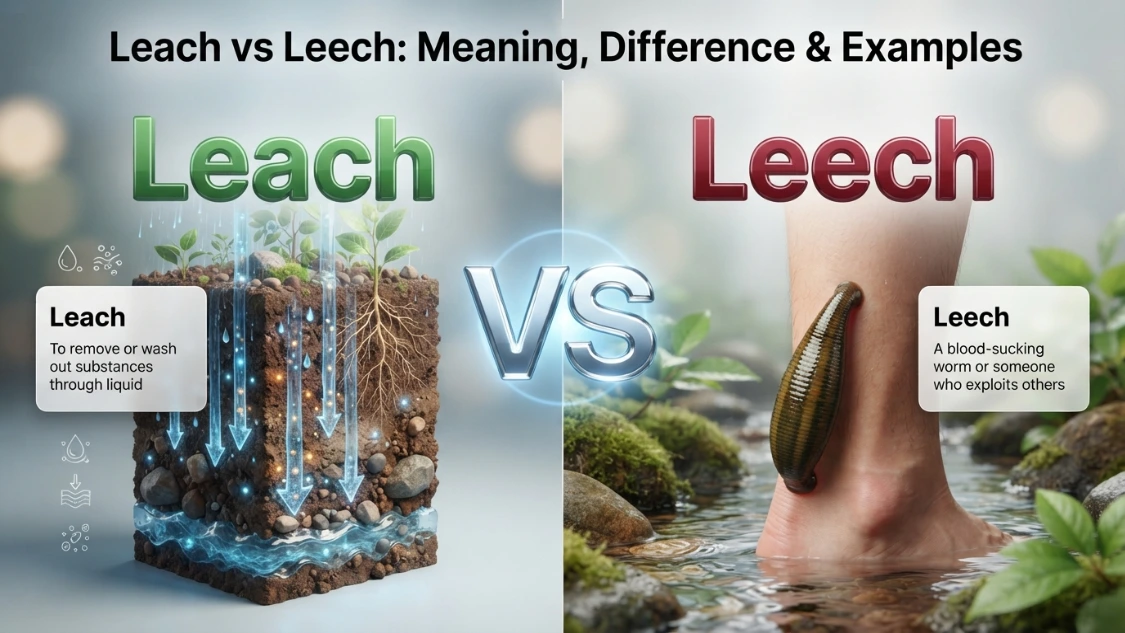
Leach vs Leech refers to the difference between two correctly spelled homophones: leach, meaning to wash out substances with liquid, and leech, meaning a blood-sucking worm or someone who exploits others.
Leach vs Leech: Quick Answer
At first glance, leach and leech look almost identical. They differ by just one letter, yet they have completely different meanings. This similarity makes them easy to confuse, especially for English learners and writers.
| Word | Part of Speech | Meaning | Correct? |
|---|---|---|---|
| Leach | Verb (sometimes noun) | To remove or dissolve substances by water or another liquid | ✅ Yes |
| Leech | Noun (sometimes verb) | A blood-sucking worm or someone who exploits others | ✅ Yes |
Quick Example
✅ Heavy rain can leach nutrients from the soil.
✅ A leech attached itself to the hiker’s leg.
In this guide, you’ll learn the meaning of each word, their origins, pronunciation, examples, common mistakes, memory tricks, and when to use each one with confidence.
What Does “Leach” Mean?
Leach is most commonly used as a verb. It means to remove, dissolve, or carry away substances by the action of water or another liquid.
The word is often used in:
- agriculture
- gardening
- chemistry
- environmental science
- medicine
Examples
- Heavy rain can leach minerals from the soil.
- Chemicals may leach into groundwater.
- Water slowly leached the salt from the rocks.
- The fertilizer began to leach into the river.
One-Line Definition
Leach means to remove or wash out soluble substances through the action of liquid.
What Does “Leech” Mean?
Leech is usually a noun.
Its primary meaning is a type of worm that feeds on blood by attaching itself to animals or humans.
It also has a figurative meaning.
A leech can describe someone who constantly depends on or exploits another person for money, support, or resources.
Examples
- A leech attached itself to his ankle during the hike.
- Doctors once used leeches in medical treatments.
- He became a financial leech, always borrowing money without repaying it.
- Don’t let others leech off your hard work.
One-Line Definition
Leech means a blood-sucking worm or a person who unfairly depends on or exploits others.
Why Do People Confuse “Leach” and “Leech”?
The confusion happens for several reasons.
1. Nearly Identical Spelling
Only one letter is different.
- leach
- leech
This makes typing mistakes very common.
2. Similar Pronunciation
Both words begin with the same sound (lee-), making them easy to mix up when heard in conversation.
3. Lack of Familiarity
Many people rarely encounter the word leach unless they study science or gardening, while leech appears more often in stories, history, and everyday speech.
4. Autocorrect Doesn’t Always Help
Since both are valid English words, spell check may not detect the wrong choice if it fits grammatically.
For example:
❌ Chemicals leech into the soil.
The spelling is correct, but the word choice is wrong.
How to Pronounce Them
| Word | IPA (UK) | IPA (US) | Pronunciation |
|---|---|---|---|
| Leach | /liːtʃ/ | /liːtʃ/ | Leech |
| Leech | /liːtʃ/ | /liːtʃ/ | Leech |
Interestingly, both words are pronounced exactly the same.
This makes them homophones words that sound alike but have different meanings and spellings.
The Origin of “Leach”
Leach comes from Middle English and Old English words related to washing or filtering substances through water.
Over time, it became closely associated with scientific and environmental processes, especially the removal of minerals, chemicals, and nutrients.
Today, it is widely used in agriculture, chemistry, geology, and environmental science.
The Origin of “Leech”
The word leech comes from Old English lǣce, which was historically connected to both healers and blood-sucking worms because medicinal leeches were once widely used to treat patients.
Although modern medicine uses leeches only in specialized situations, the figurative meaning of someone who exploits others has become increasingly common.
When Should You Use Leach?
Use leach when you’re talking about liquids removing, dissolving, or carrying away substances.
It commonly appears in scientific, environmental, agricultural, and gardening contexts.
Common Situations
- Water washing nutrients from soil
- Chemicals entering groundwater
- Minerals dissolving into water
- Environmental pollution
- Composting and gardening
Examples
- Rain can leach nutrients from the soil.
- Harmful chemicals may leach into drinking water.
- Salt was leached from the soil before planting.
- The landfill allowed toxins to leach into nearby streams.
- Excessive watering can leach valuable minerals from potted plants.
When Should You Use Leech?
Use leech when referring to:
- a blood-sucking worm
- a person who unfairly depends on others
- someone who takes advantage of another person’s money, time, or resources
Examples
- A leech attached itself to the swimmer’s leg.
- The doctor used medicinal leeches during treatment.
- He’s become a financial leech, always asking for money.
- Don’t let anyone leech off your success.
- Some species of leeches live in freshwater lakes.
Leach vs Leech: Side-by-Side Comparison
| Feature | Leach | Leech |
|---|---|---|
| Meaning | Remove substances by liquid | Blood-sucking worm or exploiter |
| Part of Speech | Mainly verb | Mainly noun |
| Pronunciation | /liːtʃ/ | /liːtʃ/ |
| Scientific Use | ✅ Very common | Sometimes (medical biology) |
| Everyday Use | Environmental topics | Animals and figurative language |
| Correct? | ✅ Yes | ✅ Yes |
Leach vs Leech in Other Forms
Both words change form depending on tense and usage. Knowing these related forms makes it even easier to use leach and leech correctly in different contexts.
Forms of “Leach”
| Form | Type | Example |
|---|---|---|
| Leach | Base verb | Rain can leach minerals from soil. |
| Leached | Past tense | The soil was leached of its nutrients after years of heavy rain. |
| Leaching | Gerund/noun | Leaching is a common concern in agricultural runoff. |
| Leachate | Noun | Leachate from the landfill seeped into the groundwater. |
Leachate is worth knowing on its own — it’s a technical term used in environmental science and waste management to describe the liquid that has picked up dissolved substances as it passes through soil, waste, or landfill material.
Forms of “Leech”
| Form | Type | Example |
|---|---|---|
| Leech | Base noun/verb | A leech attached itself to his leg. |
| Leeched | Past tense (verb) | He leeched off his roommate for months without paying rent. |
| Leeches | Plural noun | Doctors once used leeches to treat swelling. |
| Leeching | Gerund/verb form | He’s been leeching money from his parents for years. |
Quick Tip
The pattern holds across every form:
- Any form of leach → liquid, chemicals, or substances being removed
- Any form of leech → the worm, or a person exploiting someone
Common Mistakes to Avoid
Although both words are correct, using the wrong one changes the meaning of your sentence.
Mistake 1: Using Leech Instead of Leach
❌ Fertilizer can leech into rivers.
✅ Fertilizer can leach into rivers.
Why?
Here you’re describing chemicals being washed away by water, so leach is the correct word.
Mistake 2: Using Leach Instead of Leech
❌ A leach attached itself to my leg.
✅ A leech attached itself to my leg.
Why?
You’re talking about the animal, so leech is correct.
Mistake 3: Confusing Literal and Figurative Meanings
❌ He is a leach because he always borrows money.
✅ He is a leech because he always borrows money.
The figurative meaning uses leech, not leach.
Utmost or Upmost: What’s the Difference and Which Is Correct?
Memory Tricks to Remember the Difference
A simple memory trick can help you choose the correct word every time.
Trick 1: EA = Earth
Think of:
Leach → Earth → Soil → Water
If water is washing something away from the earth, use leach.
Trick 2: EE = Eyes
Picture a leech with two EE-shaped eyes.
If you’re talking about the worm—or someone who clings to others—use leech.
Trick 3: Think of the Context
Ask yourself one question:
Is water removing something?
- Yes → Leach
Is it an animal or a person taking advantage of someone?
- Yes → Leech
British vs American English
Unlike words such as organisation and organization, there is no spelling difference between British and American English.
| British English | American English |
|---|---|
| Leach | Leach |
| Leech | Leech |
The meanings and spellings remain the same in both varieties of English.
What Major Dictionaries Say
Leading dictionaries recognize both words but define them differently.
Leach
- Merriam-Webster: To remove soluble substances by the action of liquid.
- Cambridge Dictionary: To dissolve or remove materials by passing liquid through them.
- Oxford Dictionary: To wash chemicals or minerals out of a substance.
Leech
- Merriam-Webster: A blood-sucking worm; a person who exploits others.
- Cambridge Dictionary: A worm that sucks blood from animals or people.
- Oxford Dictionary: A parasitic worm or someone who lives at another person’s expense.
These dictionary definitions confirm that both spellings are correct, but they represent different words with different meanings.
Examples in Everyday Sentences
Using Leach
- Rainwater can leach nutrients from farmland.
- Toxic substances may leach into groundwater.
- The chemicals slowly leached through the soil.
- Compost helps replace nutrients lost through leaching.
Using Leech
- We found a leech while hiking in the forest.
- The hospital used medicinal leeches for treatment.
- Don’t become a leech who depends on friends for everything.
- He tried to leech off his coworkers’ hard work.
Common Collocations
Leach
- leach into soil
- leach into groundwater
- leach nutrients
- leach chemicals
- leach minerals
- nutrient leaching
- chemical leaching
Leech
- medicinal leech
- freshwater leech
- blood-sucking leech
- financial leech
- emotional leech
- leech off someone
- act like a leech
These common word combinations will help you use leach and leech naturally and correctly.
Mini Quiz: Can You Choose the Correct Word?
Test your understanding by selecting the correct answer.
1. Heavy rain can ______ nutrients from the soil.
A. Leech
B. Leach ✅
2. A ______ attached itself to the hiker’s leg.
A. Leech ✅
B. Leach
3. Which word refers to removing substances with water?
A. Leach ✅
B. Leech
4. Which word can describe someone who exploits others?
A. Leach
B. Leech ✅
5. Which sentence is correct?
A. Toxic chemicals can leach into groundwater. ✅
B. Toxic chemicals can leech into groundwater.
Practice Guide
Exercise 1: Fill in the Blanks
Choose leach or leech.
- Chemicals may ______ into nearby rivers.
- A ______ was found on the camper’s leg.
- Excessive watering can ______ nutrients from the soil.
- Don’t ______ off your friends’ generosity.
- The doctor explained how medicinal ______ are used in certain treatments.
Answers
- leach
- leech
- leach
- leech
- leeches
Exercise 2: Correct the Mistakes
Rewrite these sentences correctly.
- A leach attached itself to my ankle.
- Fertilizer can leech into rivers.
- He became a leach on his family.
- Rainwater leeches minerals from the soil.
- The gardener prevented nutrients from leeching away.
Answers
- A leech attached itself to my ankle.
- Fertilizer can leach into rivers.
- He became a leech on his family.
- Rainwater leaches minerals from the soil.
- The gardener prevented nutrients from leaching away.
Vocabulary Corner
Synonyms of Leach (verb)
- Wash out
- Dissolve
- Drain
- Filter
- Extract
- Remove
- Percolate
- Seep
Example
Heavy rain leached nutrients from the soil.
Heavy rain washed out nutrients from the soil.
Synonyms of Leech (figurative)
- Parasite
- Exploiter
- Freeloader
- Moocher
- Sponge
- Opportunist
Example
He became a leech on his relatives.
He became a freeloader on his relatives.
Antonyms
For Leach
- Retain
- Preserve
- Keep
- Hold
- Protect
For Leech (figurative)
Provider
Supporter
Contributor
Benefactor
Helper
Frequently Asked Questions (FAQs)
Q: Is leach a real word?
A: Yes. Leach is a real English word that means to remove or wash out substances through the action of a liquid, especially water.
Q: Is leech a real word?
A: Yes. Leech is a real English word referring to a blood-sucking worm or, figuratively, a person who exploits others.
Q: Are leach and leech pronounced the same?
A: Yes. They are homophones, meaning they have the same pronunciation but different spellings and meanings.
Q: Which word is used in environmental science?
A: Leach is the correct choice when discussing soil, chemicals, minerals, pollution, or groundwater.
Which word describes someone who takes advantage of others?
A: Use leech.
Example:
He became a financial leech after losing his job.
Q: Is there a British vs American spelling difference?
A: No. Both leach and leech are spelled the same in British and American English.
Q: How can I remember the difference?
A: Think of this simple rule:
- Leach → Liquid removes substances
- Leech → Living creature or exploiter
Key Takeaways
- Leach and leech are both correct English words, but they have different meanings.
- Leach means to wash out or remove substances through the action of liquid.
- Leech refers to a blood-sucking worm or someone who unfairly depends on others.
- Both words are pronounced /liːtʃ/, making them homophones.
- There is no spelling difference between British and American English.
- Remember: Liquid → Leach, Living creature → Leech.
Final Verdict
Although leach and leech sound identical, they should never be used interchangeably. Use leach when talking about liquids removing minerals, chemicals, or nutrients, and use leech when referring to the blood-sucking worm or someone who exploits others.
By understanding the meanings, practicing the examples, and using the memory tricks in this guide, you’ll be able to choose the correct word with confidence every time.
Patient or Patience: What’s the Difference? (2026)

Hi, I’m Ashley Brown, a lifelong word enthusiast with a passion for making the English language less confusing.My goal is to help readers spell with confidence and never second-guess themselves again.