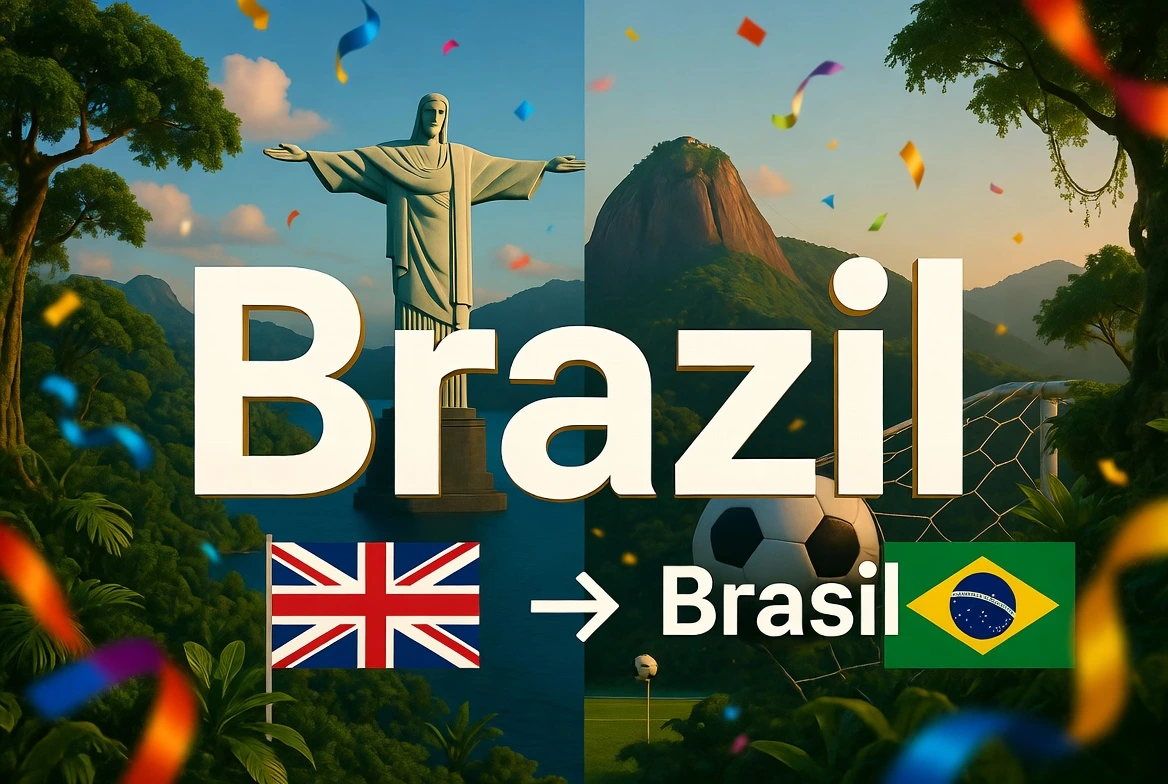
Brazil is the English name, while Brasil is the Portuguese name for the same South American country.
Quick Answer
Both “Brasil” and “Brazil” are correct, but they are used in different languages.
- Brazil is the correct English spelling.
- Brasil is the official Portuguese spelling used by the country itself.
- If you are writing in English, always use Brazil unless you are referring to the country’s Portuguese name or quoting Portuguese text.
- Knowing when to use each spelling helps you write accurately and respectfully. Whether you are preparing a school assignment, writing a travel blog, studying geography, or simply satisfying your curiosity, this guide explains everything in simple English.
- By the end of this article, you’ll know which spelling to choose, why the two versions exist, and how to avoid common mistakes.
Quick Comparison Table
| Word | Correct? | Used In | Meaning | Example |
|---|---|---|---|---|
| Brazil | ✅ Yes | English | The South American country | Brazil won the match. |
| Brasil | ✅ Yes | Portuguese | The official Portuguese name of the country | Bem-vindo ao Brasil! |
Is It “Brasil” or “Brazil”?
The answer depends entirely on the language you are writing in.
If your audience reads English, use Brazil.
If you are writing in Portuguese, use Brasil.
Think of it this way:
- English has its own names for many countries.
- Portuguese uses the country’s native spelling.
For example:
- English: Brazil
- Portuguese: Brasil
Neither spelling is wrong. The correct choice depends on the language of your document.
Quick Rule
✅ English writing → Brazil
✅ Portuguese writing → Brasil
What Does “Brazil” Mean?
Brazil is the English name of the largest country in South America.
It is famous for:
- The Amazon Rainforest
- Rio de Janeiro
- Carnival celebrations
- Football (soccer)
- Coffee production
- Beautiful beaches and wildlife
When English speakers mention the country in books, newspapers, websites, or conversations, they write Brazil.
Example Sentences
- Brazil is the largest country in South America.
- My friend is travelling to Brazil next summer.
- Brazil exports coffee to many countries.
- The Amazon rainforest covers a large part of Brazil.
- Brazil has won the FIFA World Cup multiple times.
What Does “Brasil” Mean?
Brasil is the Portuguese name of the same country.
Portuguese is spoken by more than 200 million people in Brazil, making it the country’s official language.
You will commonly see Brasil on:
- Government documents
- Passports
- Road signs
- Official websites
- Newspapers published in Portuguese
- Brazilian sports uniforms
For Portuguese speakers, Brasil is the normal and correct spelling.
Example Sentences
- Bem-vindo ao Brasil. (Welcome to Brazil.)
- O Brasil é um país muito bonito.
- Eu moro no Brasil.
When these sentences are translated into English, Brasil becomes Brazil.
The Origin of Brazil and Brasil
The history of the country’s name is surprisingly interesting.
The name comes from a valuable tree called brazilwood. Early Portuguese explorers found large quantities of this tree along the Atlantic coast of South America. The wood produced a rich red dye that was highly valuable in Europe.
The Portuguese called this tree pau-brasil because its glowing red colour reminded them of hot embers, known in Old Portuguese as brasa.
Over time, the land became known as Brasil.
When English speakers adopted the country’s name, they changed the spelling to Brazil, following English spelling conventions. Although the spelling changed slightly, both names refer to exactly the same country.
This is similar to how many countries have different names in different languages. For example:
- Germany is called Deutschland in German.
- Spain is called España in Spanish.
- Japan is called Nihon or Nippon in Japanese.
- Brazil is called Brasil in Portuguese.
These differences are completely normal and reflect the history and language of each culture.
By understanding the origin of Brazil and Brasil, it becomes much easier to remember why both spellings exist today.
Which Spelling Should You Use?
The correct spelling depends on your audience and the language you are using.
If you are writing in English, choose Brazil. This is the spelling used in English dictionaries, newspapers, books, schools, universities, and international publications.
If you are writing in Portuguese, choose Brasil. It is the country’s official name and appears in government documents, road signs, newspapers, and official communications in Brazil.
A Simple Rule to Remember
- ✅ Writing in English → Brazil
- ✅ Writing in Portuguese → Brasil
Following this simple rule will help you avoid spelling mistakes and communicate clearly.
Brazil vs Brasil: Side-by-Side Comparison
| Feature | Brazil | Brasil |
|---|---|---|
| Language | English | Portuguese |
| Correct? | ✅ Yes | ✅ Yes |
| Official name in English | Yes | No |
| Official name in Portuguese | No | Yes |
| Used in English schools and books | Yes | No |
| Used by the Brazilian government | Rarely | Yes |
| Pronunciation in English | Brazil | Usually adapted to Portuguese pronunciation |
Why Do the Spellings Differ?
Many countries have different names in different languages. These differences developed over hundreds of years as languages evolved.
For example:
| English | Native Language |
|---|---|
| Germany | Deutschland |
| Spain | España |
| Greece | Ελλάδα (Elláda) |
| Finland | Suomi |
| Japan | Nihon (Nippon) |
| Brazil | Brasil |
This shows that Brazil and Brasil are not spelling mistakes. They are simply language-specific names for the same country.
This isn’t the only case where a word carries two “correct” spellings depending on language or region. The same s-to-z shift shows up in Posole or Pozole, a dish name that keeps its original Spanish “s” in some regions while adopting the anglicized “z” in others. A similar pattern appears in Organisation or Organization, where the s/z difference comes down to British versus American spelling conventions rather than translation. In each case, neither version is technically wrong — the correct choice simply depends on which linguistic or regional standard you’re following.
Examples in Everyday Sentences
Using Brazil (English)
- Brazil is famous for its football teams.
- My cousin plans to visit Brazil next year.
- Brazil has many beautiful beaches.
- Coffee from Brazil is exported worldwide.
- The Amazon Rainforest covers much of Brazil.
Using Brasil (Portuguese)
- Bem-vindo ao Brasil!
- O Brasil é conhecido pelo Carnaval.
- Eu quero visitar o Brasil.
- O Brasil é o maior país da América do Sul.
- O futebol é muito popular no Brasil.
Common Mistakes to Avoid
Although the difference is simple, many learners make these mistakes.
❌ Mistake 1: Using Brasil in an English essay
Incorrect:
I want to travel to Brasil next year.
Correct:
I want to travel to Brazil next year.
❌ Mistake 2: Thinking one spelling is wrong
Some learners believe Brasil is a typo.
In reality, Brasil is the official Portuguese spelling and is completely correct when writing in Portuguese.
❌ Mistake 3: Mixing languages
Incorrect:
Welcome to Brasil. It is the largest country in South America.
Correct:
Welcome to Brazil. It is the largest country in South America.
Or write the entire sentence in Portuguese if you choose Brasil.
Does the Spelling Change the Pronunciation?
Not very much.
In English, Brazil is commonly pronounced as:
/brəˈzɪl/
In Portuguese, Brasil is pronounced slightly differently because Portuguese has its own pronunciation rules.
Although the written forms differ by one letter, they refer to the same country.
What Major Dictionaries Say
Leading English dictionaries consistently use Brazil as the standard English spelling.
Cambridge Dictionary
Cambridge lists Brazil as the English name of the country in South America.
Oxford English Dictionary
Oxford also recognises Brazil as the standard English spelling.
Merriam-Webster Dictionary
Merriam-Webster uses Brazil throughout its entries and examples.
These trusted dictionaries do not replace the English spelling with Brasil, because Brasil belongs to Portuguese rather than English.
If you are writing in English, following the dictionary standard means using Brazil.
Did You Know?
Many countries have names that change depending on the language being used.
For example:
- Brazil → Brasil
- Japan → Nihon
- Greece → Elláda
- Finland → Suomi
- Germany → Deutschland
This is a normal part of language and geography. These different names are called endonyms (the local name used by people in the country) and exonyms (the name used by speakers of another language).
Brasil is the country’s endonym, while Brazil is the English exonym.
Grammar Relay
Understanding Brazil and Brasil becomes easier when you compare them with other country names that change across languages.
Similar Country Name Variations
| English | Native Language |
|---|---|
| Brazil | Brasil |
| Germany | Deutschland |
| Spain | España |
| Finland | Suomi |
| Japan | Nihon (Nippon) |
Remember: These are language differences, not spelling mistakes.
Vocabulary Corner
Synonyms (Related Words)
- Nation
- Country
- Republic
- State
- Territory
Antonyms
Since Brazil is a proper noun (a country name), it has no true antonym.
Idiom
“Home away from home”
Meaning: A place where you feel comfortable even though you are not in your own country.
Example: After living in Brazil for five years, it became my home away from home.
Proverb
“When in Rome, do as the Romans do.”
Meaning: Respect the customs and language of the place you are visiting.
Mini Quiz
Test your understanding by choosing the correct answer.
1. Which spelling is correct in English?
A. Brasil
B. Brazil
✅ Answer: B. Brazil
2. Which spelling is the official Portuguese name?
A. Brazil
B. Brasil
✅ Answer: B. Brasil
3. Which sentence is correct in English?
A. I want to visit Brasil.
B. I want to visit Brazil.
✅ Answer: B. I want to visit Brazil.
4. True or False?
Brasil is a spelling mistake.
❌ False
It is the official Portuguese spelling.
Practice Guide
Fill in the blanks with Brazil or Brasil.
- The Amazon Rainforest covers much of ________.
- Welcome to ________! (Portuguese sign)
- My sister plans to travel to ________ next year.
- O ________ é famoso pelo Carnaval.
Answers
- Brazil
- Brasil
- Brazil
- Brasil
Frequently Asked Questions (FAQs)
Q: Is Brazil or Brasil correct?
A: Both are correct. Brazil is used in English, while Brasil is used in Portuguese.
Q: Why is Brazil spelled with a Z in English?
A: English adopted the country’s name using its own spelling conventions, resulting in Brazil.
Q: Why do Brazilians write Brasil?
A: Because Portuguese is Brazil’s official language, and Brasil is the official Portuguese name of the country.
Q: Can I use Brasil in an English essay?
A: It is better to use Brazil in English writing unless you are quoting Portuguese or referring to the country’s official Portuguese name.
Q: Do Brazil and Brasil refer to different countries?
A: No. They are two names for the same country, used in different languages.
Q: Which spelling should I use on Spellnexa?
A: If your content is written in English, always use Brazil as the primary spelling. Mention Brasil only when explaining the Portuguese form.
Final Verdict
The difference between Brasil and Brazil is based on language, not correctness.
Use Brazil whenever you are writing in English. It is the standard spelling used in English dictionaries, schools, books, and international publications.
Use Brasil only when writing in Portuguese or when referring to the country’s official Portuguese name.
Remember this simple rule:
- English = Brazil
- Portuguese = Brasil
Following this guideline will ensure your writing is accurate and appropriate for your audience.
Key Takeaways
- Brazil is the standard English spelling.
- Brasil is the official Portuguese spelling.
- Both names refer to the same South American country.
- Choose the spelling based on the language you are writing in.
- English dictionaries use Brazil, while Portuguese publications use Brasil.

I am Calara Stephen passionate about making English simple and easy to understand through clear spelling comparisons, grammar guides, and language tips. Through thoughtful, reliable content, I aim to be a trusted guide for anyone looking to improve their English.