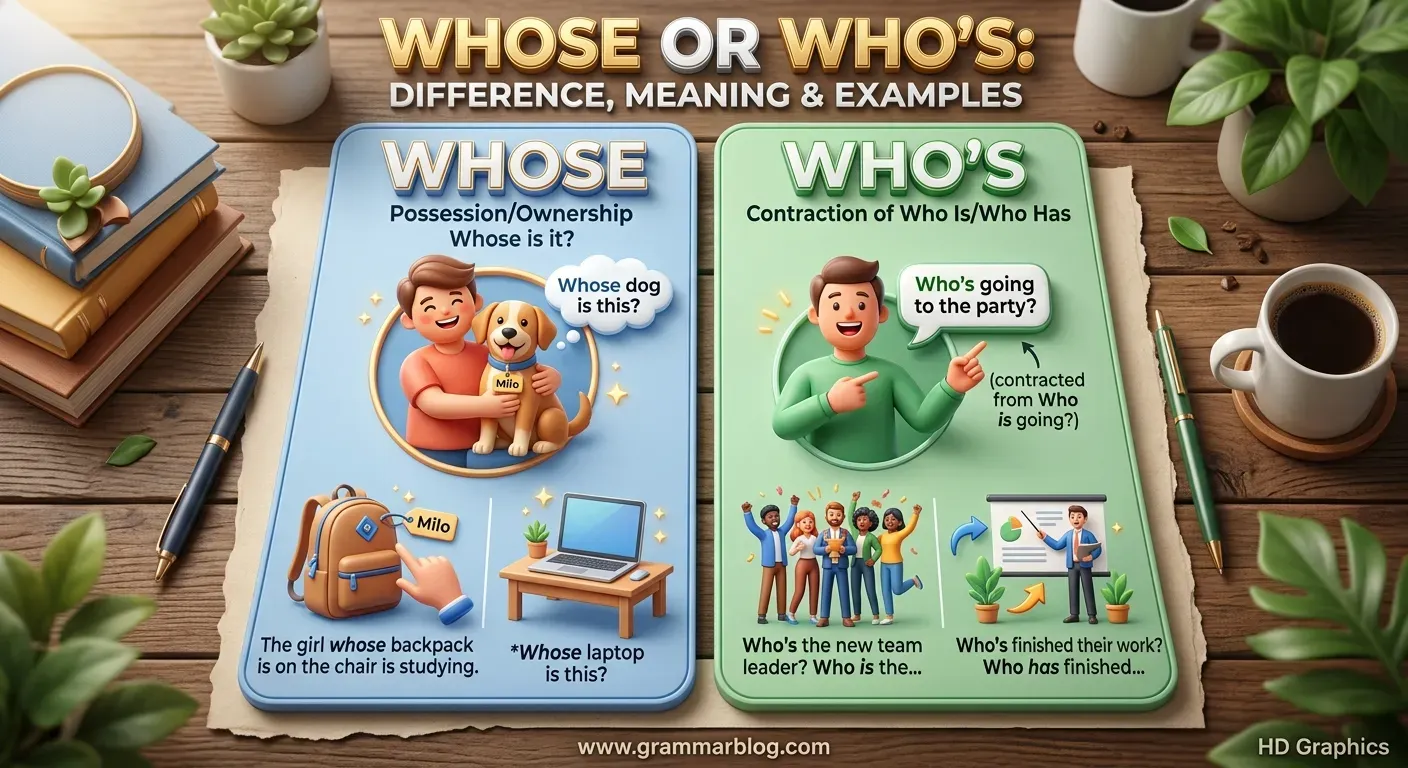
Whose shows possession or ownership, while who’s is a contraction of who is or who has.
Pronunciation:
Both whose and who’s are usually pronounced /huːz/, so they sound the same but have different meanings and grammatical functions.
Featured Snippet
Whose and who’s sound alike but are used differently. Whose shows possession or asks who something belongs to, as in “Whose book is this?” Who’s is a contraction of who is or who has, as in “Who’s coming?” or “Who’s finished?” A simple test is to replace who’s with who is or who has. If it works, use who’s; otherwise, use whose.
Quick Answer
Use whose when you are talking about possession, ownership, or association.
- Whose phone is this?
- The student whose bag was missing found it later.
Use who’s when you mean who is or who has.
- Who’s at the door? → Who is at the door?
- Who’s finished the assignment? → Who has finished the assignment?
The easiest rule
Whose = possession
Who’s = who is / who has
Quick Comparison Table
| Word | Meaning | Grammar | Example |
| whose | belonging to whom; possession | Pronoun/determiner | Whose jacket is this? |
| who’s | who is | Contraction | Who’s your teacher? |
| who’s | who has | Contraction | Who’s completed the task? |
Whose and who’s are commonly confused because they sound exactly the same in most varieties of English. The apostrophe in who’s can make the distinction look obvious, but the real difference is grammatical, not pronunciation-based.
Whose is used to show possession or to ask about ownership. Who’s, on the other hand, is a shortened form of who is or who has. Merriam-Webster and Cambridge Dictionary both make this distinction clear.
The good news is that you can usually choose the correct word with one simple substitution test.
Whose: Meaning and Usage
Whose is used to ask about or indicate possession, ownership, or a relationship to someone or something.
One-Line Definition
Whose means “belonging to whom” or “associated with whom or which.”
Cambridge Dictionary explains that whose is used especially in questions about who owns or is responsible for something. It can also introduce information about a person or thing in a relative clause.
Examples of Whose
- Whose book is this?
- Whose keys are on the table?
- Do you know whose car that is?
- I don’t know whose phone this is.
- She is the teacher whose class won the competition.
- We visited a house whose windows were broken.
Notice that whose does not necessarily refer only to people. It can also be used with animals and things.
- The dog whose tail was injured was taken to the vet.
- This is the house whose roof was damaged.
Cambridge specifically notes that whose can introduce relative clauses showing possession by people, animals, and things.
Who’s: Meaning and Usage
Who’s is a contraction. It has two possible meanings:
- who is
- who has
One-Line Definition
Who’s is the shortened form of “who is” or “who has.”
Cambridge Dictionary lists both meanings, while Merriam-Webster gives the same distinction.
Who’s = Who Is
Use who’s when you can replace it with who is.
- Who’s coming to the party?
- Who is coming to the party?
Both sentences mean the same thing.
More examples:
- Who’s your new teacher?
- Who’s at the door?
- Do you know who’s responsible?
- Who’s ready to leave?
- I wonder who’s calling.
Who’s = Who Has
Use who’s when it can be expanded to who has.
- Who’s finished the work?
- Who has finished the work?
More examples:
- Who’s taken my pen?
- Who’s been to London?
- Do you know who’s completed the assignment?
- She is the student who’s won the award.
Whose vs. Who’s: The Main Difference
The easiest way to understand the difference is to focus on possession versus contraction.
| If you mean… | Use | Example |
| belonging to someone | whose | Whose bag is this? |
| who is | who’s | Who’s in the room? |
| who has | who’s | Who’s finished? |
Compare These Sentences
Whose sister is she?
→ You are asking about possession/relationship.
Who’s her sister?
→ You mean who is her sister.
Another example:
Whose phone is ringing?
→ You are asking who owns the phone.
Who’s calling?
→ You mean who is calling.
The Simple Replacement Test
When you are unsure whether to use whose or who’s, try replacing who’s with who is or who has.
If “who is” works → use WHO’S
Who’s coming with us?
Replace it:
Who is coming with us? ✓
Therefore:
Who’s coming with us? ✓
If “who has” works → use WHO’S
Who’s completed the project?
Replace it:
Who has completed the project? ✓
Therefore:
Who’s completed the project? ✓
If neither works → use WHOSE
Whose laptop is this?
Try:
Who is laptop is this? ✗
Who has laptop is this? ✗
Therefore, the correct word is:
Whose laptop is this? ✓
Grammar Rule: Whose or Who’s?
The grammatical rule is simple:
Use “whose” as a possessive form. Use “who’s” only as a contraction of “who is” or “who has.”
Whose
Whose can function as a possessive determiner:
- Whose book is this?
- Whose car did you borrow?
It can also function as a pronoun:
- Whose is this?
- Do you know whose it is?
Cambridge Grammar identifies whose as a wh-word used to ask questions about possession and to introduce relative clauses.
Who’s
Who’s is always a contraction:
- Who’s = who is
- Who’s = who has
It is not the possessive form of who.
Common Mistakes
Mistake 1: Using “who’s” to show possession
❌ Who’s book is this?
Here, you are asking who owns the book. You cannot replace who’s with “who is” or “who has.”
✅ Whose book is this?
Mistake 2: Using “whose” instead of “who’s”
❌ Whose coming to dinner?
You mean:
Who is coming to dinner?
So the correct form is:
✅ Who’s coming to dinner?
Mistake 3: Confusing “whose” with “who’s” in relative clauses
❌ The woman who’s car was stolen called the police.
Here, you mean the car belonging to the woman.
✅ The woman whose car was stolen called the police.
However:
✅ The woman who’s calling the police is my sister.
Here, who’s means who is.
A Possessive vs. A Contraction
“Whose” and “who’s” trip people up because they sound identical, but they’re doing completely different grammatical jobs “whose” shows ownership (whose book is this?), while “who’s” is simply short for “who is” or “who has.” Mixing them up is one of the most common grammar slips in English. This same kind of function-based confusion shows up in Affect or Effect and Especially or Specially, where words that look or sound alike carry entirely different roles in a sentence.
Whose or Who’s? Examples
| Incorrect | Correct | Why? |
| Who’s book is this? | Whose book is this? | Shows possession |
| Whose coming today? | Who’s coming today? | Means “who is” |
| Who’s phone is ringing? | Whose phone is ringing? | Shows ownership |
| Whose at the door? | Who’s at the door? | Means “who is” |
| The girl who’s bag was lost… | The girl whose bag was lost… | Shows possession |
| The girl whose waiting outside… | The girl who’s waiting outside… | Means “who is” |
Whose in Questions
Whose is very common in questions about ownership.
Examples:
- Whose coat is this?
- Whose notebook is on the desk?
- Whose idea was it?
- Whose turn is it?
- Whose house are we visiting?
- Whose responsibility is this?
You can also use whose without a noun:
- Whose is this?
- Whose are these?
- Do you know whose this is?
Who’s in Questions
Who’s is commonly used at the beginning of questions when it means who is.
Examples:
- Who’s your favorite author?
- Who’s coming with us?
- Who’s responsible for this?
- Who’s at the door?
- Who’s your new manager?
- Who’s ready?
Remember: if you can expand who’s to who is, it is correct.
Who’s = Who Has
The second meaning of who’s is sometimes overlooked.
Examples:
- Who’s taken my keys?
→ Who has taken my keys? - Who’s finished the test?
→ Who has finished the test? - Who’s been waiting outside?
→ Who has been waiting outside?
Merriam-Webster confirms that who’s can represent both who is and who has.
Pronunciation: Whose vs. Who’s
In standard English pronunciation, whose and who’s are normally pronounced the same:
/huːz/
This means you cannot reliably distinguish them by listening.
| Word | Pronunciation | Sound |
| whose | /huːz/ | “hooz” |
| who’s | /huːz/ | “hooz” |
This is why the confusion is so common. The difference becomes clear from the meaning and grammar, not from pronunciation. Cambridge lists the same pronunciation for both forms.
Memory Trick
Here is an easy trick to remember the difference:
WHOSE → POSSESSION
Think:
Whose = Who owns it?
Whose bag is this?
→ Who owns the bag?
WHO’S → TWO WORDS
Think:
Who’s = Who is / Who has
Who’s coming?
→ Who is coming?
Who’s finished?
→ Who has finished?
The apostrophe clue
The apostrophe in who’s signals that letters have been removed:
who + is → who’s
who + has → who’s
It does not indicate possession here.
Whose or Who’s in Formal Writing?
Both forms are standard, but they perform different grammatical jobs.
Whose is the appropriate possessive form:
The researcher whose study received the award was interviewed.
Who’s is appropriate when a contraction is suitable:
The researcher who’s leading the project will speak first.
In very formal writing, you may choose to write who is or who has instead of who’s, but who’s itself is grammatically correct when used as the contraction. The key is not formality but meaning.
Learning Outcomes
After reading this guide, you should be able to:
- Understand the difference between whose and who’s.
- Use whose to show possession.
- Use who’s as a contraction of who is or who has.
- Apply the who is / who has replacement test.
- Avoid common spelling and grammar mistakes.
- Recognize the difference even though both words sound alike.
Mini Quiz: Whose or Who’s?
Choose whose or who’s in each sentence.
- ______ coming to the meeting?
- ______ jacket is this?
- Do you know ______ phone this is?
- ______ responsible for the project?
- The boy ______ bicycle was stolen reported it.
- ______ finished the assignment?
- ______ idea was this?
- I wonder ______ at the door.
Answers
- Who’s — who is coming
- Whose — asks about ownership
- whose — asks about ownership
- Who’s — who is responsible
- whose — shows possession
- Who’s — who has finished
- Whose — asks about ownership/association
- Who’s — who is at the door
Quick Practice Guide
Before choosing between whose and who’s, ask yourself:
Step 1: Am I talking about possession or ownership?
→ Use whose.
Step 2: Do I mean “who is”?
→ Use who’s.
Step 3: Do I mean “who has”?
→ Use who’s.
Step 4: Still unsure?
Try expanding who’s.
- Who is → who’s ✓
- Who has → who’s ✓
- Neither → whose ✓
Dictionary Check
Merriam-Webster
Merriam-Webster defines whose as a possessive form relating to whom or which and specifically warns not to confuse it with who’s, which means who is or who has.
Cambridge Dictionary
Cambridge Dictionary defines whose as a form used to ask about ownership or to introduce information about a person or thing. It defines who’s as the short form of who is or who has.
Final Verdict: Whose or Who’s?
Whose and who’s are both correct words, but they cannot normally be used interchangeably.
- Whose = possession
- Who’s = who is
- Who’s = who has
Remember:
Whose book is this? → possession
Who’s reading the book? → who is
If you remember just one rule, remember this:
Replace “who’s” with “who is” or “who has.” If the sentence still makes sense, use “who’s.” If it does not, you probably need “whose.”
FAQ
Q: Is “whose” possessive?
A: Yes. Whose is the possessive form used to ask or indicate who something belongs to or is associated with.
Q: Is “who’s” the same as “whose”?
A: No. They sound alike but have different meanings. Who’s means who is or who has, while whose expresses possession.
Q: How do I remember the difference between whose and who’s?
A: Remember: whose = possession, while who’s = who is / who has.
Q: Is “who’s” short for “who is”?
A: Yes. Who’s is a contraction of who is.
Q: Can “who’s” mean “who has”?
A: Yes. For example, “Who’s finished the work?” means “Who has finished the work?”
Q: Is “whose” used only for people?
A: No. Whose can refer to people, animals, and things in appropriate contexts, especially when introducing a relative clause.
Q: Why do whose and who’s sound the same?
A: Both are normally pronounced /huːz/, which is why they are often confused in speech. Their meanings and grammatical roles are different.
Author & Reviewer Note
Written by: English Vocabulary & Grammar Content Team
Reviewed for: spelling, grammar, usage, and learner clarity
Primary references: Merriam-Webster Dictionary and Cambridge Dictionary.

Rose Vault is an English language author who specializes in spelling comparisons, commonly confused words, and grammar. She creates clear, well-researched content that helps readers improve their writing and use English with confidence. Her goal is to make language learning simple, accurate, and accessible for everyone.