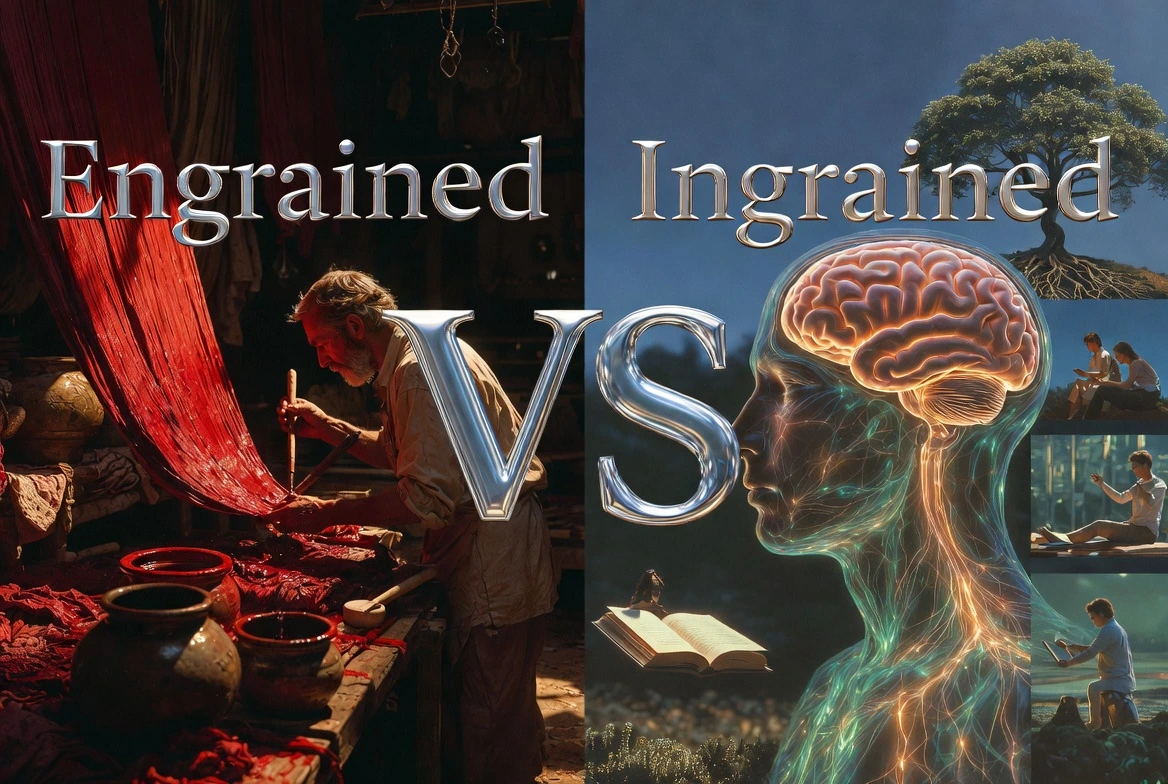
Ingrained is the correct word when you mean something that is deeply rooted, firmly established, or difficult to change. Engrained is a rare historical word related to dyeing fabric with a permanent color. In modern English, you should almost always use ingrained.
Did You Know?
Many people think engrained is simply another spelling of ingrained, but that’s not true. Although engrained is a real word, it has a different historical meaning connected to dyeing cloth. If you’re talking about habits, beliefs, behaviors, or traditions that are deeply established, ingrained is the correct choice.
Have you ever written engrained habit or engrained belief and wondered if it was correct?
You’re not alone. Many English speakers confuse engrained and ingrained because the words look and sound similar. However, they are not interchangeable.
Today, ingrained is the standard word used to describe ideas, habits, behaviors, or beliefs that have become deeply rooted over time. While engrained is a genuine English word, it has a rare historical meaning that most people never need in everyday writing.
In this guide, you’ll learn the difference between engrained and ingrained, discover why they are often confused, and see when each word should, or shouldn’t, be used.
See more: Through or Thru: What’s the Difference
Engrained or Ingrained: What’s the Difference?
The difference lies in their meaning and modern usage.
Ingrained describes something that has become firmly established and is difficult to change, such as a habit, belief, attitude, or behavior.
Engrained, on the other hand, originally referred to dyeing fabric with a permanent color. Because this meaning is rarely needed today, the word is uncommon in modern English.
| Feature | Ingrained | Engrained |
|---|---|---|
| Standard modern English | ✅ Yes | ❌ Rare |
| Means deeply rooted | ✅ Yes | ❌ No |
| Used in everyday writing | ✅ Very common | ❌ Very rare |
| Historical textile term | ❌ No | ✅ Yes |
| Recommended in professional writing | ✅ Yes | ❌ Usually no |
Quick Tip
If you’re describing a habit, tradition, opinion, belief, or behavior, choose ingrained.
What Does “Ingrained” Mean?
Ingrained means deeply rooted, firmly established, or difficult to change because it has existed for a long time.
It often describes habits, beliefs, customs, attitudes, behaviors, or traditions that have become a natural part of a person or group.
Examples
- Respect for others is an ingrained value in our family.
- She has an ingrained habit of arriving early.
- Years of practice created an ingrained routine.
- His fear of failure became deeply ingrained over time.
Common Collocations
You’ll often see ingrained used with words such as:
- ingrained habit
- ingrained belief
- ingrained behavior
- ingrained prejudice
- ingrained tradition
- ingrained attitude
- ingrained values
- deeply ingrained
These combinations are common in both spoken and written English.
What Does “Engrained” Mean?
Engrained is a rare English word that originally described fabric dyed with a permanent color produced from grain or kermes dye. Because of this historical origin, the word was associated with colors that were fixed deeply into cloth.
Today, this meaning is largely limited to historical, literary, or linguistic discussions. Outside of those contexts, engrained is rarely used and is not the correct choice when referring to habits, beliefs, or behaviors.
Historical Example
- The merchant sold engrained cloth dyed with rich red colors.
Modern Writing
In modern English, you would almost never write:
❌ He has an engrained habit of checking his phone.
Instead, write:
✅ He has an ingrained habit of checking his phone.
Origin and History of “Engrained” and “Ingrained”
The words engrained and ingrained share a common history, which is one reason they are often confused today.
Centuries ago, engrained referred to fabric that had been dyed with a permanent color, especially using a red dye called grain or kermes. Because the color soaked deeply into the cloth and was difficult to remove, the word became associated with something fixed or lasting.
Over time, English developed the word ingrained, which originally carried the same idea of something dyed deeply into a material. As the language evolved, ingrained took on a broader, figurative meaning. Instead of describing fabric, it came to describe habits, beliefs, attitudes, traditions, and behaviors that are deeply rooted and difficult to change.
Today, ingrained is the standard word in modern English for anything firmly established, while engrained survives mainly in historical, literary, or textile-related contexts.
Takeaway: Although the two words have connected historical roots, modern English almost always uses ingrained when describing deeply rooted ideas, habits, or behaviors.
See more: Adviser or Advisor: Which Spelling Should You Use?
Which Word Should You Use?
For almost all modern writing, the answer is simple: use ingrained.
Whether you’re writing an essay, email, report, blog post, or social media update, ingrained is the correct word when describing something that is firmly established or difficult to change.
Reserve engrained only for rare historical discussions about textiles or when quoting older texts where the word appears in its original sense.
Remember
If you’re talking about a habit, belief, value, attitude, custom, or behavior, the correct word is ingrained.
Why Do People Confuse “Engrained” and “Ingrained”?
The confusion between engrained and ingrained is understandable because the words look and sound very similar. They also share the ending -grained, which makes many people assume they are simply two spellings of the same word.
Another reason for the confusion is that people often associate ingrained with the verb engrave, thinking that something deeply “engraved” in the mind should be written as engrained. While this seems logical, it is not how modern English works.
In addition, some spell-checkers and online content may not immediately flag engrained as incorrect because it is a real but rare historical word. As a result, many writers mistakenly use it when they actually mean ingrained.
Remember: If you’re talking about habits, beliefs, traditions, attitudes, or behaviors that are deeply rooted, ingrained is almost always the correct choice.
Can You Ever Use “Engrained”?
Yes, but only in very limited situations.
Engrained is a genuine English word with a historical meaning. It originally referred to fabric or yarn that had been dyed with a permanent color, especially using a red dye known as kermes. Because this usage belongs mainly to historical and textile contexts, most people will never need to use engrained in everyday writing.
Historical Example
- The museum displayed engrained fabrics from the medieval period.
Everyday Writing
When describing habits, beliefs, or behaviors, always choose ingrained.
❌ Teamwork is an engrained value in our company.
✅ Teamwork is an ingrained value in our company.
Quick Tip
Unless you’re writing about historical textiles or quoting an old source, you should use ingrained.
Quick Visual Guide
Use this simple guide to remember the correct word.
| ✅ Use Ingrained | ❌ Avoid Engrained |
|---|---|
| ingrained habit | engrained habit |
| ingrained belief | engrained belief |
| ingrained behavior | engrained behavior |
| ingrained tradition | engrained tradition |
| ingrained values | engrained values |
| deeply ingrained prejudice | deeply engrained prejudice |
If the phrase refers to something that is deeply rooted or difficult to change, ingrained is the correct choice.
Memory Trick: Engrained vs. Ingrained
Remember “IN = Inside.”
If a habit, belief, or value is deeply rooted inside a person, the correct word is ingrained.Think:
- INgrained = deeply rooted IN your mind.
- ENgrained = historical word about dyed fabric.
Common Mistakes to Avoid
1. Using “engrained” instead of “ingrained”
This is the most common mistake.
❌ Honesty is an engrained value.
✅ Honesty is an ingrained value.
2. Assuming they are interchangeable
Although both words exist, they do not have the same meaning in modern English.
❌ You can always replace ingrained with engrained.
✅ Use ingrained for habits, beliefs, attitudes, and behaviors.
3. Confusing “ingrained” with “engraved”
Many people think engrained comes from engrave, but ingrained is the correct adjective for something that has become deeply established.
❌ His manners are engrained in him.
✅ His manners are ingrained.
See more: Especially or Specially: What’s the Difference?
Common Collocations with “Ingrained”
The adjective ingrained is frequently paired with certain nouns in everyday English. Learning these common combinations will help you sound more natural and write with confidence.
Some of the most common collocations include:
- ingrained habit
- ingrained belief
- ingrained behavior
- ingrained prejudice
- ingrained tradition
- ingrained attitude
- ingrained values
- ingrained fear
- ingrained culture
- deeply ingrained practice
Example Sentences
- Punctuality is an ingrained habit for her.
- The community has deeply ingrained traditions.
- Years of training created an ingrained behavior.
- The company is working to change ingrained attitudes toward remote work.
Grammar Relay Corner
Synonyms of Ingrained
Depending on the context, ingrained can be replaced with:
- deep-rooted
- entrenched
- embedded
- established
- fixed
- instilled
- inherent
Example:
The team has an ingrained culture of collaboration.
The team has a deep-rooted culture of collaboration.
Antonyms of Ingrained
Common antonyms include:
- temporary
- superficial
- flexible
- changeable
- weak
- unstable
Example:
Their traditions are ingrained.
Their traditions are temporary.
Idiom
Old habits die hard.
Meaning: Long-standing habits are difficult to change.
Example:
Even after retirement, he wakes up at 6 a.m. every day. Old habits die hard.
Proverb
As the twig is bent, so grows the tree.
Meaning: Early habits and influences often shape a person’s future character and behavior.
Mini Quiz: Test Your Knowledge
Choose the correct answer for each question.
1. Which word should you use when describing a deeply rooted habit?
A. Engrained
B. Ingrained ✅
C. Both are equally correct.
D. Neither.
2. Which word has a historical meaning related to dyeing fabric?
A. Engrained ✅
B. Ingrained
C. Both
D. Neither
3. Which sentence is correct?
A. She has an engrained belief in honesty.
B. She has an ingrained belief in honesty. ✅
C. Both sentences are correct.
D. Neither sentence is correct.
4. Which statement is true?
A. Engrained and ingrained are interchangeable in modern English.
B. Ingrained is the standard word for habits, beliefs, and behaviors. ✅
C. Engrained is more common than ingrained.
D. Ingrained is only used in British English.
Practice Exercise
Fill in the blanks with ingrained or engrained.
- Respect for elders is an __________ value in many cultures.
- The museum displayed __________ cloth from the 18th century.
- She has an __________ habit of checking her email every morning.
- Years of practice created an __________ routine.
- The historian explained how __________ fabrics were produced.
Answers
- ingrained
- engrained
- ingrained
- ingrained
- engrained
Key Takeaways
- Ingrained is the correct word when describing habits, beliefs, traditions, attitudes, or behaviors that are deeply rooted or difficult to change.
- Engrained is a real but rare historical word connected to permanently dyed fabric.
- The two words are not interchangeable in modern English.
- In everyday writing, professional communication, and academic work, ingrained is almost always the right choice.
- If you’re writing about historical textiles or quoting an old source, engrained may be appropriate.
Frequently Asked Questions (FAQs)
Q: Is “engrained” a real word?
A: Yes. Engrained is a genuine English word, but it has a rare historical meaning related to fabric dyed with a permanent color. It is seldom used in modern English.
Q: Which is correct: engrained or ingrained?
A: For almost all modern writing, ingrained is the correct choice. Use engrained only in historical or textile-related contexts.
Q: Why do people say “engrained” instead of “ingrained”?
A: Many people assume engrained is another spelling of ingrained because the words look and sound similar. Others mistakenly connect ingrained with the verb engrave. In standard modern English, however, ingrained is the correct word for something deeply established.
Q: Can I write “engrained habit”?
A: No. The correct expression is ingrained habit because ingrained describes habits, behaviors, and beliefs that have become deeply rooted.
Q: Is “deeply ingrained” correct?
A: Yes. Deeply ingrained is a common and natural English expression. It is often used to describe beliefs, traditions, prejudices, habits, and behaviors that are firmly established.
Examples:
- The tradition is deeply ingrained in the community.
- Her work ethic is deeply ingrained.
Q: Is “engrained” ever used today?
A: It is very rare. Most modern writers will never need to use engrained unless they are discussing historical textiles or quoting older literature.
See more: Pass or Past: What’s the Difference? (With Examples)
Conclusion
Although engrained and ingrained look similar, they are not interchangeable. Ingrained is the standard word used to describe habits, beliefs, values, traditions, and behaviors that are deeply rooted or difficult to change. It is the form you should use in everyday conversation, academic writing, business communication, and professional documents.
Engrained, by contrast, is a rare historical term related to permanently dyed fabric. Outside of historical or textile contexts, it is seldom appropriate in modern English.
When in doubt, remember this simple rule: If you’re describing something deeply rooted in a person’s mind, character, or culture, choose ingrained.
See more: Grey or Gray: Which Spelling Is Correct? (2026)

Amna Akhtar is a writer dedicated to making English easier to understand. She creates research-informed guides on grammar, vocabulary, spelling differences, and commonly confused words, combining careful research with clear, practical explanations. She is also the co-author of the peer-reviewed research article “Determinants of Jobs Satisfaction of Female Teachers: An Evidence from District Hafizabad, Pakistan,” published in the Journal of Education and Social Studies (2021).