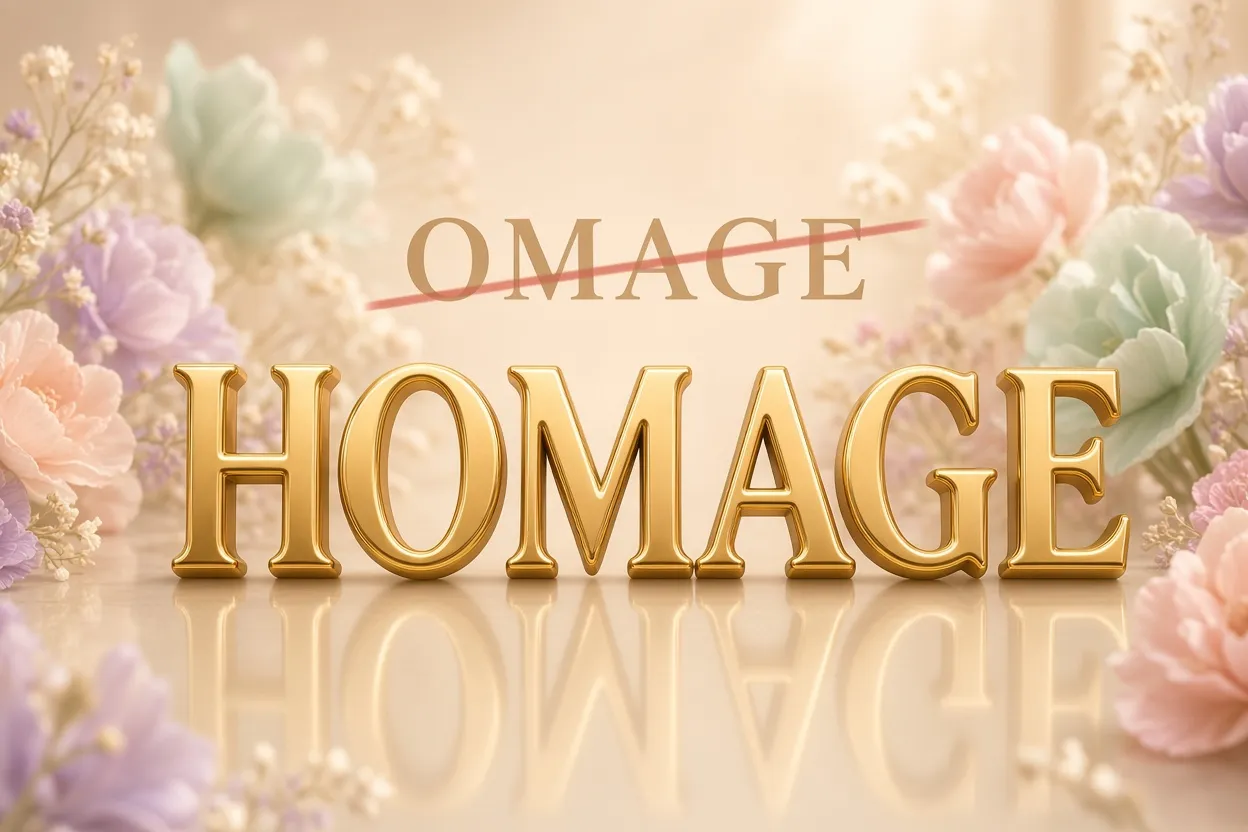
Homage means a public expression of respect, honor, or admiration while Omage a common misspelling of homage.
Quick Answer
Homage is the correct standard spelling. Omage is a misspelling and should not be used in standard English. Homage means a public expression of respect, honor, or admiration, especially for someone or something influential.
Quick Comparison Table
| Spelling | Correct? | Meaning | Usage |
|---|---|---|---|
| Homage | ✅ Yes | Respect, honor, or admiration | Standard English |
| Omage | ❌ No | — | Misspelling |
Why “Homage” Is Often Misspelled
If you want to describe an artist’s work that honors a famous painter, you might say, “The painting is an homage to her.” But when people hear the word rather than see it written, the silent h can make the spelling confusing. This is why some people write omage instead of homage. The two forms may sound similar, but they are not equal in standard English. Homage is the correct spelling and is used in dictionaries, formal writing, journalism, literature, and everyday English. Omage is simply a misspelling. In this guide, we will compare omage vs. homage, explain their meanings, pronunciation, origin, grammar, usage, and provide examples to help you remember the correct spelling.
“Omage” vs. “Homage”: Which Is Correct?
Homage: Correct Spelling
Homage is the correct spelling in standard English.
It means an expression of respect, honor, or admiration for a person, group, work, tradition, or idea.
Examples:
- The film is an homage to classic cinema.
- The monument was built as an homage to the fallen soldiers.
- Her speech paid homage to her former teacher.
Omage: Incorrect Spelling
Omage is not the standard English spelling of the word. It is usually a spelling error caused by the fact that the h in homage is often silent in pronunciation.
❌ The director made an omage to the old film.
✅ The director made an homage to the old film.
The Grammar of “Homage”
Homage is primarily a noun.
It commonly appears in the phrase pay homage to, which means to show respect or admiration for someone or something.
Examples:
- The museum paid homage to the famous artist.
- The novel pays homage to traditional storytelling.
- The ceremony was held to pay homage to the country’s heroes.
Can “Homage” Be Used as a Verb?
In standard modern English, homage is normally used as a noun, not a verb.
Instead of saying:
❌ The artist homaged the old painting.
Use:
✅ The artist paid homage to the old painting.
Why Is “Omage” a Common Misspelling?
The main reason is pronunciation.
The h in homage is commonly silent, so the word may sound roughly like “om-ij.” When people learn the word mainly through speech, they may naturally assume it begins with o.
This creates the spelling error:
omage ❌ → homage ✅
A useful memory trick is:
Homage has an H for Honor.
Think of H = Honor to remember the correct spelling.
Pronunciation of “Homage”
Homage has more than one accepted pronunciation in English.
- IPA: /ˈhɒmɪdʒ/ or /ˈhɑːmɪdʒ/
- Common pronunciation: HOM-ij
- The initial h may be pronounced in some varieties of English and silent in others.
The pronunciation difference does not change the spelling. The standard written form remains homage.
Etymology of “Homage”
Homage comes from Old French hommage, meaning an act of respect or allegiance. It is related to Old French home or homme, meaning “man,” and historically referred to a feudal ceremony in which a vassal expressed loyalty to a lord.
Over time, English broadened the meaning. Today, homage usually refers to an expression of respect, honor, or admiration rather than a feudal act of loyalty.
Historical Development
- Middle English: homage entered English through Anglo-French and Old French.
- Early meaning: It referred to an expression of allegiance or submission to a superior.
- Modern English: It commonly means an expression of respect, honor, or admiration.
Homage vs. Tribute
Homage and tribute are closely related, but they are not always interchangeable.
| Word | Main Meaning | Example |
|---|---|---|
| Homage | Respect or admiration shown toward someone or something | The film is an homage to old musicals. |
| Tribute | An act, statement, or gift showing respect or praise | The event was a tribute to the retired teacher. |
Something may be described as an homage when it is deliberately created or presented to show respect for another person, work, style, or tradition.
For example:
- The director’s new movie is an homage to classic westerns.
Homage vs. Honor
Honor is a broad word for respect, while homage usually describes an explicit expression of that respect.
- We honor our teachers.
- We pay homage to our teachers.
Both sentences express respect but pay homage to is more formal and often emphasizes a deliberate expression of admiration.
Real-World Usage of “Homage”
- Films: The movie is an homage to classic horror films.
- Music: The song is an homage to the singer’s early work.
- Art: The painting pays homage to a famous Renaissance artist.
- Literature: The novel is an homage to traditional storytelling.
- Architecture: The building was designed as an homage to the city’s history.
Usage Tip: The phrase “pay homage to” is especially common when talking about showing respect or admiration for a person, tradition, artistic work, or historical influence.
Vocabulary Corner: Words Related to “Homage”
Learning related words can help you understand homage more deeply and use it naturally in different contexts.
| Word | Part of Speech | Simple Meaning | Example |
|---|---|---|---|
| Homage | Noun | An expression of respect or admiration | The film is an homage to classic cinema. |
| Honor | Noun/Verb | Respect or show respect | We honor those who served their country. |
| Tribute | Noun | Something done or said to show respect | The book is a tribute to her father. |
| Admiration | Noun | Strong respect or approval | She has great admiration for her teacher. |
| Respect | Noun/Verb | High regard for someone or something | They showed respect for the artist. |
| Reverence | Noun | Deep respect and admiration | The monument is treated with reverence. |
| Praise | Noun/Verb | Words expressing approval or admiration | The writer received praise for her work. |
| Commendation | Noun | Formal praise for an achievement | He received a commendation for his service. |
💡 Vocabulary Tip
Homage, tribute, and honor are closely related, but homage often suggests a deliberate expression of admiration or respect. The common phrase “pay homage to” means to show respect or admiration for someone or something.
where should I add this
Common Mistakes
Mistake 1: Writing “Omage”
❌ The song is an omage to her childhood.
✅ The song is an homage to her childhood.
Mistake 2: Forgetting “Pay”
Because pay homage to is such a common phrase, learners sometimes create incorrect constructions.
❌ She gave homage to the artist.
This is possible in some contexts, but paid homage to is the more established expression.
✅ She paid homage to the artist.
Mistake 3: Confusing “Homage” With “Home”
Although homage begins with hom-, it does not mean anything related to a home. Its historical roots are connected to Old French and the idea of a person showing allegiance or respect.
“Homage” in American and British English
Both British English and American English use the spelling homage.
| Variety | Correct Spelling |
|---|---|
| British English | Homage |
| American English | Homage |
| Canadian English | Homage |
| Australian English | Homage |
There is no British vs. American spelling difference here.
Omage is not an accepted alternative spelling in standard English.
What Major Dictionaries Say
Major English dictionaries recognize homage as the standard word for an expression of respect or admiration. They do not treat omage as a standard spelling variant.
This means that in formal writing, academic work, professional communication, and SEO content, you should always use homage.
Homage: Common Collocations
Learning common word combinations can make the correct spelling easier to remember.
- pay homage to
- an homage to
- a fitting homage
- a respectful homage
- an artistic homage
- a tribute and homage
- paying homage to
Examples
- The exhibition pays homage to local artists.
- The song is an homage to 1980s pop music.
- The building serves as a fitting homage to the city’s history.
Quick Memory Trick
Remember:
HOMAGE = H + OMAGE
The H can remind you of Honor.
Homage = Honor + admiration
So when you are unsure whether to write omage or homage, choose the version with H.
Short Questions and Answers
Q: Is “omage” a correct spelling?
A: No. Omage is a misspelling. Homage is the correct standard spelling.
Q: Is “homage” British or American?
A: Homage is used in both British and American English. There is no spelling difference between the two varieties.
Q: Why is the H in “homage” confusing?
A: The h can be silent in pronunciation, depending on the variety of English and the speaker. This can make homage sound like it begins with an o.
Q: What does “homage” mean?
A: Homage means an expression of respect, honor, or admiration for someone or something.
Q: Is “pay homage to” correct?
A: Yes. Pay homage to is a common and standard English expression meaning to show respect or admiration.
Q: What is the difference between homage and tribute?
A: Both express respect or admiration. Homage often emphasizes a deliberate act or artistic expression of respect, while tribute is a broader term for something given or done to honor someone.
A Letter Lost in Pronunciation
The ‘h’ in “homage” is barely audible when spoken some pronunciations skip it almost entirely which is exactly why “omage” sneaks into so many people’s writing. It’s not a stylistic choice or an alternate form, just a letter that got dropped somewhere between hearing the word and spelling it. The same pronunciation-driven slip shows up in Fiend or Feen and Putty or Puddy, where the sound of a word quietly overrides its actual spelling.
Conclusion
When choosing between “omage” and “homage,” the correct spelling is clear: homage. The spelling omage is a common mistake, often caused by the silent or weakly pronounced h at the beginning of the word. Homage is a noun meaning an expression of respect, honor, or admiration, and it is especially common in the phrase pay homage to. It is used in both British and American English, so there is no regional spelling difference to remember. If you are writing an essay, article, email, or professional document, always choose homage. A simple way to remember it is H for Honor: homage expresses honor or admiration. Once you connect the spelling with its meaning, this commonly confused word becomes much easier to remember.
Homage ✅: Correct spelling
Omage ❌: Incorrect spelling
Remember: Homage has an H for Honor.

I am Calara Stephen passionate about making English simple and easy to understand through clear spelling comparisons, grammar guides, and language tips. Through thoughtful, reliable content, I aim to be a trusted guide for anyone looking to improve their English.