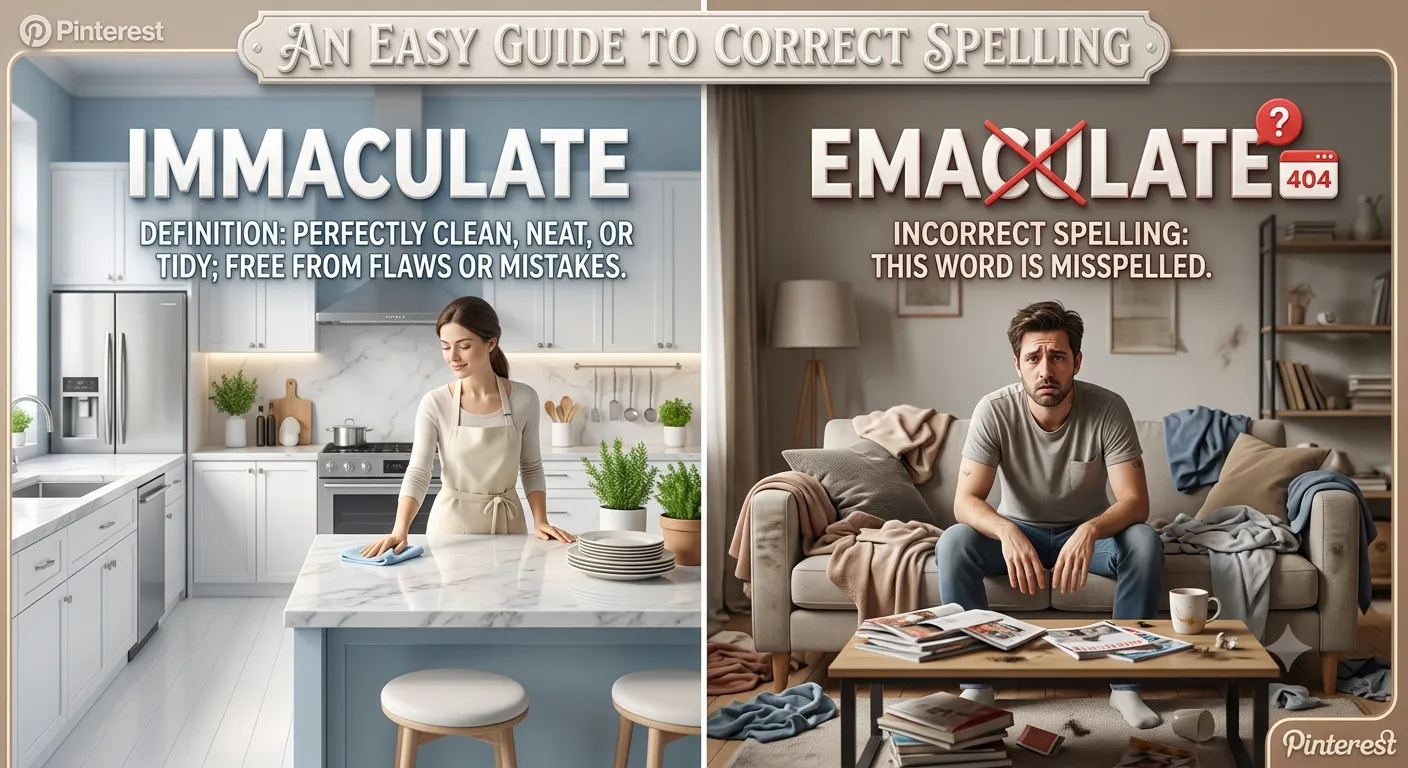
Immaculate: Perfectly clean, neat, flawless, or free from imperfections while emaculate usually an incorrect spelling of immaculate
Quick Answer
Immaculate is the correct spelling.
Emaculate is not a standard English word. It is simply a misspelling of “immaculate.”
- ✅ Immaculate = perfectly clean, spotless, flawless, or free from mistakes.
- ❌ Emaculate = incorrect spelling.
Quick Tip: If you want to describe something as perfectly clean or flawless, always use immaculate.
Quick Comparison Table
| Feature | Immaculate | Emaculate |
|---|---|---|
| Correct spelling? | ✅ Yes | ❌ No |
| Standard English word? | ✅ Yes | ❌ No |
| Part of Speech | Adjective | Not a standard word |
| Meaning | Perfectly clean, spotless, flawless | Usually a misspelling |
| Used in formal writing? | ✅ Yes | ❌ No |
Learning Outcomes
By the end of this article, you’ll be able to:
- Identify the correct spelling.
- Understand the meaning of immaculate.
- Avoid the common misspelling emaculate.
- Use immaculate correctly in everyday and professional writing.
Is It Immaculate or Emaculate?
The correct spelling is immaculate.
Many people accidentally write emaculate because the pronunciation makes the first syllable sound like “em.” However, English dictionaries recognize only immaculate.
Correct Examples
- The hotel room was immaculate.
- She arrived in an immaculate white dress.
- His handwriting is immaculate.
- The garden was kept in immaculate condition.
Incorrect Examples
- ❌ The hotel room was emaculate.
- ❌ She wore an emaculate dress.
What Does “Immaculate” Mean?
Immaculate means perfectly clean, spotless, tidy, or without flaws.
It can describe physical cleanliness as well as excellent quality or appearance.
Examples
- The kitchen was immaculate after cleaning.
- He keeps his car immaculate.
- Her presentation was immaculate.
- The lawn looked immaculate all year.
In every example, immaculate suggests a very high standard of cleanliness or perfection.
Why Do People Misspell It as “Emaculate”?
There are several reasons:
- The beginning “im-“ is often pronounced quickly, making it sound like “em.”
- The word has several syllables, increasing the chance of spelling mistakes.
- People write it based on pronunciation instead of memorizing the correct spelling.
Despite these reasons, immaculate is the only correct spelling in standard English.
Common Contexts for “Immaculate”
You will often see immaculate used to describe:
- Homes
- Rooms
- Cars
- Gardens
- Clothing
- Handwriting
- Workmanship
- Personal appearance
- Records or performances
Examples
- An immaculate office
- An immaculate uniform
- An immaculate performance
- An immaculate record
- An immaculate lawn
Immaculate vs. Emaculate: Side-by-Side Comparison
| Immaculate | Emaculate |
|---|---|
| The house was immaculate before the guests arrived. | ❌ The house was emaculate before the guests arrived. |
| She wore an immaculate white dress. | ❌ She wore an emaculate white dress. |
| His desk is always immaculate. | ❌ His desk is always emaculate. |
| The hotel room was immaculate. | ❌ The hotel room was emaculate. |
| They maintained an immaculate garden. | ❌ They maintained an emaculate garden. |
Key Point: Whenever you want to describe something as spotless, neat, or flawless, always use immaculate.
Common Mistakes
Because immaculate is a long word, it’s often misspelled. Here are some common errors:
Incorrect
❌ The apartment looked emaculate.
✅ The apartment looked immaculate.
❌ She keeps her office emaculate.
✅ She keeps her office immaculate.
❌ He has an emaculate attendance record.
✅ He has an immaculate attendance record.
❌ The chef prepared an emaculate kitchen.
✅ The chef prepared an immaculate kitchen.
Memory Trick
A simple way to remember the correct spelling is:
Immaculate starts with “I’m.”
Think:
“I’m immaculate.”
This phrase can help you recall that the word begins with Im-, not Em-.
Another trick is to remember that immaculate has double “m”:
I + mm + aculate
If you write only one m or begin with Em-, the spelling is incorrect.
Grammar Rule
Immaculate is an adjective.
It describes a noun by telling us that something is perfectly clean, tidy, or flawless.
Examples
- An immaculate room
- An immaculate garden
- An immaculate uniform
- An immaculate report
Comparative and Superlative
Because immaculate is a multi-syllable adjective, we normally use more and most instead of adding -er or -est.
| Form | Example |
|---|---|
| Positive | immaculate |
| Comparative | more immaculate |
| Superlative | most immaculate |
Although phrases like more immaculate are grammatically possible, they are relatively uncommon because immaculate already implies a very high level of perfection.
Real-Life Examples
Home
- The living room was immaculate after the renovation.
- Their kitchen is always immaculate.
Workplace
- She keeps an immaculate workspace.
- His report was immaculate and free of errors.
Personal Appearance
- He arrived in an immaculate suit.
- Her shoes remained immaculate despite the rain.
Performance
- The dancer gave an immaculate performance.
- The team’s planning was immaculate.
Common Collocations
These words frequently appear with immaculate:
| Common Phrase | Meaning |
|---|---|
| Immaculate condition | Perfect state |
| Immaculate appearance | Extremely neat look |
| Immaculate home | Spotlessly clean house |
| Immaculate record | No mistakes or failures |
| Immaculate uniform | Perfectly clean clothing |
| Immaculate garden | Beautifully maintained garden |
| Immaculate presentation | Flawless presentation |
| Immaculate taste | Excellent style or judgment |
Quick Practice
Choose the correct spelling.
- The office was ______ before the inspection.
- She has an ______ sense of style.
- The hotel maintained ______ rooms.
- His school record is ______.
- They admired the ______ garden.
Answers
- immaculate
- immaculate
- immaculate
- immaculate
- immaculate
In standard English, every answer is “immaculate.” Emaculate is simply a misspelling.
Frequently Asked Questions (FAQs)
Q: Is it immaculate or emaculate?
A: The correct spelling is immaculate.
Emaculate is not a standard English word and is considered a misspelling.
Q: What does immaculate mean?
Immaculate means:
- Perfectly clean
- Spotless
- Neat and tidy
- Flawless or free from mistakes
Examples:
- The room was immaculate.
- She has an immaculate sense of style.
- His report was immaculate.
Q: Is emaculate a real word?
A: No. Emaculate does not appear as a standard word in major English dictionaries. If you see it in writing, it is almost always a spelling mistake for immaculate.
Q: Why do people misspell immaculate?
A: People often spell it as emaculate because:
- The first syllable sounds similar to “em” in casual speech.
- The word is relatively long.
- Writers sometimes spell it the way they hear it instead of memorizing the correct form.
Q: How do you pronounce immaculate?
A: Pronunciation (IPA): /ɪˈmæk.jə.lət/
Simple pronunciation: ih-MAK-yuh-luht
The stress falls on the second syllable: MAC.
Word Origin
The word immaculate comes from the Latin immaculatus, meaning “unstained,” “spotless,” or “without blemish.”
This explains why the word is associated with cleanliness, purity, and perfection.
Synonyms of Immaculate
Depending on the context, you can use:
- Spotless
- Pristine
- Flawless
- Perfect
- Clean
- Neat
- Tidy
- Faultless
- Unblemished
- Impeccable
Example
- The office was immaculate.
- The office was spotless.
- The office was pristine.
Antonyms of Immaculate
The opposite of immaculate includes:
- Dirty
- Messy
- Untidy
- Filthy
- Unclean
- Imperfect
- Flawed
- Stained
- Disorderly
- Scruffy
Example
- The room was immaculate. ✅
- The room was messy. ❌ (Opposite meaning)
Final Summary
| If you mean… | Correct Spelling |
|---|---|
| Perfectly clean | Immaculate |
| Spotless | Immaculate |
| Flawless | Immaculate |
| Neat and tidy | Immaculate |
| Emaculate | ❌ Incorrect |
Key Takeaway
Whenever you want to describe something as spotless, flawless, or perfectly clean, always use immaculate.
Avoid emaculate, as it is simply a spelling mistake and is not accepted in standard English.
When One Letter Changes Everything
“Emaculate” isn’t a stylistic choice or a regional spelling it’s simply what happens when a word gets typed the way it sounds instead of the way it’s spelled. Swap that first vowel and you go from “spotlessly clean” to a word that doesn’t officially exist. This same one-letter slip shows up in Fiend or Feen and Surprise or Suprise words where pronunciation quietly nudges people toward the wrong spelling.
Conclusion
The choice between immaculate and emaculate is straightforward: immaculate is the only correct spelling.
Whether you’re describing a spotless home, a flawless performance, a neat appearance, or an excellent record, immaculate is the word you need.
Remember this simple rule:
- ✅ Immaculate = Correct
- ❌ Emaculate = Incorrect
By remembering that immaculate begins with “Im-“ and contains double “m”, you’ll avoid this common spelling error and write with greater confidence.

Amna Akhtar is a writer dedicated to making English easier to understand. She creates research-informed guides on grammar, vocabulary, spelling differences, and commonly confused words, combining careful research with clear, practical explanations. She is also the co-author of the peer-reviewed research article “Determinants of Jobs Satisfaction of Female Teachers: An Evidence from District Hafizabad, Pakistan,” published in the Journal of Education and Social Studies (2021).