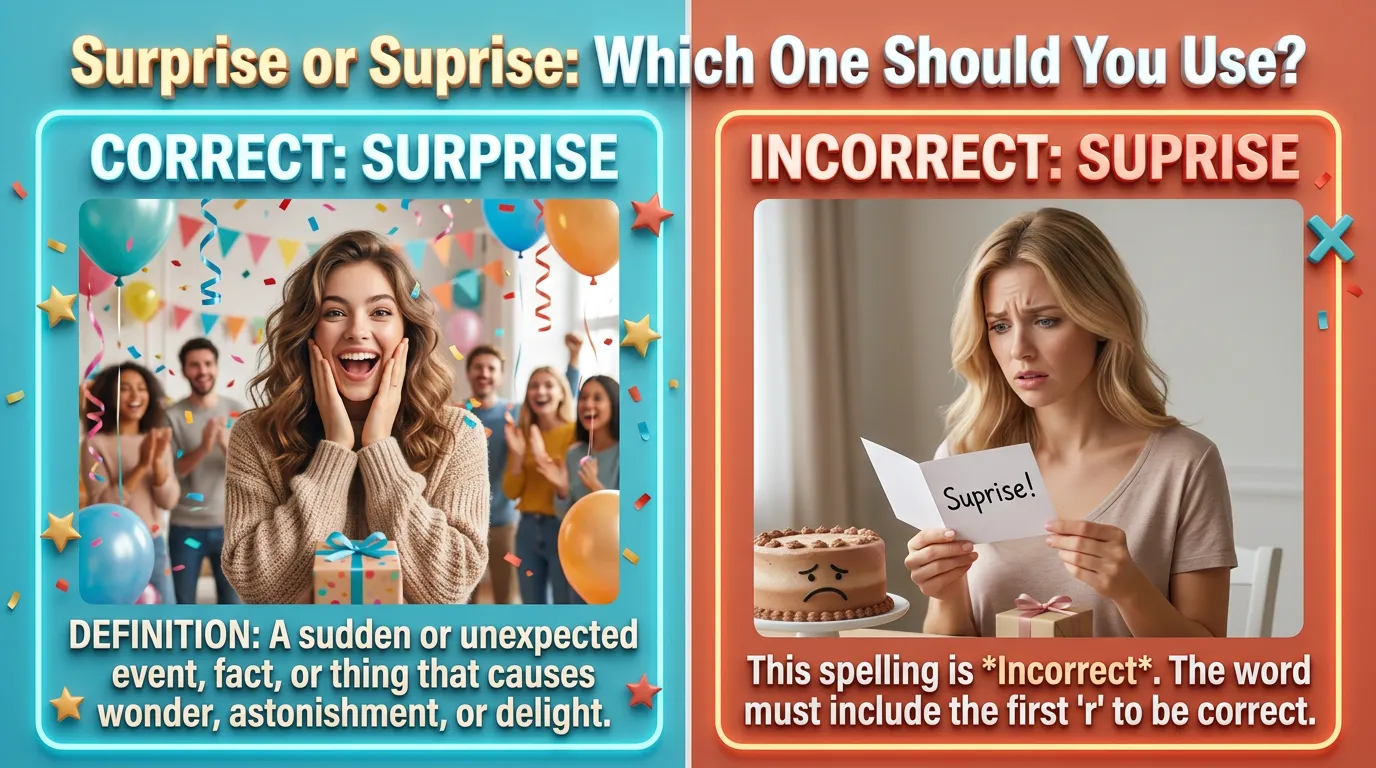
Surprise: An unexpected event or the act of astonishing someone.
Suprise: A common misspelling of surprise and not a standard English word.
Quick Answer
✅ Surprise is the correct spelling.
❌ Suprise is a misspelling and is not a standard English word.
Easy Memory Trick
Remember that surprise contains the word pattern:
sur + prise
There is an “r” after su.
Never drop the “r.”
Quick Comparison Table
| Word | Correct? | Meaning |
|---|---|---|
| Surprise | ✅ Yes | An unexpected event or to astonish someone |
| Suprise | ❌ No | Not a standard English word |
Many English learners and even native speakers accidentally write suprise instead of surprise. Since the two words look very similar, it’s easy to drop one letter without noticing. But which spelling is correct?
The correct spelling is surprise. It can be used as both a noun and a verb, meaning an unexpected event or to astonish someone.
The spelling suprise is a common misspelling. It is not recognized as a standard English word and should be avoided in all types of writing.
In this guide, you’ll learn the difference between surprise and suprise, why people confuse them, and simple tricks to remember the correct spelling.
What Does Surprise Mean?
Surprise can be used as both a noun and a verb.
As a noun
It means an unexpected event or occurrence.
Examples
- The birthday party was a wonderful surprise.
- Winning the award came as a complete surprise.
- Her visit was a pleasant surprise.
As a verb
It means to astonish, amaze, or catch someone unexpectedly.
Examples
- They surprised their teacher with a thank-you card.
- His answer surprised everyone.
- The announcement surprised the audience.
Is Suprise a Real Word?
No.
Suprise is not recognized in major English dictionaries. It is simply a spelling mistake caused by leaving out the letter r after su.
Most spell-checkers automatically change suprise to surprise.
Why Do People Misspell Surprise?
There are several reasons why this mistake is so common.
1. Missing the Letter “R”
The most common mistake is accidentally removing the r, resulting in suprise.
Correct:
surprise
Incorrect:
suprise
2. Fast Typing
Because the letters are close together on a keyboard, writers sometimes skip the r when typing quickly.
3. Pronunciation
In fast speech, the first r may not be strongly emphasized, making some people believe the word is spelled suprise.
However, the correct spelling always includes the r.
The Origin of Surprise
The word surprise entered English through Old French, from the verb surprendre, meaning to overtake unexpectedly or to seize unexpectedly.
Over time, the word came to describe anything unexpected or astonishing.
Its historical spelling has always included the r, which is why surprise remains the standard form today.
Why Surprise Is the Correct Spelling
Major English dictionaries, style guides, and grammar references all use surprise.
The spelling follows the historical development of the word and has remained unchanged for centuries.
The form suprise has never become an accepted spelling.
Memory Trick
Here’s an easy way to remember it:
A surprise is Rare.
The word Rare contains the letter R, reminding you that surprise also needs an R after su.
Or simply remember:
SUR + PRISE = SURPRISE
Don’t forget the R!
When Should You Use Surprise?
Use surprise whenever you refer to something unexpected or when someone is astonished.
Common contexts
| Situation | Correct Word |
|---|---|
| Birthday party | Surprise |
| Unexpected gift | Surprise |
| Good news | Surprise |
| Shocking announcement | Surprise |
| Unexpected visitor | Surprise |
| Secret celebration | Surprise |
Is Surprise British or American English?
The spelling surprise is the standard form in British English, American English, Canadian English, and Australian English.
Unlike words such as colour/color or centre/center, there is no spelling variation for surprise.
| English Variety | Preferred Spelling |
|---|---|
| British English | Surprise |
| American English | Surprise |
| Canadian English | Surprise |
| Australian English | Surprise |
Key takeaway: Surprise is the correct spelling in every major variety of English.
What Major Dictionaries Say
Leading English dictionaries consistently list surprise as the correct spelling.
| Dictionary | Preferred Spelling |
|---|---|
| Oxford English Dictionary | Surprise |
| Cambridge Dictionary | Surprise |
| Merriam-Webster | Surprise |
| Collins English Dictionary | Surprise |
| Dictionary.com | Surprise |
None of these dictionaries recognize suprise as a standard English word.
Pronunciation Guide
Surprise is pronounced:
British English: /səˈpraɪz/
American English: /sərˈpraɪz/
Simple pronunciation: ser-PRIZE
Notice that the word has two “r” sounds in writing, even though the first one may be less noticeable in fast speech.
Surprise as a Noun vs. a Verb
One reason surprise is so useful is that it can function as both a noun and a verb.
| Part of Speech | Meaning | Example |
|---|---|---|
| Noun | An unexpected event | The party was a wonderful surprise. |
| Verb | To astonish or catch someone unexpectedly | They surprised their parents with dinner. |
Both uses share the same spelling: surprise.
Common Mistakes
Here are some mistakes writers often make.
| Incorrect | Correct | Why? |
|---|---|---|
| It was a big suprise. | It was a big surprise. | Surprise is the correct spelling. |
| They planned a suprise party. | They planned a surprise party. | The word always includes the first r. |
| Her visit was a pleasant suprise. | Her visit was a pleasant surprise. | Suprise is a misspelling. |
| The news suprised everyone. | The news surprised everyone. | The past tense is surprised. |
Examples of Surprise in Sentences
- Her promotion came as a complete surprise.
- We planned a surprise birthday party for our friend.
- The result didn’t surprise anyone.
- His unexpected visit was a pleasant surprise.
- They surprised their grandparents with flowers.
- The magician’s final trick amazed the audience and ended with a big surprise.
- The teacher surprised the class with a fun quiz.
Common Expressions with Surprise
You’ll often hear surprise in everyday English.
- Surprise party
- Pleasant surprise
- Big surprise
- To my surprise
- Surprise visit
- Birthday surprise
- Surprise announcement
- Full of surprises
Examples
- To my surprise, I passed the exam.
- We organized a surprise party for Sarah.
- The ending of the movie was a complete surprise.
Surprise vs. Suprise at a Glance
| Question | Answer |
|---|---|
| Which spelling is correct? | Surprise |
| Is suprise a real English word? | No |
| Which spelling appears in dictionaries? | Surprise |
| Which spelling should you use? | Surprise |
| Is there a British vs. American difference? | No |
Did You Know?
💡 Interesting fact: The phrase “to my surprise” has been used in English for hundreds of years and remains one of the most common expressions for introducing unexpected news. Because of its frequent use, surprise is among the English words most often misspelled as suprise.
A Simple Slip, Not a Style Choice
There’s no debate to settle here “Suprise” isn’t an alternate spelling or a regional preference, it’s just a missing letter that happens when the word is typed faster than it’s spelled. It’s an easy slip because the ‘r’ gets swallowed in pronunciation, and English has plenty of these letter-dropping traps. Excel or Excell and Steer or Stear follow the same pattern one version is simply correct, and the other is a mistake that’s become common enough to need its own explainer
Mini Quiz
Test your understanding by choosing the correct answer.
1. Which spelling is correct?
- A. Suprise
- ✅ B. Surprise
2. What does surprise mean?
- A. Something expected
- ✅ B. Something unexpected or to astonish someone
- C. A type of celebration only
3. Which sentence is correct?
- A. They planned a suprise party.
- ✅ B. They planned a surprise party.
4. Which spelling is recognized by major dictionaries?
- A. Suprise
- ✅ B. Surprise
Score Guide
- 4/4: Excellent! You know the correct spelling and usage.
- 2–3/4: Great work! Review the pronunciation and memory trick sections.
- 0–1/4: Read the article again to master this common spelling mistake.
Practice Guide
Use surprise whenever you refer to something unexpected or when someone is astonished.
| Situation | Correct Word |
|---|---|
| Birthday party | Surprise |
| Unexpected gift | Surprise |
| Secret celebration | Surprise |
| Unexpected visitor | Surprise |
| Amazing news | Surprise |
| Sudden announcement | Surprise |
Quick Tip
Ask yourself:
Is it something unexpected or does it astonish someone?
If the answer is yes, use surprise.
Frequently Asked Questions (FAQs)
Q: Is suprise a real word?
A: No. Suprise is a common misspelling. The correct spelling is surprise.
Q: Why is surprise spelled with an r?
A: The word comes from the Old French surprendre, which included the r. Modern English has kept that spelling.
Q: Is surprise a noun or a verb?
A: It can be both.
- Noun: The gift was a wonderful surprise.
- Verb: They surprised everyone with the announcement.
Q: Is surprise spelled differently in British and American English?
A: No. Both varieties use surprise.
Q: Why do so many people write suprise?
A:The first r is easy to miss when typing or speaking quickly, making suprise one of the most common English spelling mistakes.
Q: What is the opposite of surprise?
Depending on the context, opposites include expectation, predictability, certainty, or anticipation.
Grammar Relay Corner
Synonyms of Surprise
- Astonish
- Amaze
- Shock
- Startle
- Stun
- Delight
- Astound
- Catch off guard
Antonyms of Surprise
- Expectation
- Predictability
- Certainty
- Anticipation
- Preparation
- Awareness
- Foreknowledge
- Familiarity
Word Family
| Word | Part of Speech | Meaning |
|---|---|---|
| Surprise | Noun/Verb | An unexpected event or to astonish |
| Surprised | Adjective/Verb | Feeling or showing surprise |
| Surprising | Adjective | Causing surprise |
| Surprisingly | Adverb | In an unexpected way |
Idiom Connection
Spring a surprise
Meaning: To unexpectedly reveal or do something that catches someone off guard.
Example:
They sprang a surprise by announcing the winner early.
Proverb
Expect the unexpected.
This proverb reminds us that surprises are a natural part of life and that being prepared for unexpected events is often wise.
Key Takeaways
- ✅ Surprise is the correct spelling.
- ❌ Suprise is a common misspelling.
- ✅ Surprise can be both a noun and a verb.
- ✅ The word always includes the first r after su.
- ✅ There is no British vs. American spelling difference.
- ✅ All major dictionaries recognize surprise as the standard spelling.
Conclusion
Although surprise and suprise may look similar, only surprise is correct in standard English. Whether you’re referring to an unexpected event or the act of astonishing someone, surprise is the spelling recognized by dictionaries, style guides, and English speakers around the world.
The mistake suprise usually happens because the first r is accidentally omitted. A simple way to avoid this error is to remember that surprise has two “r” letters. Whenever you’re writing about an unexpected event, a surprise party, or surprising news, always choose surprise.

Hi, I’m Ashley Brown, a lifelong word enthusiast with a passion for making the English language less confusing.My goal is to help readers spell with confidence and never second-guess themselves again.