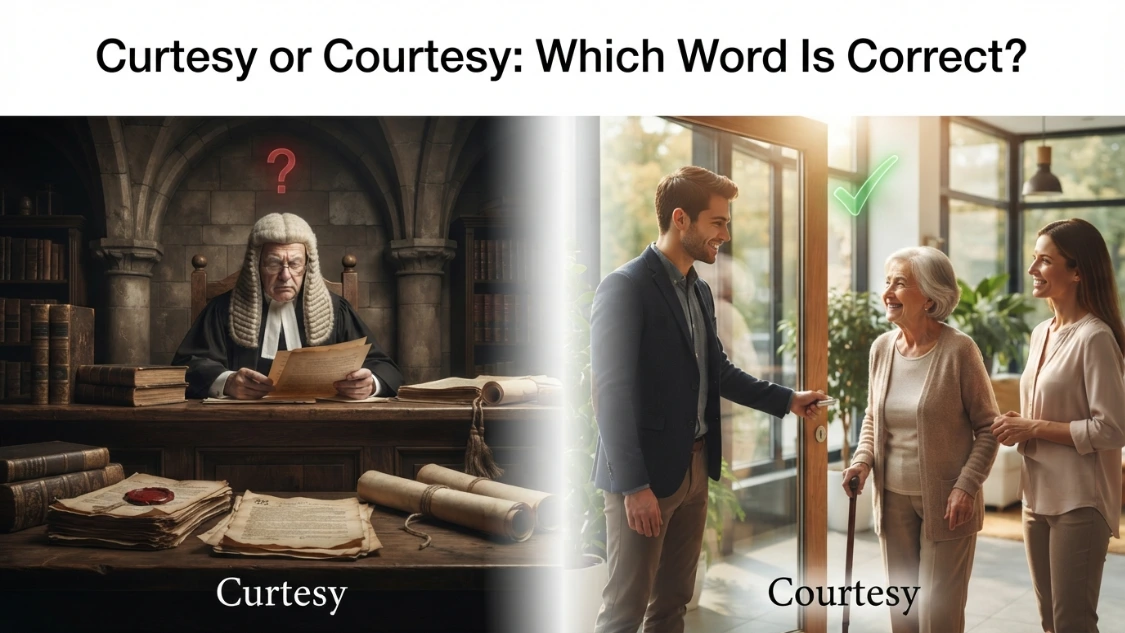
Curtesy: A rare historical legal term referring to a husband’s inheritance rights under old English common law while Courtesy means polite behavior, respect, or a thoughtful act shown toward others.
Quick Answer
If you’re referring to politeness, good manners, respect, or a kind gesture, the correct word is courtesy.
Curtesy is not the everyday spelling. Instead, it is a rare historical legal term that once described a husband’s right to inherit certain property from his deceased wife under old English common law.
In almost every email, essay, workplace message, or conversation, courtesy is the word you should use.
Quick Comparison Table
| Word | Correct? | Meaning | Example |
|---|---|---|---|
| Courtesy | ✅ Yes | Politeness, respect, or a thoughtful act | She thanked everyone for their courtesy. |
| Curtesy | ✅ Yes (legal term only) | A historical common-law inheritance right | The textbook explained the doctrine of curtesy. |
Why People Confuse Curtesy and Courtesy
Many English learners and even native speakers mistakenly write curtesy when they mean courtesy. The confusion is understandable because the two words are nearly identical in both spelling and pronunciation.
Here are the main reasons people mix them up:
- They differ by only one letter (u instead of ou).
- They are pronounced almost exactly the same.
- Most people have never heard of the legal term curtesy.
- Typing quickly can easily lead to the wrong spelling.
- Spell-checkers may recognize curtesy as a real word, so they don’t always flag it as an error.
Although curtesy is a legitimate English word, it is not a spelling variant of courtesy. Each word has its own meaning and should be used in different contexts.
A simple rule to remember is this:
If you’re talking about kindness, respect, or good manners, choose courtesy.
If you’re reading a historical legal document about inheritance rights, you may come across curtesy instead.
Pronunciation
Although courtesy and curtesy have different meanings, they are pronounced almost the same.
Courtesy (KUR-tuh-see)
Pronunciation: KUR-tuh-see
- American English: /ˈkɝː.tə.si/
- British English: /ˈkɜː.tə.si/
The rare legal term curtesy is pronounced the same way in modern English.
Because they sound alike, the meaning of the sentence not the pronunciation is what tells readers which word is intended.
What Does Courtesy Mean?
Courtesy is a noun that means polite behavior, respect, consideration, or a thoughtful act toward others. It can also describe a favor or service provided free of charge as a gesture of goodwill.
In modern English, courtesy is the standard word you’ll encounter in everyday conversations, emails, workplaces, schools, customer service, and formal writing. Whether you’re thanking someone for their kindness or describing professional behavior, courtesy is almost always the correct choice.
Common meanings of courtesy
- Politeness and good manners
- Respectful treatment of others
- A kind or thoughtful gesture
- A complimentary service or privilege
Examples of Courtesy in Sentences
- Thank you for your courtesy and patience.
- The receptionist greeted every visitor with courtesy.
- Showing courtesy to others creates a positive environment.
- The airline upgraded our seats as a courtesy.
- Common courtesy costs nothing but means a great deal.
Common Phrases with Courtesy
You’ll often see courtesy in these expressions:
- Common courtesy
- Courtesy of
- Courtesy call
- Courtesy copy (CC)
- Courtesy notice
- Courtesy shuttle
- Professional courtesy
Examples
- The event was sponsored courtesy of a local business.
- As a courtesy, the hotel extended our checkout time.
- She made a courtesy call after the meeting.
- Please extend the same professional courtesy to your colleagues.
What Does Curtesy Mean? (Historical Legal Term)
Unlike courtesy, curtesy has nothing to do with politeness or good manners.
Curtesy is an old legal term from English common law. It referred to a husband’s right to enjoy or inherit certain property belonging to his deceased wife, provided specific legal conditions such as the birth of a living child had been met.
Today, this doctrine has been abolished or replaced in most legal systems. As a result, curtesy is now found almost exclusively in:
- Historical legal documents
- Law textbooks
- Academic discussions of common law
- Legal history research
Outside these contexts, you are unlikely to see or use the word.
Examples of Curtesy in Sentences
- The professor explained the doctrine of curtesy during the lecture.
- The court examined historical rules regarding curtesy rights.
- The legal historian compared curtesy with the doctrine of dower.
- Curtesy played an important role in early English property law.
Key Difference
A helpful way to remember the distinction is this:
- Courtesy = kindness, respect, and good manners.
- Curtesy = a historical legal concept about inheritance.
If you’re writing an email, article, report, or social media post, you almost certainly mean courtesy, not curtesy.
What Major Dictionaries Say
Leading English dictionaries clearly distinguish courtesy from curtesy. They agree that courtesy is the standard everyday word for politeness and respect, while curtesy is a specialized legal term used mainly in historical contexts.
| Dictionary | Courtesy | Curtesy |
|---|---|---|
| Cambridge Dictionary | Defines courtesy as polite behavior or a respectful action. | Does not list it as an everyday word; its legal use is rare. |
| Merriam-Webster | Defines courtesy as well-mannered conduct, polite behavior, or a courteous act. | Lists curtesy as a legal term in common law referring to a husband’s inheritance rights. |
| Oxford English Dictionary (OED) | Defines courtesy as politeness, respect, and considerate behavior. | Records curtesy as a historical legal term used in English common law. |
| Collins English Dictionary | Defines courtesy as politeness, good manners, or a courteous action. | Identifies curtesy as an old legal doctrine relating to inheritance. |
Dictionary Verdict
All major dictionaries reach the same conclusion:
- ✅ Courtesy is the correct word for everyday English.
- ✅ Curtesy is also a real English word, but it belongs to historical legal vocabulary, not ordinary writing.
- ✅ If you’re talking about kindness, respect, or good manners, always choose courtesy.
Real-Life Situations: Which Word Fits?
Sometimes the easiest way to understand the difference is to see each word in context.
Situation 1: Writing a Thank-You Email
You want to thank a colleague for being polite and helpful.
✅ Correct: Thank you for your courtesy during the meeting.
❌ Incorrect: Thank you for your curtesy during the meeting.
Situation 2: Customer Service
A hotel offers you a free room upgrade because of a booking issue.
✅ Correct: The upgrade was provided as a courtesy.
Situation 3: Classroom or Workplace
A teacher reminds students to respect one another.
✅ Correct: Please show courtesy to your classmates.
Situation 4: Reading a History Book
You’re studying medieval English property law.
✅ Correct: The chapter explains the doctrine of curtesy.
Here, curtesy is the right word because the discussion is about a historical legal principle not politeness.
Situation 5: Reading a Court Record
An old legal case mentions a husband’s inheritance rights.
✅ Correct: The judge referred to the common-law right of curtesy.
The Simple Rule
Ask yourself one question:
Am I talking about politeness or legal history?
- Politeness, respect, kindness, or a thoughtful gesture → Courtesy ✅
- Historical inheritance law under common law → Curtesy ✅
Common Contexts Where You’ll See Courtesy
The word courtesy appears in many everyday expressions. Learning these common phrases will help you recognize and use the word naturally in both spoken and written English.
1. Courtesy of
This phrase means provided by, thanks to, or with the permission of someone.
Examples
- The concert tickets were courtesy of our local sponsor.
- These photos are courtesy of the city museum.
- The scholarship was awarded courtesy of a charitable foundation.
2. Common Courtesy
This expression refers to basic politeness and respect that everyone should show.
Examples
- Saying “please” and “thank you” is a matter of common courtesy.
- Waiting your turn is simply common courtesy.
- Showing common courtesy helps create a friendly environment.
3. Professional Courtesy
Professional courtesy means the respect and consideration professionals show one another in the workplace.
Examples
- She informed the other department as a professional courtesy.
- Doctors often extend professional courtesy to their colleagues.
- Responding promptly is a sign of professional courtesy.
4. Courtesy Call
A courtesy call is a polite visit or phone call made out of respect rather than necessity.
Examples
- The manager made a courtesy call to welcome the new client.
- The ambassador paid a courtesy call to local officials.
- She made a courtesy call after hearing the good news.
5. Courtesy Copy (CC)
In emails, a courtesy copy (commonly shortened to CC) means sending a copy of the message to someone for their information.
Examples
- Please send me a courtesy copy of the report.
- I was included on the email as a courtesy copy.
- The manager received a CC for reference.
6. As a Courtesy
This phrase describes a kind or thoughtful action that someone chooses to do.
Examples
- The airline waived the fee as a courtesy.
- The hotel offered a late checkout as a courtesy.
- The company replaced the item as a courtesy, even though the warranty had expired.
Can You Ever Use Curtesy Today?
Yes but only in a very specific context.
Although curtesy is a legitimate English word, it is not used in everyday communication. Today, you’ll find it almost exclusively in discussions of legal history or English common law.
You might encounter curtesy in:
- Historical law books
- Academic research papers
- University law courses
- Court cases discussing old inheritance laws
- Legal dictionaries
For most writers, journalists, students, and professionals, there is no practical reason to use curtesy.
Examples
- The legal scholar examined the historical doctrine of curtesy.
- The article compared curtesy with the doctrine of dower.
- Modern inheritance laws have largely replaced the concept of curtesy.
Editor’s Tip
If your sentence is about good manners, kindness, respect, customer service, or thoughtful behavior, you almost certainly need courtesy.
Reserve curtesy only for writing about historical legal concepts. Using it in place of courtesy will confuse readers and make your writing appear incorrect.
Common Mistakes and How to Avoid Them
Because courtesy and curtesy are spelled and pronounced so similarly, it’s easy to choose the wrong word. Fortunately, avoiding this mistake is simple once you know what each word means.
Mistake 1: Using Curtesy Instead of Courtesy
This is by far the most common error. Many people assume curtesy is an alternative spelling of courtesy, but it isn’t.
❌ Incorrect: Thank you for your curtesy.
✅ Correct: Thank you for your courtesy.
Mistake 2: Thinking They Are British and American Variants
Some spelling pairs ,such as colour and color,change between British and American English. Courtesy and curtesy do not.
❌ Incorrect: Curtesy is the British spelling.
✅ Correct: Courtesy is the standard spelling in both British and American English. Curtesy is a separate historical legal term.
Mistake 3: Using Curtesy in Everyday Writing
Unless you’re discussing old inheritance laws, curtesy is almost never the right choice.
❌ Incorrect: The staff treated us with great curtesy.
✅ Correct: The staff treated us with great courtesy.
Quick Memory Trick
Remember this simple rule:
Courtesy = Courteous = Good manners
If you can replace the word with courteous, then courtesy is the correct spelling.
For example:
- She was courteous to everyone.
- She showed great courtesy to everyone.
Since curteous isn’t a word, curtesy shouldn’t be used when talking about politeness.
English contains many words that look or sound alike but have different meanings. Similar confusion occurs with utmost or upmost, where one word refers to the highest degree while the other relates to physical position, and engrained or ingrained, where one spelling is standard in modern English and the other appears far less often. Learning these distinctions helps you write more accurately and confidently.
Grammar Relay Corner
Synonyms of Courtesy
Depending on the context, you can replace courtesy with:
- Politeness
- Respect
- Civility
- Consideration
- Kindness
- Thoughtfulness
- Good manners
- Graciousness
- Etiquette
- Decorum
Example:
- Her courtesy impressed everyone.
- Her kindness impressed everyone.
Antonyms of Courtesy
The opposite of courtesy includes:
- Rudeness
- Impoliteness
- Disrespect
- Incivility
- Discourtesy
- Insolence
- Harshness
- Bad manners
Example:
- His rudeness upset the customers.
- His lack of courtesy upset the customers.
Idioms About Politeness
Here are a few idioms related to respectful behavior:
- Mind your manners – Behave politely.
- Treat someone with kid gloves – Handle someone gently and respectfully.
- Go out of your way – Make a special effort to help someone.
- Roll out the red carpet – Give someone a warm and respectful welcome.
Example:
The staff rolled out the red carpet for the visiting guests.
Proverbs About Courtesy
- Courtesy costs nothing.
- Good manners open all doors.
- Kind words cost nothing but mean everything.
- You catch more flies with honey than with vinegar.
These sayings remind us that politeness and kindness can leave a lasting positive impression.
Vocabulary Corner
Expand your vocabulary with these words related to courtesy.
| Word | Meaning |
|---|---|
| Courteous | Polite and respectful |
| Civility | Formal politeness in behavior |
| Etiquette | Rules of polite behavior |
| Respect | Admiration and consideration for others |
| Consideration | Thoughtful concern for others |
| Gracious | Kind, polite, and pleasant |
| Discourtesy | Rude or impolite behavior |
| Decorum | Proper and dignified behavior |
Learn Them in Sentences
- The receptionist was courteous to every visitor.
- Workplace etiquette helps create a professional environment.
- Showing respect builds stronger relationships.
- Her gracious response calmed the situation.
- A simple act of consideration can brighten someone’s day.
These related words will help you use courtesy more naturally and improve your overall English vocabulary.
Mini Quiz
Test your understanding by choosing the correct answer.
1. Which word means politeness and respectful behavior?
A. Curtesy
B. Courtesy ✅
2. Which word is a historical legal term?
A. Courtesy
B. Curtesy ✅
3. Which sentence is correct?
A. Thank you for your curtesy during the meeting.
B. Thank you for your courtesy during the meeting. ✅
4. Which sentence uses curtesy correctly?
A. The airline offered a free upgrade as a curtesy.
B. The historian explained the doctrine of curtesy. ✅
Answers
- B — Courtesy
- B — Curtesy
- B — Courtesy
- B — Curtesy
Key Takeaways
- Courtesy is the correct everyday word for politeness, respect, kindness, and considerate behavior.
- Curtesy is a real English word, but it is a rare historical legal term related to inheritance under old English common law.
- The two words are pronounced almost the same, but they have completely different meanings.
- If you’re writing an email, essay, report, blog post, or social media update, courtesy is almost certainly the word you need.
- Reserve curtesy only for discussions of legal history or historical property law.
Frequently Asked Questions
Q: Is curtesy a misspelling of courtesy?
Not exactly. Curtesy is a genuine English word, but it is a rare legal term. In everyday writing, people who type curtesy usually mean courtesy.
Q: Which spelling should I use?
Use courtesy whenever you’re talking about politeness, good manners, respect, or a thoughtful gesture. Use curtesy only in discussions of historical legal concepts.
Q: Is courtesy correct in both British and American English?
Yes. Courtesy is the standard spelling in British English, American English, Canadian English, Australian English, and other major varieties of English.
Q: Why is curtesy still found in dictionaries?
Major dictionaries include curtesy because it has historical significance in English common law. Although the term is rarely used today, it remains part of the English language.
Q: How can I remember the difference?
Think of the adjective courteous. If your sentence is about someone being polite or respectful, the correct noun is courtesy. If the topic is historical inheritance law, the correct word is curtesy.
Conclusion
Although curtesy and courtesy look and sound alike, they have very different meanings. Courtesy is the standard English word for politeness, respect, kindness, and considerate behavior, making it the correct choice in almost every everyday situation. Curtesy, by contrast, is a rare historical legal term related to inheritance under old English common law.
Whenever you’re writing an email, essay, blog post, or professional document, you’ll almost always want courtesy. Save curtesy for discussions of legal history or historical property law. Understanding this distinction will help you avoid a common writing mistake and use the correct word with confidence.

Amna Akhtar is a writer dedicated to making English easier to understand. She creates research-informed guides on grammar, vocabulary, spelling differences, and commonly confused words, combining careful research with clear, practical explanations. She is also the co-author of the peer-reviewed research article “Determinants of Jobs Satisfaction of Female Teachers: An Evidence from District Hafizabad, Pakistan,” published in the Journal of Education and Social Studies (2021).