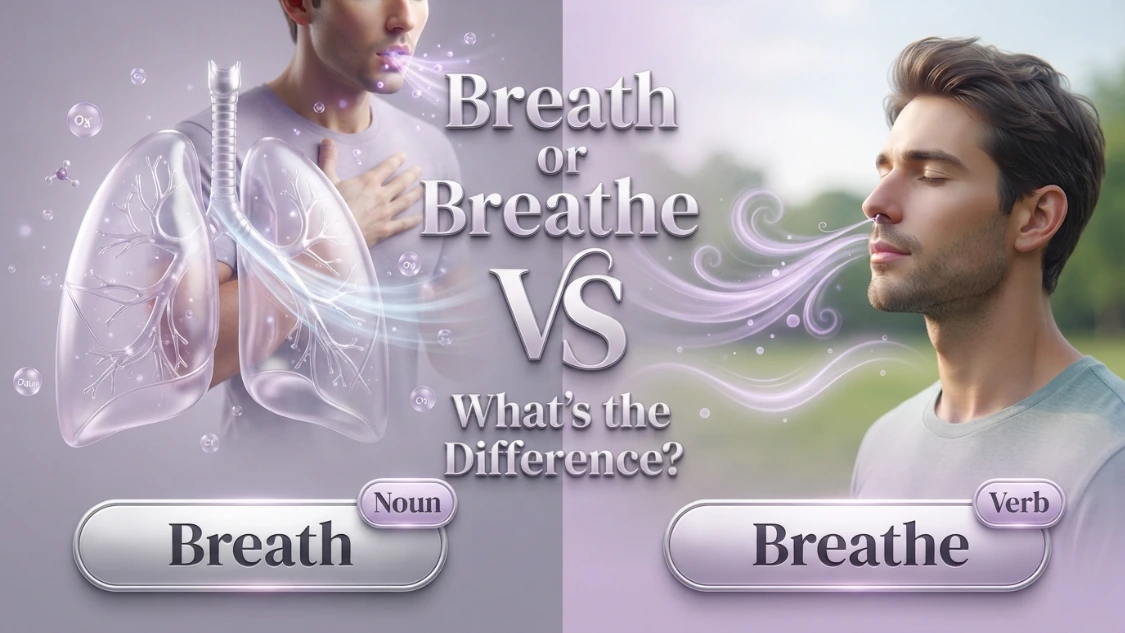
Breath is a noun that means the air inhaled and exhaled through the lungs or a single act of inhaling and exhaling. Breathe is a verb that means to inhale and exhale air through the lungs; in other words, to take in oxygen and release carbon dioxide as part of the breathing process.
Have you ever stopped while writing and wondered whether the correct word is breath or breathe? Although they differ by only one letter, they have completely different meanings and grammatical roles. Confusing them is one of the most common English writing mistakes because they are closely related in pronunciation and meaning.
The good news is that the difference is simple once you understand one basic rule: breath is a noun, while breathe is a verb.
In this complete guide, you’ll learn the meaning of each word, how to use them correctly, common mistakes to avoid, pronunciation tips, real-life examples. By the end, you’ll know exactly when to use breath and when to use breathe with confidence.
Quick Answer: Breath or Breathe?
If you’re short on time, here’s the simple rule:
- Breath is a noun. It refers to the air you take into or let out of your lungs.
- Breathe is a verb. It means to inhale and exhale air.
Examples:
- Take a deep breath before speaking.
- Try to breathe slowly during the exercise.
- She held her breath underwater.
- It’s difficult to breathe when your nose is blocked.
Quick Memory Trick:
Breath ends with -th, just like many nouns such as growth and truth.
Breathe ends with -the, and the extra e reminds you that it’s an action—a verb.
Quick Comparison Table: Breath or Breathe
| Feature | Breath | Breathe |
|---|---|---|
| Part of Speech | Noun | Verb |
| Meaning | The air you inhale and exhale | To inhale and exhale air |
| Pronunciation | breth (/brɛθ/) | breeth (/briːð/) |
| Usage | Refers to air or a single act of breathing | Refers to the action of breathing |
| Example | Take a deep breath before speaking. | Remember to breathe slowly during meditation. |
| Common Tip | Breath = a thing (noun) | Breathe = an action (verb) |
| Memory Trick | No “e” at the end = the air | Ends with “e” = the action of breathing |
What Does “Breath” Mean?
Breath is a noun that refers to the air moving into and out of your lungs. It can also describe a single act of inhaling or exhaling.
Definition
Breath (noun): The air taken into or expelled from the lungs, or one complete inhalation or exhalation.
Examples
- She took a deep breath before giving her presentation.
- His breath smelled like fresh mint.
- Hold your breath for ten seconds.
- After climbing the stairs, I was out of breath.
- The cold air took my breath away.
Notice that breath names a thing rather than an action. You can take, hold, lose, or catch a breath, but you cannot “breath” something because it isn’t a verb.
What Does “Breathe” Mean?
Breathe is a verb. It describes the action of taking air into your lungs and releasing it again.
Definition
Breathe (verb): To inhale and exhale air; to draw air into the lungs and expel it.
Examples
- Remember to breathe slowly during meditation.
- I couldn’t breathe because of the heavy smoke.
- Babies naturally breathe through their noses.
- Please breathe deeply before the test begins.
- He stopped running so he could breathe normally again.
Unlike breath, breathe always describes an action.
Breath vs Breathe: What’s the Difference?
Although the two words are closely connected, they belong to different parts of speech.
| Breath | Breathe |
|---|---|
| Noun | Verb |
| Refers to air or one inhalation | Means to inhale and exhale |
| Names a thing | Describes an action |
| “Take a breath.” | “Please breathe slowly.” |
Think of it this way:
- You take a breath.
- You breathe every moment you’re alive.
This simple distinction will help you choose the correct word almost every time.
Pronunciation Difference
Many learners confuse these words because they look nearly identical, but they are pronounced differently.
Breath
- Pronounced: BRETH
- Ends with the unvoiced th sound, like in think or bath.
Breathe
- Pronounced: BREETHE
- Ends with the voiced th sound, like in this or smooth.
Saying them aloud a few times can make it much easier to remember which word you’re using.
Why Do People Confuse Breath and Breathe?
Many English learners, and even native speakers, confuse breath and breathe because the words look almost identical, sound similar, and are closely related in meaning. However, they serve different grammatical purposes.
Here are the main reasons for the confusion:
- Only one letter is different. The extra “e” at the end of breathe is easy to miss when reading or typing.
- Their pronunciations are similar. Breath is pronounced /brɛθ/, while breathe is pronounced /briːð/. The subtle difference can be difficult to hear, especially for English learners.
- Both words relate to breathing. Since they describe the same general concept, many people mistakenly think they can be used interchangeably.
- Noun vs. verb confusion. Breath is a noun (the air you inhale and exhale), while breathe is a verb (the action of inhaling and exhaling). Confusing parts of speech is one of the most common grammar mistakes.
- Typing and autocorrect errors. Because both words are correctly spelled English words, spell-check tools may not detect the mistake if the wrong one is used in a sentence.
Quick Memory Trick
- Breath = thing (noun) → Take a deep breath.
- Breathe = action (verb) → Don’t forget to breathe.
Remember: If you’re talking about the action, use breathe. If you’re referring to the air itself or a single inhalation, use breath.
Read more: It’s or Its? Difference, Grammar Rules & Easy Examples
Common Mistakes with “Breath” and “Breathe”
Because breath and breathe differ by only one letter, many English learners—and even native speakers—use them interchangeably. However, choosing the wrong one can make a sentence grammatically incorrect.
Let’s look at the mistakes people make most often.
Mistake 1: Using “Breath” as a Verb
❌ Incorrect: I can’t breath through my nose.
✅ Correct: I can’t breathe through my nose.
Why?
The sentence describes an action. Actions require verbs and breathe is the verb.
Mistake 2: Using “Breathe” as a Noun
❌ Incorrect: Take a deep breathe before speaking.
✅ Correct: Take a deep breath before speaking.
Why?
Here you’re referring to the air you inhale, not the action itself. That’s why you need the noun breath.
Mistake 3: Forgetting the Silent “E”
Many writers accidentally omit the final e in breathe.
❌ She couldn’t breath.
✅ She couldn’t breathe.
The extra e changes the word from a noun into a verb.
Mistake 4: Confusing Related Word Forms
Understanding the entire word family makes it much easier to remember the difference.
| Word | Part of Speech | Example |
|---|---|---|
| Breath | Noun | Take a deep breath. |
| Breathe | Verb | Breathe slowly. |
| Breathing | Gerund/Present Participle | Deep breathing reduces stress. |
| Breathless | Adjective | I felt breathless after running. |
| Breathlessly | Adverb | She spoke breathlessly after the race. |
Notice how all other forms come from the verb breathe, while breath remains the noun.
Everyday Examples of Breath and Breathe
Seeing these words in real-life situations is one of the easiest ways to remember the difference.
At the Doctor’s Office
- The doctor asked me to take a deep breath.
- Please breathe slowly while I check your lungs.
- She listened carefully as I breathed in and out.
During Exercise
- I was out of breath after running five kilometres.
- Remember to breathe steadily while lifting weights.
- Deep breathing helps improve endurance.
At School
- The student took a deep breath before giving a speech.
- Try to breathe calmly if you feel nervous during the exam.
In Everyday Conversation
- Hold your breath for a few seconds.
- I couldn’t breathe because the room was full of smoke.
- The beautiful sunset took my breath away.
- Take a deep breath and relax.
These examples show that breath always refers to the air or a single inhalation, while breathe describes the action.
Common Expressions Using “Breath”
English includes many everyday expressions with breath.
Here are some of the most common:
- Take a deep breath – Calm yourself before doing something difficult.
- Hold your breath – Stop breathing for a short time.
- Catch your breath – Recover after physical activity.
- Out of breath – Breathing heavily because of exertion.
- Save your breath – Don’t waste your time talking because it won’t help.
- Take someone’s breath away – To amaze or astonish someone.
Examples
- Take a deep breath before answering the interview question.
- After the race, everyone needed to catch their breath.
- The mountain view took my breath away.
Vocabulary Corner
Synonyms of Breath
Depending on the context, these words can have a similar meaning to breath:
- Respiration – the process of breathing.
- Inhalation – the act of drawing air into the lungs.
- Exhalation – the act of breathing air out.
Note: These words are not always perfect substitutes for breath, but they are closely related in meaning.
Antonyms of Breath
The opposite idea of breath may include:
- Suffocation – the inability to breathe.
- Asphyxiation – a lack of oxygen caused by blocked breathing.
- Breathlessness – difficulty catching enough air (context-dependent).
Common Collocations
Here are some natural word combinations with breath:
- Take a deep breath
- Catch your breath
- Shortness of breath
Idioms and Expressions
English speakers frequently use these expressions:
- Hold your breath – wait anxiously for something to happen.
- Out of breath – breathing heavily after physical activity.
- Breathe a sigh of relief – feel relieved after a stressful situation ends.
Proverbs & Famous Sayings
- “While there is breath, there is hope.”
- “Life is not measured by the number of breaths we take, but by the moments that take our breath away.”
- “Every breath is a second chance.”
🧠 Memory Trick
Think of it this way:
- Breath = A thing you take.
- Breathe = An action you perform.
The extra e in breathe can remind you that it is a verb.
Read more: Ageing or Aging: Which Spelling Is Correct? (2026)
👩🏫 Teacher’s Tip
A quick trick can help you choose the correct word every time.
If the word is something you have, use breath.
If the word describes something you do, use breathe.
For example:
- ✅ Take a deep breath.
- ✅ Please breathe slowly.
Remember:
Breath = Thing (noun)
Breathe = Action (verb)⚡ Quick Test
Use this simple test whenever you’re unsure.
Ask yourself:
Can I replace the word with inhale or exhale?
- Yes → Use breathe.
- No → You probably need breath.
Example 1
I need to ______ deeply.
You can replace it with inhale, so the correct word is breathe.
Example 2
Take a deep ______ before speaking.
You cannot replace it with inhale, so the correct word is breath.
✍ Practice Challenge
Now it’s your turn.
Write five original sentences using the words correctly.
- Write two sentences with breath.
- Write two sentences with breathe.
- Write one sentence using an idiom such as hold your breath or breathe a sigh of relief.
This simple exercise will help you remember the difference much better than memorizing the rule alone.
💡 Did You Know?
Although breath and breathe look almost identical, they serve different grammatical roles.
The noun breath came first in English. Over time, the verb breathe developed by adding the letter e, and its pronunciation changed as well. Today, this small spelling difference helps readers recognize whether the word refers to a thing (breath) or an action (breathe).
📝 Mini Quiz
Choose the correct answer.
1. Please ______ slowly through your nose.
a) breath
b) breathe
2. She took a deep ______ before giving her presentation.
a) breath
b) breathe
3. After running up the stairs, I was out of ______.
a) breath
b) breathe
4. It’s important to ______ calmly during meditation.
a) breath
b) breathe
5. He stopped to catch his ______ after the race.
a) breath
b) breathe
Answers
- breathe
- breath
- breath
- breathe
- breath
✅ 30-Second Revision
Before you leave, let’s review the key points.
✔ Breath is a noun.
✔ Breathe is a verb.
✔ Breath means the air you inhale or exhale.
✔ Breathe means to inhale and exhale.
✔ If it is a thing, choose breath.
✔ If it is an action, choose breathe.
Final Verdict: Breath or Breathe?
Although breath and breathe look almost identical, remembering their grammatical roles makes choosing the correct word easy.
- Use breath when referring to the air you inhale or exhale, or to a single inhalation. It is always a noun.
- Use breathe when describing the act of inhaling and exhaling. It is always a verb.
Whenever you’re unsure, ask yourself one simple question:
Am I naming something or describing an action?
If you’re naming the air or a single inhalation, choose breath. If you’re describing the action of taking air into and out of the lungs, choose breathe.
Mastering this small distinction will make your writing clearer, more accurate, and more natural in both everyday and professional English.
Read more: Grey or Gray: Which Spelling Is Correct? (2026)
Related Articles
If you’re improving your English grammar and commonly confused words, you may also find these guides helpful:
- It’s or Its
- Their or There
- Who or Whom
- Grey or Gray
- Ageing or Aging
- Dreamed or Dreamt
- Among or Amongst
- Flies or Flys
These articles will help you avoid common writing mistakes and build greater confidence in your English.

Hi, I’m Ashley Brown, a lifelong word enthusiast with a passion for making the English language less confusing.My goal is to help readers spell with confidence and never second-guess themselves again.