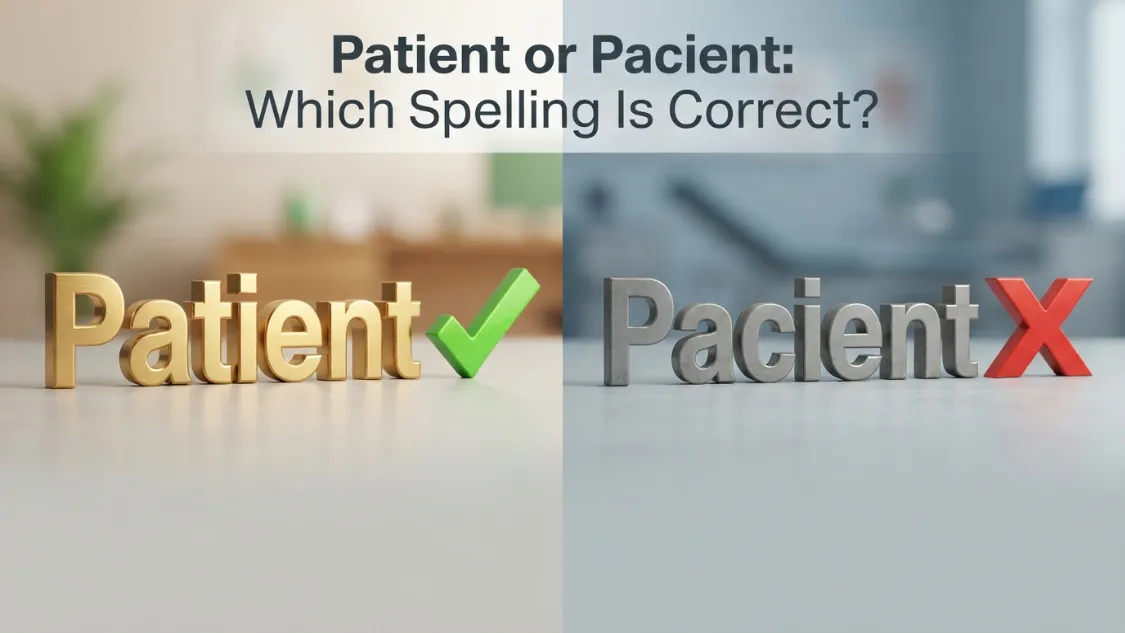
Patient is the correct English spelling means a person receiving medical care or someone able to wait calmly without becoming annoyed, while pacient is a misspelling in standard English.
Quick Answer
Patient is the correct spelling in English. It can mean a person receiving medical care or able to wait calmly without becoming annoyed. Pacient is a common misspelling in English.
❌ Pacient : Incorrect spelling in standard English
✅ Patient: Correct spelling
Quick Comparison
| Word | Correct? | Meaning | Example |
|---|---|---|---|
| Patient | ✅ Yes | A person receiving medical care; also able to wait calmly | The patient is waiting for the doctor. |
| Pacient | ❌ No | Common misspelling of patient | ❌ The pacient is waiting. |
What Does “Patient” Mean?
Patient has two common meanings in English.
As a noun, a patient is a person who is receiving medical treatment or care:
The patient spoke with the doctor.
As an adjective, patient describes someone who can wait calmly without becoming annoyed or frustrated:
She is very patient with young children.
So, the same spelling can function as both a noun and an adjective.
One-Line Definition
Patient means a person receiving medical care or someone able to wait calmly without complaining.
Why Is “Patient” the Correct Spelling?
The standard English spelling is patient, with -tient in the middle:
P-A-T-I-E-N-T → patient
The spelling pacient incorrectly replaces the ti sequence with ci.
Compare:
- ✅ patient
- ❌ pacient
Although pacient may look logical because of the pronunciation, it is not the standard English spelling.
Patient as a Noun
When patient is a noun, it refers to someone receiving medical examination, treatment, or care.
Examples:
- The patient arrived at the clinic early.
- The doctor examined the patient.
- Each patient received a medical record.
- The nurse helped the patient into the examination room.
- The hospital has several new patients.
Singular and Plural
| Number | Form | Example |
|---|---|---|
| Singular | patient | The patient is resting. |
| Plural | patients | The patients are resting. |
Notice that the plural is formed by adding -s:
patient → patients
Patient as an Adjective
As an adjective, patient means being able to remain calm while waiting or dealing with something difficult.
Examples:
- You need to be patient.
- She is patient with her students.
- He was patient while waiting for the results.
- Parents often need to be patient with young children.
- Thank you for being so patient.
In this sense, the opposite is often impatient.
She is patient with beginners.
She becomes impatient when people are late.
Patient vs. Impatient
These are opposites when patient refers to someone’s ability to wait calmly.
| Word | Meaning | Example |
|---|---|---|
| Patient | Able to wait calmly | He was patient while waiting. |
| Impatient | Easily annoyed by waiting or delay | He became impatient after an hour. |
The prefix im- changes the meaning to its opposite:
patient → impatient
Patient vs. Patience
Another common confusion involves patient and patience.
Patient can be an adjective describing a person:
She is patient with children.
Patience is the noun referring to the ability to remain calm while waiting or dealing with difficulty:
She has a lot of patience.
| Word | Part of Speech | Meaning | Example |
|---|---|---|---|
| Patient | Adjective / Noun | Calm while waiting; person receiving care | He is patient with his students. |
| Patience | Noun | The ability to remain calm | Teaching requires patience. |
Easy Memory Trick
Think:
A PATIENT has an I and an E before the final T.
P-A-T-I-E-N-T → patient
If you’re talking about someone at a hospital, remember:
The PATIENT is waiting for treatment.
Is “Pacient” a Word?
Pacient is not the standard spelling of this word in English.
You may encounter pacient in other languages or in English text written by people influenced by another language, but when writing standard English, use patient.
For example:
❌ The pacient needs treatment.
✅ The patient needs treatment.
❌ Please ask the pacient to wait.
✅ Please ask the patient to wait.
Common Spelling Mistake: Patient vs. Pacient
The mistake usually happens because the spelling pacient may seem to match the pronunciation or resemble spelling patterns found in other words.
However, English uses:
patient
not:
pacient
A useful way to remember it is to break the word into parts:
pat + ient → patient
The letters “ti” are essential to the standard spelling.
Common Phrases With “Patient”
When patient is used as a noun, common expressions include:
- patient care
- patient records
- patient safety
- patient history
- patient treatment
- patient information
- patient room
- patient examination
Examples:
The hospital prioritizes patient safety.
The doctor reviewed the patient’s medical history.
When it is used as an adjective, common phrases include:
- be patient
- remain patient
- stay patient
- patient with someone
- patient enough
Examples:
Please be patient.
You need to remain patient during the process.
Patient in Sentences
Here are examples showing both major meanings of patient:
- The patient is waiting for the doctor.
- The nurse checked the patient’s temperature.
- She was very patient with her students.
- Please be patient while we process your request.
- The doctor spoke calmly to the patient.
- He is patient when teaching beginners.
- The hospital provides excellent patient care.
- You must be patient if you want to learn a new skill.
- Several patients were waiting in the clinic.
- Her patience helped her deal with the difficult situation.
Patient vs. Pacient: At a Glance
| Feature | Patient | Pacient |
|---|---|---|
| Standard English spelling | ✅ Yes | ❌ No |
| Medical meaning | ✅ Yes | ❌ No |
| Meaning “calm while waiting” | ✅ Yes | ❌ No |
| Used in formal English | ✅ Yes | ❌ No |
| Recommended spelling | ✅ Patient | ❌ Pacient |
Learning Outcomes
After reading this guide, you should be able to:
- Identify patient as the correct English spelling.
- Recognize pacient as a misspelling in standard English.
- Understand the two main meanings of patient.
- Distinguish patient from patience and impatient.
- Use patient correctly in medical and everyday contexts.
- Remember the spelling using the “ti” pattern.
Mini Practice Quiz
Choose the correct spelling.
1. The ___ is waiting to see the doctor.
A. pacient
B. patient
Answer: B. patient
2. Please be ___ while we find your records.
A. patient
B. pacient
Answer: A. patient
3. The nurse spoke to the ___.
A. pacient
B. patient
Answer: B. patient
4. She is very ___ with young children.
A. pacient
B. patient
Answer: B. patient
Frequently Asked Questions
Q: Is “patient” the correct spelling?
A: Yes. Patient is the standard and correct spelling in English.
Q: Is “pacient” correct in English?
A: No. Pacient is not the standard English spelling. Use patient instead.
Q: What does patient mean?
A: As a noun, patient means a person receiving medical care. As an adjective, it means able to wait calmly without becoming annoyed.
Q: What is the difference between patient and patience?
A: Patient is an adjective meaning calm while waiting, or a noun referring to someone receiving medical care. Patience is the noun for the ability to remain calm while waiting or dealing with difficulty.
Q: What is the opposite of patient?
A: When patient means calm and willing to wait, its common opposite is impatient.
Q: How do you spell patient?
A: The correct spelling is P-A-T-I-E-N-T: patient.
Q: Why do people spell patient as pacient?
A: The misspelling pacient may occur because the pronunciation can make the spelling confusing, or because writers are influenced by spelling patterns from other languages. In standard English, however, the correct form is patient.
Final Verdict: Patient or Pacient?
Patient is the correct spelling in standard English.
Use patient when referring to someone receiving medical care or someone who can wait calmly without becoming annoyed.
❌ Pacient : Incorrect in standard English
✅ Patient: Correct
Remember: P-A-T-I-E-N-T → patient.
If you’re writing in English, always choose patient, not pacient.

Amna Akhtar is a writer dedicated to making English easier to understand. She creates research-informed guides on grammar, vocabulary, spelling differences, and commonly confused words, combining careful research with clear, practical explanations. She is also the co-author of the peer-reviewed research article “Determinants of Jobs Satisfaction of Female Teachers: An Evidence from District Hafizabad, Pakistan,” published in the Journal of Education and Social Studies (2021).