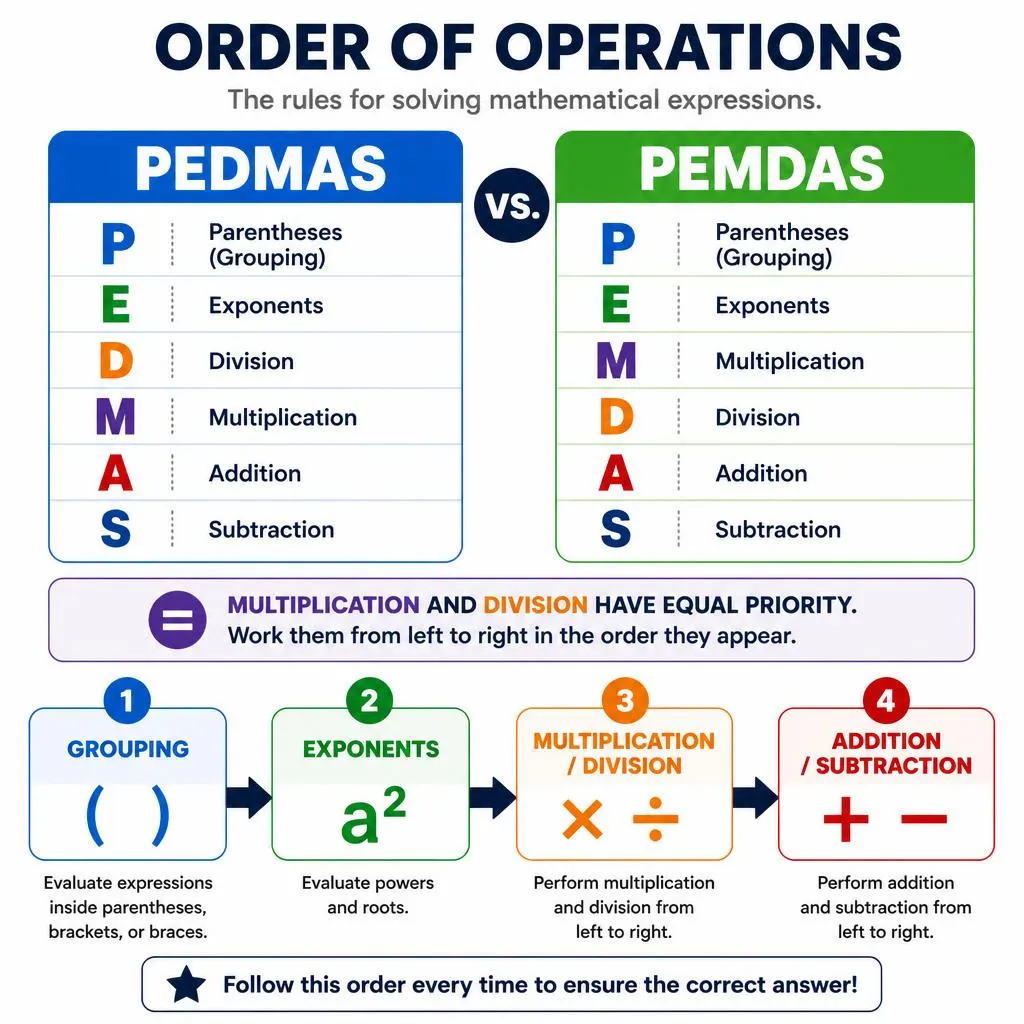
PEMDAS and PEDMAS are both mnemonics for the order of mathematical operations, with M (multiplication) and D (division) appearing in a different order.
Quick Answer
PEMDAS is the most widely recognized form of the acronym for the order of operations in mathematics. PEDMAS is also used in some countries and educational systems, where the E represents exponents and the D represents division. Both acronyms describe the same general order of operations, but PEMDAS is more widely used internationally.
| Acronym | Correct? | Meaning | Common Usage |
|---|---|---|---|
| PEMDAS | Yes | Parentheses, Exponents, Multiplication, Division, Addition, Subtraction | Widely used, especially in the United States |
| PEDMAS | Yes | Parentheses, Exponents, Division, Multiplication, Addition, Subtraction | Used in some educational systems |
What You’ll Learn
By the end of this guide, you will know:
- Whether PEDMAS or PEMDAS is correct
- What each acronym stands for
- Why the letters appear in a different order
- Whether PEDMAS and PEMDAS give different answers
- Which form you should use in mathematics
Why Are “PEDMAS” and “PEMDAS” Confusing?
If you learned the order of operations using PEDMAS but later saw PEMDAS in a textbook or online lesson, you may have wondered whether one of them was wrong.
The confusion comes from the position of D and M.
PEMDAS stands for:
P = Parentheses
E = Exponents
M = Multiplication
D =Division
A= Addition
S =Subtraction
PEDMAS stands for:
P = Parentheses
E= Exponents
D = Division
M = Multiplication
A =Addition
S= Subtraction
At first, this looks like a different mathematical rule. However, multiplication and division have the same priority, just as addition and subtraction have the same priority.
So, the letters are not meant to tell you that multiplication must always come before division.
What Does PEMDAS Mean?
PEMDAS is a mnemonic used to remember the standard order of operations.
It represents:
- P = Parentheses
- E = Exponents
- M = Multiplication
- D = Division
- A = Addition
- S = Subtraction
For example:
2 + 3 × 4
Multiplication comes before addition.
So:
2 + 12 = 14
The answer is 14, not 20.
PEMDAS helps students remember the general order in which operations are handled.
What Does PEDMAS Mean?
PEDMAS is another mnemonic for the same basic order of operations.
It represents:
- P = Parentheses
- E = Exponents
- D = Division
- M = Multiplication
- A = Addition
- S = Subtraction
The important point is that division and multiplication have equal priority.
Therefore, you should not always perform every division before every multiplication simply because D appears before M in PEDMAS.
Instead, multiplication and division should be performed from left to right.
Example
Consider:
24 ÷ 4 × 2
Work from left to right:
24 ÷ 4 = 6
Then:
6 × 2 = 12
So the answer is:
12
Not 3.
PEDMAS vs PEMDAS: What’s the Difference?
The main difference is simply the order in which D and M appear in the acronym.
| Acronym | D and M Position | Mathematical Rule |
|---|---|---|
| PEMDAS | M before D | Multiplication and division have equal priority |
| PEDMAS | D before M | Division and multiplication have equal priority |
The acronym itself does not change the mathematical rule.
Therefore, PEMDAS and PEDMAS can both be used to remember the order of operations, as long as multiplication and division are treated as equal-priority operations.
The same principle applies to addition and subtraction.
Why Does PEMDAS Put Multiplication Before Division?
This is one of the most common sources of confusion.
Seeing M before D in PEMDAS does not mean that multiplication always comes before division.
Multiplication and division are at the same level of priority.
When both appear in an expression, work from left to right.
For example:
18 ÷ 3 × 2
First:
18 ÷ 3 = 6
Then:
6 × 2 = 12
This left-to-right rule is essential.
Why Does PEDMAS Put Division Before Multiplication?
PEDMAS simply puts D before M in the mnemonic.
It does not create a mathematical rule that says division must always happen first.
For example:
18 × 2 ÷ 3
Work from left to right:
18 × 2 = 36
Then:
36 ÷ 3 = 12
You do not divide first simply because you learned the acronym PEDMAS.
In other words, the letters are a memory aid, not a list of six separate steps that must always be followed exactly in the displayed order.
Is PEDMAS or PEMDAS More Correct?
Neither acronym should be treated as the only possible form.
PEMDAS is the more widely recognized version, particularly in American mathematics education.
PEDMAS is also used in some regions and educational systems.
The underlying mathematical convention is more important than the acronym.
A more precise way to remember the order is:
- Parentheses or other grouping symbols
- Exponents
- Multiplication and division, from left to right
- Addition and subtraction, from left to right
This avoids the common mistake of treating multiplication as higher priority than division or addition as higher priority than subtraction.
Is PEMDAS American?
PEMDAS is strongly associated with American mathematics education, although the acronym is also widely recognized elsewhere.
Different countries and schools may teach the order of operations using different mnemonics.
For example, some learners encounter BODMAS, BIDMAS, or BEDMAS instead.
The names may differ, but the underlying mathematical convention is broadly the same.
Other Order-of-Operations Acronyms
You may encounter several versions:
| Acronym | Meaning |
|---|---|
| PEMDAS | Parentheses, Exponents, Multiplication, Division, Addition, Subtraction |
| PEDMAS | Parentheses, Exponents, Division, Multiplication, Addition, Subtraction |
| BODMAS | Brackets, Orders, Division, Multiplication, Addition, Subtraction |
| BIDMAS | Brackets, Indices, Division, Multiplication, Addition, Subtraction |
| BEDMAS | Brackets, Exponents, Division, Multiplication, Addition, Subtraction |
These acronyms can look different because mathematical terminology varies by country.
For example, brackets and parentheses can refer to the same type of grouping symbol in different varieties of English, while indices, orders, and exponents can refer to powers.
A Better Way to Remember the Rule
Instead of memorizing the letters as six separate steps, remember the structure:
Grouping → Exponents → Multiplication/Division → Addition/Subtraction
There are two important pairs:
Multiplication and Division: work from left to right.
Addition and Subtraction: work from left to right.
This method works regardless of whether your school teaches PEMDAS, PEDMAS, or another acronym.
Common Mistakes
| Common Mistake | Correct Approach | Why? |
|---|---|---|
| Always multiplying before dividing | Perform M and D from left to right | They have equal priority |
| Always dividing before multiplying | Perform D and M from left to right | PEDMAS does not make D higher priority |
| Always adding before subtracting | Perform A and S from left to right | They have equal priority |
| Treating PEMDAS as six strict steps | Group operations by priority | The acronym is a memory aid |
| Assuming PEDMAS is incorrect | Recognize it as a variant mnemonic | Different systems use different acronyms |
Real-World Examples
Example 1: PEMDAS
5 + 4 × 3
First multiply:
4 × 3 = 12
Then add:
5 + 12 = 17
Answer: 17
Example 2: PEDMAS
20 ÷ 5 + 3
First divide:
20 ÷ 5 = 4
Then add:
4 + 3 = 7
Answer: 7
Example 3: Multiplication and Division Together
24 ÷ 6 × 3
Work from left to right:
24 ÷ 6 = 4
4 × 3 = 12
Answer: 12
Example 4: Addition and Subtraction Together
15 − 5 + 2
Work from left to right:
15 − 5 = 10
10 + 2 = 12
Answer: 12
Grammar Relay Corner
This topic is mathematical rather than grammatical, so a traditional grammar rule does not apply.
Instead, the key usage rule is:
Do not treat the letters in PEMDAS or PEDMAS as six completely separate priority levels.
The correct mathematical structure is:
- Parentheses/grouping first
- Exponents next
- Multiplication and division from left to right
- Addition and subtraction from left to right
Vocabulary Corner
A few useful mathematical terms can help you understand this topic:
- Mnemonic: a memory aid that helps you remember information
- Exponent: a number showing how many times a base is multiplied by itself
- Operation: a mathematical process such as addition or multiplication
- Priority: the order in which an operation is performed
- Expression: a combination of numbers, symbols, and mathematical operations
Mini Quiz
Choose the correct answer.
1. What does PEMDAS stand for?
a) Parentheses, Exponents, Multiplication, Division, Addition, Subtraction
b) Parentheses, Exponents, Division, Multiplication, Addition, Subtraction
2. What does PEDMAS change?
a) The basic rules of mathematics
b) The order of the letters in the mnemonic
3. Calculate:
8 + 2 × 5
a) 18
b) 50
4. Calculate:
24 ÷ 4 × 2
a) 3
b) 12
Answers
- a) Parentheses, Exponents, Multiplication, Division, Addition, Subtraction
- b) The order of the letters in the mnemonic
- a) 18
- b) 12
Practice Guide
Try these expressions:
- 6 + 3 × 2
- 20 ÷ 5 + 4
- 18 ÷ 3 × 2
- 15 − 4 + 3
Answers
- 12
- 8
- 12
- 14
Remember to apply multiplication and division from left to right, and do the same with addition and subtraction.
PEDMAS vs PEMDAS: Final Comparison
| Acronym | Stands For | Main Use | Is It Correct? |
|---|---|---|---|
| PEMDAS | Parentheses, Exponents, Multiplication, Division, Addition, Subtraction | Order-of-operations mnemonic | Yes |
| PEDMAS | Parentheses, Exponents, Division, Multiplication, Addition, Subtraction | Order-of-operations mnemonic | Yes |
FAQs
Q: Is PEDMAS or PEMDAS correct?
A: Both are used as mnemonics for the order of operations. PEMDAS is more widely recognized, while PEDMAS is used in some educational systems.
Q: What is the difference between PEDMAS and PEMDAS?
A: The only difference in the acronym is the position of D and M. Both represent multiplication and division as operations with the same priority.
Q: Does multiplication come before division in PEMDAS?
A: No. Multiplication and division have equal priority. When they appear together, work from left to right.
Q: Does division come before multiplication in PEDMAS?
A: No. Although D appears before M in PEDMAS, division and multiplication still have equal priority. Work from left to right.
Q: Which is more common, PEDMAS or PEMDAS?
PEMDAS is generally more widely recognized, especially in American educational materials. However, other versions such as PEDMAS and BODMAS are also used.
Q: Is PEMDAS the same as BODMAS?
A: They are different mnemonics for remembering the order of operations. Their terminology differs, but the underlying mathematical rules are essentially the same.
Q: What should I remember instead of PEMDAS or PEDMAS?
A: A reliable way to remember the rule is:
Grouping → Exponents → Multiplication/Division left to right → Addition/Subtraction left to right.
Key Takeaways
- PEMDAS and PEDMAS are both used as order-of-operations mnemonics.
- PEMDAS is the more widely recognized version.
- PEDMAS is used in some educational systems.
- Multiplication and division have equal priority.
- Addition and subtraction also have equal priority.
- When operations have equal priority, work from left to right.
When Both Versions Get Used
Not every “which one is correct” question has a single winner sometimes two versions simply coexist; each accepted in its own context. PEMDAS and PEDMAS are a good example: the letters get reordered, but the math rule underneath stays exactly the same, and both versions show up in real classrooms depending on where you’re learning. It’s the same idea behind Adviser or Advisor and Sempai or Senpai two forms, one shared meaning, no real right or wrong.
Conclusion
So, is it PEDMAS or PEMDAS? Both are recognized mnemonics, but PEMDAS is the more widely used form, especially in American mathematics education. PEDMAS is also used in some regions and schools.
The most important point is not the order of the letters D and M. Both multiplication and division have the same priority, so they should be performed from left to right. The same rule applies to addition and subtraction.
For this reason, it is better to think of the order of operations in groups rather than as six rigid steps: grouping, exponents, multiplication/division, and addition/subtraction.
If your school or textbook uses PEDMAS, you are not learning a different mathematical rule. It is simply another way to remember the same basic order of operations.

Rose Vault is an English language author who specializes in spelling comparisons, commonly confused words, and grammar. She creates clear, well-researched content that helps readers improve their writing and use English with confidence. Her goal is to make language learning simple, accurate, and accessible for everyone.