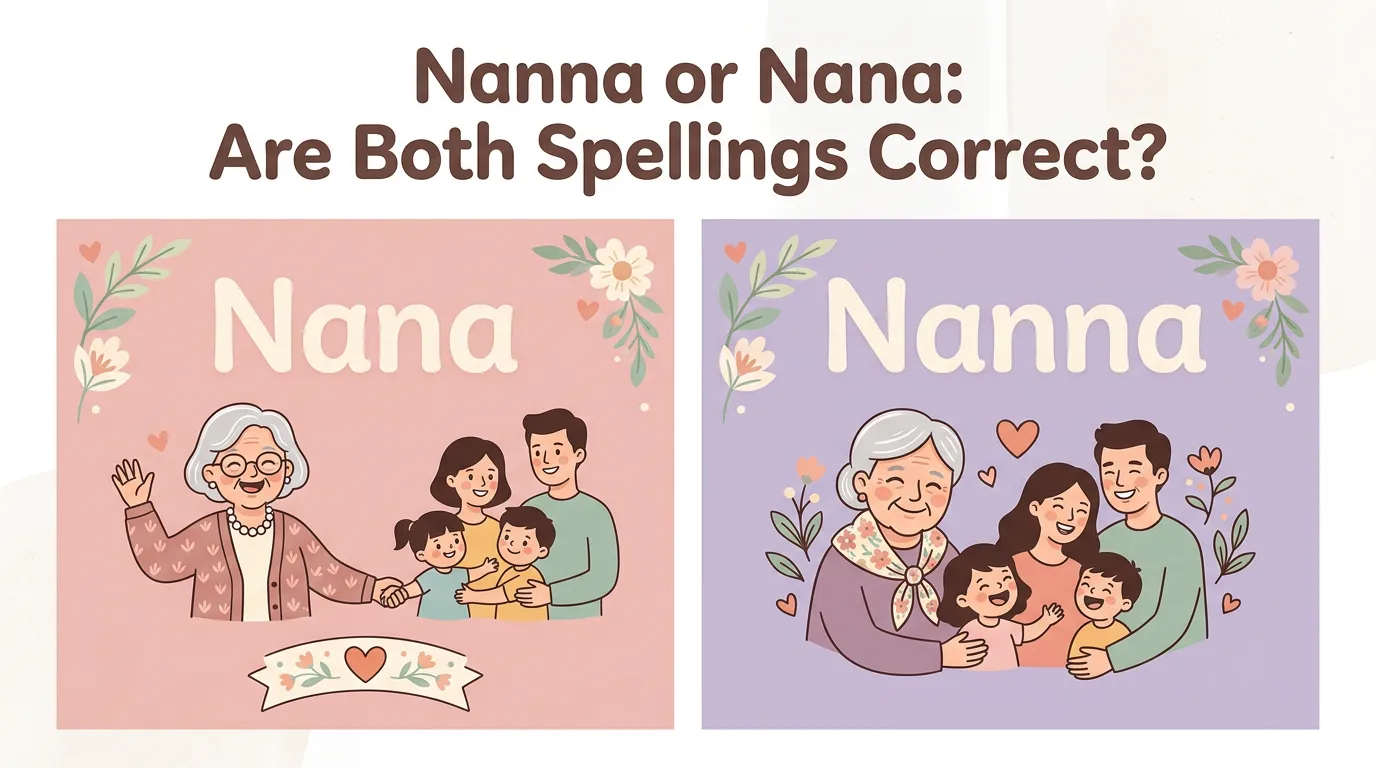
Nanna and Nana are both correct informal terms for a grandmother, with usage varying by region and family preference.
Quick Answer
Both Nanna and Nana are correct spellings for an informal name for a grandmother or another family member. Nana is more widely used in American English, while Nanna is especially common in British English and some other varieties. The preferred spelling depends on regional and family usage.
Quick Comparison
| Spelling | Correct? | Common Use | Example |
|---|---|---|---|
| Nanna | ✅ Yes | British English and some other varieties | I’m visiting my Nanna this weekend. |
| Nana | ✅ Yes | American English and widely used elsewhere | My Nana makes the best cookies. |
What Do “Nanna” and “Nana” Mean?
Nanna and Nana are informal family terms used primarily for a grandmother. They are affectionate alternatives to the more formal word grandmother.
The two spellings have the same basic meaning in this context. The difference is mainly one of regional preference, family tradition, and individual spelling choice.
For example:
- My Nana lives in California.
- My Nanna lives in London.
- We are having dinner with Nana tonight.
- Nanna always tells wonderful stories.
Both forms can be perfectly natural.
Nanna vs. Nana: What’s the Difference?
The main difference is spelling and regional usage, not meaning.
Nanna
Nanna is a common informal spelling of grandmother, particularly in British English and in some other English-speaking communities.
Examples:
- I’m going to see my Nanna tomorrow.
- Nanna baked a chocolate cake.
- My Nanna taught me how to knit.
Nana
Nana is another informal spelling for grandmother. It is particularly common in American English, although it is also used in Britain and many other English-speaking regions.
Examples:
- My Nana lives nearby.
- We visited Nana during the holidays.
- Nana gave me this old photograph.
Which Spelling Is More Common?
Nana is generally the more widely recognized spelling internationally, especially in American English.
Nanna is also well established and is particularly associated with British English and certain family or regional traditions.
However, there is no universal rule requiring every family to use one spelling. Grandparent names are often personal or family-specific.
A family might use Nanna, while another family in the same country might use Nana.
British English vs. American English
There is a useful regional pattern:
| Variety | Common Form | Example |
|---|---|---|
| British English | Nanna | I’m staying with my Nanna. |
| American English | Nana | I’m staying with my Nana. |
However, this is a tendency, not a strict grammar rule. Both spellings can appear in either variety of English.
Important Note
Unlike words such as colour/color or travelling/traveling, the difference between Nanna and Nana is not a standardized British-versus-American spelling rule.
Family preference plays a major role.
Is “Nanna” a Word?
Yes. Nanna is an established informal term used for a grandmother.
It is generally treated as a family or kinship term, rather than as a formal synonym for grandmother.
For example:
My Nanna always makes us tea.
The spelling Nanna is therefore not a misspelling of Nana.
Is “Nana” a Word?
Yes. Nana is also an established informal term for a grandmother.
It is widely used in everyday speech and writing, particularly in American English.
For example:
My Nana lives across the street.
Again, Nana is not simply an incorrect version of Nanna. Both forms are legitimate.
Grammar Rule: Nanna and Nana
Both Nanna and Nana function primarily as informal nouns or names for a grandmother.
When used as a person’s family name or a direct form of address, they are normally capitalized:
- I’m going to visit Nana.
- Nanna, can you help me?
- We had lunch with Nanna.
When referring to a grandmother generally rather than using the term as a name, lowercase may be appropriate depending on the sentence:
- Her nana lives nearby.
- He wrote a story about his nana.
Capitalization Tip
If the word is being used like a proper name, capitalize it:
I called Nana last night.
If it is being used generically as a common noun, lowercase can be used:
Her nana lives in another city.
In many family contexts, however, capitalization may depend on the writer’s style and how strongly the term is treated as a name.
Nanna or Nana: Which One Should You Use?
Use the spelling your family, region, or intended audience normally uses.
Choose “Nanna” if:
- Your family traditionally spells it Nanna.
- You are following a British English preference.
- Your intended audience commonly uses Nanna.
- You are writing about someone whose preferred family name is Nanna.
Choose “Nana” if:
- Your family uses Nana.
- You are writing for an American English audience.
- The person specifically prefers the spelling Nana.
- You want the more internationally familiar short form.
Examples in Sentences
“Nanna” (Examples)
- My Nanna lives in Manchester.
- I spent the weekend at my Nanna’s house.
- Nanna taught me how to bake.
- We bought flowers for Nanna.
- My Nanna tells the funniest stories.
Examples with “Nana”
- My Nana lives in Texas.
- We visited Nana last Sunday.
- Nana made us pancakes.
- I called my Nana after school.
- My Nana gave me this necklace.
Common Mistake
❌ “Nanna is the British spelling, so Nana is wrong.”
This is incorrect.
Although Nanna is particularly common in British English and Nana is particularly common in American English, both spellings are accepted and widely used.
The choice often depends on family tradition rather than a strict language rule.
❌ “Nana is the only correct spelling.”
Also incorrect.
Nanna is an established spelling and is perfectly correct when it is the form used by a family or community.
Related Family Terms
English has many informal terms for grandparents, and their usage can vary considerably by region and family.
| Term | Common Meaning |
|---|---|
| Grandmother | Formal/general term |
| Grandma | Informal grandmother |
| Granny | Informal grandmother |
| Gran | Informal grandmother, especially common in Britain |
| Nana | Informal grandmother |
| Nanna | Informal grandmother |
| Nan | Informal grandmother, especially common in Britain |
These terms are not necessarily interchangeable within an individual family. A person may have a Nana, Nanna, Nan, or another special family name.
Quick Memory Tip
Think of it this way:
Nana = one “n” in the middle
Nanna = double “n” in the middle
Both can mean grandmother.
Nana and Nanna are both correct; the preferred form usually depends on family and regional usage.
Mini Quiz
Choose the best answer for each sentence.
1. My ___ is coming to visit us tomorrow.
a) Nana
b) Nanna
c) Either can be correct
2. Which spelling is particularly common in American English?
a) Nana
b) Nanna
c) Neither
3. Which spelling is particularly associated with British English?
a) Nana
b) Nanna
c) Both are impossible
4. Is “Nanna” a misspelling of “Nana”?
a) Yes
b) No
Answers
- c) Either can be correct
- a) Nana
- b) Nanna
- b) No
A Family Word With No Single Rule
“Nanna” and “Nana” aren’t competing for one correct answer both are affectionate, widely used names for grandmother, and which one a family uses often comes down to region, culture, or simply what stuck when the first grandchild started talking. Neither spelling is more “official” than the other. The same no-single-winner situation shows up in Sempai or Senpai and Saree or Sari, where two accepted spellings exist side by side simply because language leaves room for more than one right answer.
Final Verdict
Both “Nanna” and “Nana” are correct. They are informal terms commonly used for grandmother, and neither spelling is inherently wrong.
Nana is especially common in American English, while Nanna is particularly common in British English and some other English-speaking communities. However, family preference matters more than a strict spelling rule.
So, if your grandmother is called Nanna, use Nanna. If your family calls her Nana, use Nana.
Correct: ✅ Nanna
Correct: ✅ Nana
Meaning: Usually an informal term for grandmother
Main difference: Regional and family preference

I’m Leo Jackson, an English writer with a soft spot for the peculiarities of language and spelling. I believe good spelling shouldn’t feel like guesswork, so I break down each comparison into clear, practical explanations anyone can use. Outside of writing, I’m usually buried in a novel or hunting down the next tricky word pair to demystify.