Definition
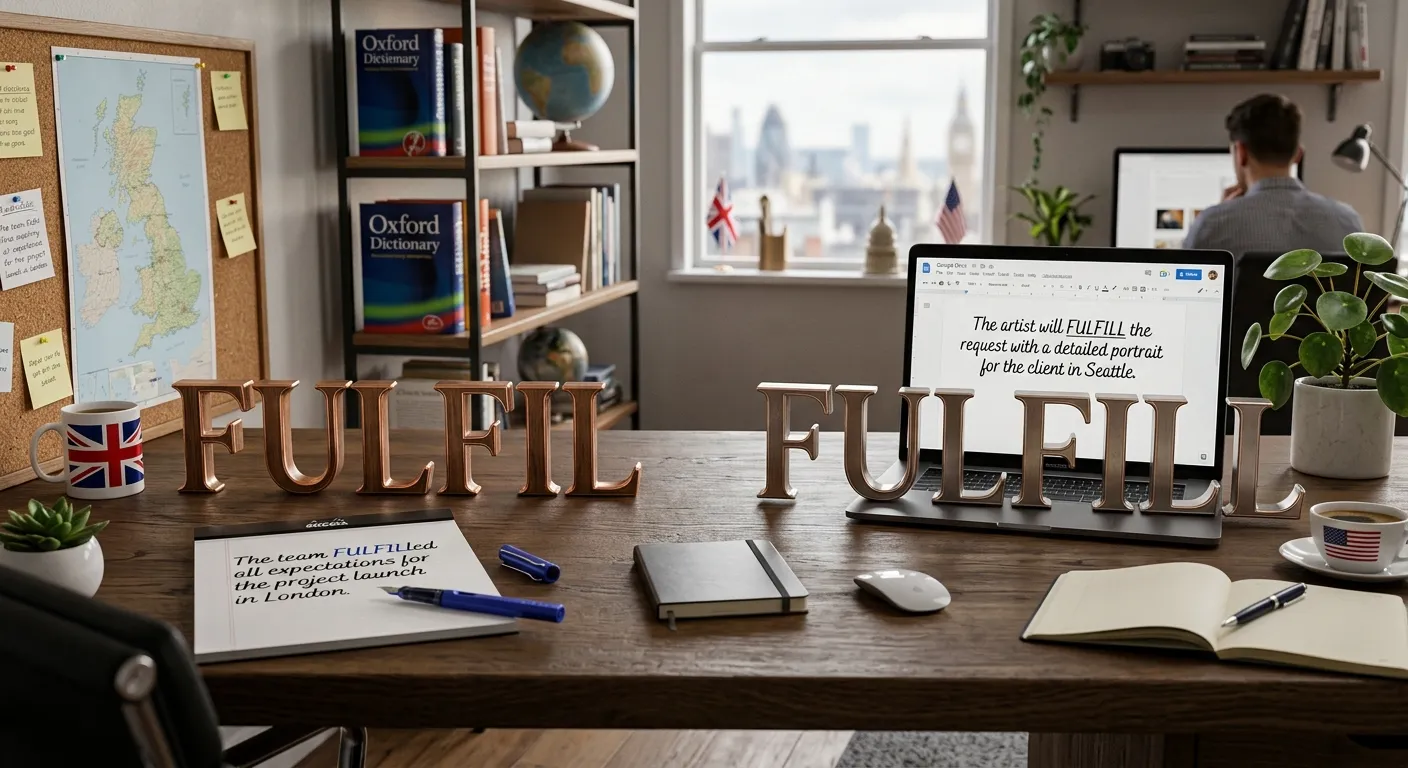
Fulfil and fulfill are both correct spellings of the same verb, meaning to do what is expected, promised, required, or hoped for. Fulfil is mainly used in British English, while fulfill is the usual American English spelling.
Quick Answer
- British English: fulfil
- American English: fulfill
- Meaning: to complete, achieve, satisfy, or carry out something
- Past tense: fulfilled
- -ing form: fulfilling
So, neither fulfil nor fulfill is inherently wrong. The choice depends mainly on the variety of English you are using.
Example:
British English: She worked hard to fulfil her ambition.
American English: She worked hard to fulfill her ambition.
Cambridge identifies fulfil as mainly British and fulfill as the usual US spelling. Oxford also lists fulfil as British English and fulfill as North American English.
Fulfil vs. Fulfill: Quick Comparison
| Feature | Fulfil | Fulfill |
| Correct? | Yes | Yes |
| Main variety | British English | American English |
| Meaning | Same | Same |
| Pronunciation | /fʊlˈfɪl/ | /fʊlˈfɪl/ |
| Present form | fulfil | fulfill |
| Third-person form | fulfils | fulfills |
| Past tense | fulfilled | fulfilled |
| -ing form | fulfilling | fulfilling |
| Example | They fulfilled their duty. | They fulfilled their duty. |
The important point is that the spelling difference is mainly in the base form. The past and participle forms are normally spelled fulfilled and fulfilling in both varieties.
What Does Fulfil or Fulfill Mean?
Fulfil or fulfill means to do, achieve, complete, or satisfy something that is expected, promised, required, or desired.
The verb can be used in several common ways.
1. To achieve a dream or ambition
When someone achieves something they have wanted or hoped for, they can fulfil or fulfill that dream.
- She fulfilled her dream of becoming a teacher.
- He hopes to fulfil his ambition of writing a book.
- They finally fulfilled their lifelong goal.
2. To keep a promise
The word can also mean to do what you promised to do.
- She fulfilled her promise to help them.
- He failed to fulfil his commitment.
- The company fulfilled its obligations.
3. To meet a requirement
We can use the verb when someone meets a condition, requirement, duty, or expectation.
- You must fulfil all the requirements before applying.
- The candidate fulfills the necessary criteria.
- The student fulfilled the conditions for admission.
4. To perform a role or function
Fulfil/fulfill can also mean to perform a particular role or purpose.
- The program fulfills an important function.
- Schools fulfil an important role in society.
- This tool fulfills its intended purpose.
5. To give someone satisfaction
The verb can describe something that makes a person feel satisfied or gives their life a sense of purpose.
- Teaching fulfils her.
- He found work that truly fulfilled him.
- She wanted a career that would fulfil her.
Oxford includes these uses, including achieving what was hoped for, meeting requirements, performing a role or purpose, and making someone feel satisfied.
Why Are There Two Spellings?
The difference comes from the spelling conventions of different varieties of English.
British English generally uses:
fulfil
American English generally uses:
fulfill
This is similar to other British-American spelling differences such as:
- cancelled / canceled
- travelling / traveling
- labour / labor
- colour / color
However, fulfil/fulfill has its own spelling pattern. The American form keeps the double l at the end of the base word, while the British form normally uses only one l before the final consonant.
Cambridge explicitly describes fulfill as the US spelling of fulfil, while Oxford gives fulfil as British English and fulfill as North American English.
Is Fulfil Wrong in American English?
No, but fulfill is the standard spelling you will normally see in American English.
For example:
- American: The company must fulfill the contract.
- British: The company must fulfil the contract.
Using fulfil in an American-English text may look unusual because American readers generally expect fulfill.
Likewise, fulfill is understandable in British English, but fulfil is the traditional British spelling.
The safest approach is to stay consistent with the variety of English used by your audience.
Is Fulfill Wrong in British English?
No. Fulfill is recognized as an American spelling and is understood in British English.
However, if you are writing specifically in British English, fulfil is normally the more appropriate spelling.
For example, a British-English sentence would usually be:
The applicant must fulfil all the requirements.
An American-English version would be:
The applicant must fulfill all the requirements.
Pronunciation of Fulfil and Fulfill
Both forms are pronounced essentially the same:
/fʊlˈfɪl/
You can think of the pronunciation as:
ful-FILL
The spelling changes, but the pronunciation does not change in the usual British-American distinction. Cambridge and Oxford give the same basic pronunciation for the two forms.
Grammar Rule: Fulfil and Fulfill
Fulfil/fulfill is a verb.
It is commonly followed by a noun such as:
- a promise
- a dream
- an ambition
- a requirement
- a duty
- an obligation
- a role
- a function
- a condition
- a purpose
Common patterns
fulfil/fulfill + noun
- fulfil a promise
- fulfill a requirement
- fulfil a duty
- fulfill an ambition
- fulfil a function
fulfil/fulfill + someone
- fulfil someone
- fulfill someone
fulfil/fulfill + yourself
- fulfil yourself
- fulfill yourself
Examples
- She fulfilled her promise.
- He fulfilled the requirements.
- The organization fulfilled its duty.
- This job fulfills her.
- He hopes to fulfil his potential.
Oxford lists these patterns, including fulfil a dream, fulfil a requirement, fulfil a function, and fulfil somebody/yourself.
Grammar Relay: Watch the Other Forms
A common mistake is to think that the spelling difference continues in every form.
It does not.
Base form
- British: fulfil
- American: fulfill
Third-person singular
- British: fulfils
- American: fulfills
Past tense
- Both: fulfilled
Past participle
- Both: fulfilled
-ing form
- Both: fulfilling
So remember:
fulfil → fulfilled → fulfilling
fulfill → fulfilled → fulfilling
Do not write fulfillling or fulfilling with only one l.
Oxford lists fulfilled and fulfilling as the forms used with both regional spellings.
Fulfil vs. Fulfill in Sentences
Here are some natural examples.
British English
- She hopes to fulfil her potential.
- The company failed to fulfil its obligations.
- You must fulfil the entry requirements.
- Teaching can fulfil a person’s desire to help others.
- The new system fulfils an important function.
American English
- She hopes to fulfill her potential.
- The company failed to fulfill its obligations.
- You must fulfill the entry requirements.
- Teaching can fulfill a person’s desire to help others.
- The new system fulfills an important function.
Notice that the meaning stays the same.
Fulfil or Fulfill: Which One Should You Use?
Use the spelling that matches your chosen variety of English.
Use fulfil when:
- You are writing in British English.
- Your school, employer, publication, or website follows British spelling.
- Your audience mainly uses British English.
Example:
The student must fulfil all the course requirements.
Use fulfill when:
- You are writing in American English.
- Your publication follows American spelling.
- Your audience mainly uses American English.
Example:
The student must fulfill all the course requirements.
The key is consistency. Do not switch between British and American spelling without a reason.
A Useful Memory Trick
Think:
British = one L → fulfil
American = two Ls → fulfill
You can remember it as:
US English “fills” the word with an extra L.
This is only a spelling memory aid. Both words have the same basic meaning.
What Major Dictionaries Say
Major dictionaries agree that fulfil and fulfill are regional spelling variants rather than different words.
- Cambridge Dictionary: lists fulfil as mainly UK and fulfill as the US spelling.
- Oxford Learner’s Dictionaries: gives fulfil as British English and fulfill as North American English.
- Collins Dictionary: lists fulfil and fulfill as variants and identifies the British/American distinction.
The dictionaries also show that the word can refer to achieving hopes or ambitions, carrying out duties or promises, meeting requirements, performing a function, and gaining satisfaction.
What About Fulfilment and Fulfillment?
The same regional pattern appears in the related noun.
British English: fulfilment
American English: fulfillment
For example:
- British: She found a sense of fulfilment in her work.
- American: She found a sense of fulfillment in her work.
Cambridge identifies fulfilment as the UK spelling and fulfillment as the US spelling. Oxford follows the same distinction.
This is useful to remember because writers often use the verb and noun in the same piece of content.
Common Spelling Mistakes
❌ Fulfilll
This has three ls at the end and is incorrect.
Correct: fulfill
❌ Fulfiling
This incorrectly drops an l from the -ing form.
Correct: fulfilling
❌ Fulfilled
Some writers may wonder whether the British spelling should be fulfiled. It is not.
Correct in both varieties: fulfilled
❌ Switching forms randomly
Avoid writing:
The company will fulfil the order and later discuss its fulfillment policy.
This mixes British fulfil with American fulfillment.
A consistent British version would be:
The company will fulfil the order and later discuss its fulfilment policy.
A consistent American version would be:
The company will fulfill the order and later discuss its fulfillment policy.
Fulfil or Fulfill: Quick Practice
Choose the correct spelling for the variety of English shown.
1. British English
She wants to ___ her ambition.
Answer: fulfil
2. American English
The company must ___ the legal requirements.
Answer: fulfill
3. Either variety
He has finally ___ his promise.
Answer: fulfilled
4. Either variety
She has a very ___ career.
Answer: fulfilling
5. British English
The ___ of his dream took years.
Answer: fulfilment
6. American English
The ___ of her dream took years.
Answer: fulfillment
Learning Outcomes
After reading this guide, you should know that:
- Fulfil and fulfill have the same meaning.
- Fulfil is mainly the British English spelling.
- Fulfill is the usual American English spelling.
- The pronunciation is essentially the same.
- Fulfilled and fulfilling are used in both varieties.
- The related nouns are fulfilment in British English and fulfillment in American English.
- Consistency matters more than choosing one form as universally correct.
Frequently Asked Questions
Is fulfil or fulfill correct?
Both are correct. Fulfil is mainly used in British English, while fulfill is the usual American English spelling.
Is fulfil British or American?
Fulfil is mainly British English. American English generally uses fulfill.
Is fulfill American or British?
Fulfill is the usual American English spelling. British English generally uses fulfil.
Do fulfil and fulfill have different meanings?
No. They have the same basic meanings, including achieving something hoped for, carrying out a promise or duty, meeting a requirement, and performing a role or function.
Is it fulfilling or fulfilling?
The correct spelling is fulfilling in both British and American English.
Is it fulfilled or fulfiled?
The correct spelling is fulfilled. The form fulfiled is incorrect.
What is the British spelling of fulfillment?
The British spelling is fulfilment. American English generally uses fulfillment.
Key Takeaway
Fulfil and fulfill are both correct. The main difference is regional:
British English → fulfil
American English → fulfill
Both mean to achieve, complete, carry out, or satisfy something that is expected, promised, required, or desired. If you are writing for a British-English audience, choose fulfil. If you are following American English, choose fulfill.
Saviour or Savior: Which Spelling Is Correct?

I’m Leo Jackson, an English writer with a soft spot for the peculiarities of language and spelling. I believe good spelling shouldn’t feel like guesswork, so I break down each comparison into clear, practical explanations anyone can use. Outside of writing, I’m usually buried in a novel or hunting down the next tricky word pair to demystify.