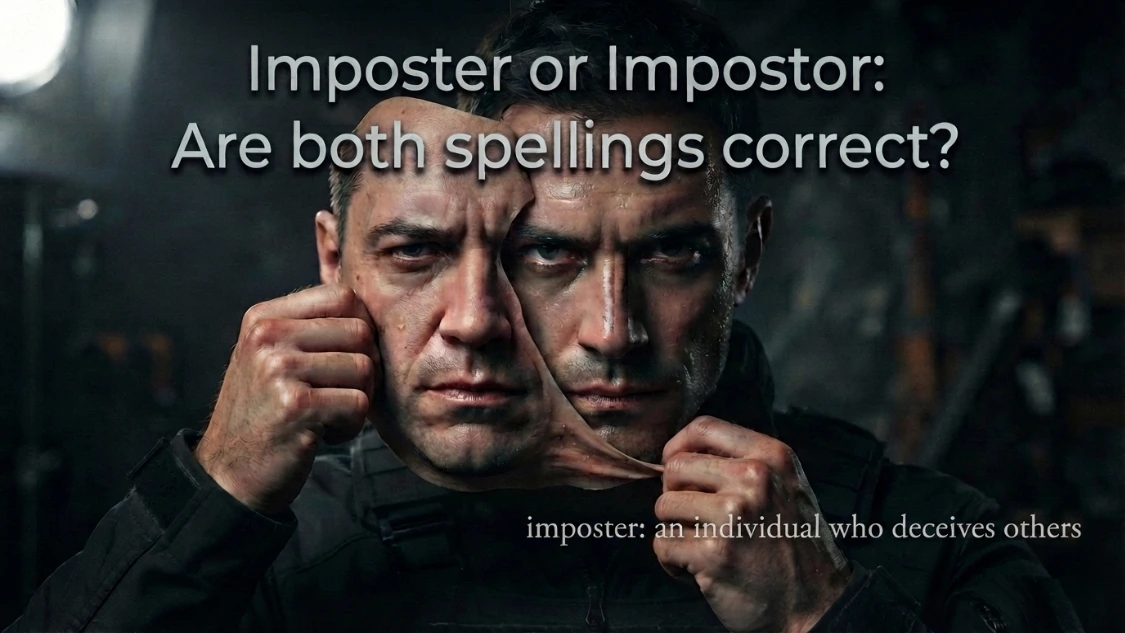
Impostor and imposter are both correct spellings for a person who pretends to be someone else in order to deceive others.
Quick Answer:
Yes. Imposter and Impostor are both correct spellings in English. However, impostor is the traditional and historically original spelling, while imposter is a later variant that has become very common, especially in modern American English.
If you’re unsure which one to use:
- ✅ Impostor — Preferred by many dictionaries and style guides; traditional spelling.
- ✅ Imposter — Widely accepted modern variant, especially in everyday writing.
Both words mean a person who pretends to be someone else in order to deceive others.
Examples
- The detective exposed the impostor before the ceremony.
- She realised the online imposter was using a fake identity.
- The king discovered an impostor pretending to be a royal messenger.
Bottom Line: Both spellings are correct, but impostor has a longer historical tradition.
Quick Comparison Table
| Feature | Impostor | Imposter |
|---|---|---|
| Correct spelling | ✅ Yes | ✅ Yes |
| Meaning | A person who pretends to be someone else | Same meaning |
| Historical spelling | ✅ Original | Variant |
| Accepted by dictionaries | ✅ Yes | ✅ Yes |
| Safe in academic writing | ✅ Yes | ✅ Yes |
| Modern everyday usage | Common | Very common |
English is full of words that have more than one accepted spelling. While some spelling pairs differ between British and American English, others exist simply because the language has evolved over time.
One such pair is impostor and imposter.
Many writers wonder:
- Is imposter a spelling mistake?
- Should I always write impostor?
- Do dictionaries accept both forms?
- Which spelling should I use in essays or professional writing?
The good news is that both spellings are recognised in modern English. They carry exactly the same meaning and pronunciation. The difference lies mainly in history, usage preferences, and editorial style.
In this guide, you’ll learn:
- Whether both spellings are correct
- Which form is older
- What major dictionaries recommend
- British and American usage
- Word origin
- Everyday examples
- Tips for choosing the best spelling
By the end of this article, you’ll know exactly when to use impostor and imposter with confidence.
What Does “Impostor” (or “Imposter”) Mean?
An impostor or imposter is:
Someone who pretends to be another person in order to deceive or gain an advantage.
The deception may involve identity, qualifications, status, or authority.
Examples
- The police arrested an impostor posing as a doctor.
- An online imposter created a fake social media account.
- Everyone believed the impostor until the truth emerged.
- She recognised the imposter immediately.
Common Collocations
Native English speakers often use these combinations:
- identity impostor
- online imposter
- financial impostor
- royal impostor
- political impostor
- expose an impostor
- catch an impostor
- pretend to be an impostor
- suspected impostor
- dangerous imposter
Are Both Spellings Really Correct?
Yes.
Unlike many spelling comparisons where one form is simply incorrect, impostor and imposter are both standard English spellings.
Neither is considered a spelling mistake.
Most readers will understand either version immediately, and both appear in books, newspapers, academic writing, and online publications.
The main difference is consistency. If you choose one spelling in a document, it is best to use the same spelling throughout the entire piece.
Word Origin
The word comes from the Late Latin impostor, meaning a deceiver or cheat. It passed into English through French and has been used in English since the sixteenth century.
Because of its Latin origin, impostor is the older and original English spelling.
The variant imposter appeared later as English spelling gradually became more regular. Since many English nouns end in -er, writers naturally began using imposter, and over time it became an accepted alternative.
Today, both spellings are recognised by major dictionaries, although impostor remains closer to the word’s historical roots.
What Major Dictionaries Say
Leading dictionaries accept both spellings, though some list one as the primary headword and the other as a variant.
- Merriam-Webster lists impostor and recognises imposter as a standard variant.
- Cambridge Dictionary recognises both spellings with the same meaning.
- Oxford English Dictionary records both forms, with impostor reflecting the traditional spelling.
- Collins Dictionary includes both spellings in modern English usage.
The important point is that both are correct, so your choice depends on style and consistency rather than correctness.
What Style Guides Recommend
Beyond dictionaries, major style guides also weigh in on this spelling choice:
- AP Stylebook: Recommends impostor, making it the standard choice for journalists and news writers.
- Chicago Manual of Style: Follows Merriam-Webster’s primary headword, impostor, as the preferred spelling for books and academic publishing.
- APA Style: Does not specify a strict preference but defers to Merriam-Webster, favoring impostor in psychology and academic writing (relevant given the popularity of “impostor syndrome” in psychological literature).
Practical takeaway: If you’re writing for a publication, employer, or academic institution that follows a specific style guide, checking their preferred spelling will resolve the choice for you instantly — most default to impostor.
British vs American English
Unlike spelling pairs such as colour/color or realise/realize, there is no strict British vs American rule for impostor and imposter.
Both spellings are accepted on both sides of the Atlantic.
However, there are some general preferences.
| English Variety | More Common | Also Accepted |
|---|---|---|
| British English | Impostor | Imposter |
| American English | Imposter (slightly more common in everyday writing) | Impostor |
| Australian English | Impostor | Imposter |
| Canadian English | Both are common | Both accepted |
Tip: If you’re writing for a school, university, publisher, or employer, follow their preferred style guide and use that spelling consistently.
Which Spelling Should You Choose?
Since both spellings are correct, your choice depends on your audience and writing style.
Choose Impostor if you:
- Prefer the traditional spelling
- Are writing formal or academic content
- Want to follow the word’s historical form
- Need consistency with many dictionary headwords
Choose Imposter if you:
- Prefer modern everyday English
- Are writing blogs or casual content
- Are following a style guide that uses -er endings
Neither choice is wrong. The most important rule is to stay consistent throughout your document.
Usage Trends
Both spellings have appeared in English for many years.
- Impostor has a longer history and remains widely used in books, legal writing, and formal publications.
- Imposter has become increasingly common in newspapers, websites, blogs, and everyday communication.
Because both are standard spellings, readers rarely notice which one you choose.
“Impostor Syndrome” or “Imposter Syndrome”?
This is one of the most searched questions.
The psychological term describing persistent self-doubt is commonly written as:
- Impostor syndrome ✅
- Imposter syndrome ✅
Both forms appear in books, research papers, news articles, and mental health resources.
However, impostor syndrome is often preferred in academic and psychological literature because it follows the traditional spelling.
Everyday Examples
At School
- The student exposed an impostor pretending to be a teacher.
- An online imposter sent fake exam messages.
At Work
- The company warned employees about email impostors.
- Security quickly identified the imposter.
In News Reports
- Police arrested an impostor posing as a government officer.
- Authorities searched for an online imposter who stole personal information.
In Conversation
- He turned out to be an impostor.
- Everyone believed the imposter at first.
Common Mistakes to Avoid
Mistake 1: Thinking one spelling is wrong
❌ Imposter is incorrect.
✅ Both impostor and imposter are correct.
Mistake 2: Mixing spellings
❌ The impostor escaped. Later, the imposter was arrested.
✅ The impostor escaped. Later, the impostor was arrested.
OR
✅ The imposter escaped. Later, the imposter was arrested.
Choose one spelling and use it throughout your writing.
Mistake 3: Confusing with Similar Words
Don’t confuse these words with:
- Impose – to force something on someone.
- Imposture – the act of pretending to be someone else.
- Impersonate – to pretend to be another person.
Although these words are related, they have different meanings and uses.
Memory Trick
Here’s an easy way to remember:
- Impostor → Think of the original Latin spelling ending in -or.
- Imposter → Think of the common English -er ending found in words like teacher and writer.
Since both spellings are correct, you don’t need to memorise one as “right” and the other as “wrong.” Instead, remember this rule:
Pick one spelling and use it consistently.
Did You Know?
The word impostor became especially popular in everyday conversation after the online multiplayer game Among Us, where one or more players secretly take on the role of an “Impostor.” This helped introduce the word to millions of people worldwide.
Although the game uses Impostor, many players still search online for Imposter, showing how common both spellings have become.
Search Intent Answer
If you searched:
- Imposter or impostor
- Is imposter correct?
- Impostor vs imposter
- Which spelling should I use?
- Are both spellings accepted?
The answer is simple:
Yes. Both “impostor” and “imposter” are correct spellings. “Impostor” is the traditional form, while “imposter” is a widely accepted modern variant. Use either one, but remain consistent throughout your writing.
Frequently Asked Questions (FAQs)
Q: Is imposter a correct spelling?
A: Yes. Imposter is a correct and widely accepted spelling in modern English. It is recognised by major dictionaries as a variant of impostor.
Q: Which spelling is more correct: impostor or imposter?
A: Neither is more correct. Both spellings are standard English. However, impostor is the original historical spelling, while imposter is a later but equally accepted variant.
Q: Which spelling should I use in formal writing?
A: For academic papers, legal documents, and formal publications, many editors prefer impostor because it reflects the traditional spelling. However, if your organisation’s style guide uses imposter, that is also perfectly acceptable.
Q: Is impostor syndrome the correct term?
A: Yes. Impostor syndrome is the more common spelling in psychology and academic writing.
However, imposter syndrome is also widely used in books, articles, and everyday English.
Q: Do British and American English use different spellings?
A: Not strictly. Both impostor and imposter are accepted in British and American English, although impostor is often preferred in formal contexts.
Mini Quiz
1. Which spelling is correct?
A. Impostor
B. Imposter
C. Both ✅
2. Which spelling is the older historical form?
A. Impostor ✅
B. Imposter
3. Which sentence is correct?
A. The impostor fooled everyone. ✅
B. The imposter fooled everyone. ✅
C. Both are correct. ✅
4. Which is more important?
A. Choosing one spelling and using it consistently. ✅
B. Mixing both spellings in the same document.
5. Which spelling is common in psychology?
A. Impostor syndrome ✅
B. Imposter syndrome (also accepted)
Practice Exercise
Choose the spelling you prefer and rewrite the sentences consistently.
- The ______ pretended to be a police officer.
- Everyone believed the ______ for several weeks.
- She struggled with ______ syndrome throughout university.
- The detective finally exposed the ______.
- An online ______ created fake social media profiles.
Sample Answers (using impostor):
- The impostor pretended to be a police officer.
- Everyone believed the impostor for several weeks.
- She struggled with impostor syndrome throughout university.
- The detective finally exposed the impostor.
- An online impostor created fake social media profiles.
Vocabulary Corner
Synonyms
- Pretender
- Fraud
- Deceiver
- Fake
- Charlatan
- Cheat
- Counterfeit person
- Mimic
- Hoaxer
- Masquerader
Antonyms
- Genuine person
- Authentic person
- Honest person
- Original
- Truthful individual
Grammar Relay Corner
Continue improving your English with these commonly confused word pairs:
- Adviser or Advisor
- Leach or Leech
- Grey or Gray
- Realised or Realized
- Excell or Excel
- Curtesy or Courtesy
Word Family
- Impostor / Imposter (noun)
- Imposture (noun)
- Impersonate (verb)
- Impersonation (noun)
- Impose (verb)
- Imposturous (rare and largely obsolete)
Common Learner Mistakes
❌ Believing imposter is incorrect.
✅ Both spellings are accepted.
❌ Switching between impostor and imposter in the same article.
✅ Choose one spelling and use it consistently.
Why This Confusion Happens
The uncertainty between “Imposter” and “Impostor” is a common example of English words having two accepted spelling variants for the same meaning. This same pattern shows up in other word pairs as well, such as Adviser or Advisor, where both spellings are considered correct and simply reflect stylistic preference rather than a right-or-wrong distinction. Recognizing this pattern can help you feel more confident when choosing between similar spelling variants in your writing.
Key Takeaways
- Impostor and imposter are both correct spellings.
- They have exactly the same meaning.
- Impostor is the older, traditional spelling.
- Imposter is a modern accepted variant.
- Both spellings appear in major English dictionaries.
- In formal writing, impostor is often preferred.
- The most important rule is consistency.
Conclusion
If you’ve ever wondered whether impostor or imposter is correct, the answer is reassuring: both spellings are accepted in modern English. They share the same pronunciation, meaning, and grammatical function.
The main difference lies in tradition and style. Impostor reflects the word’s historical origin and is often favoured in formal and academic writing, while imposter has become a common alternative in modern English, especially in everyday communication.
Rather than worrying about which spelling is “right,” focus on using one version consistently throughout your writing. Whether you’re writing an essay, a news article, a blog post, or a business report, consistency will make your work look polished and professional.

“I am Paul Emerson, a language writer dedicated to untangling the English language’s trickiest spelling dilemmas. With a sharp eye for detail, I break down confusing word pairs into clear, simple comparisons anyone can grasp.”