Definition
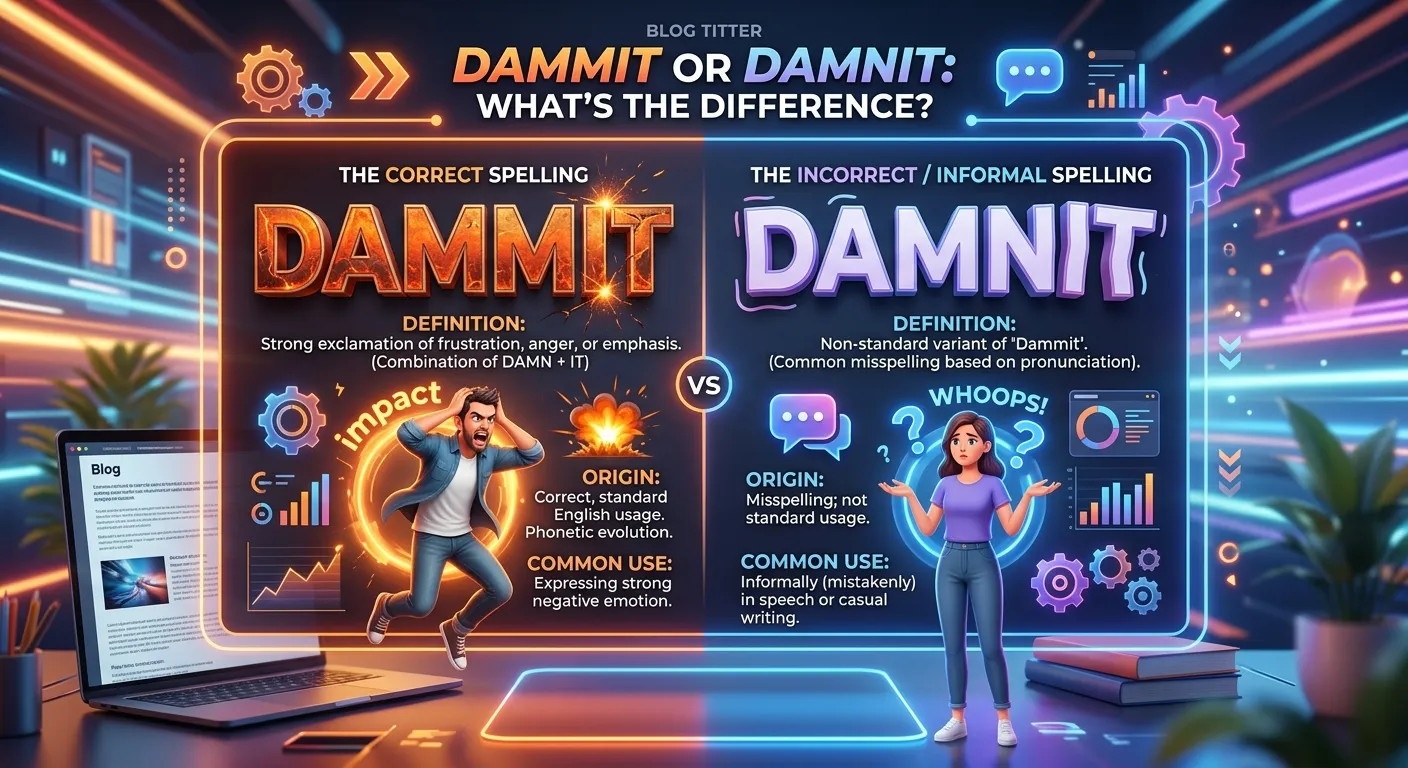
Dammit is the more established spelling of the informal exclamation meaning “damn it,” while damnit is a less common variant. Damn it is also correct when written as two words.
Quick Answer
If you’re wondering whether it is dammit or damnit, use dammit in most informal writing.
- Dammit: established informal spelling
- Damnit :informal variant, less common
- Damn it: the original two-word form
Examples
Dammit! I forgot my keys again.
Damnit! Why won’t this computer work?
Damn it, I knew I had forgotten something.
For standard writing, especially formal or professional writing, it is usually better to avoid this expression altogether because it is an informal exclamation.
Dammit vs. Damnit: Quick Comparison
| Form | Status | Meaning | Example |
| dammit | Established informal spelling | An exclamation showing anger, frustration, or annoyance | Dammit! I missed the bus. |
| damnit | Informal variant | Same meaning as dammit | Damnit! I made the same mistake. |
| damn it | Two-word form | Original expression | Damn it, I forgot the deadline. |
What Does “Dammit” Mean?
Dammit is an informal interjection used to express anger, frustration, irritation, disappointment, or annoyance.
It is commonly understood as a contracted or conventionalized spelling of “damn it.”
For example:
- Dammit! I lost my wallet.
- Dammit, I was so close to winning.
- Oh, dammit! I forgot the appointment.
The word does not usually contribute much literal meaning to a sentence. Instead, it expresses the speaker’s emotional reaction.
Is “Dammit” or “Damnit” Correct?
Dammit is the safer and more established choice.
Damnit is also used, especially in casual online communication, but it is generally treated as a variant spelling rather than the preferred form.
So, if you need to choose between the two:
Dammit is the better-established spelling.
However, there is an important third option: damn it.
The expression originally consists of the verb damn and the pronoun it, so the two-word form remains perfectly natural:
Damn it! I forgot my phone.
Over time, dammit became established as a single-word spelling of the exclamation.
Why Are There Two Spellings?
The difference comes largely from the way informal speech is represented in writing.
When people say “damn it” quickly, the two words can sound like a single unit. Informal writing sometimes reflects this pronunciation by joining them:
damn it → dammit
The spelling damnit can also arise because the final n in damn is more noticeable in pronunciation than the written m, especially when the expression is spoken quickly.
As a result, both dammit and damnit appear in informal writing, but they do not have the same level of conventional acceptance.
Dammit vs. Damn It: What’s the Difference?
The main difference is form and style, not meaning.
Dammit
Dammit is written as one word and functions as an informal interjection.
I broke the handle Dammit!
Damn it
Damn it keeps the original two-word structure.
Both express frustration or anger.
In everyday informal writing, dammit is often the more natural one-word spelling. In more careful writing, damn it may be preferable if you want to preserve the original grammatical structure.
Grammar: How Is “Dammit” Used?
Dammit functions as an interjection.
It can appear:
- at the beginning of a sentence
- by itself
- in the middle of a sentence
- after another interjection
At the beginning
Dammit, I left my bag at home.
By itself
Dammit!
In the middle
I can’t, dammit, remember where I put it.
With another interjection
Oh, dammit! The door is locked.
A comma or exclamation mark may be used depending on how strongly the expression is separated from the rest of the sentence.
Is “Damnit” a Misspelling?
Damnit is not simply an accidental spelling mistake in every context. It is an established informal variant that appears in real-world usage.
However, dammit is the more conventional spelling.
That distinction matters because informal variants can be widely understood without being equally preferred in edited writing.
If you are writing an article, story, dialogue, or casual message and want the most recognizable spelling, dammit is generally the better choice.
Examples: Dammit or Damnit
Using “dammit”
- Dammit! I forgot my password.
- Dammit, we are already late.
- I tried three times, dammit.
- Dammit! That was my last chance.
Using “damnit”
- Damnit! I left my keys inside.
- Damnit, why did I do that?
- I can’t believe I missed it, damnit.
The meaning remains essentially the same in these examples.
When Should You Use “Dammit”?
Use dammit when you are intentionally writing an informal expression of frustration, anger, or annoyance.
It can work well in:
- casual messages
- informal dialogue
- fiction
- personal writing
- social media posts
For example:
Dammit! I knew this would happen.
In formal contexts, however, consider replacing it with a more neutral expression:
Unfortunately, I made a mistake.
or
I’m frustrated that this happened.
When Should You Avoid “Dammit”?
Although dammit is common in informal English, it is derived from “damn it,” which can be considered a mild swear expression.
Therefore, avoid it when you need especially polite or formal language, such as:
- academic papers
- professional reports
- formal emails
- official documents
- business communication
Instead of:
Dammit! We missed the deadline.
you could write:
Unfortunately, we missed the deadline.
Mini Quiz
Choose the more established spelling in each sentence.
- (Dammit / Damnit), I forgot my umbrella.
- I can’t believe I did that, (dammit / damnit)!
- (Dammit / Damn it), this isn’t working.
- Which is the less common informal variant: dammit or damnit?
Answers
- Dammit
- Dammit
- Both can be correct
- Damnit
Practice Guide
Remember this simple rule:
DAMMIT = preferred one-word informal spelling
And keep this distinction in mind:
dammit → established informal spelling
damnit → informal variant
damn it → two-word form
Easy Memory Trick
Think:
DAMN + IT → DAMMIT
The m from damn remains visible in the established one-word spelling.
What Major Dictionaries Say
Major English dictionaries recognize dammit as an informal exclamation derived from “damn it.” Dictionary treatment of damnit is less consistent, reflecting its status as a less common variant.
This is why dammit is the better choice when you want the more established spelling.
Frequently Asked Questions
Is dammit or damnit correct?
Dammit is the more established spelling. Damnit is an informal variant that is also encountered.
Is “dammit” one word?
Yes. Dammit is commonly written as one word.
Is “damn it” correct?
Yes. Damn it is the original two-word expression and remains correct.
Is damnit a real word?
Damnit is used as an informal variant of dammit, although it is less established.
Is dammit a swear word?
Dammit is a mild informal swear expression derived from “damn it.” Its strength depends on context and the speaker.
Which is better: dammit or damnit?
For the established one-word spelling, dammit is generally the better choice.
Final Verdict
When choosing between dammit or damnit, remember:
Dammit is the more established spelling.
Damnit is a less common informal variant, while damn it is the original two-word form.
So, for ordinary informal writing, choose dammit:
Dammit! I forgot my keys.
For formal writing, it is usually better to choose a neutral expression instead.
Pricey or Pricy: Correct Spelling Explained

Rose Vault is an English language author who specializes in spelling comparisons, commonly confused words, and grammar. She creates clear, well-researched content that helps readers improve their writing and use English with confidence. Her goal is to make language learning simple, accurate, and accessible for everyone.