Definition
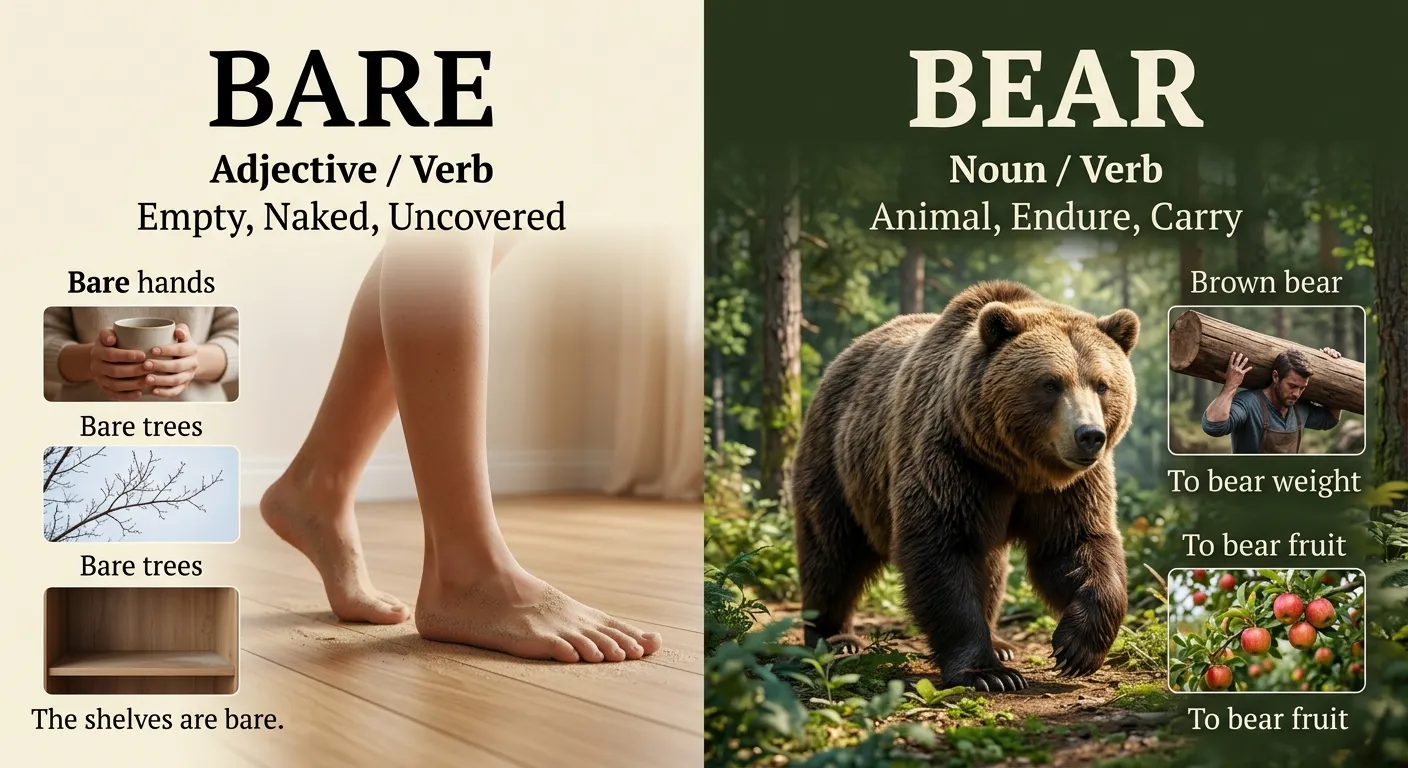
Bare means uncovered, exposed, or without something, while bear usually means to carry, endure, or tolerate; it can also refer to the large animal.
Quick Answer:
Bare and bear are both correct words, but they have different meanings. Use bare when you mean uncovered, exposed, empty, or without something. Use bear when you mean to carry, endure, tolerate, or support, or when referring to the animal.
- Bare = uncovered or without something
- Bear = carry, endure, tolerate, or the animal
- Bare = adjective or verb
- Bear = noun or verb
- They are pronounced the same in most varieties of English.
Bare vs. Bear: Quick Comparison Table
| Word | Main meaning | Part of speech | Example |
| bare | uncovered or without something | Adjective, verb | He walked on the bare floor. |
| bear | carry, endure, or tolerate | Verb | I cannot bear the noise. |
| bear | a large wild animal | Noun | We saw a bear in the forest. |
What Does “Bare” Mean?
Bare means uncovered, exposed, plain, empty, or without the usual covering or contents.
As an adjective, it describes something that has nothing covering or protecting it.
Examples of “bare”
- She walked across the bare floor.
- He stood with his bare feet in the sand.
- The tree had bare branches in winter.
- The room contained only the bare essentials.
- His explanation gave the bare facts.
Bare can also mean only just enough or minimal.
We had the bare minimum of supplies.
As a verb, bare means to uncover or reveal something.
The investigation bared the truth.
Here, bared is the past tense of bare.
Common expressions with “bare”
- bare feet: feet without shoes or socks
- bare hands: hands without gloves or protection
- bare skin: uncovered skin
- bare walls: walls without decorations
- bare minimum: the smallest amount necessary
- bare necessities: only the things that are essential
- bare facts: basic facts without extra detail
What Does “Bear” Mean?
Bear has several meanings, so it can be more difficult to remember.
As a verb, bear can mean to carry, support, endure, tolerate, or accept something.
Examples of “bear” as a verb
- I cannot bear the pain.
- She could not bear the thought of leaving.
- He had to bear the responsibility.
- This bridge can bear a heavy load.
- Please bear with me for a moment.
In these examples, bear does not mean the animal.
“Bear” can also mean to give birth
The verb bear has a formal or literary use meaning to give birth to a child.
She bore three children.
The past tense is bore, while the past participle is usually borne in this sense.
She has borne two children.
This meaning is less common in everyday conversation but appears frequently in formal, historical, and literary writing.
Bear as an Animal
A bear is a large mammal with thick fur, strong limbs, and a short tail.
We saw a bear near the forest.
Common types include:
- brown bear
- black bear
- polar bear
- grizzly bear
When bear refers to the animal, it is a noun.
The Grammar Difference Between Bare and Bear
The easiest way to separate these words is to look at their grammatical roles.
Bare as an adjective
Use bare to describe something that is uncovered, empty, plain, or lacking something.
She walked with bare feet.
The walls were bare.
Bare as a verb
Use bare when someone uncovers or reveals something.
The wind bared the rocks.
His actions bared his true intentions.
Bear as a verb
Use bear when someone carries, supports, endures, tolerates, or accepts something.
I cannot bear this heat.
She bore the responsibility alone.
Bear as a noun
Use bear when referring to the animal.
A bear appeared near the campsite.
Bare or Bear: How to Remember the Difference
A simple memory trick can help:
Bare = without a covering.
Think of bare feet: feet without shoes or socks.
Bear = carry or endure.
Think of the expression bear the burden: carry or endure a difficult responsibility.
And when you see bear as a noun, think of the animal.
Easy memory sentence
Bare feet have no covering, while you bear a burden.
This sentence connects each spelling with its most useful meaning.
Common Confusion: “Bear With Me” or “Bare With Me”?
The correct expression is:
Please bear with me.
It means please be patient with me.
Bear with me is correct because bear here means endure or tolerate.
❌ Please bare with me.
✅ Please bear with me.
This is one of the most common mistakes involving these two words.
Common Confusion: “Bare the Cost” or “Bear the Cost”?
The correct expression is:
bear the cost
It means to pay or accept responsibility for a cost.
The company will bear the cost of repairs.
Here, bear means carry or accept a burden.
❌ The company will bare the cost.
✅ The company will bear the cost.
Common Confusion: “Bare the Responsibility” or “Bear the Responsibility”?
The correct phrase is:
bear the responsibility
It means accept or carry responsibility.
She was willing to bear the responsibility for the decision.
Use bare only when you mean uncover or expose.
Bare vs. Bear in Different Sentences
Compare these examples:
He walked with bare feet.
Here, bare means without shoes or socks.
He had to bear the pain.
Here, bear means endure.
The dog exposed its bare teeth.
Here, bare means uncovered.
I cannot bear this noise.
Here, bear means tolerate.
A bear crossed the road.
Here, bear is the name of an animal.
The investigation bared the truth.
Here, bared means revealed.
These examples show why context matters.
Bare vs. Bear: Grammar Relay
| Form | Bare | Bear |
| Base form | bare | bear |
| Third-person singular | bares | bears |
| -ing form | baring | bearing |
| Past tense | bared | bore |
| Past participle | bared | borne / born* |
Important: born is generally used for birth, while borne is used for other meanings of the past participle.
She was born in 1995.
He has borne the responsibility for years.
“Bearing” Has Several Meanings
The word bearing can come from bear, but it has meanings that may look unrelated.
For example:
She is bearing the responsibility.
Here, bearing means carrying or enduring.
But bearing can also mean a person’s manner or posture:
He maintained a calm bearing.
It can also refer to direction:
The ship changed its bearing.
So do not assume that every word beginning with bear- relates directly to the animal.
“Baring” Is Different from “Bearing”
This is another useful spelling distinction.
Baring comes from bare and means uncovering or exposing.
She was baring her arms.
Bearing comes from bear and can mean carrying, enduring, or supporting.
He was bearing a heavy load.
Compare:
- baring = uncovering
- bearing = carrying or enduring
A simple trick
If you can replace the word with uncovering, use baring.
If you can replace it with carrying or enduring, use bearing.
Pronunciation: Bare and Bear
In most standard varieties of English, bare and bear are homophones.
- bare — /ber/
- bear — /ber/
They sound the same, which is why spelling can be confusing.
Their meanings, however, are completely different.
This makes bare/bear a classic example of a homophone pair.
Bare or Bear: Common Mistakes
1. “Please bare with me.”
❌ Please bare with me.
✅ Please bear with me.
Use bear because the expression means be patient or tolerate the situation.
2. “Bear feet”
❌ bear feet
✅ bare feet
Feet without shoes or socks are bare feet.
3. “Bare the burden”
❌ bare the burden
✅ bear the burden
A person bears a burden because they carry or endure it.
4. “A bare attacked the camper.”
❌ A bare attacked the camper.
✅ A bear attacked the camper.
The animal is a bear.
5. “The report bared the cost.”
This depends on the intended meaning.
If the meaning is accepted or paid the cost, use:
The company bore the cost.
If the meaning is revealed something, bared may be correct, but the object and context must make sense.
Bare or Bear: Quick Decision Guide
Ask yourself what you mean.
Do you mean “uncovered” or “without something”?
→ Use bare.
Do you mean “carry” or “endure”?
→ Use bear.
Do you mean the animal?
→ Use bear.
Do you mean “uncover” or “reveal”?
→ Use bare.
Examples
- bare skin → uncovered skin
- bare minimum → smallest necessary amount
- bare the truth → reveal the truth
- bear the burden → carry or endure the burden
- bear the cost → accept or pay the cost
- bear the pain → endure the pain
- a polar bear → the animal
Vocabulary Corner
Here are some useful words connected with each meaning.
Words related to “bare”
- uncovered
- exposed
- naked
- plain
- empty
- minimal
- sparse
- reveal
Words related to “bear”
When bear means endure:
- tolerate
- endure
- withstand
- support
- carry
- accept
When bear means the animal:
- mammal
- predator
- grizzly
- polar bear
- black bear
Mini Quiz: Bare or Bear?
Choose the correct word.
- She walked across the beach with ___ feet.
- I cannot ___ the noise anymore.
- We saw a ___ near the river.
- The company agreed to ___ the cost.
- The room had ___ walls.
- Please ___ with me while I check the information.
- The investigation ___ the truth.
- He had to ___ the responsibility.
Answers
- bare
- bear
- bear
- bear
- bare
- bear
- bared
- bear
Practice Guide
To master bare and bear, remember these three core associations:
BARE → uncovered
bare feet
bare skin
bare walls
BEAR → endure or carry
1: – bear pain
2: -bear responsibility
3: -bear the cost
BEAR → animal
brown bear
polar bear
black bear
If you remember these three groups, most spelling decisions become much easier.
What Major Dictionaries Say
Major English dictionaries distinguish bare and bear as separate words with different meanings.
Bare is associated with being uncovered, lacking a covering, or being minimal. It can also function as a verb meaning to uncover or reveal.
Bear has several meanings, including carrying or enduring something and referring to the large mammal. Its verb forms also include irregular forms such as bore and borne.
The distinction is therefore based on meaning and grammatical function, not pronunciation.
Final Answer: Bare or Bear?
Both bare and bear are correct spellings, but they cannot normally be substituted for each other.
Use bare for something uncovered, exposed, plain, or without something:
She walked in her bare feet.
Use bear when you mean carry, endure, tolerate, or support:
I cannot bear the pain.
Use bear for the animal:
A bear was spotted in the forest.
And remember the common expression:
Please bear with me.
Bare = uncovered.
Bear = endure, carry, or the animal.
Below or Bellow: Meaning, Difference & Correct Usage

I am Calara Stephen passionate about making English simple and easy to understand through clear spelling comparisons, grammar guides, and language tips. Through thoughtful, reliable content, I aim to be a trusted guide for anyone looking to improve their English.