Definition
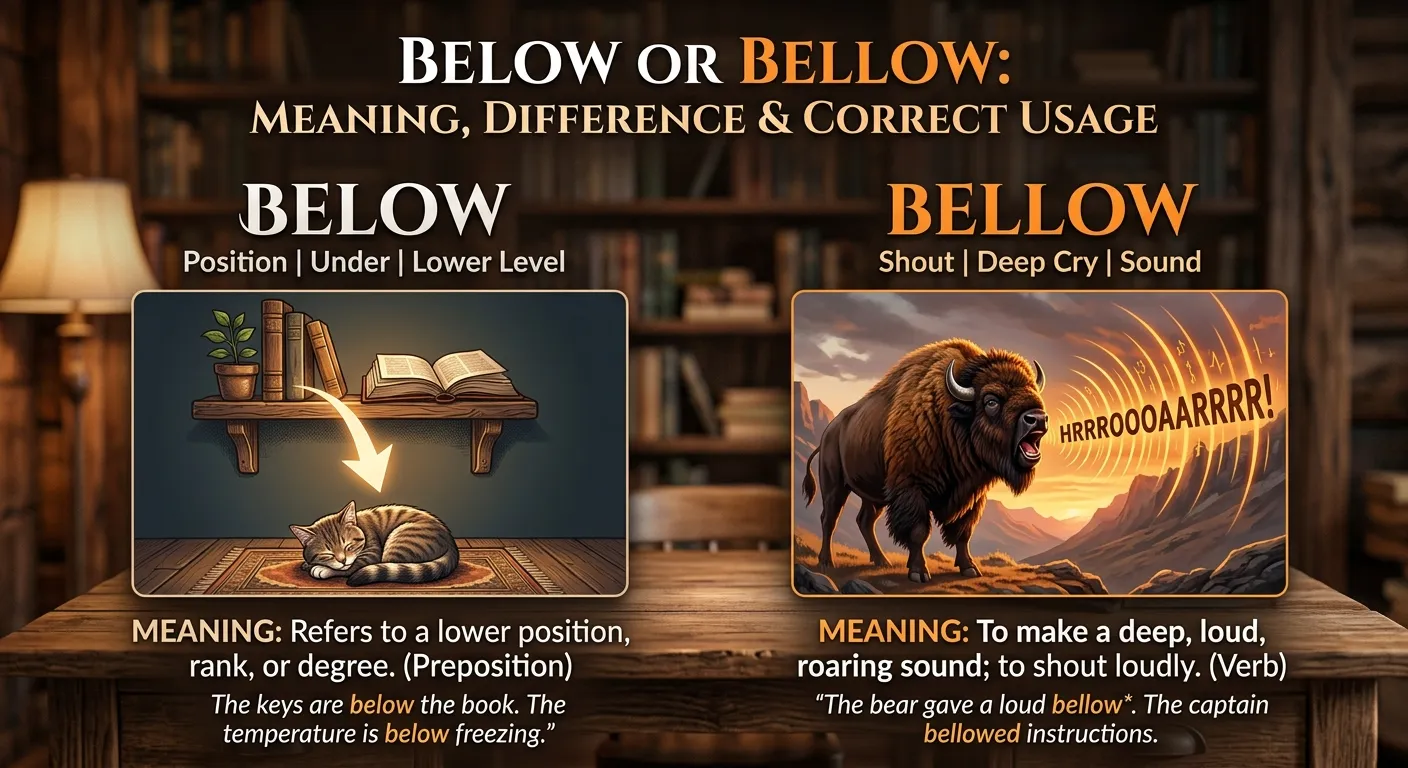
Below means at a lower position, level, amount, or rank, while bellow means to shout loudly or make a deep, loud sound.
Below and bellow are both correct English words, but they have completely different meanings and uses. Use below for position, level, amount, or rank; use bellow for a loud shout or roar.
Quick Answer
- Below = lower than something; underneath; at a lower level.
- Bellow = to shout loudly or make a deep, loud sound.
- Below can be a preposition, adverb, adjective, or noun.
- Bellow is mainly a verb and can also be a noun.
- They are pronounced differently: below /bɪˈloʊ/ and bellow /ˈbel.oʊ/.
- If you mean “at a lower level”, use below.
- If you mean “to shout loudly”, use bellow.
Below vs. Bellow: Quick Comparison Table
| Word | Correct? | Main Meaning | Example |
| below | ✅ Yes | At a lower position, level, amount, or rank | The temperature fell below zero. |
| bellow | ✅ Yes | To shout or make a loud, deep sound | The angry man began to bellow. |
What Does “Below” Mean?
Below means at a lower position, level, amount, or rank than something else.
It is commonly used when talking about physical location:
The valley lies below the mountain.
It can also describe numbers, temperatures, standards, ages, ranks, or levels:
The temperature dropped below freezing.
Children below the age of ten must be accompanied by an adult.
His score was below the required level.
Common Uses of “Below”
1. Lower physical position
The apartment below ours is empty.
2. Lower number or amount
The temperature is below 10°C.
3. Lower standard or level
Her performance was below expectations.
4. Lower rank or status
The employees listed below will attend the meeting.
5. Further down on a page or document
See the examples below.
Grammar Note
Below can function in several ways depending on the sentence.
As a preposition:
The shoes are below the bed.
As an adverb:
Please read the information below.
As an adjective:
See the below examples.
The adjective use is common in formal and business writing, although many writers prefer examples below because it sounds more natural.
What Does “Bellow” Mean?
Bellow means to shout in a very loud, deep, or forceful voice. It can also describe the loud, deep sound made by certain animals, especially bulls.
As a verb:
The coach bellowed instructions at the players.
The bull bellowed loudly.
As a noun, bellow means a loud, deep cry or roar:
We heard a bellow from the field.
The word often suggests a voice that is unusually loud, harsh, or powerful.
Common Uses of “Bellow”
1. To shout loudly
“Come back here!” he bellowed.
2. To make a deep animal sound
The bull bellowed across the field.
3. A loud, deep cry
A sudden bellow came from the hallway.
The Main Difference Between Below and Bellow
The easiest way to remember the difference is to connect each word with its meaning:
Below → lower
Bellow → loud shout
For example:
The keys are below the book.
Here, below tells us about the position of the keys.
The man began to bellow at the workers.
Here, bellow describes a loud way of speaking.
The two words look similar because they share the letters b-e-l-l-o-w, but the extra l in bellow changes the spelling, pronunciation, and meaning.
Below or Bellow: Which One Should You Use?
Choose below when you are talking about something lower, underneath, or less than another thing.
The answer is written below.
The village is below the hill.
The score fell below 50%.
Choose bellow when you are talking about shouting loudly or making a deep, loud sound.
The teacher bellowed across the classroom.
The lion bellowed in the distance.
He let out a loud bellow.
A Simple Test
Ask yourself:
Does the sentence describe a lower position, level, amount, or rank?
→ Use below.
Does the sentence describe a loud shout or deep sound?
→ Use bellow.
Examples of “Below”
Here are some natural examples of below:
- The temperature stayed below freezing.
- Please write your name below the heading.
- The boat disappeared below the surface.
- Her score was below the class average.
- The office is located below the main entrance.
- Read the instructions below carefully.
- The price is below $50.
- The village lies below the mountain.
- His work was below the expected standard.
- The details are provided below.
Examples of “Bellow”
Here are some natural examples of bellow:
- The angry customer bellowed at the manager.
- The bull bellowed in the field.
- He bellowed for someone to help him.
- The captain bellowed an order.
- A loud bellow came from the barn.
- The man bellowed with anger.
- The elephant gave a deep bellow.
- She could hear someone bellowing outside.
- The coach bellowed instructions from the sidelines.
- He let out a powerful bellow.
Grammar Relay: Below vs. Bellow
Below is commonly used to show position, direction, level, amount, or rank.
The temperature is below zero.
Bellow is commonly used as a verb meaning “to shout loudly.”
The manager bellowed at the workers.
It can also be a noun meaning “a loud, deep cry.”
We heard a bellow from the animal.
Word Forms
| Word | Part of Speech | Example |
| below | Preposition | The garage is below the house. |
| below | Adverb | Look below. |
| below | Adjective | See the below information. |
| below | Noun | The below is rarely used as a noun in ordinary English. |
| bellow | Verb | He bellowed loudly. |
| bellow | Noun | A loud bellow filled the room. |
| bellowed | Verb | She bellowed an order. |
| bellowing | Verb | The animal was bellowing. |
Pronunciation
The words are pronounced differently.
Below
below → /bɪˈloʊ/
The stress falls on the second syllable:
be-LOW
Bellow
bellow → /ˈbel.oʊ/
The stress falls on the first syllable:
BEL-low
This difference in stress can help you distinguish the words when speaking.
Vocabulary Corner
The two words have very different vocabulary families.
Words Related to “Below”
- underneath
- under
- beneath
- lower
- downward
- down
- inferior
- lesser
Examples:
The shelf is below the window.
The shelf is beneath the window.
Words Related to “Bellow”
- shout
- yell
- roar
- cry
- holler
- scream
- thunder
- roar
However, these words are not always exact substitutes. Bellow usually suggests a very loud, deep, or forceful sound.
Below vs. Beneath vs. Under
Because below is related to position, it is sometimes confused with under and beneath.
Below
Usually indicates a lower position or level.
The temperature is below zero.
Under
Often indicates a position directly beneath something, and it has many additional meanings.
The cat is under the table.
Beneath
Usually means physically or figuratively lower than something and can sound more formal or literary.
The river flows beneath the bridge.
These words can overlap in some contexts, but they are not interchangeable in every sentence.
Below or Bellow: Common Mistakes
Incorrect:
The temperature fell bellow zero.
Correct:
The temperature fell below zero.
Why? The sentence describes a lower temperature, so below is required.
Incorrect:
The angry man began to below at everyone.
Correct:
The angry man began to bellow at everyone.
Why? The sentence describes loud shouting, so bellow is the correct word.
Incorrect:
The bull belowed loudly.
Correct:
The bull bellowed loudly.
Why? The verb is bellow, and its past tense is bellowed.
Memory Trick: How to Remember the Difference
Try this simple association:
BELOW = lower
Both ideas involve something being down.
BELLOW = loud
Think of a person or animal making a big, booming sound.
You can also remember:
Below tells you where something is.
Bellow tells you how loudly someone or something makes a sound.
Quick Memory Examples
Lower position:
The shoes are below the bed.
Loud sound:
The man bellowed across the room.
Mini Quiz
Choose below or bellow in each sentence.
- The temperature dropped ___ freezing.
- The angry man began to ___ at the waiter.
- Please see the information ___.
- The bull gave a loud ___.
- The village is ___ the mountain.
- The coach ___ instructions to the team.
- Her score was ___ the required level.
- We heard a deep ___ from the field.
Answers
- below
- bellow
- below
- bellow
- below
- bellowed
- below
- bellow
Practice Guide
To use these words correctly, remember their two core ideas:
Below = lower
Use it for:
- physical position
- temperature
- numbers
- amounts
- standards
- ranks
- information farther down a page
Bellow = loud
Use it for:
- loud shouting
- deep human voices
- loud animal sounds
- a loud or deep cry
If you see a sentence involving position or level, below is probably the word you need.
If you see a sentence involving a loud voice or deep sound, bellow is likely correct.
What Major Dictionaries Say
Major English dictionaries distinguish these words clearly.
Below is defined in dictionaries such as Cambridge and Merriam-Webster in terms of being in or moving to a lower position, level, amount, or rank.
Bellow is defined as making or producing a loud, deep sound, especially by shouting or by certain animals.
The dictionary definitions support the central distinction:
below = lower position or level
bellow = loud, deep sound
Frequently Asked Questions
Is “below” the correct word?
Yes. Below is a standard English word meaning at a lower position, level, amount, or rank.
Is “bellow” a real word?
Yes. Bellow is a standard English word meaning to shout loudly or make a deep, loud sound. It can also be a noun for such a sound.
What is the difference between below and bellow?
Below refers to something lower in position, level, amount, or rank. Bellow refers to a loud, deep shout or sound.
Is it “below zero” or “bellow zero”?
The correct phrase is below zero.
The temperature is below zero.
Is it “bellow loudly” or “below loudly”?
The correct phrase is bellow loudly when you mean “shout loudly.”
He began to bellow loudly.
What is the past tense of bellow?
The past tense is bellowed.
The man bellowed for help.
Can “bellow” be a noun?
Yes. A bellow can mean a loud, deep cry or roar.
A loud bellow came from the barn.
Final Takeaway
Below and bellow are both correct words, but they belong to completely different meanings.
Use below when something is lower in position, level, amount, or rank:
The temperature is below freezing.
Use bellow when someone or something shouts or makes a loud, deep sound:
The bull bellowed loudly.
Remember:
Below = lower
Bellow = loud
Once you connect below with lower and bellow with loud shouting, the difference becomes easy to remember.
This one is especially clean for search intent because “below or bellow” is primarily a spelling/word-confusion query, so I kept the article focused on the actual distinction rather than padding it with unrelated sections.
“Waive” vs “Wave”: Homophones Explained (Meaning & Spelling)

Rose Vault is an English language author who specializes in spelling comparisons, commonly confused words, and grammar. She creates clear, well-researched content that helps readers improve their writing and use English with confidence. Her goal is to make language learning simple, accurate, and accessible for everyone.